
Criminals scale with AI. Crimefighters scale with Ardence.
AI is making crime faster, cheaper, and easier to scale. Ardence gives crimefighters the investigative capacity to respond, helping teams uncover criminal networks and take action to disrupt them.
Closing the capacity gap.
Crimefighters know how to build a case. But while one gets worked, dozens more pile up. Ardence takes on the manual parts of an investigation, from cross-referencing intelligence to assembling the picture, so your team can work more cases at once.
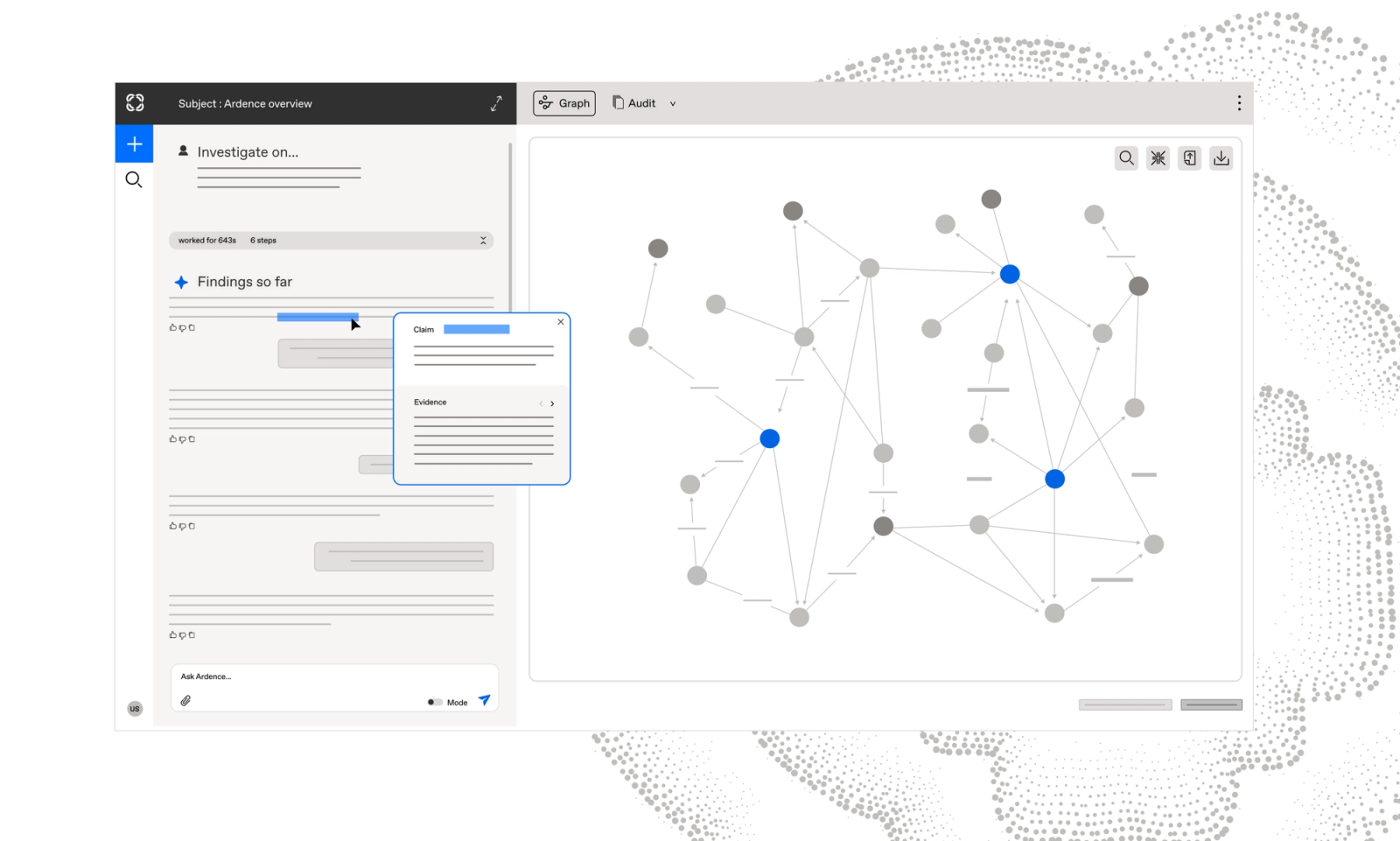
A fictional investigation. An analyst asks whether any of a data center company’s critical vendors appeared on ransomware leak sites without disclosing it. The chat lists the findings, and each finding lights up the entities it rests on in a graph beside it. Sending the suggested follow-up question asks who is behind the ransomware group and adds three entities to the graph.
Intelligence
Understand what no single source reveals.
Bring corporate, cyber, identity, dark web, financial, sanctions, and other intelligence into one investigation.
SPEED
Search further. Move faster.
Pursue more lines of inquiry and follow connections further than a team can manage by hand.
Tradecraft
Put specialist methods to work.
Use expert-tested skills and repeatable analytic methods across teams, even when the expert who developed them is focused elsewhere.
What crimefighters have achieved.
More victims supported. More crime networks disrupted.

How HSI Forfeited $15M from a Prominent Fentanyl Vendor
Homeland Security Investigations (HSI) needed a way to trace crypto as part of their narcotics trafficking investigations.
“It gave us phenomenal leads.”
US law enforcement agency 
Unmasking a Scam Network: The Royal Thai Police Crack Down
Learn how the Royal Thai Police’s Cyber Crime Investigation Bureau (CCIB) uncovered an international pig butchering network that stole millions in cryptocurrencies from victims, and see how CCIB’s investigation led to a 28-year prison sentence for the suspect.
“It's much faster than our normal methods, and we actually get results instead of hitting the walls we're used to.”
Financial regulator “I mean, you guys are pulling on threads that I didn't really know existed.”
Bank
Solutions
Tackling the world’s most urgent problems.
- Law Enforcement
- National Security
- Financial Services
- Enterprise Security
- Regulators & Revenue Agencies
Close more cases without adding more people.
Ardence resolves a wallet, username, or phone number across every source in one session, with the methodology documented at each step so your findings can be defended in court.
From a single selector to the full picture.
Ardence fuses identity, infrastructure, financial, and open-source data into a brief-ready picture with provenance on every step, so any analyst can work at mission tempo.
Know your crypto counterparties before you transact.
Get visibility into entity, address, and asset risk, from onboarding through ongoing monitoring, with alerts set to your organization's risk tolerance.
Attribute the actor, not just the indicator.
Start with one indicator. Ardence runs the pivot chain your analysts used to run by hand across every source and returns an attributed cluster with full provenance.
Verify what institutions tell you.
Ardence puts the same investigative capability in examiners' hands, so supervisors can trace and verify independently, in plain language, without blockchain expertise or added headcount.
News & Insights

2026 Crypto Crime Report
Analysis of the scale, methods, and financial infrastructure behind crypto-enabled fraud.
The 2026 AI-in-Crime Adoption Index
Analysis of how criminals are adopting AI across scams and other illicit activity.
- (opens in a new tab)

Scammed
How online scams steal billions, and how TRM helped FRONTLINE and the AP follow the money

Careers
Think you have what it takes?
Defeating modern crime takes a persevering team. And we’re resolved to win.

Get Started