Belgium Convicts Seven in ISIS Crypto Financing Network Funding Weapons and CBRN Procurement

Key takeaways
- On June 9, 2026, a Belgian court convicted seven members of an international ISIS support network, with sentences ranging from five to 15 years in prison.
- The network — primarily composed of individuals of Chechen origin residing in Europe — used cryptocurrency-based money laundering to finance weapons procurement, CBRN-E precursor acquisition, and support for ISIS fighters and foreign terrorist fighters detained in Syria and Central Asia.
- German authorities separately handed down related sentences in 2026, indicating the network extended across multiple European jurisdictions.
- On June 5, 2026, the US DOJ charged three individuals arrested in Kansas and California with conspiring to support ISIS, including an attempted use of cryptocurrency to procure RPGs and drones — an effort that did not succeed but reflects a documented pattern of crypto knowledge among ISIS supporters.
- Terrorist groups like Hamas and the Houthis in Yemen have used cryptocurrency to purchase UAVs and counter UAV equipment.
- Crypto remains a growing but traceable slice of terror financing. Cash, hawala, and traditional financial institutions still dominate, but the on-chain portion leaves a verifiable trail.
{{horizontal-line}}
On June 9, 2026, a Belgian court convicted seven members of an international ISIS support network, with sentences ranging from five to 15 years in prison alongside substantial financial penalties. The network — primarily composed of individuals of Chechen origin residing in Europe — was found to have used cryptocurrency-based money laundering to finance weapons procurement, CBRN-E (chemical, biological, radiological, nuclear, and explosive materials) precursor acquisition, and support for ISIS fighters detained in Syria and Central Asia. German authorities separately handed down related sentences earlier in 2026.
Days earlier, on June 5, 2026, the US DOJ announced charges against three individuals arrested in Kansas and California, alleging a conspiracy to support ISIS that, according to the DOJ, included the attempted use of cryptocurrency to procure rocket-propelled grenades (RPGs) and drones.
Cash, hawala transactions, and traditional financial institutions still make up the majority of terrorist financing cases. Cryptocurrency is just one part — albeit a growing one — of the broader terror financing picture, but in many cases, one that can be more easily traced.
Crypto use in weapons procurement, attack fundraising
The network convicted yesterday in Belgium provided financial support to ISIS members in Syria and Central Asia and funded the procurement of weapons and CBRN-E precursors. Europol’s CBRN-E specialists provided technical support to the investigation, alongside cross-agency data analysis and terrorist financing intelligence. German authorities also handed down lengthy prison sentences in related cases earlier this year. Europol, which supported the investigation through its European Counter Terrorism Centre (ECTC), described a sophisticated infrastructure involving terrorism financing, cryptocurrency-based money laundering, and facilitation networks.
The use of fundraising campaigns to purchase weapons is not new. In 2025, TRM identified a fundraising campaign linked to ISIS activity in Nigeria that was soliciting donations for equipment including UAVs and grenades. Another fundraising campaign based in Syria focused on equipping ISIS fighters in and outside of Syria has raised tens of thousands of dollars.
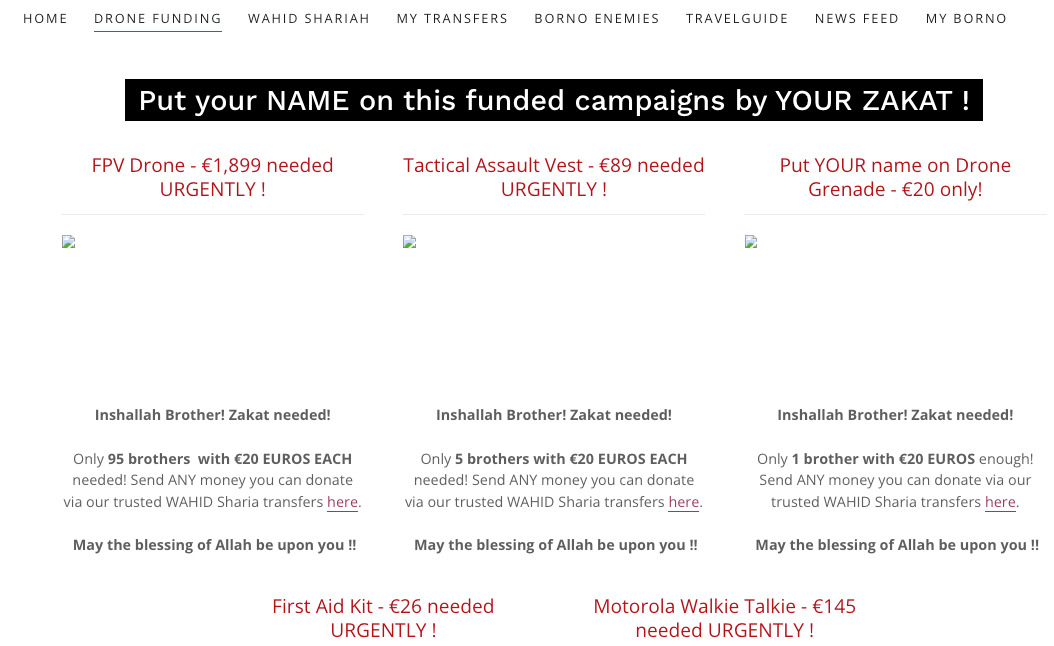
TRM Labs has also previously documented evidence that Iran-backed terrorist groups like Hamas and the Houthis have used cryptocurrency to procure military equipment such as UAVs, drone components, and counter-drone systems, via Chinese suppliers.
Cryptocurrency has also been used to finance the attacks themselves. A March 2024 attack near Moscow attributed to Islamic State Khurasan Province (ISKP) was at least partially financed with cryptocurrency. ISKP, which has been documented as supporting ISIS’s global external operations, has emerged as the key transnational node in ISIS's crypto financing network, according to TRM analysts.
Crypto as a tool for ISIS fundraising
A persistent driver of crypto adoption among ISIS supporters has been fundraising campaigns for ISIS members and families that were held until recently in camps such as al-Hol and Roj in northeast Syria. TRM found these campaigns typically raised anywhere from as little as USD 20 to tens of thousands of dollars each, with individual donations usually in the tens to low hundreds of dollars. The Belgium network convicted this week also financed the release of foreign terrorist fighters detained in conflict zones including Syria, channeling funds to facilitate their departure from detention facilities — a function that mirrors the above detention camp fundraising.
Fundraising campaigns have reused both hosted and unhosted addresses, spun up temporary addresses, relied on a handful of preferred wallet providers, and occasionally reached for privacy coins such as Monero, according to TRM analysis. Stablecoins — chiefly USDT on TRON — are the primary asset, and off-ramps frequently run through Syria-based exchanges and hawala networks. Tracking donors surfaces radicalization networks, and the consistency of the tactics across campaigns makes them easier to detect and disrupt. Most cryptocurrency terrorism charges today are linked to these fundraising campaigns.
Tracing terrorist financing on-chain
Because blockchain data is traceable and immutable, investigators can follow the money from fundraising campaigns to weapons purchase, helping to build cases that can be effectively prosecuted. Authorities are deploying multiple tools to combat terror financing on-chain, from prosecutions to sanctions.
Some examples include Mohammed Azharuddin Chhipa, who was convicted of financing ISIS through cryptocurrency — raising more than USD 188,000, with at least USD 18,000 traced directly to ISIS-linked campaigns, prosecuted under the material-support statute. Swedish law enforcement secured its first conviction under a new terrorism financing law tied to ISIS-linked fundraising campaigns.
Additionally, OFAC has specifically designated ISIS-linked crypto addresses. US enforcement has increasingly targeted intermediaries, as documented in TRM's 2026 Crypto Crime Report, illustrated by the roughly USD 2 million forfeiture connected to BuyCash, a Gaza-based money services business tied to Hamas.
{{horizontal-line}}
Frequently asked questions (FAQs)
1. Is cryptocurrency the main way terrorist groups raise and move money?
No. Cash, hawala, and traditional financial institutions remain dominant. Crypto is a small, though documented and growing, piece of the terrorist financing picture.
2. What is the difference between crypto fundraising and crypto procurement in this context?
Fundraising raises and moves funds, often to support detained members and families. Procurement applies funds toward acquiring physical goods. The on-chain mechanics are largely the same, which is why both are traceable.
3. What are CBRN-E precursors?
CBRN-E stands for chemical, biological, radiological, nuclear, and explosive materials. Precursors are the component materials used to produce such weapons or devices. The Europol announcement confirmed the Belgium network financed their acquisition, prompting the deployment.
4. Who was part of the Belgium network?
The network was primarily composed of individuals of Chechen origin residing in Europe. According to Europol, its members were deeply radicalized and operated across multiple countries, with related prosecutions resulting in lengthy prison sentences in Germany as well as Belgium.
5. What does financing the release of detained fighters involve?
A significant portion of ISIS crypto fundraising has been directed at Foreign Terrorist Fighters and their families held in detention camps in northeast Syria, including al-Hol and Roj. Financing their release means channeling funds to intermediaries to facilitate FTFs departing those facilities. TRM has tracked fundraising campaigns with this explicit purpose across multiple campaigns and jurisdictions.
8. What cryptocurrencies are typically involved?
Based on publicly documented TRM findings, Bitcoin has been the primary asset, with stablecoins — particularly USDT on TRON and Ethereum — the growing secondary choice. Privacy coins such as Monero appear in some campaigns, as documented in TRM’s 2026 Crypto Crime Report and prior TRM research.