Cuba After EO 14404: Following the Money Beyond the Sanctions List

Key takeaways
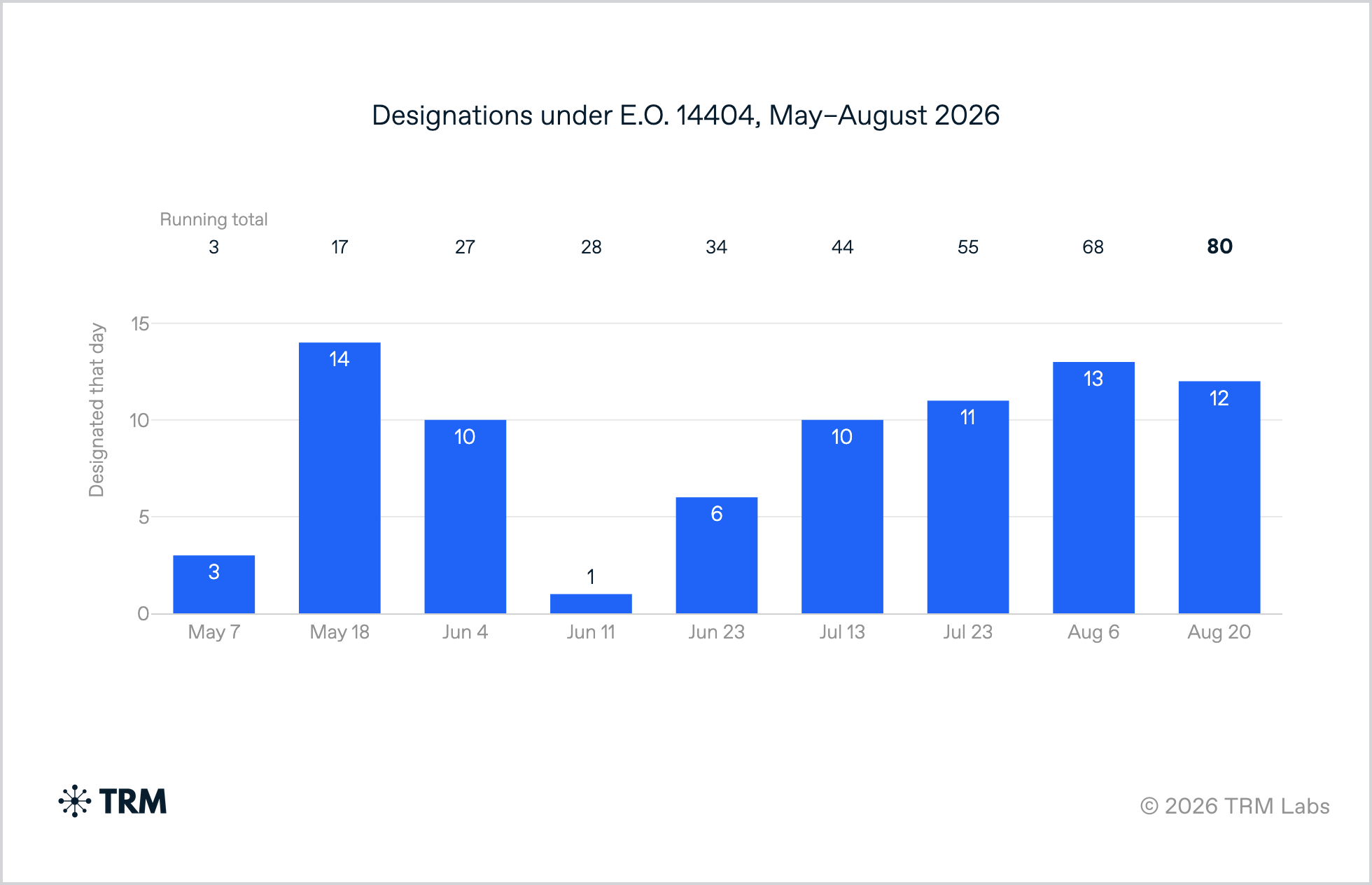
- Executive Order 14404 materially expanded US sanctions pressure on Cuba. Since May 2026, the US Treasury has designated 80 Cuban individuals and entities across nine tranches, including senior government officials, ministries, banks, ports, energy companies, and major state enterprises.
- That pressure rapidly narrowed Cuba’s conventional access to international finance. Within two months, the country had lost major card networks, international cryptocurrency exchange access, and its state remittance channel, pushing Cuban businesses to change how they transact in order to circumvent sanctions.
- One circumvention tactic: Cuban companies in key sectors have been observed transferring assets and operations to new legal entities shortly before or after being designated, allowing them to continue doing business under a new profile less likely to be flagged for sanctions risk.
- Another tactic: Having foreign buyers pay in hard currency for goods delivered inside Cuba, allowing value to enter the country without a corresponding cross-border payment into Cuba. This is known as the venta en frontera or border purchasing model.
- Cryptocurrency does not currently appear to be part of Cuba’s sanctions mitigation efforts. Cuba’s only licensed crypto exchange has low volume in the last year, and TRM assesses Cuban activity on non-licensed crypto platforms to be small and mostly related to retail users. No cryptocurrency addresses appear in recent Cuban sanctions designations.
{{horizontal-line}}
Between May 7 and August 20, 2026, the US sanctioned 80 Cuban entities and individuals across nine separate rounds of designations.
Cuba’s economy has operated under US sanctions for more than 60 years, but for most of that time, this meant a broad embargo punctuated by occasional individual designations. Executive Order 14404, issued in May 2026, created a new designation program focused on repression by the Cuban government and threats to US national security inside Cuba.
EO 14404 reaches beyond US jurisdiction. It authorizes the Office of Foreign Assets Control (OFAC) to designate foreign persons and entities doing business with blocked Cuban parties. It also empowers Treasury to punish foreign financial institutions that conduct or facilitate significant transactions for designated Cuban entities, for instance by imposing strict conditions on their use of US correspondent bank accounts or blocking their US property outright.
Cuba’s documented sanctions circumvention channels
As sanctions have escalated, value moving in and out of Cuba has shifted to two documented channels that help sanctioned entities transact with less chance of being flagged.
- The first channel involves shifting assets and operations to a new corporate entity. One example comes from the Port of Mariel, Cuba's main container port. Soon before the Port was sanctioned, its operator transferred the Port’s assets to a newly created company, and did business under the new entity until OFAC designated it as well a month later.
- The second channel involves trade. Under Cuba's venta en frontera model, a buyer outside Cuba pays in hard currency, and a Cuban state enterprise delivers the goods to someone else inside Cuba, typically a relative. The payer never takes possession, and the payment stays outside Cuba's borders entirely.
While many have speculated crypto could be a third sanctions circumvention channel for Cuba, TRM finds no evidence of this yet. So far, no cryptocurrency addresses have been included with sanctions on vessels, companies, or individuals under the order. Cuba has licensed one crypto provider, a Lithuania-based company called Ebioro, which has taken in just USD 437,000 between July 2025 and August 2026. Cuba-attributed activity on non-licensed exchanges is small and concentrated to retail users. However, the two fiat-based channels we describe above are being actively utilized by designated Cuban entities, and pose a threat to non-U.S. businesses who want to avoid accidental sanctions exposure.
Cuban designations ramp up in mid-2026
The US embargo on Cuba is the oldest sanctions program OFAC still administers, and one of the broadest. The Cuban Assets Control Regulations (CACR), issued in 1963 under the Trading with the Enemy Act, block all property in which Cuba or a Cuban national has any interest. They also bar anyone subject to US jurisdiction — US persons wherever located, anyone in the United States, and the foreign companies they own or control — from dealing in that property, or in Cuban-origin goods anywhere in the world.
The CACR prohibitions apply without any specifically designated individual or entity being involved. A Cuban nexus is sufficient.
The US administration signed EO 14404 on May 1, 2026. Designations began six days later and have not paused since. Nine tranches through August 20 tagged 80 parties under the order — 72 newly added to the Specially Designated Nationals (SDN) List, and eight already listed under earlier programs.
The order authorizes the Secretaries of State and the Treasury to designate foreign persons operating in Cuba’s energy, defense and related materiel, metals and mining, financial services, or security sectors, and may also encompass other sectors later. It also reaches those who provide goods or services in support of the Cuban government or a blocked person, their senior officers and directors, and their adult family members. TRM Labs assesses that combination as the basis on which foreign shipowners, operators, charterers, brokers, and insurers dealing with designated Cuban parties are exposed — the same sector-based logic Treasury applied when it named digital assets a sanctionable sector of the Iranian economy in August 2026.
The nine tranches, May 7 to August 20, 2026
- May 7 (3) — Ania Guillermina Lastres Morera, plus GAESA and Moa Nickel, both listed under the 1963 embargo and retagged under the new order
- May 18 (14) — the Ministry of the Interior, the Policía Nacional Revolucionaria, and the Directorate of Intelligence, Cuba’s foreign intelligence service, plus Juan Esteban Lazo Hernández, president of the National Assembly, and ten other senior officials
- June 4 (10) — Miguel Díaz-Canel Bermúdez, Cuba’s sitting president, along with four relatives and close associates, the Ministry of the Revolutionary Armed Forces, the Committees for the Defense of the Revolution, and three tourism and mining entities
- June 11 (1) — CUPET, the state oil company
- June 23 (6) — Almacenes Universales, RAFIN, Banco Financiero Internacional, GEOMINERA, and the José Martí steelworks
- July 13 (10) — GECOMEX and GEMAR, the state foreign-trade and maritime groups, and the Ministry of Tourism
- July 23 (11) — including Coral Marítima and the Mariel container terminal
- August 6 (13) — arms imports and foreign military cooperation
- August 20 (12) — construction, nickel, and metals trading
Payment channels close within weeks
Reuters reported that Cuba suspended Visa and Mastercard starting June 6, 2026, after a foreign processor limited its operations following the executive order. Those flows had run through a foreign bank and through Fincimex, the financial arm of GAESA.
Cuba’s access to international cryptocurrency exchanges was already limited by the long-standing US embargo. For example, Binance lists Cuba as a prohibited jurisdiction, and KuCoin and BingX exclude Cuban users under sanctions-screening rules.
On June 26, 2026, CoinEx, the country’s most widely used international exchange, added Cuba to its restricted list and said it would block VPN circumvention.
By July 2026, the corridor had lost card networks, international cryptocurrency exchanges, and the state remittance channel. The rest of this report examines what the Cuban economy has put in their place.
Establishing new successor entities for sanctioned businesses
OFAC designations name specific companies. Once a company is named, its assets are blocked from interacting with US entities. When those assets move to another company, OFAC's 50% rule can apply. That rule states that an entity owned 50% or more, directly or indirectly, by one or more blocked persons is itself blocked. This holds whether or not the entity appears on the SDN List. From a screening perspective, a change in legal entity makes sanctions status harder to identify, which some Cuban companies appear to have exploited after being designated.
One clear signal of this pattern is a new company receiving assets from a designated entity. This signal grows stronger when the two companies share directors, officers, or an address. Officer and shareholder filings are worth checking against designated persons for this reason. Screening tools that expand designations through ownership will surface some of these connections automatically. Registry searches can also reveal a transfer that happened just before a designation.
One example of this tactic in action: OFAC designated Almacenes Universales S.A., the GAESA subsidiary controlling container traffic at the Port of Mariel, on June 23, 2026. That same month, Terminal de Contenedores de Mariel (TC Mariel – the original legal entity in charge of the Port’s operations) told clients it had sold its assets to a new company, Coral Marítima S.A., which would run the port through a subsidiary. TC Mariel's commercial director signed the notice on June 16, a week before the designation.
Under the 50% rule, Coral Marítima was blocked the moment TC Mariel was designated. Screening tools built on entity name alone would have missed that connection, since Coral Marítima did not yet appear on the SDN List. OFAC closed that gap on July 23, designating Coral Marítima directly, one month after TC Mariel.
This case shows why screening on officers and other selectors matters as much as screening on entity name.
Venta en frontera: Cuban trade with payment outside of Cuba
The 2026 designations also reached companies involved in Cuba’s trade and logistics infrastructure, highlighting another sanctions circumvention tactic: venta en frontera, or border purchasing, in which buyers abroad pay in hard currency for goods delivered inside Cuba.
The model predates EO 14404, and it gains relevance as Cuba’s conventional hard-currency channels narrow. Western Union left the island in 2020 after its state counterparty, Fincimex, was designated, and card networks stopped working on June 6, 2026. As each of those channels closed, buying goods became one of the few remaining ways to send value to someone on the island. Cubanet documented Cuban state enterprise Alcona using this strategy to conduct cross-border food sales, with goods delivered inside Cuban borders.
For compliance teams, this model changes where the financial relationship becomes visible. A direct transfer into Cuba may present an obvious jurisdictional or counterparty signal. A purchase made abroad for goods delivered inside Cuba can instead appear as a payment to a storefront incorporated outside Cuba, alongside a purchase order and shipping records.
Screening tools surface the counterparty named in the payment. When that counterparty is a designated Cuban importer, most tools will flag it automatically. But often, the counterparty is an online store registered abroad, and the Cuban state enterprise behind the goods never appears in the payment at all.
Online storefronts serving the diaspora
Online stores serving Cubans under the border purchasing model have operated this way for years, at scale. Supermarket23, the largest of them, presents itself as a foreign company. Cubanet traced it to Alcona and identified at least 11 further sites run by Alcona-linked companies.
Another storefront, Tuambia, ran on the logistics infrastructure of the state importer Palco S.A. and recorded more than 1.2 million deliveries to roughly 360,000 Cuban households before it closed on May 1, 2025. EnviosCuba, which sold against retail chains operated by CIMEX and Tiendas Caribe under GAESA, utilized this model as well until announcing on June 14, 2026 that it could no longer operate.
A China procurement leg
One variant of the border purchasing model adds a China procurement leg. The relationships described here are drawn from private intelligence reporting reviewed by TRM Labs, together with corporate registry filings and import records.
- Gran Azul LLC, a US parcel company, registered roughly 40 branches across ten states between November 2024 and October 2025, several of them at residential addresses
- Public import records place a January 2026 shipment to Gran Azul from Leke Holding Group, a Quanzhou-based trading company whose public material is written entirely in Spanish and aimed at Latin American buyers
- Leke manages Nihao53, a wholesale platform that positions itself as a bridge between China and Cuba and requires its buyers to hold foreign bank accounts. Its chief executive has said publicly that Nihao53 operates with Cuban government support to ease domestic shortages.
- Impexport, a Cuba-based import-export firm inside the state trade framework, promotes both platforms
Public profiles indicate that staff across these companies previously held roles at Cuban and Venezuelan state institutions, including the foreign trade ministry MINCEX, the state food importer Alimport, and PDVSA, with several holding concurrent roles at affiliated entities in China, Spain, and Canada. While none of these four companies have been designated, their activity fits Cuba’s border purchasing model for sanctions circumvention.
Is Cuba using crypto to get around sanctions?
The evidence to date indicates no. No cryptocurrency address appears in any of the nine tranches designated under EO 14404, and TRM Labs attributes no blockchain infrastructure to any Cuban state entity. Cuba’s sole licensed crypto platform shows relatively low activity, with USD 437,000 received and USD 414,000 sent between July 2025 and August 23, 2026.
Most crypto activity observed in Cuba takes place outside the government’s licensed platforms and appears to be made up of small, retail-sized payments unrelated to large-scale sanctions circumvention. The 2026 designations target corporate and industrial activity. So, despite the loss of payments channels following EO 14404, Cuban crypto activity does not appear to be part of a state sanctions-mitigation strategy.
Cuba’s licensed crypto platform
Cuba has regulated virtual assets since 2021, when Resolution 215/2021 gave the Banco Central authority over licensing providers operating in Cuban territory. Resolution 89/2022 limited licenses to one year, with the option to extend for another year. Today, only one provider is licensed. Ebioro UAB incorporated in Vilnius, Lithuania on January 28, 2022, with about EUR 150,000 in declared capital, four shareholders, and no registered employees. The Cuban license is its only visible tie to Cuba.
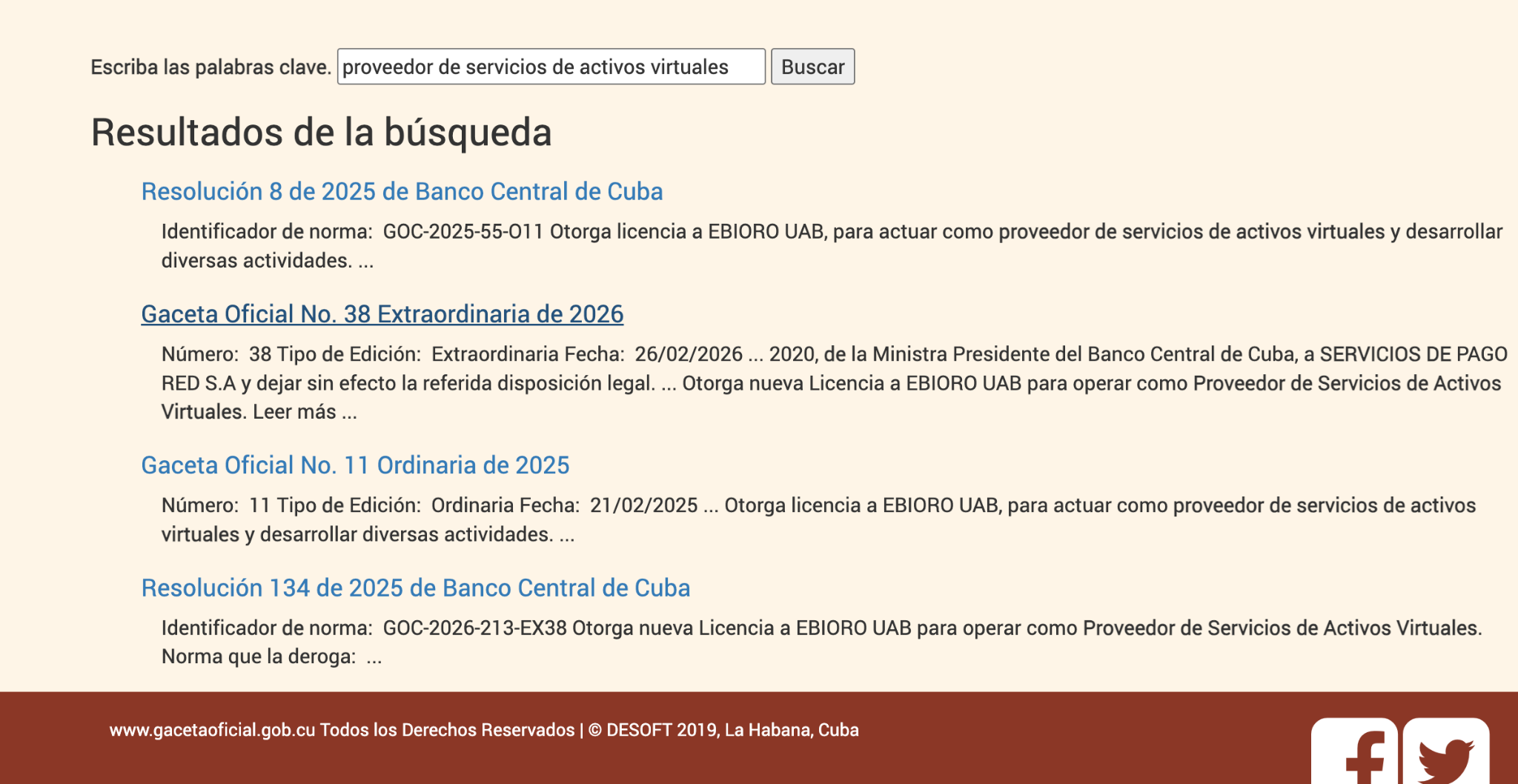
Resolution 8/2025 granted the license in January 2025. When Ebioro applied to renew, the Banco Central repealed Resolution 8 and granted a new one-year license under Resolution 134/2025, in force from January 28, 2026 and published in the Gaceta Oficial a month after it took effect.
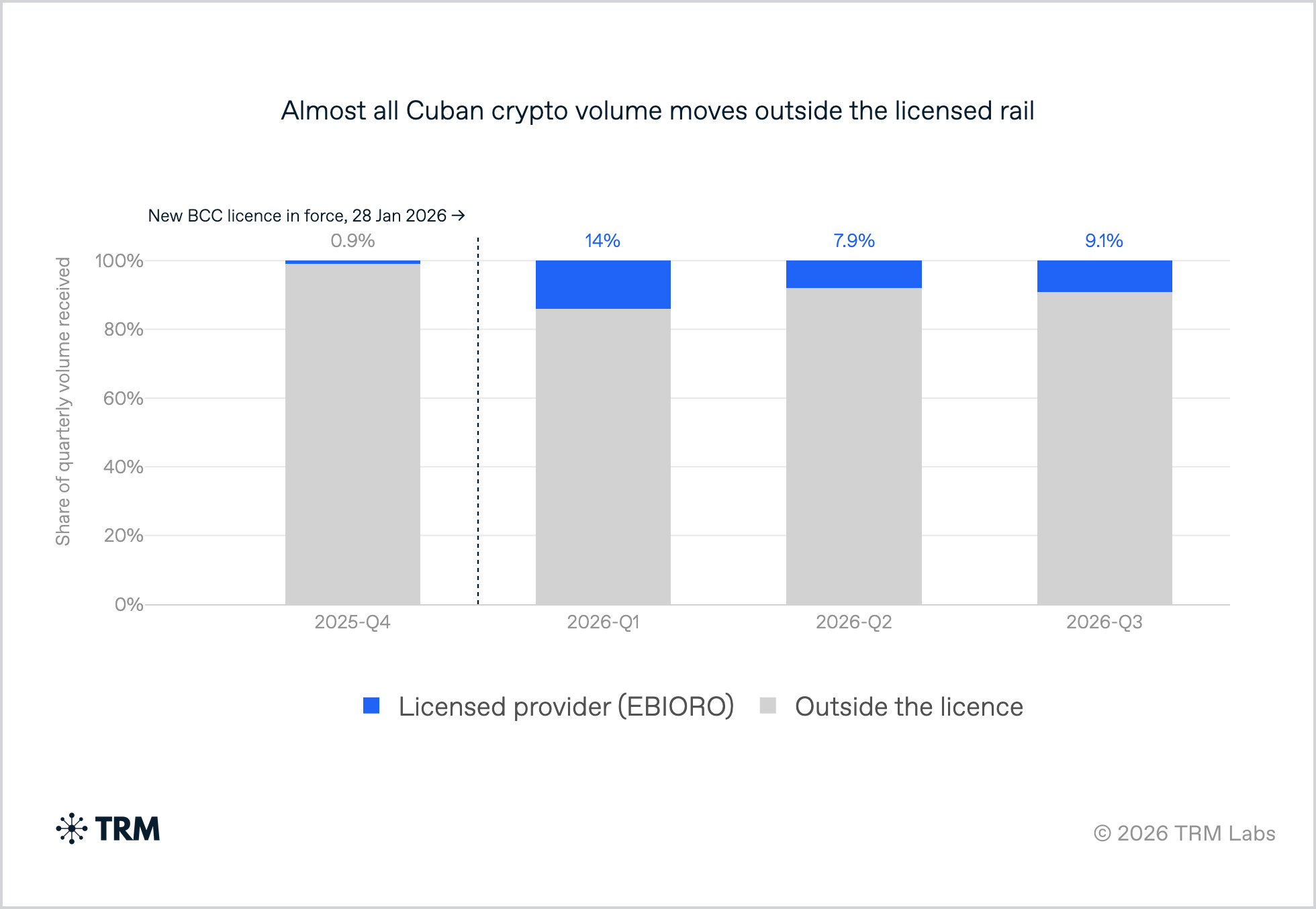
Under 10% of Cuban crypto volume identified by TRM Labs in the last two quarters has flowed through Ebioro — a split that mirrors what TRM Labs observed when OFAC designated Iran’s domestic crypto exchanges, where unlicensed platforms accounted for the majority of Iranian crypto activity.
Activity outside the licensed perimeter
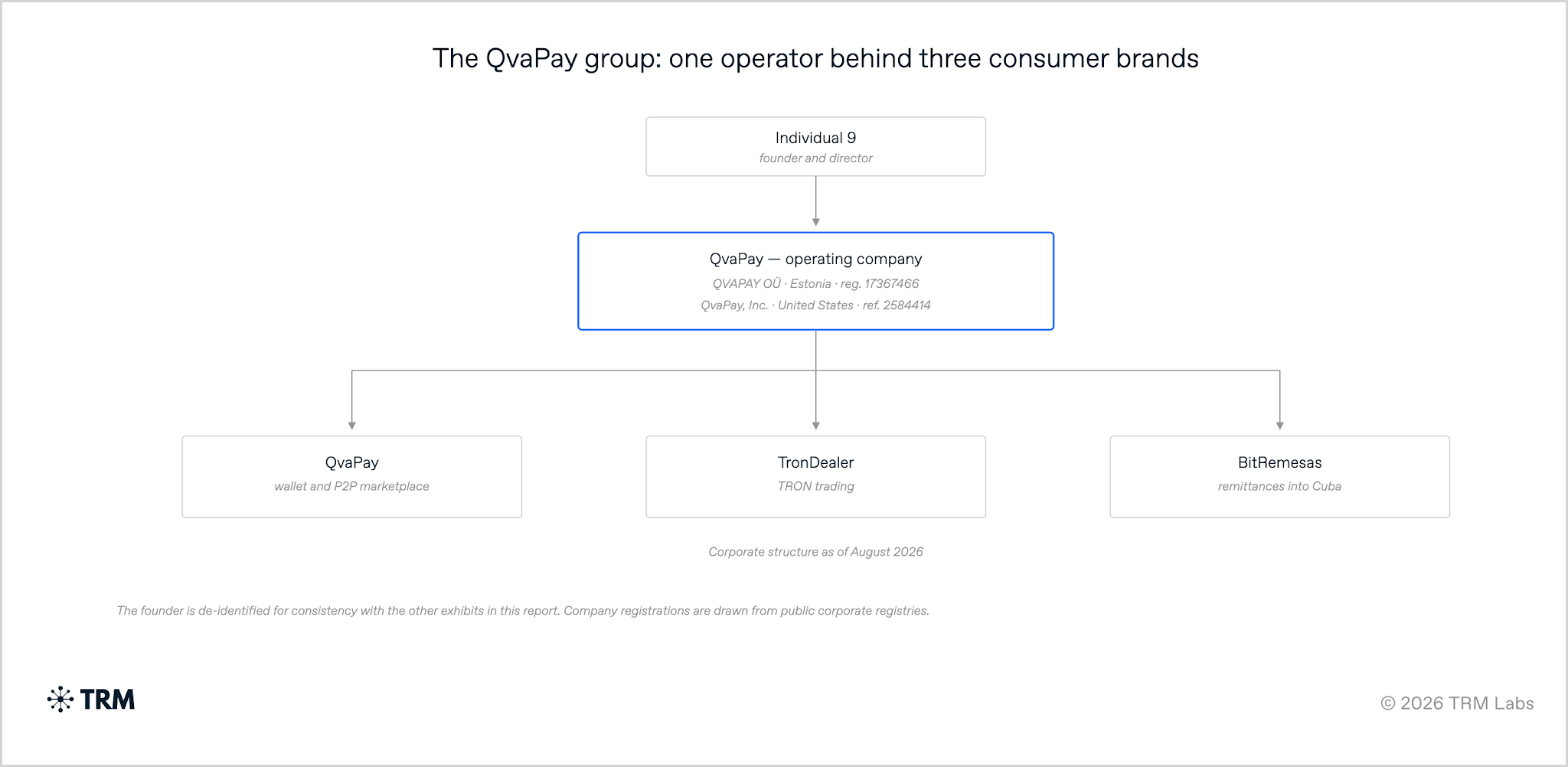
Many services not licensed by the government show significant Cuban usage; below, we show a sample of three services, all owned by the same holding company.
QvaPay is the retail wallet, P2P market, and the best-known Cuban platform in the ecosystem. Trades between its users settle on an internal ledger and are never recorded on a blockchain, though deposits and withdrawals to the service are.
QvaPay’s model rests on QUSD, an internal balance representing the USDT and USDC that users deposit. Users trade currencies and crypto assets against that balance across more than 40 payment methods. The platform reports more than 350,000 cumulative P2P transactions in its published figures, as of August 2026.
BitRemesas auctions a sender’s crypto to buyers inside Cuba, so no single transaction ever links sender to beneficiary. BitRemesas and QvaPay share a founder with the gateway TronDealer, which has also promoted a private peso-pegged token that would let remittance agents settle outside the banking system’s 80,000-peso daily cap.
From P2P groups to card issuers
Below those entities sit Telegram and WhatsApp groups trading pesos, MLC (moneda libremente convertible) balances, euros, and stablecoins on reputation alone. At the end of the chain are card issuers that convert stablecoins into Visa and Mastercard instruments without disclosing an owner, a jurisdiction, or an issuing bank — one of them loading up to USD 50,000 with no identity check.
The difference sits in the size of each payment, which rose from an average of USD 115 in 2021 to USD 209 in 2025. In 2026 the average transfer had fallen to USD 97, and the first 26 days of August recorded more transfers than any full month since the series began.
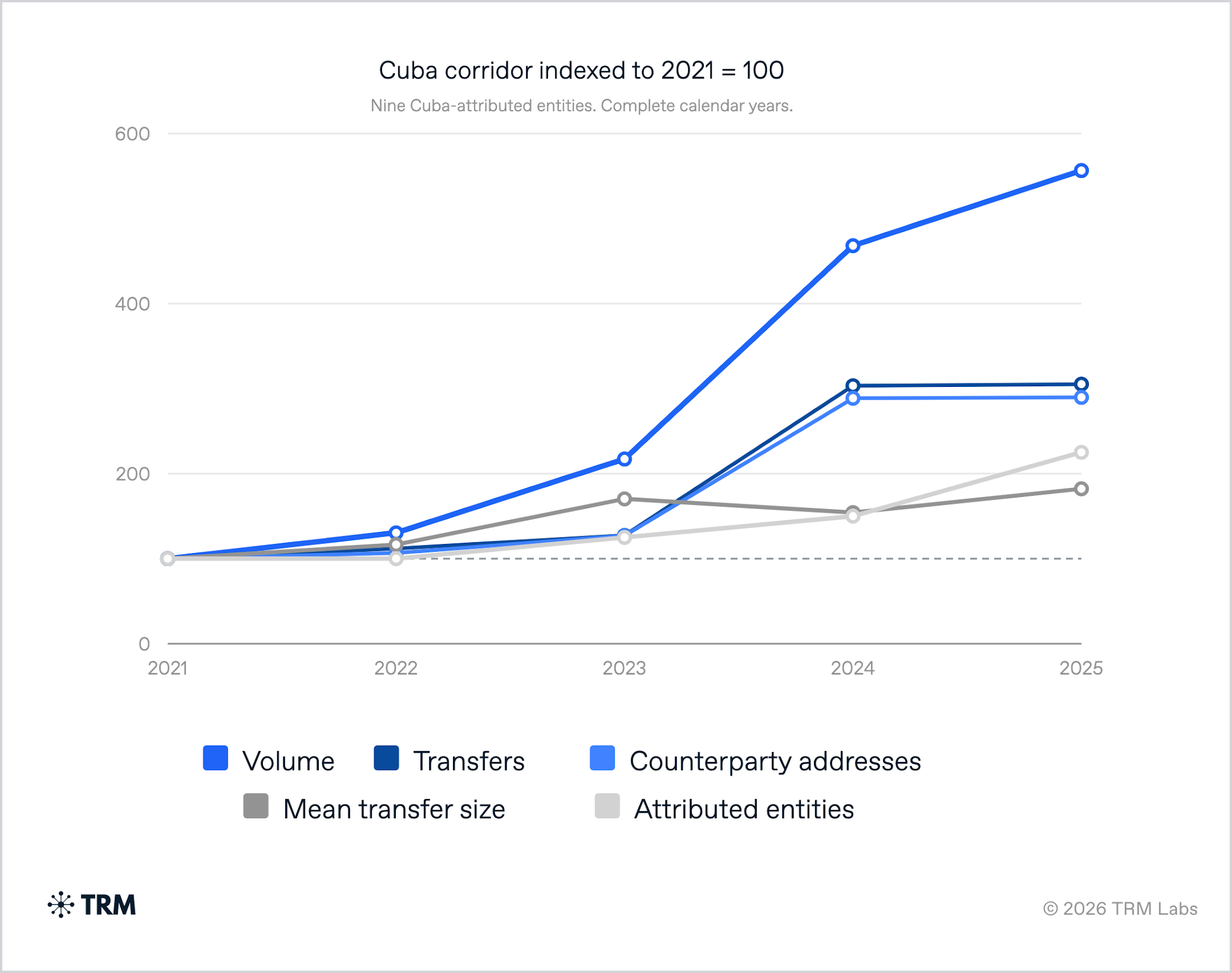
Sanctions on Cuba continue to expand, and each new tranche brings fresh scrutiny of whether crypto is being used for circumvention. So far, there is no evidence to suggest this is the case
What to watch next
EO 14404 is not yet four months old, and the designations are still arriving — the ninth tranche landed on August 20. So far, the evidence suggests Cuba’s designated enterprises are adapting in two ways: by shifting operations to newly formed entities, and by moving payments for Cuban sales into non-Cuban channels through the border purchasing model. Cryptocurrency does not appear to be playing a significant role in Cuba’s sanctions-mitigation strategy, though that could change as more designations arrive.
For compliance teams, the relevant signals will not always sit in the same place. Names and sanctions lists remain important, and corporate records, ownership and management links, trade and shipping data, payment intermediaries, and blockchain activity can provide additional context as the network changes.
Frequently asked questions (FAQs)
1. Is it legal for Cubans to use cryptocurrency?
Cuba has regulated virtual assets since 2021 and requires a Banco Central de Cuba license to operate a crypto business on the island. One company currently holds that license, and it is registered in Lithuania. Most platforms Cubans use day to day operate outside the licensed perimeter.
2. Why did Visa and Mastercard stop working in Cuba?
Reuters reported that Cuba suspended payments on both networks starting June 6, 2026, after a foreign payment processor limited its Cuba operations following the new sanctions authority. Those payments had historically run through a foreign bank and Fincimex, the designated financial arm of Cuba’s military conglomerate.
3. What is venta en frontera?
Venta en frontera, or border purchasing, is a Cuban commercial model in which a state enterprise sells goods for hard currency to a buyer outside the country and delivers them to a recipient inside Cuba. The payment settles offshore, usually to a storefront incorporated abroad, and the Cuban leg appears as a delivery rather than a transfer. For a screening system, the visible counterparty is the storefront, not the state enterprise behind the goods.
4. Is the Cuban government using cryptocurrency to evade sanctions?
No cryptocurrency address has appeared in a designation under EO 14404. In March 2026, Cuba authorized ten companies to make international payments in virtual assets through a licensed provider, but TRM Labs has observed no on-chain activity connecting those companies to that provider. The evidence to date does not establish crypto as a significant state sanctions-evasion channel.
5. What does EO 14404 mean for non-US firms?
Foreign shipowners, charterers, brokers, banks, and insurers dealing with designated Cuban parties can face sanctions risk without a direct US nexus. Foreign financial institutions that conduct or facilitate significant transactions for a blocked person risk strict conditions on, or the loss of, their US correspondent and payable-through accounts. For maritime firms, vessels calling at Mariel or Moa Bay under arrangements involving designated entities are one example of where that exposure can arise. The same third-country reach is now a feature of other regimes: the EU’s 21st sanctions package extended crypto-focused measures to platforms based outside the bloc in July 2026.
6. Where should compliance teams focus in this corridor?
Name-based screening is only one part of the picture. Corporate records and ownership links can help identify connections when operating entities change. Trade and shipping data can surface relationships that appear through goods rather than direct payments. Blockchain intelligence can provide visibility into the crypto ecosystem where on-chain activity exists.