Leaked Documents Shed Light on the Banking Behind Iran–China Trade

Key Takeaways
- Zhejiang Chouzhou Commercial Bank, a regional bank based in Yiwu, is the Chinese bank most often named as the place to send payment in leaked Iranian trade documents. It leads in every period from 2021 through early 2025.
- The paperwork points to regional and mid-sized national banks. The large state-owned banks that dominate Chinese finance rarely appear in that role.
- Ping An Bank, a large national lender, goes from a rare name in 2021 to one of the most common in 2025, mostly at the expense of other national banks.
- The documents show where buyers were told to pay. They do not show how much money moved.
{{horizontal-line}}
Iran needs access to foreign currency and overseas banking to pay for imports and settle trade. Sanctions have sharply restricted that access, and many large international banks avoid Iranian business. Buyers and the exchange houses acting for them must still find ways to pay suppliers abroad, but the banking arrangements behind those payments are difficult to observe.
Leaked Iranian trade documents offer a partial view. Invoices and other records published by WikiIran name accounts at Chinese banks where Iranian buyers were instructed to send payment. TRM Labs searched more than 200,000 of these documents to identify which banks appeared most often.
The leading bank was Zhejiang Chouzhou Commercial Bank, a regional lender based in Yiwu. Of roughly 910 distinct labeled accounts that TRM could tie to a Chinese bank, about 240 were at Chouzhou. It was the most frequently named bank in every period from 2021 through the first half of 2025, while China’s largest state-owned banks rarely appeared as payment destinations. The Wall Street Journal reported on the bank, drawing on this analysis.
These records show where buyers were told to pay. They do not establish whether payments were completed or how much money moved.
How the documents connect Iranian buyers to Chinese banks
The arrangements become visible at the point where a buyer receives instructions for paying a supplier. Many of the records are pro-forma invoices: quotes that specify the goods, their price, and the account where payment should be sent. Exchange houses often appear on the Iranian side, arranging payment on a buyer’s behalf.
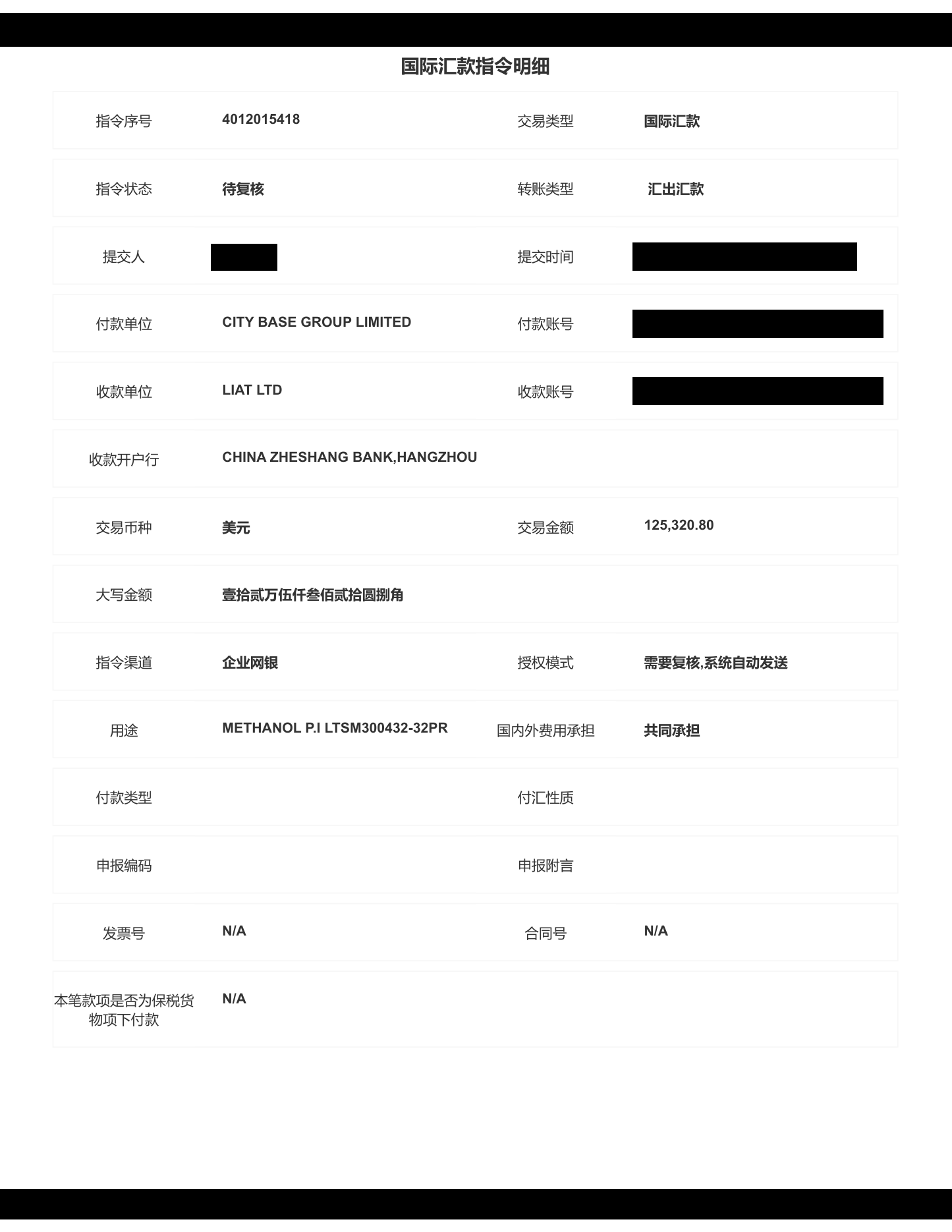
The destination accounts are at Chinese banks, but the account holders include overseas companies. Many accounts carry labels identifying them as non-resident accounts or other foreign-currency account types. The holders named in the documents include both shell companies and ordinary commercial businesses.
This gives TRM a way to identify the banks named in the payment arrangements. By matching labeled account numbers to the accompanying bank details, TRM counted the distinct accounts associated with each bank and compared their presence across periods.
Chouzhou appears most often
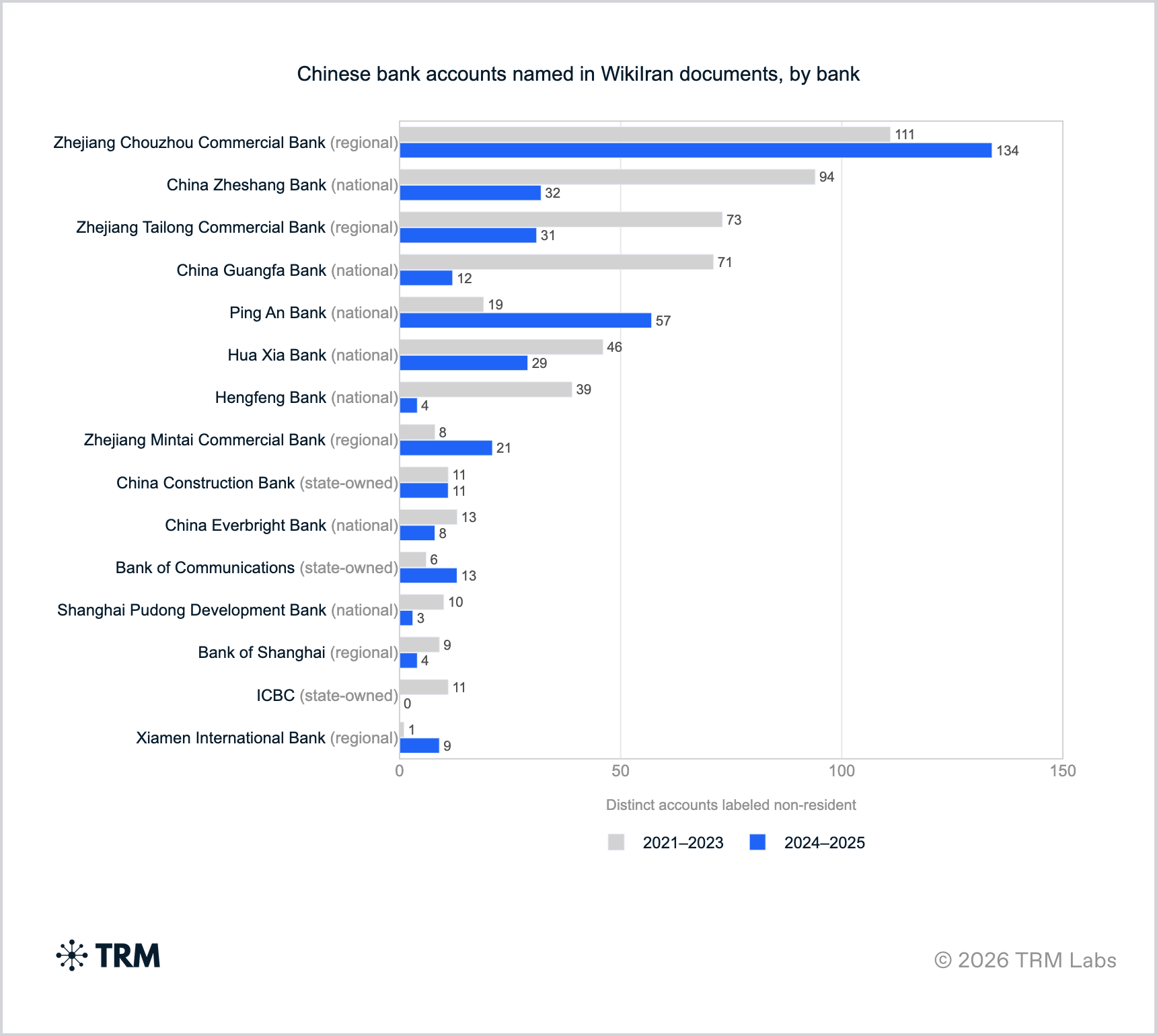
Chouzhou stands out for both the number of accounts named and its consistent lead across the sample. It ranks first in every period analyzed, and in the combined 2024–2025 period it is associated with more than twice as many accounts as any other bank.
The comparison across banks shows how unusual that position is. Chouzhou appears alongside nationwide lenders such as China Zheshang, Guangfa, and Ping An, yet it has a substantially larger presence in the documents. Other regional banks, including Zhejiang Tailong and Zhejiang Mintai, also appear.
Chouzhou accounts continue to appear in documents dated February through April 2025. That establishes their continued presence in payment instructions near the end of the sample, although it does not establish that the accounts remained active or received payments.
China’s largest banks have a limited presence
Chouzhou’s prominence is part of a broader pattern: most identified accounts are at regional banks and national joint-stock lenders, rather than China’s largest state-owned banks.
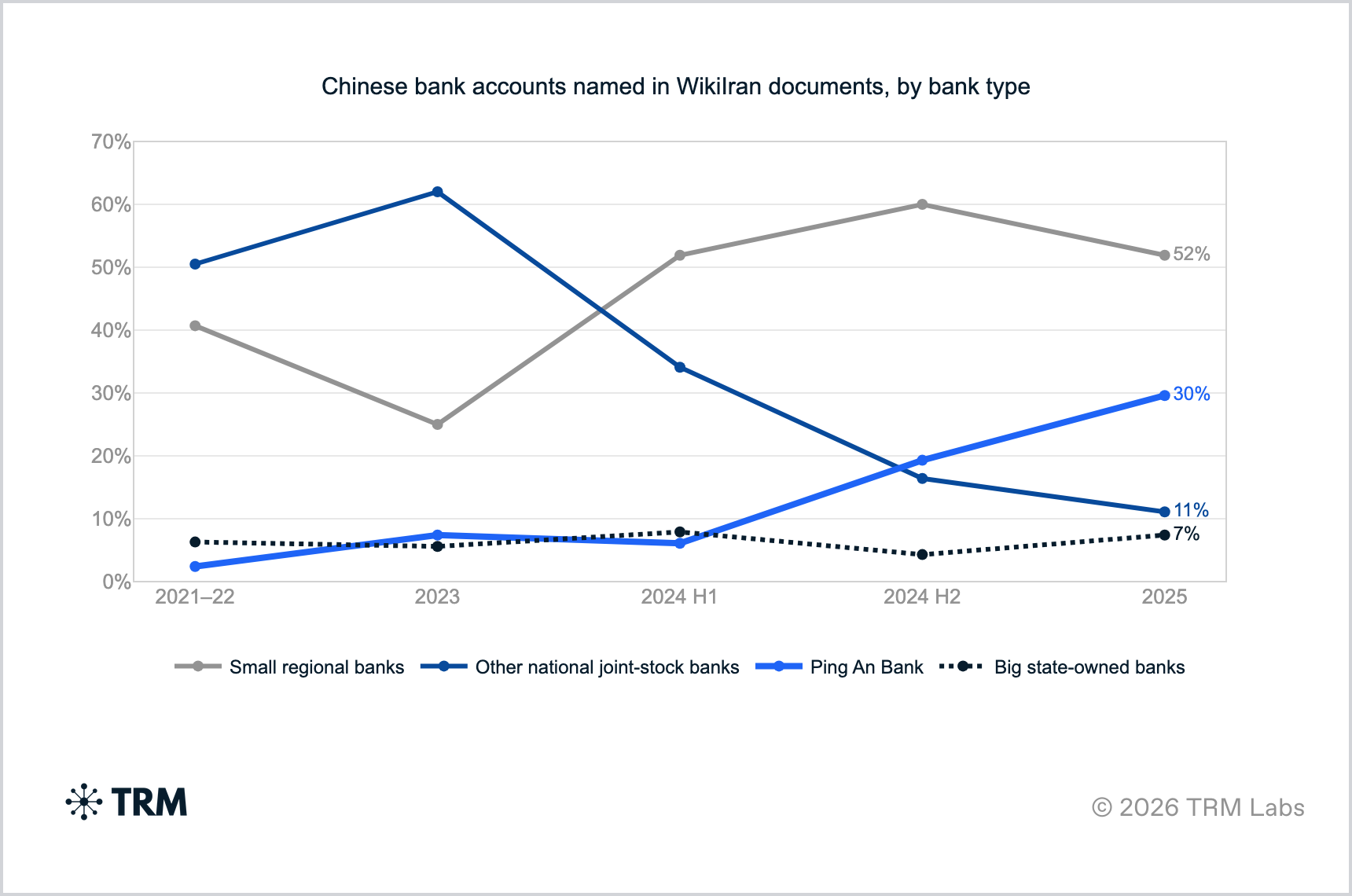
The large state-owned banks account for about 6% of identified accounts in 2021–2022 and about 7% in 2025. In sampled documents, they mostly appear as the Chinese exporter’s own domestic bank account, rather than as a non-resident account designated for payment from an Iranian buyer.
Industrial and Commercial Bank of China (ICBC) illustrates the limited presence of these institutions. It is associated with 11 accounts in the combined 2021–2023 period and none in 2024–2025.
Regional banks account for roughly half of identified accounts in most periods, although their share falls to about a quarter in 2023. National joint-stock lenders account for much of the remainder, with a significant change in which banks appear toward the end of the sample.
Ping An becomes more prominent
The clearest change within the national joint-stock category is the rise of Ping An Bank. It accounts for about 2% of identified accounts in 2021–2022 and about 30% in the first half of 2025.
Over the same period, the combined share of other national joint-stock banks, including China Zheshang, Guangfa, and Hengfeng, falls from about half of identified accounts to about 11%. The composition of the sample shifts toward Ping An, even as Chouzhou remains the most frequently named individual bank.
Changes in document coverage could explain some of this movement. Each leak covers a different span of years, so comparisons across periods also reflect which sources are available.
To examine that effect, TRM compared Chouzhou and Ping An within the Pedram leak, which spans 2024 and 2025 and contains the same kinds of documents throughout. The number of Chouzhou accounts falls from 50 in the first half of 2024 to 24 in 2025, while Ping An accounts rise from four to 14.
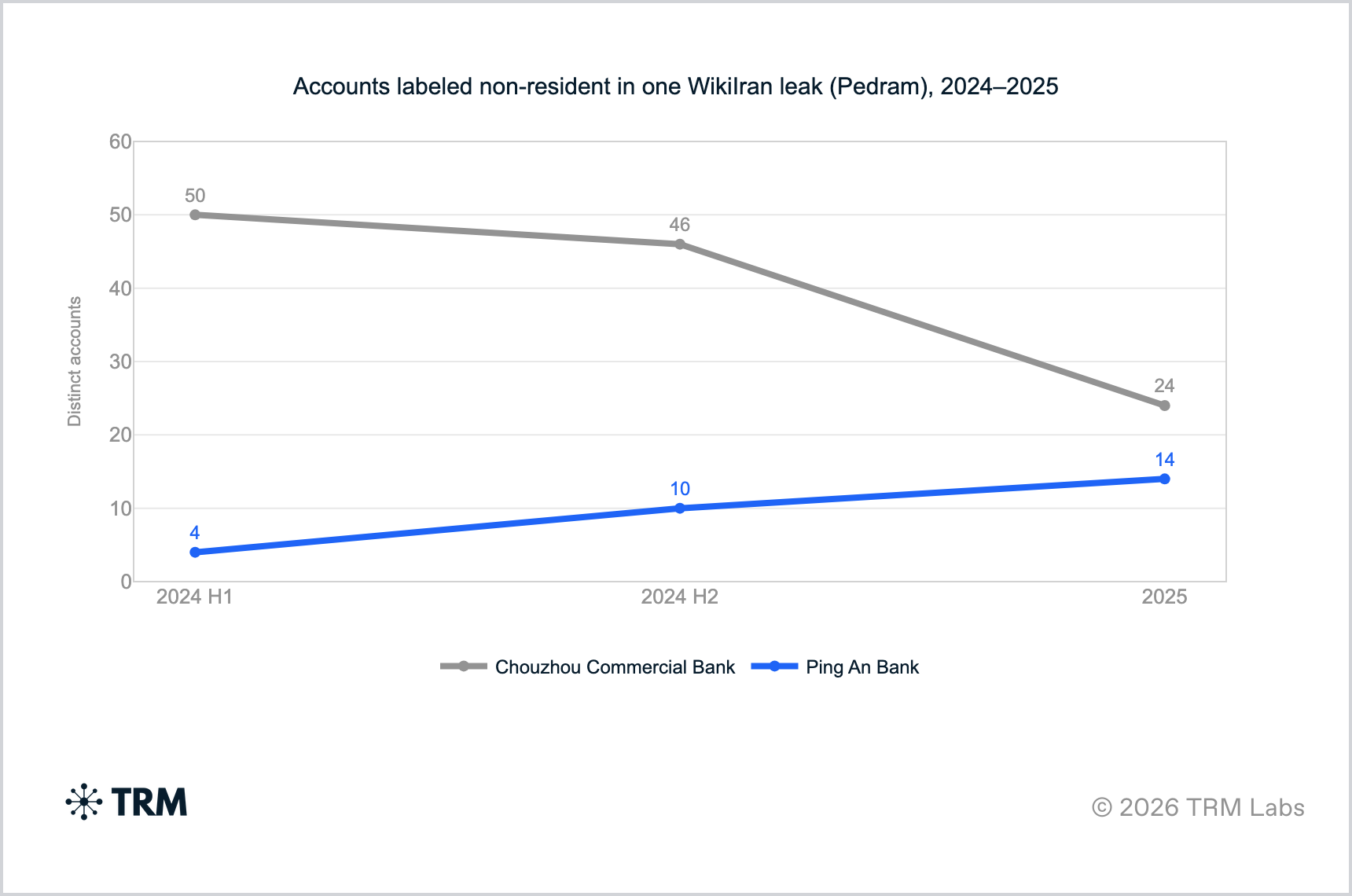
The single-leak comparison shows the same direction of change, reducing the likelihood that the broader pattern is entirely a result of switching between sources. The counts are small, however, and the 2025 period covers roughly January through June. They do not establish that customers moved from Chouzhou to Ping An or that payment volumes followed the same pattern.
What the documents establish
The records identify a set of Chinese bank accounts named in Iranian trade paperwork, with Chouzhou appearing most often and Ping An becoming more prominent over time. They offer visibility into intended payment arrangements that are otherwise difficult to observe.
Most of the underlying records are invoices. A rough keyword classification identified only about 20 of the approximately 720 references to Chouzhou as payment instructions or wires. That is a count of references, not of the roughly 240 accounts. Those document categories are not confirmation that a transfer occurred.
TRM did not establish whether the listed payments were completed, how much money moved, or in what currency. The documents have not been independently verified for authenticity or completeness. The findings describe the banks represented in this collection of leaked records, rather than the full banking network supporting Iranian trade.
{{horizontal-line}}
Frequently Asked Questions (FAQs)
1. How many accounts were counted?
About 1,040 distinct labeled accounts were found across roughly 205,000 documents for 2021 through 2025. About 910 could be tied to a bank, with about 240 at Chouzhou and about 670 at other Chinese banks. About 12% could not be tied to a bank. Unlabeled accounts were not counted, so a wider search might find more.
2. Does this show that Chinese banks processed Iranian payments?
The documents name these accounts, mostly on invoices that tell buyers where to pay. Payment amounts and completed transfers were not measured, and the documents have not been verified as authentic.
3. Why do the periods end in mid-2025?
The latest document that contains an account number is dated July 7, 2025, and nearly all are from June 2025 or earlier. WikiIran has published documents dated later, but no account numbers were found in them. WikiIran is the source for why the leaks stop where they do.
4. Why can a bank appear to fade between periods?
Each leak covers a different span of years, so a bank can look like it fades when the leak covering its busy period is no longer part of the sample. The single-leak chart shows Chouzhou and Ping An in one source over 2024 and 2025 to limit that effect.
5. What was excluded?
Bank of Kunlun was excluded because its matches are mostly tender clauses, with no Society for Worldwide Interbank Financial Telecommunication (SWIFT) code hits. Front-company compilations and news articles in the WikiIran set were also excluded.