OFAC Sanctions BitBank, Expanding Action Against Babak Zanjani’s Digital Asset Network

TRM User Conference
Which mission will you select?
Key takeaways
- On September 17, 2026, the US Department of the Treasury’s Office of Foreign Assets Control (OFAC) designated BitBank, an Iranian digital asset exchange Treasury describes as a priority digital asset venture controlled by sanctioned Iranian financier Babak Zanjani. OFAC also designated BitBank developer Pishtaz Simorgh Electronic Trade Company and three senior figures in Zanjani’s Dot One network.
- According to Treasury, Zanjani used BitBank between June and July 2026 to move hundreds of millions of dollars worth of Bitcoin to the Islamic Revolutionary Guard Corps (IRGC). OFAC also said the previously sanctioned Hormuz Safe Marine Services Authority has used BitBank since June to transfer payments it received to the Iranian regime.
- The action is the latest expansion of sanctions against a network TRM Labs has tracked throughout 2026. TRM initially identified approximately USD 1 billion in IRGC-linked activity through Zedcex and Zedxion, then expanded its investigation into the broader corporate, payments, and digital infrastructure surrounding the exchanges.
- BitBank and Pishtaz Simorgh also sit within a growing Dot One digital ecosystem encompassing the MyDot social platform, DOTO digital asset, and Dot One Smart Chain
- The progression from Zedcex and Zedxion to Dot One and now BitBank reinforces a central finding from TRM’s investigations: sophisticated sanctions-evasion networks are best understood by following the people, infrastructure, and control relationships behind individual companies, rather than examining exchanges or wallet addresses in isolation
{{horizontal-line}}
On September 17, 2026, OFAC designated BitBank, an Iranian digital asset exchange that Treasury describes as a priority digital asset venture controlled by sanctioned Iranian financier Babak Zanjani. OFAC issued the designation under Executive Order 13902, the authority behind Treasury’s Operation Economic Outcast campaign against Iran. It marks the latest action against a financial network TRM Labs has tracked throughout 2026 — work that began with TRM’s identification of approximately USD 1 billion in IRGC-linked activity through cryptocurrency exchanges Zedcex and Zedxion, and has since expanded into an ecosystem spanning digital asset exchanges, payment companies, transportation and commodity businesses, consumer applications, and purpose-built digital asset infrastructure.
Treasury’s latest findings show how parts of that infrastructure are being used.
According to OFAC, between June and July 2026, Zanjani used BitBank to move hundreds of millions of dollars worth of Bitcoin to the IRGC. Treasury also said that, since June, OFAC-designated Hormuz Safe Marine Services Authority has used BitBank to transfer payments it received to the Iranian regime.
OFAC additionally designated Pishtaz Simorgh Electronic Trade Company, the developer of BitBank’s digital asset software and a subsidiary of the previously sanctioned Dot One Value Creation Group. The designation also covers three senior figures within the wider network: Pishtaz Simorgh CEO Mohammad Mahdi Zaker Hossein, Dot One board vice chairman Seyed Adel Heidari, and Dot One executive Hossein Ali Zaker Hossein, whom OFAC describes as central to Zanjani’s sanctions-evasion activity.
From Zedcex and Zedxion to BitBank
TRM’s investigation into this network began on-chain. In January 2026, TRM published an investigation into Zedcex and Zedxion, two UK-registered companies that publicly presented themselves as conventional cryptocurrency exchanges. Blockchain analysis identified approximately USD 1 billion in funds linked to the IRGC, roughly 56% of their observed transaction volume between 2023 and 2025. IRGC-linked activity peaked in 2024, when approximately USD 619 million accounted for an estimated 87% of observed activity.
Corporate records connected that activity to Zanjani. Zedxion Exchange Ltd was incorporated in the UK in May 2021. Later that year, an individual named Babak Morteza — the name under which Zanjani appears in UK corporate filings — became a director and person with significant control. Zedcex Exchange Ltd followed in 2022, shortly after Zanjani’s formal departure from Zedxion, sharing Zedxion’s successor director and UK virtual-office address. The overlapping governance, addresses, corporate filings, and timing led TRM to assess that the two companies functioned as a single exchange operation distributed across multiple legal entities rather than independent businesses.
On January 30, 2026, OFAC designated Zanjani, Zedcex, and Zedxion, in the first US sanctions action against digital asset exchanges for supporting the IRGC. TRM’s investigation continued past the exchanges.
Following the network beyond the blockchain
TRM subsequently expanded its investigation beyond blockchain activity, examining the corporate records, digital infrastructure, payment platforms, commercial businesses, and individuals surrounding Zedcex and Zedxion. That work uncovered several corporate entities and associated individuals, many of whom Treasury later sanctioned in its July 24, 2026 action against another portion of Zanjani’s commercial ecosystem, including Dot One Value Creation Group, ZEDX DMCC, ZedPay, BZ Diamond, transportation companies, and associated individuals.
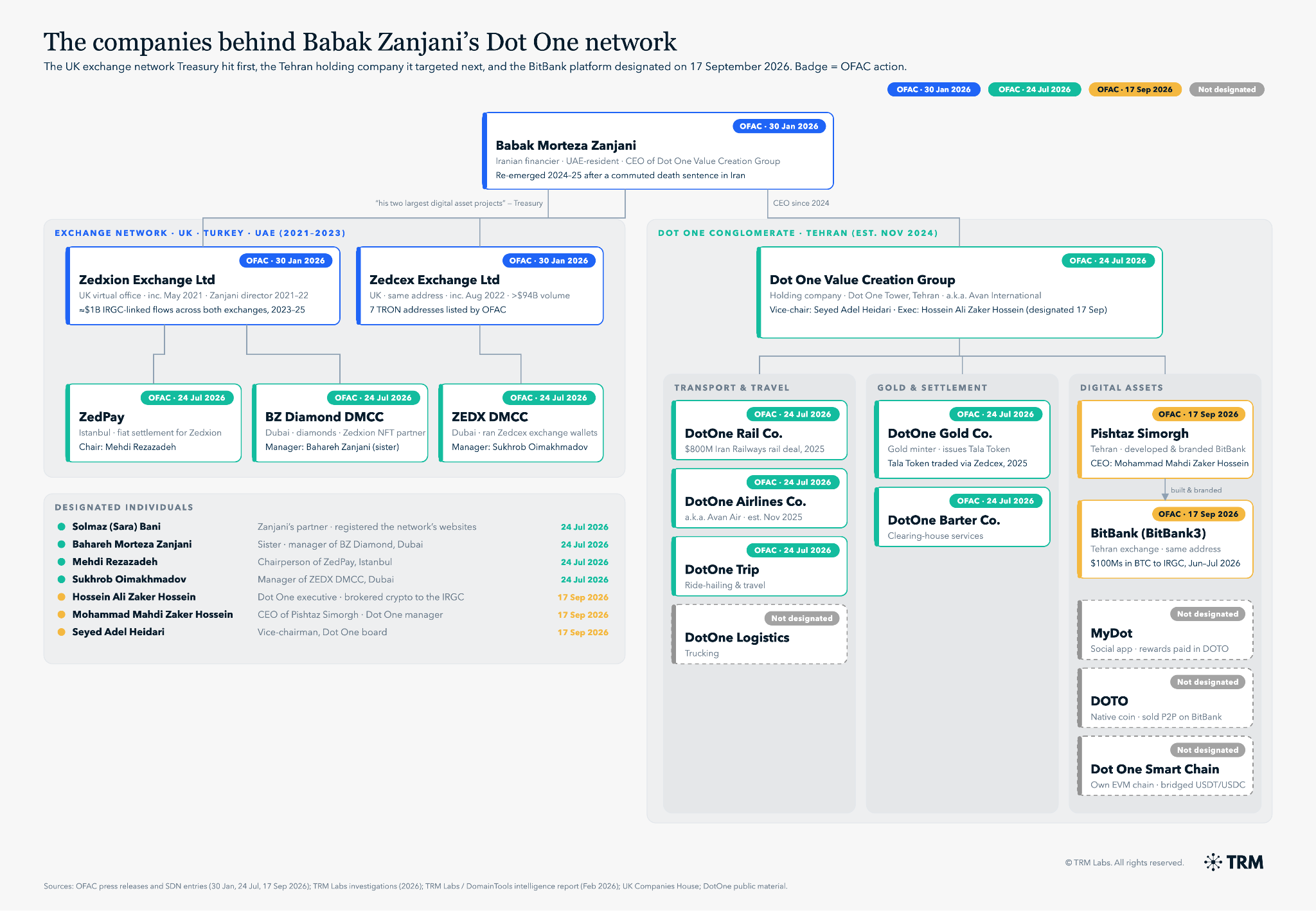
Treasury’s latest action extends that enforcement to BitBank itself.
BitBank: A core digital asset component of the network
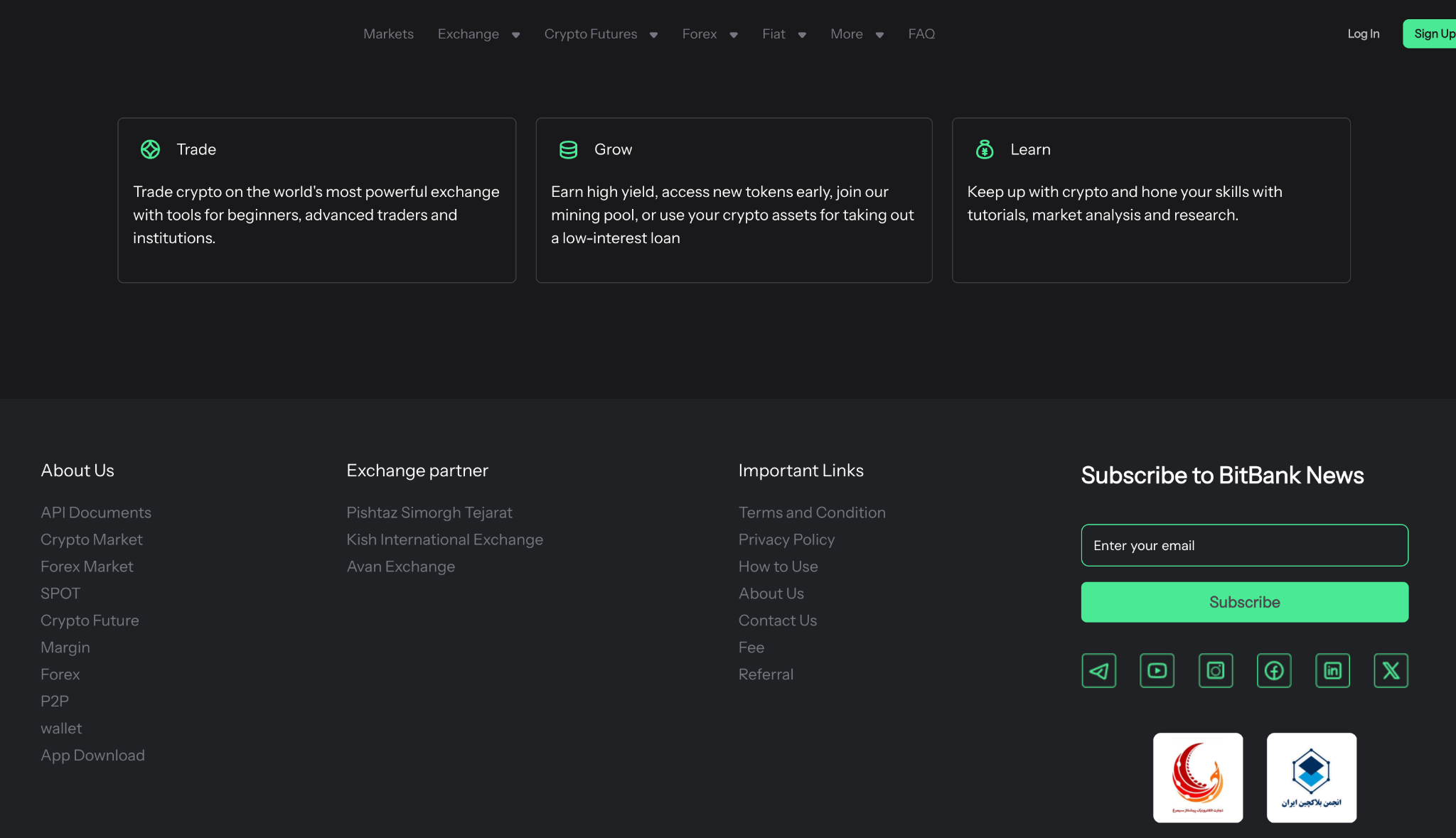
Treasury describes BitBank as an Iranian digital asset exchange controlled by Zanjani that he used to move hundreds of millions of dollars worth of Bitcoin to the IRGC. According to OFAC, Zanjani has advertised BitBank through his social media accounts since at least 2024, while several other companies within his sanctions-evasion network have publicly identified BitBank as a partner. These include platform developer Pishtaz Simorgh and several businesses operating under the Dot One brand.
From social media to BitBank: The Dot One digital ecosystem
Dot One has increasingly developed digital products alongside its more traditional commercial businesses. One example is MyDot, a social platform within the Dot One ecosystem. Dot One’s social media has promoted a rewards model through which activity on MyDot generates “stars,” which can be converted into a purpose-built digital asset: DOTO. Users are then directed to transfer DOTO to BitBank (also listed as BitBank3), where the asset can be offered for sale through BitBank’s P2P marketplace.
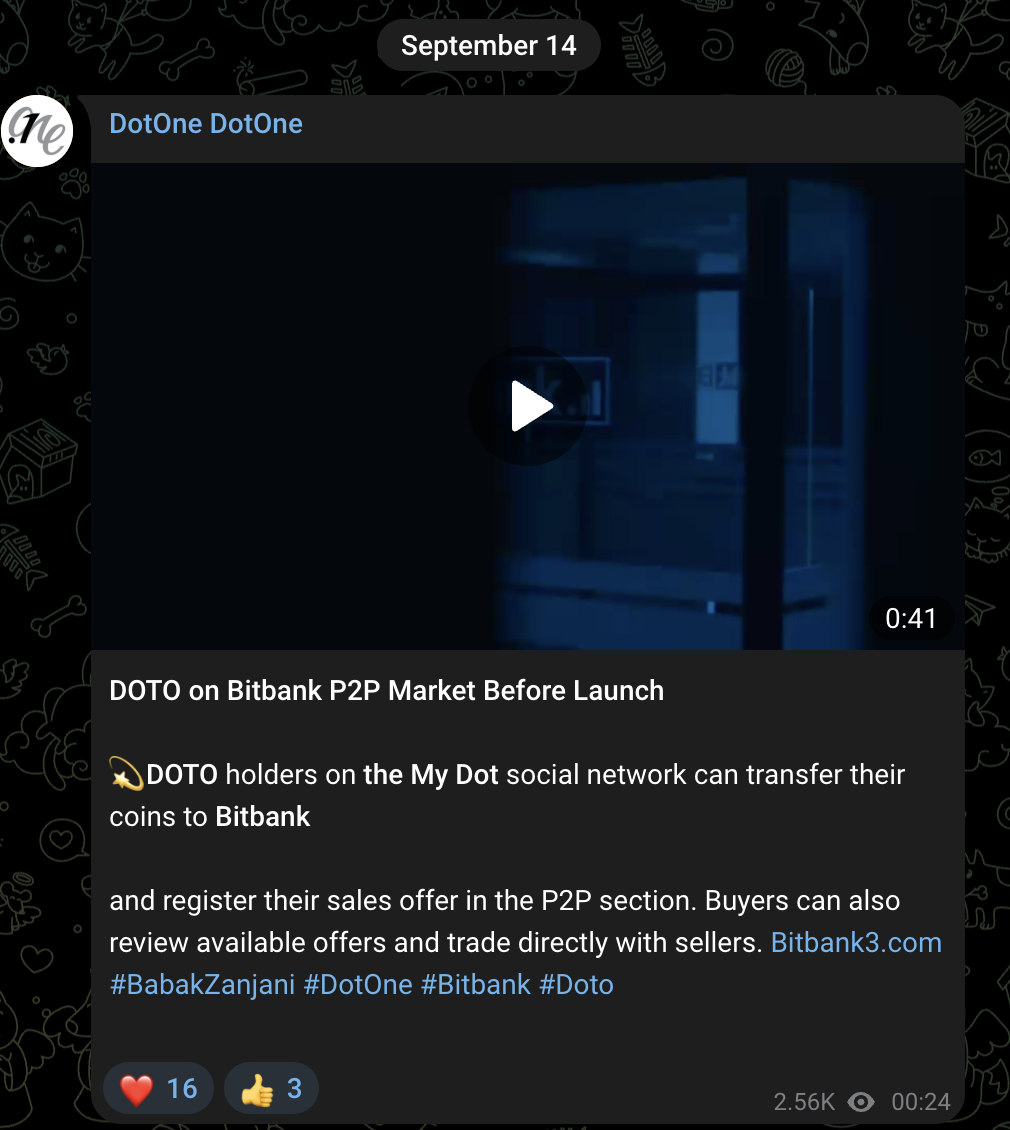
That creates a functional connection between Dot One’s consumer-facing platform, its digital asset, and BitBank:
MyDot → DOTO → BitBank
Treasury’s finding that Zanjani has personally advertised BitBank since at least 2024, and that other companies within his network have listed BitBank as a partner, gives that connection added weight. The social media activity shows how these businesses and products function together as one ecosystem of blockchain businesses, consumer applications, and financial services. And that ecosystem now extends to its own blockchain infrastructure.
Dot One Smart Chain
Dot One has also developed blockchain infrastructure referred to publicly as Dot One Smart Chain. The network is EVM-compatible and uses DOTO as its native digital asset. It includes Wrapped DOTO (WDOTO) as well as bridged representations of major digital assets, including USDT and ETH. As a standalone blockchain, Dot One Smart Chain is a notable evolution from the infrastructure TRM originally observed around Zedcex and Zedxion. It gives Zanjani’s organization control of the underlying crypto rails, and functions as a foundational component of a larger digital economy built around Dot One-branded businesses:
MyDot → DOTO → Dot One Smart Chain → BitBank
Not every component or user of this ecosystem is engaged in illicit activity. Their integration is what shows the scale and direction of the financial technology infrastructure developing around a network Treasury has repeatedly targeted for sanctions evasion.
Combining on-chain analysis with corporate intelligence
The Zanjani investigation shows why blockchain intelligence needs to be combined with corporate, infrastructure, and open-source intelligence when investigating sophisticated sanctions-evasion networks. Blockchain analysis first exposed how much IRGC-linked activity flowed through Zedcex and Zedxion — roughly 56% of observed volume. Corporate records were then necessary to connect that infrastructure to Zanjani and the wider Dot One ecosystem, including his businesses outside the blockchain world.
Treasury has now designated parts of this network in January, July, and September 2026, alongside separate OFAC action against Iran’s domestic crypto exchanges. Each designation has arrived after the network had already built its next layer — from UK-registered exchanges, to a commercial ecosystem, to a proprietary chain and a consumer application. For compliance and investigations teams, screening against designated entities alone will trail that expansion. Mapping the people, corporate filings, and infrastructure behind a platform is what surfaces the next BitBank before it appears on the SDN List.
{{horizontal-line}}
Frequently asked questions (FAQs)
1. What is BitBank?
BitBank, also known as BitBank3, is an Iranian digital asset exchange. OFAC designated BitBank on September 17, 2026 and describes it as a priority digital asset venture controlled by Babak Zanjani.
Treasury says Zanjani used BitBank between June and July 2026 to move hundreds of millions of dollars worth of Bitcoin to the IRGC.
2. How is BitBank connected to Babak Zanjani?
Treasury explicitly identifies BitBank as controlled by Zanjani and says he has advertised the exchange through his social media accounts since at least 2024.
OFAC also says multiple other companies within Zanjani’s sanctions-evasion network have publicly identified BitBank as a partner.
3. How is BitBank connected to Dot One?
Treasury identifies Pishtaz Simorgh Electronic Trade Company, a subsidiary of OFAC-designated Dot One Value Creation Group, as the developer of BitBank’s digital asset software.
Mohammad Mahdi Zaker Hossein, a Dot One manager and representative, is also CEO of Pishtaz Simorgh.
4. What is Dot One Smart Chain?
Dot One Smart Chain is an EVM-compatible blockchain associated with the Dot One ecosystem. DOTO serves as its native digital asset, while the network also supports wrapped and bridged assets.
5. What did TRM previously uncover about the network?
TRM’s January 2026 investigation identified approximately USD 1 billion in IRGC-linked activity through Zedcex and Zedxion and connected their corporate infrastructure to Babak Zanjani.
TRM subsequently expanded its investigation into the broader commercial architecture surrounding the exchanges. Numerous entities identified through that work — including Dot One companies, ZEDX DMCC, ZedPay, and BZ Diamond — were subsequently designated by Treasury.
6. Why does the BitBank designation matter?
BitBank shows how the financial infrastructure surrounding Zanjani has continued to evolve beyond Zedcex and Zedxion.
Alongside its role in facilitating sanctions evasion, BitBank’s integration into the broader Dot One ecosystem shows how exchange services increasingly coexist with proprietary digital assets, consumer applications, software development, and blockchain infrastructure.