Russia Escalates Prosecutions of Darknet Market Figures as Volume Heads Toward USD 1.7 Billion

Key takeaways
- Russian prosecutions escalated in 2026: courts took up cases against Hydra’s alleged creators and extended the pretrial detention of four defendants in the Kraken and WayAway investigation through late November
- Major darknet market takedowns and actions have historically been led by US and European authorities. Russian prosecutions of Hydra-linked figures date to at least 2024 and moved toward the alleged creators in 2026, although none has shut down an active market
- Russian-language darknet markets, the Tor-based platforms centred on selling illicit drugs, received over USD 1.2 billion of the nearly USD 1.3 billion that such markets received from January through September 2026 (about 95%), excluding independent drug vendor shops
- Kraken Market received nearly USD 320 million in the third quarter of 2026, close to both the prior quarter and the same quarter of 2025, which points to steady demand that the market continues to meet
{{horizontal-line}}
The Russian cases in context
Large darknet markets have been taken down before, and US or European agencies led many of those operations. The Federal Bureau of Investigation (FBI) shut down the original Silk Road in October 2013 and arrested its operator, Ross Ulbricht. A court sentenced Ulbricht to life in 2015, and he was pardoned on January 21, 2025. In July 2017, a coordinated international operation shut down AlphaBay, which the US Justice Department described as the largest online dark market, and Hansa. In April 2022, Germany’s Federal Criminal Police Office took down Hydra, which received over 90% of darknet market volume in 2021. In May 2025, Operation RapTor ended in 270 arrests and more than USD 200 million in seized currency and digital assets, with US and European agencies and partners in ten countries.
However, sales volumes began growing shortly after Hydra's demise, as within months of the platform's closure, new darknet markets opened. According to TRM Labs findings from April 2025, most darknet markets close within two to three years of launch, but the Russian-language ecosystem has by contrast remained relatively unchallenged since Hydra's disappearance. There have been no recorded law enforcement takedowns of Russian-language darknet markets since Hydra.
No Russian-language darknet market has been taken down since Hydra. In 2026, Russian courts moved forward cases against Hydra’s alleged creators and people tied to the WayAway forum. Unlike past takedowns, these are led by Russian authorities rather than US or European agencies.
Russian authorities moved two sets of darknet cases forward in mid-2026. In the Hydra case, Russia’s Interior Ministry said on June 30 that it had finished its case against one of the group’s alleged leaders, according to RIA Novosti. In July, a court in Perm took up the case against two men alleged to have created Hydra. In the separate Kraken and WayAway investigation, Moscow City Court extended the detention of four people on August 18, according to Kommersant, a Russian daily business newspaper. Over the same weeks, Russian-language markets kept receiving about USD 145 million a month.
The 2026 cases
The cases involve Hydra’s alleged creators and the alleged leaders and staff of WayAway, one of two forums behind a claimed partnership in about 2015 that created Hydra, according to the US indictment.
Several Hydra figures were convicted earlier. On December 2, 2024, a Moscow-area court sentenced Stanislav Moiseev to life, with 15 co-defendants receiving 8 to 23 years, according to Mediazona and The Record. Interfax and TASS, citing law enforcement sources, identified Moiseev as Hydra’s founder or organizer, though prosecutors did not name Hydra. In October 2025, a court in Yaroslavl sentenced a man identified by Russian media as Hydra’s system administrator to 21 years, according to The Moscow Times and SecurityLab.
The 2026 Hydra case is newer. Irina Volk of the Interior Ministry said on June 30 that the case against one unnamed alleged leader had gone to court in 358 volumes. Investigators seized more than 300 million rubles in cash and cryptocurrency and froze more than 1 billion rubles in assets of the suspect and his relatives. Kommersant reported on July 8 that the case against Alexei Baikov reached Kirovsky District Court in Perm. Progorod59 reported on July 29 that the court named Baikov as a Hydra co-founder and Alexei Kornienko, who is on the international wanted list, as the second creator. Newsko reported that both men signed pretrial cooperation agreements. These charges remain allegations.
What the cases might mean
It is early for large effects, and no Russian-language darknet market has been taken down since Hydra. Russian prosecutions of Hydra-linked people date to at least 2024, and the 2026 cases escalate them: they reach the alleged creators and leaders of Hydra and people tied to WayAway, and they are moving to court. None of the public reporting describes a seizure or a shutdown of a market that is still operating. Hydra itself was taken down by Western law enforcement in 2022. The people named in the 2026 Hydra matters are alleged creators of a market that has already closed.
Russian-language volume since 2022
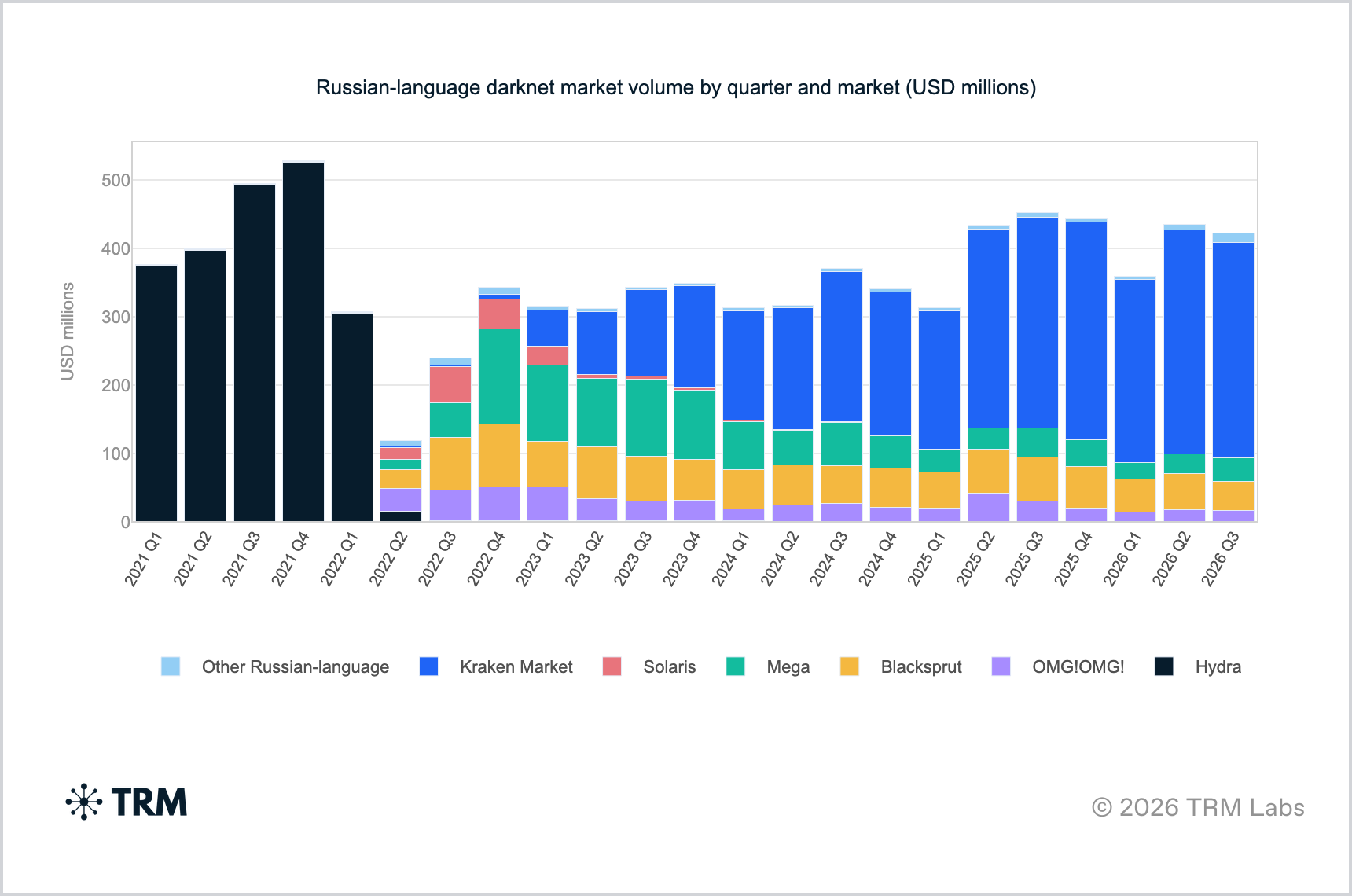
These enforcement actions are occurring in the context of a growing and robust darknet marketplace ecosystem. Russian-language markets received over USD 1.2 billion of the nearly USD 1.3 billion that darknet markets received from January through September 2026 (about 95%), up from about 90% in 2022, when Hydra closed. TRM’s 2026 Crypto Crime Report put darknet market receipts at USD 1.7 billion in 2025, with Russian-language markets above 90% of that total.
This analysis applies specifically to darknet markets only. TRM defines those as the Tor-based platforms centred on selling illicit drugs. It does not include independent drug vendor shops, so the totals are not a measure of all online drug activity.
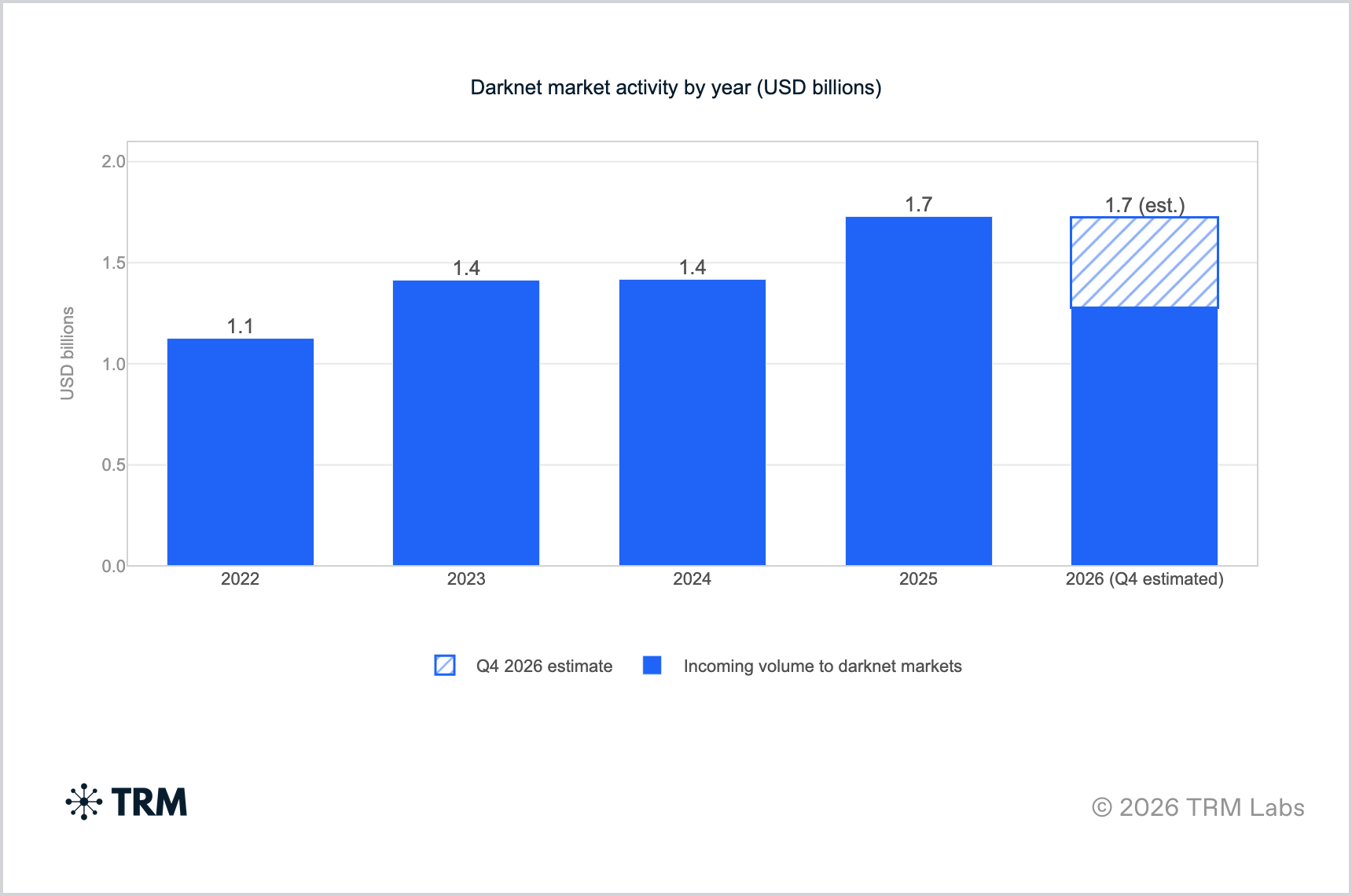
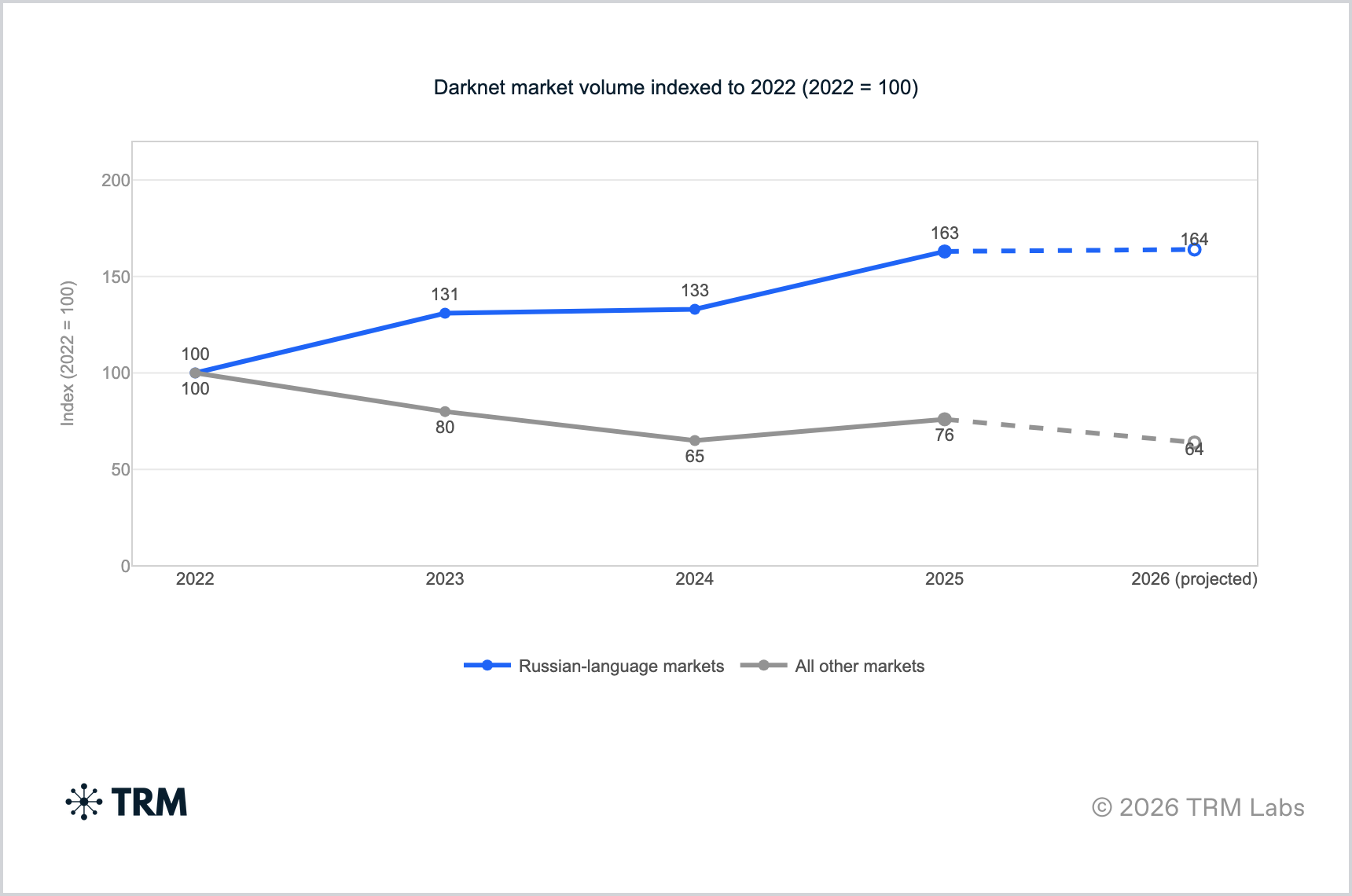
Total darknet market volume rose every year from USD 1.1 billion in 2022 to USD 1.7 billion in 2025 and is projected to be at about USD 1.7 billion in 2026, level with 2025. Russian-language volume has risen every year since 2022, from about USD 1 billion to over USD 1.6 billion in 2025, and 2026 is projected slightly above 2025. While growth has slowed, Russian-language volume still rose 22% in 2025 and is projected to rise about 1% in 2026. The first half of 2026 was up 6% on a year earlier, and the third quarter was down 7%.
One reason Russian-language marketplaces have grown since 2022 is a high-frequency, efficient delivery system known as dead drops, in which a vendor hides a package in a public place and reveals the location after payment. TRM research has found that dead drops can complete within minutes, while mail deliveries generally take several days, and that the model is faster growing and harder to contain than postal delivery.
Kraken Market is the largest darknet market currently operating, Russian-language or Western, and it accounts for about three-quarters of Russian-language volume today. After Hydra closed, vendors and buyers migrated to Blacksprut, Mega, and OMG!OMG!, a pattern TRM documented in December 2022, allowing the ecosystem to survive and continue growing. Kraken Market launched that month, touted by the community as Hydra's successor, and now receives over 70% of darknet market volume, making it the largest darknet market operating in either the Russian-language or Western ecosystem.
Kraken Market activity has not moved
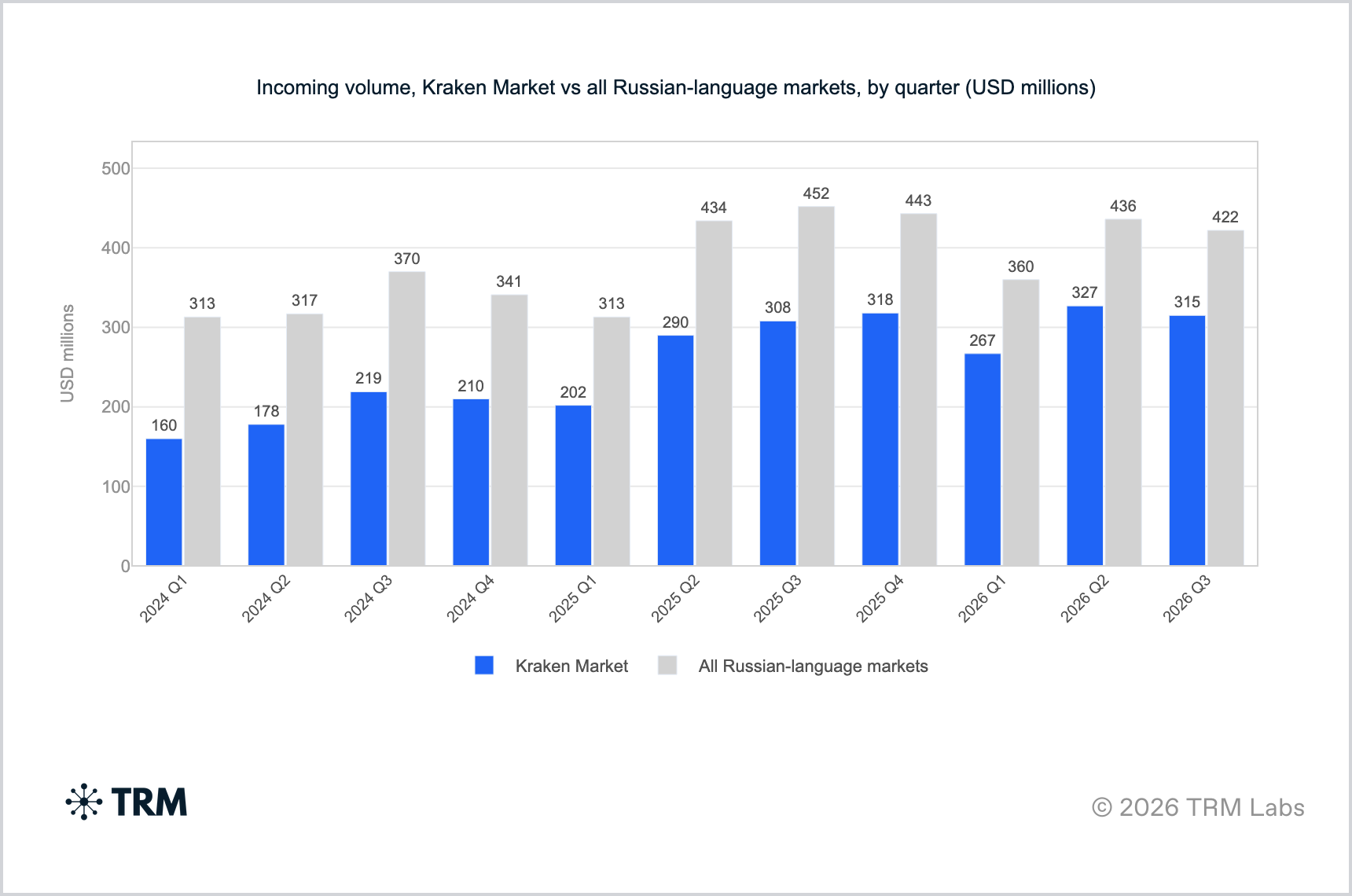
Although Russian prosecutions escalated in 2026, Kraken Market’s volume did not change in the quarters that include the court cases. It received nearly USD 320 million in the third quarter of 2026, within 4% of both the second quarter and the third quarter of 2025. All Russian-language markets together were also within 4% of the second quarter, at about USD 420 million against about USD 440 million. Daily data shows the same pattern. Kraken Market averaged about USD 3.5 million a day in August, when Moscow City Court extended the detentions, and about USD 3.4 million a day from September 19 through October 18. This continued activity makes sense because no market has been shut down as of yet. The defendants are Hydra’s alleged creators, whose market closed in 2022, and people connected to the WayAway forum, so Kraken Market and the other large markets remain online.
What to watch
Darknet marketplaces first surged in the West, and repeated law enforcement takedowns, including Silk Road in 2013 and AlphaBay and Hansa in 2017, followed. Russian-language marketplaces have since grown every year without a comparable law enforcement focus. Russian prosecutions of Hydra-linked figures have escalated since 2024, and TRM will watch whether they reach a market that is still operating. Detentions in the Kraken and WayAway case run to late November, and Kommersant reports that four cases are heading to court.
TRM will update this analysis if Russian-language market volume changes. To see how TRM tracks darknet market activity and attributes the entities behind it, contact the TRM team.
{{horizontal-line}}
Frequently asked questions (FAQs)
1. What share of darknet market volume is Russian-language?
Russian-language markets received about 95% of darknet market volume from January through September 2026 (over USD 1.2 billion of nearly USD 1.3 billion), compared with about 90% in 2022. These shares do not include Monero.
2. What happened to Hydra’s volume after the 2022 takedown?
Vendors and buyers moved to Blacksprut, Mega, and OMG!OMG!, which received most of the volume in 2022. Kraken Market, which launched in December 2022, then grew to over USD 1.1 billion in 2025 and received over 70% of darknet market volume in 2026 through September.
3. Are Russian-language darknet markets declining?
No. Kraken Market’s second quarter of 2026 (about USD 330 million) was its highest quarter to date, and the third quarter was nearly USD 320 million. All Russian-language markets together received about USD 420 million in the third quarter, 3% below the second quarter.
4. Why do Russian-language darknet markets keep receiving this much volume?
One reason is high-frequency delivery through dead drops, which can complete within minutes, together with frequent small purchases: the average incoming transfer was about USD 150 in 2026, and transfers rose about 50% in 2025. Volume rose 22% in 2025 and is projected to rise about 1% in 2026.
5. Did the 2026 Russian court activity change onchain volume?
Not through the third quarter of 2026. Kraken Market received nearly USD 320 million in the third quarter, within 4% of both the second quarter and the third quarter of 2025.
6. Which Russian-language market is largest?
Kraken Market. It received over USD 900 million from January through September 2026, against about USD 140 million for Blacksprut, about USD 90 million for Mega, and about USD 50 million for OMG!OMG!.
7. Do these figures include vendor shops or other online drug activity?
No. This analysis covers darknet markets only, which TRM defines as the Tor-based platforms centred on selling illicit drugs. It does not include independent drug vendor shops, so the totals do not measure all online drug activity. It also does not include Monero.