The TOP Takeover: Tornado Cash’s Latest Chapter

Key takeaways
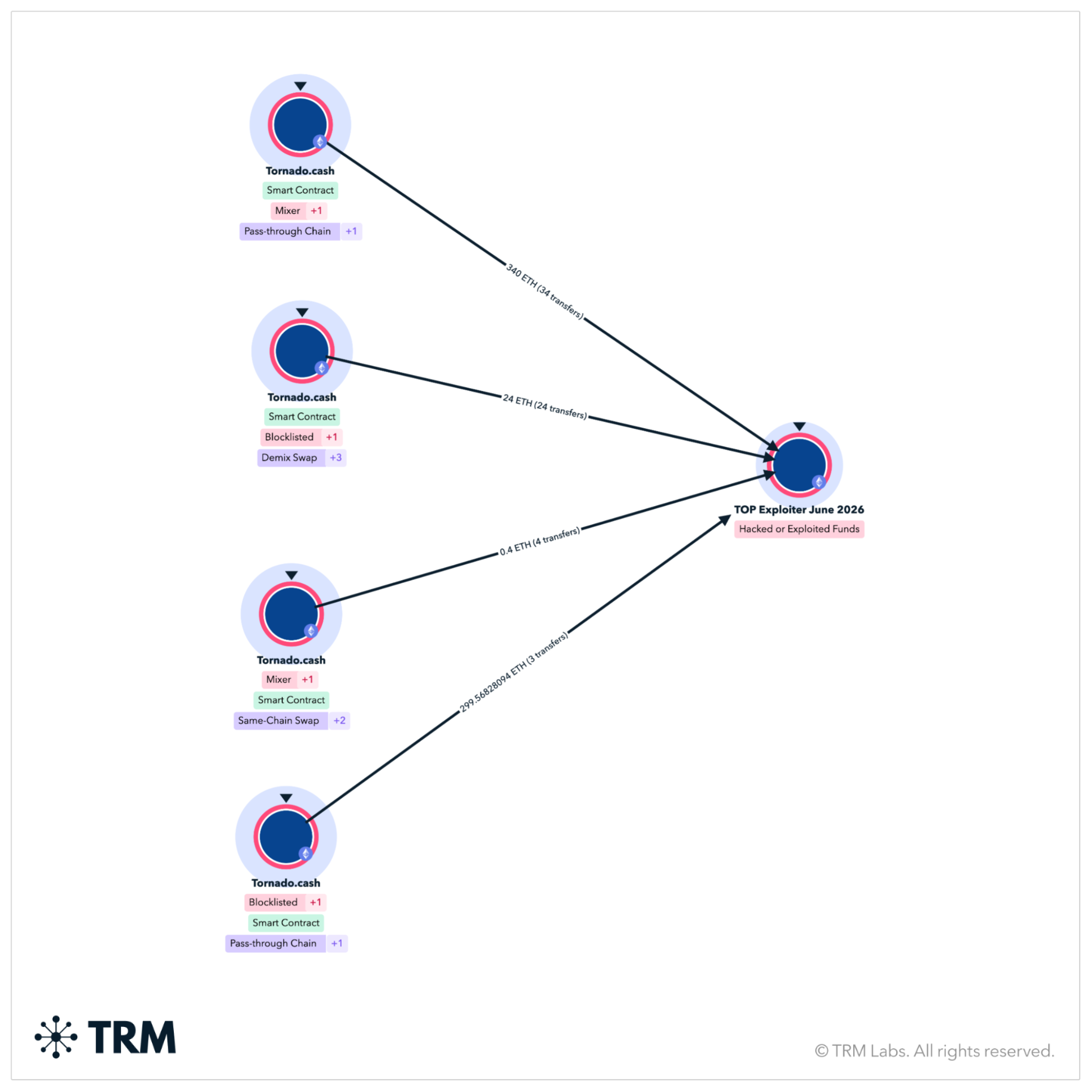
- On June 9, 2026, an attacker withdrew roughly 664 ETH — approximately USD 2.7 million — from Tornado Cash and used those funds to seize majority control of TOP, a decentralized trade-settlement protocol on Ethereum, minting new tokens and selling them for roughly USD 1.6 million in proceeds, more than a year after OFAC delisted Tornado cash addresses from its sanctions list.
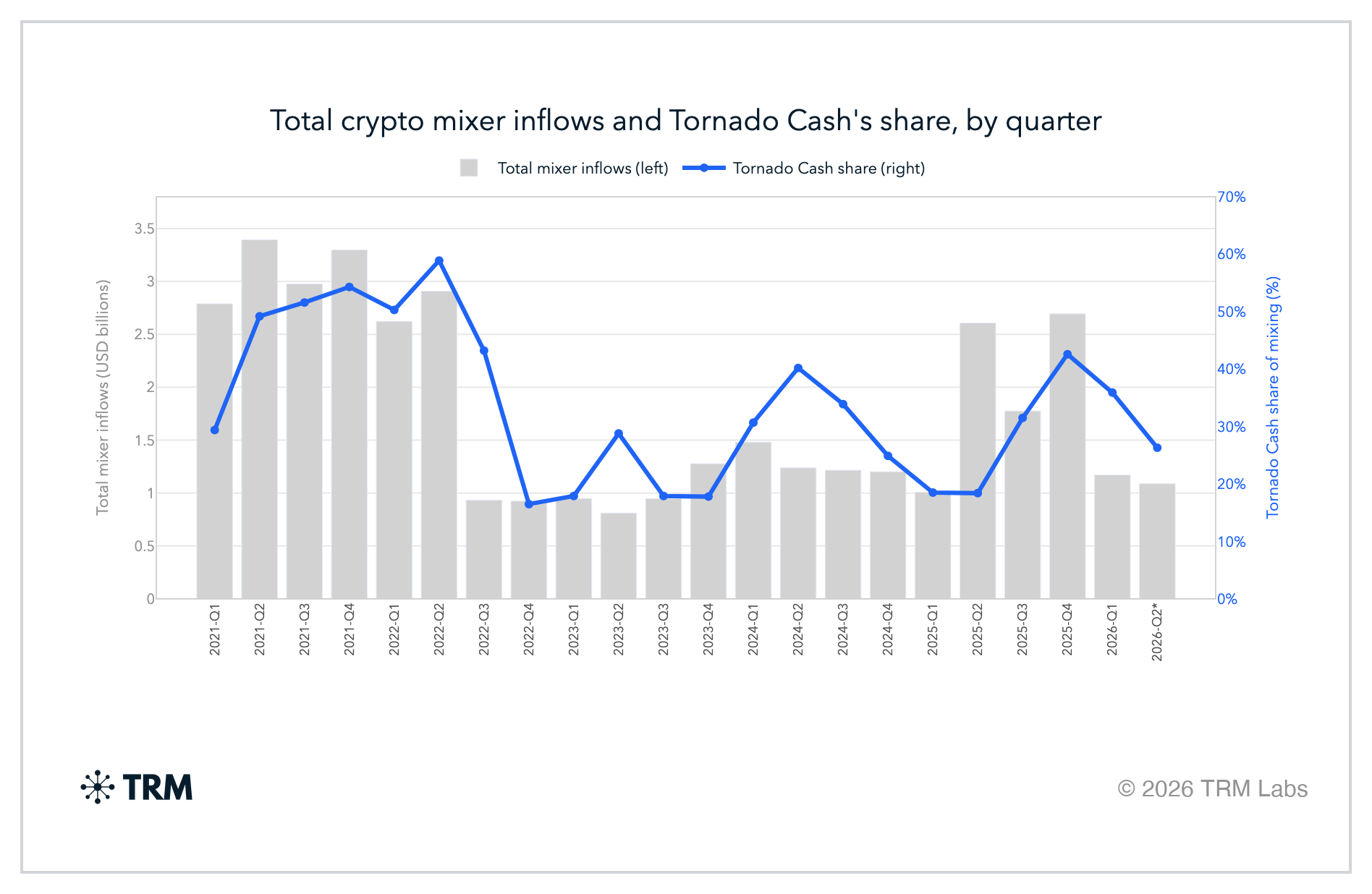
- Before sanctions, Tornado Cash accounted for roughly half of all crypto mixing across blockchains, peaking near 59% in the second quarter of 2022. Its share collapsed to about 16% after the August 2022 designation, then recovered to more than 40% by late 2025.
- The TOP takeover follows a recoverable, end-to-end on-chain pattern. A Tornado Cash withdrawal becomes seed capital, seed capital becomes a governance majority, the majority votes to mint protocol tokens, and the minted tokens are swapped for profit.
- Mixer-origin funds remain a risk signal for governance-layer attacks and stay traceable through time-bound attribution, regardless of a mixer's current designation status.
{{horizontal-line}}
What happened
On June 9, 2026, an attacker withdrew roughly 664 ETH — approximately USD 2.7 million — from Tornado Cash and used those funds to seize majority control of TOP, a decentralized trade-settlement protocol on Ethereum, minting new tokens and selling them for roughly USD 1.6 million in proceeds. TRM traced the full sequence on-chain from the mixer withdrawals to the exploit proceeds.
To understand why that matters, it is necessary to understand the history of Tornado Cash itself — one of the most legally contested, operationally persistent, and analytically complex subjects in crypto over the last four years.
Background: Tornado Cash and the sanctions debate
Tornado Cash is an Ethereum-based mixing protocol, first deployed in 2019, that breaks the on-chain link between the source of funds and their destination. Users deposit ETH into a smart contract pool and withdraw equivalent amounts to a different address. The core pool contracts are immutable. Once deployed, no individual or organization can alter, pause, or redirect them.
While used by lawful actors for an array of activities where on-chain privacy is essential, by mid-2022, the protocol had received more than USD 7 billion in lifetime deposits and accounted for close to half of all crypto mixing across blockchains, with documented use by ransomware actors, cybercriminals, and North Korea's Lazarus Group.
OFAC added Tornado Cash to its Specially Designated Nationals (SDN) list in August 2022 under Executive Order 13694 — the first time the US government sanctioned open-source software rather than a person or entity. The designation was immediately contested. Critics argued it exceeded OFAC's statutory authority. Roman Storm and Roman Semenov were indicted in 2023 on money laundering and sanctions violations charges for their roles in developing the protocol. Bad actors began "dusting" — sending small amounts of Tornado Cash-tainted funds to prominent wallets to expose the compliance implications of a designation that could make innocent recipients technically non-compliant.
The Fifth Circuit ruled in Van Loon v. Department of the Treasury in November 2024 that immutable smart contracts are not "property" under the relevant statute and that OFAC had exceeded its authority. Treasury removed Tornado Cash from its sanctions list on March 21, 2025.
The criminal prosecutions proceeded on separate legal theories. As of June 2026, the protocol is not designated and its developers are still in the midst of protracted criminal proceedings. While the policy questions around developer liability and sanctions authority over decentralized software remain unresolved, Tornado Cash remains one of the most active mixing protocols on Ethereum.
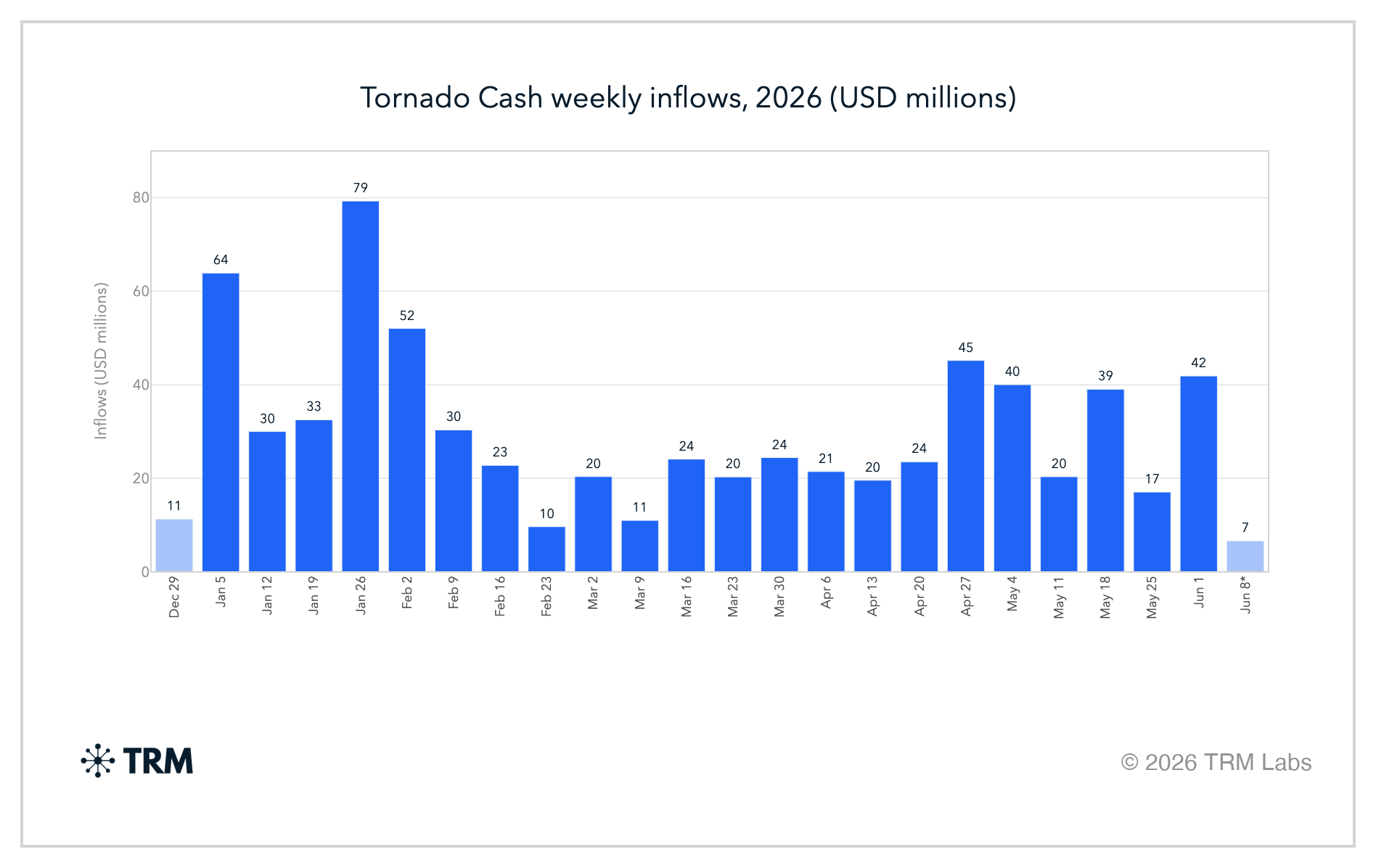
Tornado Cash received over USD 700 million in 2026 YTD
When OFAC sanctioned Tornado Cash addresses in August 2022, Tornado Cash’s share of mixing collapsed to about 16%. However, the mixer recovered to more than 40% by the fourth quarter of 2025. In 2026, Tornado Cash has captured just over 20% of all mixer activity and remains the largest mixer on Ethereum-based networks, with between USD 10 million and USD 80 million in total weekly inflows.
Putting Tornado Cash activity into perspective, total inflows to mixers across all blockchains ran above USD 3 billion per quarter through 2021, then fell to roughly USD 1 billion per quarter for much of 2023 and 2024, and climbed back toward USD 2.7 billion per quarter in 2025. Although Wasabi led mixers by value received in 2026 year-to-date, Tornado Cash remained the second-largest mixer overall and the largest on Ethereum-based networks.
The TOP governance takeover
TOP is a small Ethereum-based token with a total supply of just 16,384, governed through an Aragon DAO with voting power proportional to holdings. An address that accumulates a majority of the supply controls the outcome of any vote outright. TOP traded against WETH in a Balancer V1 liquidity pool. Its governance had no timelock — a passed proposal could be created, voted through, and executed in a single transaction, with no window for review or challenge.
With 664 ETH of Tornado Cash-withdrawn funds as seed capital, the attacker bought a governance majority, passed a proposal to mint new TOP tokens to a wallet it controlled, and sold those tokens into the decentralized exchange liquidity pool for roughly USD 1.6 million in proceeds. The entire sequence is on-chain. The takeover was the governance design working as written, in the hands of a single majority holder. The absence of a timelock made it executable in a single block, with no opportunity to identify or contest the malicious proposal before execution.
How TRM traces through ttornado Cash
Attackers use Tornado Cash in part because they believe the funds become untraceable.However, TRM tracks mixer-obscured flows through demixing, behavioral and timing correlation, anonymity-set analysis, and off-ramp identification. Funds withdrawn from Tornado Cash carry their exposure forward — traced and risk-flagged as they move downstream, regardless of the protocol's current legal status.
TRM has applied these methods in cases that reached a court-ready evidence standard, including the trace of the USD 190 million Nomad bridge attack and the investigation underlying the first-ever conviction for a smart contract hack in the Nirvana Finance case.
What this means for investigators and compliance teams
When funds withdrawn from Tornado Cash begin accumulating a governance majority in a token protocol, the conditions for a takeover are already in place before any malicious transaction executes. The TOP attack illustrates the full sequence — withdrawal, governance majority, minted tokens, profit — with each step recorded on-chain and traceable. Compliance and AML teams at exchanges and DeFi platforms can use that signal in their monitoring: a concentration of mixer-origin holdings against a protocol's voting supply is observable before it is exercised.
{{jhorizontal-line}}
Frequently asked questions (FAQs)
1. Is Tornado Cash still sanctioned?
No. OFAC designated Tornado Cash in August 2022. It remained on the sanctions list until March 21, 2025, when Treasury delisted it following the Fifth Circuit's November 2024 ruling in Van Loon v. Department of the Treasury. As of June 2026, Tornado Cash is not designated.
2. What share of crypto mixing does Tornado Cash account for?
Before the August 2022 sanctions, Tornado Cash made up close to half of all crypto mixing across blockchains, peaking near 59% in the second quarter of 2022. Its share fell to about 16% by the end of 2022, then recovered to more than 40% by the fourth quarter of 2025. In 2026, it captures just over 20% of all mixer activity.
3. Can funds sent through a mixer be traced?
Mixers complicate attribution but do not eliminate it. TRM recovers mixer-obscured flows through demixing, timing and behavioral correlation, anonymity-set analysis, and off-ramp identification, with recoverability depending on the strength of the underlying signals in a given case.
4. What is a governance takeover?
A governance takeover occurs when a single party acquires enough of a protocol's governance tokens to control its on-chain votes, then uses that majority to pass and execute proposals in its own interest — such as minting new tokens.
5. Was TOP's protocol at fault?
This analysis describes what the on-chain data shows and assigns no institutional fault. The sequence is presented as a documented pattern of attacker behavior.