Spokane Valley Police Detectives Find Answers for a Grieving Family


Spokane Valley Police Department


Problem
An imposter tech-support agent scammed Eric, a trusting caregiver who never missed a day of work, out of his life savings
Results
- Spokane Valley Police detectives followed the money and identified an entire fraud network
- Detectives back-traced to identify seven other scam victims, ultimately recovering and returning USD 225,000 to the victims
- As the agency's first crypto case, it helped develop new agency-wide capability
If you suspect you are a victim of a scam, report it to Chainabuse.
Eric Inaba was the kind of person other people built their memories around. He grew up in Pullman, Washington; loved the Chicago Bears; and spent his career caring for adults with disabilities at a residential home, work his family says was his calling.
"If anyone's going to remember anyone, they'll remember Eric, because he was so genuine," his younger sister, Christine, recalled. When Eric asked how you were doing, it was never a line. "He really wanted to know how you were."
Unfortunately, a scammer weaponized that same kindness and openness against Eric. "He was too trusting of people," his father, Fred Inaba, said. "I think that was his downfall."
In the fall of 2023, that trust cost Eric roughly USD 325,000 — nearly everything he had saved — when a scammer posing as tech support convinced him his money was in danger. He told no one. And before his family understood what was happening, Eric had taken his own life.
It all started with a fake Norton alert
The scam began around September 8, 2023, with a message claiming to be from Norton, the antivirus company. The premise of these tech-support scams is simple: your computer or your money is at risk, and you need to take immediate action to protect it.
Eric had dedicated his life to helping and serving others in his community, but he was not an expert with computers — like many people who are targeted by similar scams. When he saw the alert, he had no reason not to believe it was real. "It just wouldn't have been in his realm of knowledge," Christine said. "I don't really think he would have questioned it."
The scammer didn’t steal Eric's money straight away. He kept Eric on the line for weeks, and phone records would later show roughly 321 separate communications between Eric and a single suspect operating under the name David Wells. Under that pressure, Eric began withdrawing cash late at night and converting it into bitcoin, telling no one.
"He never told us about his ATM withdrawals," Fred said. "He would do it late at night. He would go to the ATM and withdraw $10,000, $15,000, $20,000." The family only pieced it together afterward, from bank statements. "He must have been under tremendous stress to be doing these things in the middle of the night," Fred said.
When Eric didn't show up for work
The first sign that something was wrong was when Eric — a person with a track record of perfect attendance — didn’t show up for work. On November 1, 2023, patrol responded to a welfare check at his Spokane Valley apartment. An officer made entry and found Eric deceased inside.
The case went to Detective Michael Drapeau, a major crimes detective with the Spokane County Sheriff's Office, who confirmed Eric's death was not a homicide. The money was another matter. When Detective Drapeau met with Eric's father, Fred told him that roughly USD 256,000 had been transferred out of Eric's accounts, most of it into bitcoin. Eric had also left a handwritten note referencing Norton.
Detective Drapeau called Spokane Valley Police Department’s Detective Ken Scott, who works in the property crimes unit and serves as the department's go-to for financial fraud.
Following the money to seven more victims
Eric's case was Detective Scott's first cryptocurrency investigation. "I knew how to follow money, but my investigative skills when it came to cryptocurrency were really new," he said. He reached out to TRM, working alongside Senior Global Investigator Casey Dougherty on the initial trace.
Detective Scott started by writing search warrants to every financial institution Eric might have touched, then followed the money onto the blockchain. He found USD 325,000 had moved into bitcoin, even more than the family had initially thought. Using TRM Forensics, Detective Scott traced USD 238,000 of those stolen funds to two major cryptocurrency exchange accounts.
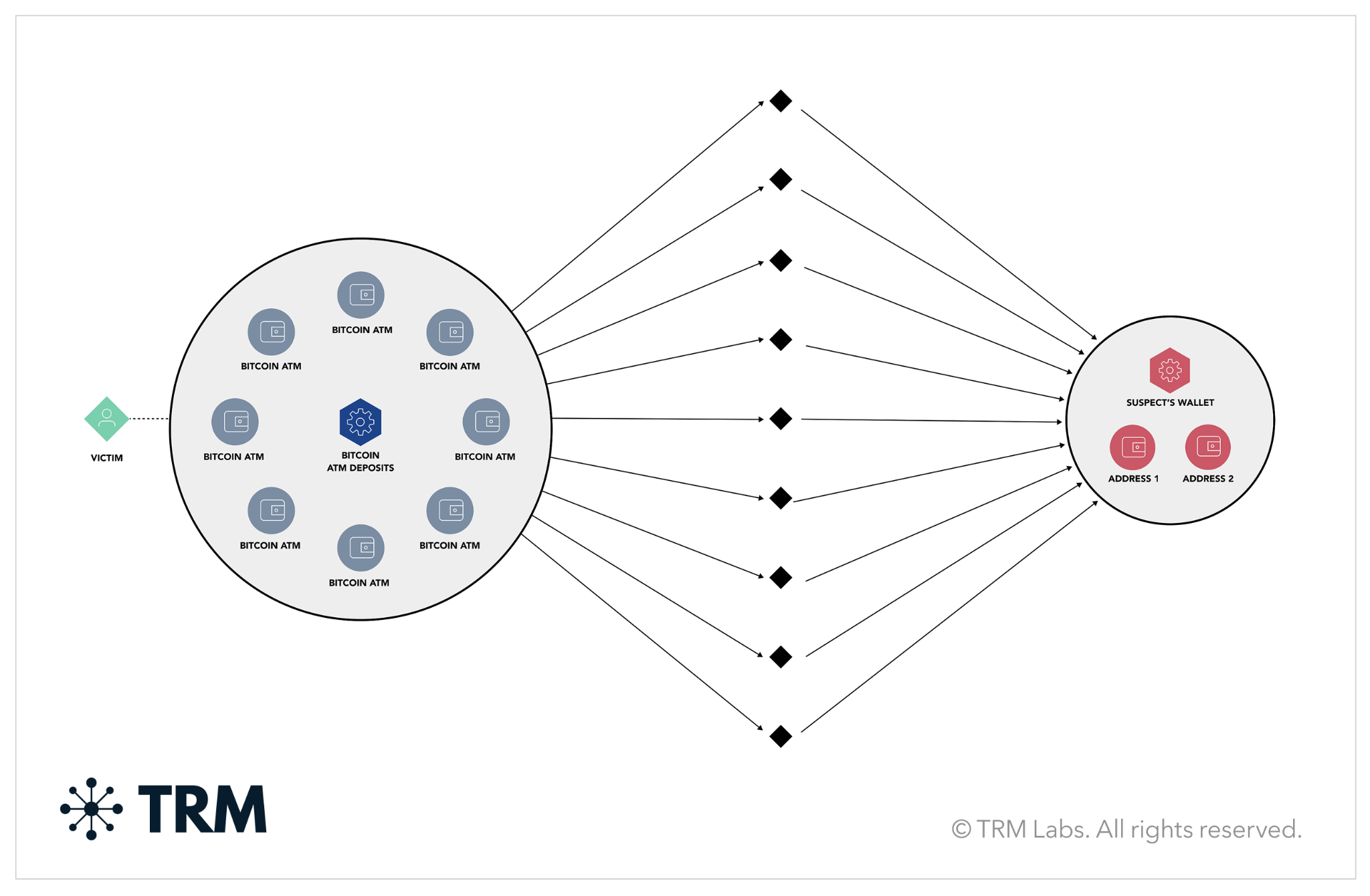
Seeing the money move on the blockchain was a revelation for Detective Scott. The graph he built showed him the full path of the funds with a degree of transparency he hadn’t seen in fiat investigations. "With cryptocurrency, you can see the other side of these transactions in real time," he said.
The trail didn’t end with Eric. Working backward from the two exchange accounts, Detective Scott traced the money to several cash-to-crypto ATMs. He wrote search warrants to those ATM operators to find out who else had been feeding money into them and discovered seven other victims across the United States who had been sending money to the same destination addresses.
When Detective Scott cross-referenced this information with local agencies and the FBI, the pattern held: nearly all seven of them had been hit with the same Norton tech-support scam, and the same suspect's phone number kept reappearing. "There were hundreds of communications between Eric and the suspect," Detective Scott said. "That was a common theme through all the victims we identified."
Seeking restitution for the victims
"When I learned that this case was about a suicide, I knew that this case wasn't about tracing assets. It was about getting answers for Eric's father and the rest of the family," said Detective Scott. Through this investigation, he was able to recover and return USD 225,000 to the other victims. "Most of these people lose everything they have," he said. "If there's anything I can do for them, it's to restore their financial life."
"When Detective Scott told me they could recover some of the money, the first thing that came to my mind was that if Eric had known this could happen, he probably would not have ended his life," Fred said. "There would have been some hope for him."
Christine said the detectives never overpromised. "They just wanted to make sure we weren't expecting the impossible," she said. "I appreciate all the work they put into this, because I also know it wasn't easy."
The case took about a year from the first call to final payment. And what Detective Scott learned from the investigation became the foundation for a unit-wide capability. Today, property crimes investigators across Spokane County work crypto cases. "The goal is that everybody in our agency, whether it's the Spokane County Sheriff’s Office or the Spokane Valley Police Department, knows what to do with a financial crime," Detective Scott explained.
Breaking the silence scammers count on
Unfortunately, there is stigma around reporting scams, due to a fear of judgement or victim-blaming. But the tactics these scammers use are sophisticated, convincing, and highly manipulative. Speaking up is critical for quickly identifying scam organizations and sparing victims further harm.
Detective Scott points to three red flags to pay attention to:
- Unexpected messages telling you to call a number or act fast because an account is frozen
- Outreach asking you to pay a bill in cryptocurrency
- Communications that prey on your emotions or give you the sense that the person on the other end is trying to induce fear
His advice is to step outside the conversation: "You need to get a disinterested person — your bank, law enforcement, your family — and talk to them about what’s going on."
Fred's advice is born of what it cost his family. "Tell your loved one. Even though you may feel you're letting them down, they love you, and they know they can help you."
Detective Drapeau, echoed Fred’s message: “We're not going to judge you, and it can happen to anyone — so report it,” he said. “[Eric] was a genuinely nice guy who felt he was in a place he couldn't come back from. I wish he had reached out to someone."
Nothing can bring Eric back. But Detective Scott and Detective Drapeau’s efforts answered the question that haunted Eric’s father most — where the money went, and who took it — and spared seven other families the same pain. That, Detective Drapeau said, is the work: speaking for those who can no longer speak for themselves.
{{horizontal-line}}
If you or someone you know is struggling or in crisis, help is available. In the US, call or text 988 to reach the Suicide and Crisis Lifeline, available 24 hours a day, seven days a week.
Ready to get started?
Fill out the form to schedule a demo with our team.


