5 min
Who’s Actually Paying? Measuring AI Agent Payments Onchain
x402 is the most widely used agent-payment rail, but most of its volume is not agentic — and much of it isn't commerce
Four emerging standards aim to make it easier for AI agents to pay for goods and services:
- Google’s AP2 provides a framework for verifying that an agent’s purchases are authorized by a user.
- OpenAI and Stripe’s ACP connects AI assistants to merchants so users can complete purchases within a conversation.
- Stripe and Tempo’s MPP enables machine-to-machine payments for services such as APIs and inference.
- x402 makes payment part of a web request, allowing software to pay for a resource through an on-chain transaction.
Across Base, Solana, and Polygon, TRM identified roughly USD 52.7 million across 198.9 million settlement transactions mediated by known x402 facilitators since May 2025. It is both the most widely adopted of the four, and the one whose full volume is directly visible on-chain.
That observable payment trail lets us move beyond the promise of agentic commerce and examine what is actually happening: how much activity looks like true commerce, what buyers are paying for, and how much appears to come from agents rather than ordinary automation. Those are the questions this analysis sets out to answer.
How x402 works
x402 revives the dormant HTTP 402 Payment Required status code as a real payment step. A buyer requests a resource; the server answers 402 with a price; the buyer retries with a signed authorization. A facilitator then verifies it and broadcasts the settlement on-chain, paying the gas.
Rather than sending a person through checkout, the payment becomes part of the software’s request. Most endpoints operate on a pay-per-call basis, though some support batched purchases settled through a single payment.

Most x402 volume is not agentic
x402 was designed for agentic commerce, but nothing in the protocol requires an agent. Anyone who writes a script can drive the same 402 sequence, and it leaves an identical onchain record. Scheduled jobs, load tests, self-dealing, and ordinary automation all look the same as an agent from the chain's point of view. So a headline number that sizes x402 tells you how much moved through the protocol, but not how much is agentic.
To start to estimate agentic volume, we start with three screens that separate likely commerce from the rest. We start with all funds settled through known x402 facilitators since May 2025, roughly USD 52.7 million across 198.9 million settlement transactions. Then remove addresses paying themselves, remove bulk flows from one or two payers, and remove sellers with fewer than ten distinct buyers. The last two are anomaly screens — they strip concentrated or thin-traffic flows.
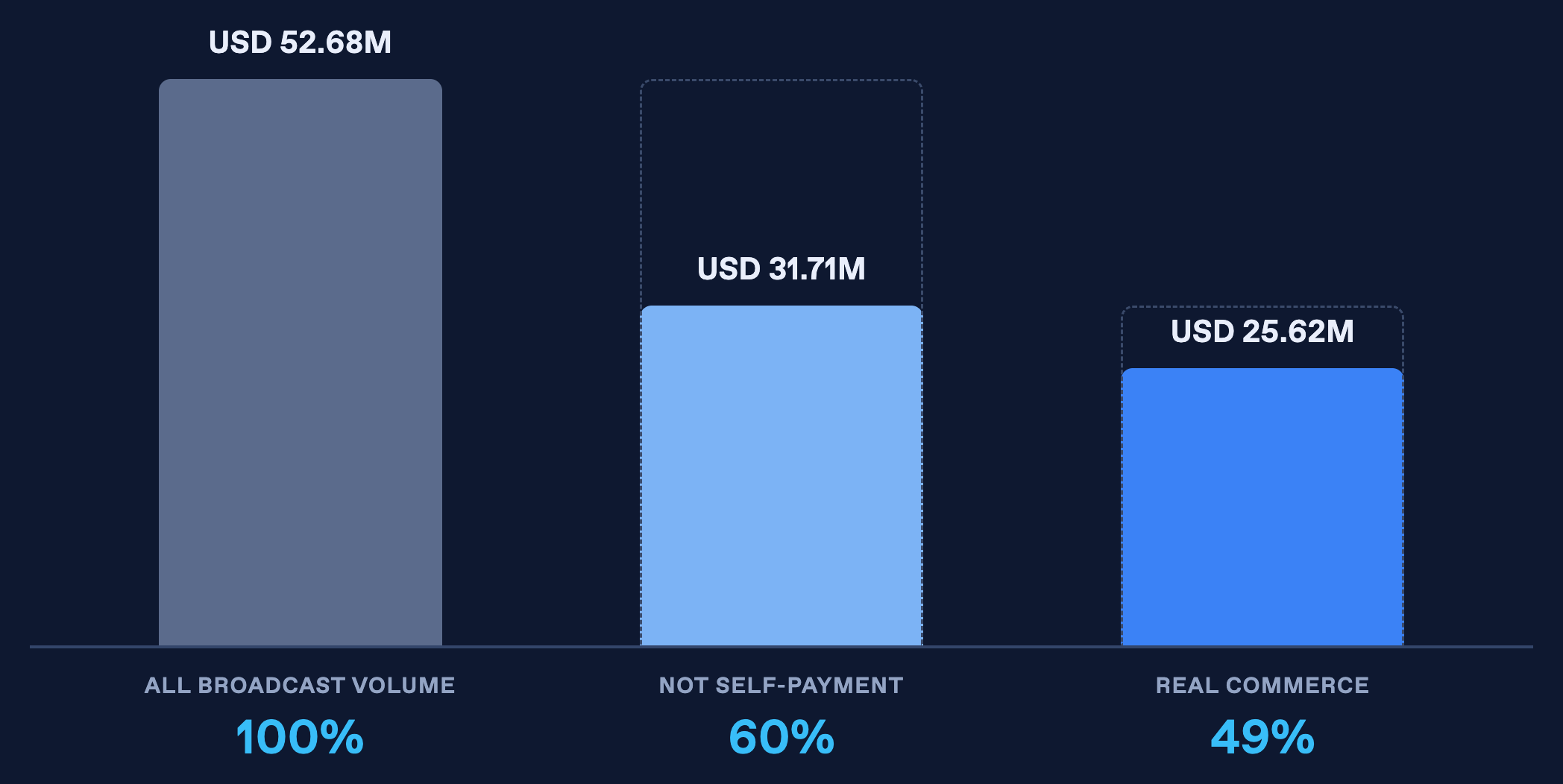
Then comes the harder question: How much of that is an agent? Agency cannot be read off a transaction, because a scheduled script and an agent produce the same record.
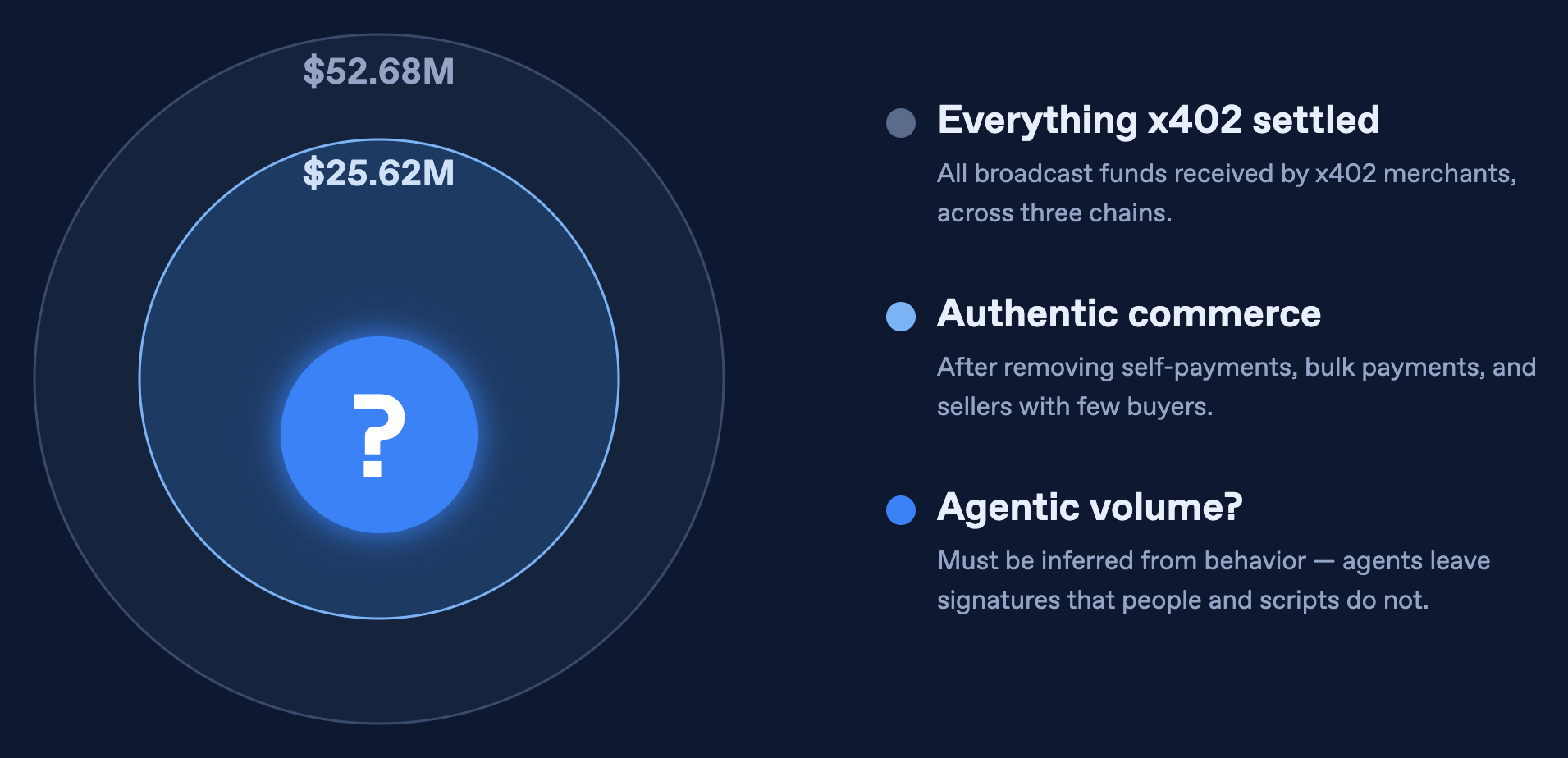
Rather than assert a single figure, we bound it — a permissive test that counts anything that plausibly could be an agent, and a strict test that requires a higher evidence standard.
The permissive model counts any payer that could plausibly be an agent. The payment was broadcast by a facilitator, the amounts were sub-dollar on average, and they varied rather than repeating a fixed price. The strict test keeps only those that also sustained the pattern across months and either registered in a public agent registry (ERC-8004) or paid more than one seller.
Applied to the USD 25.62 million of screened x402 commerce, the two tests put the share that appears to be agentic at between 0.6% and 7.5%. Price variation significantly limits the agentic population. The assumption is that a true agent explores across multiple services and products, while an address repeating the same price behaves more like a script hitting one service over and over. This is a deliberate modeling choice, and it may understate the space: many agents today could be single-purpose, paying one service repeatedly, which this test would read as a script.
What x402 commerce looks like — and how it has shifted
We grouped identifiable merchants by primary function: AI and agent services, financial services, data and developer APIs, and speculative token mints. Tracking the mix month over month, we see the composition of x402 commerce has shifted drastically across the year.
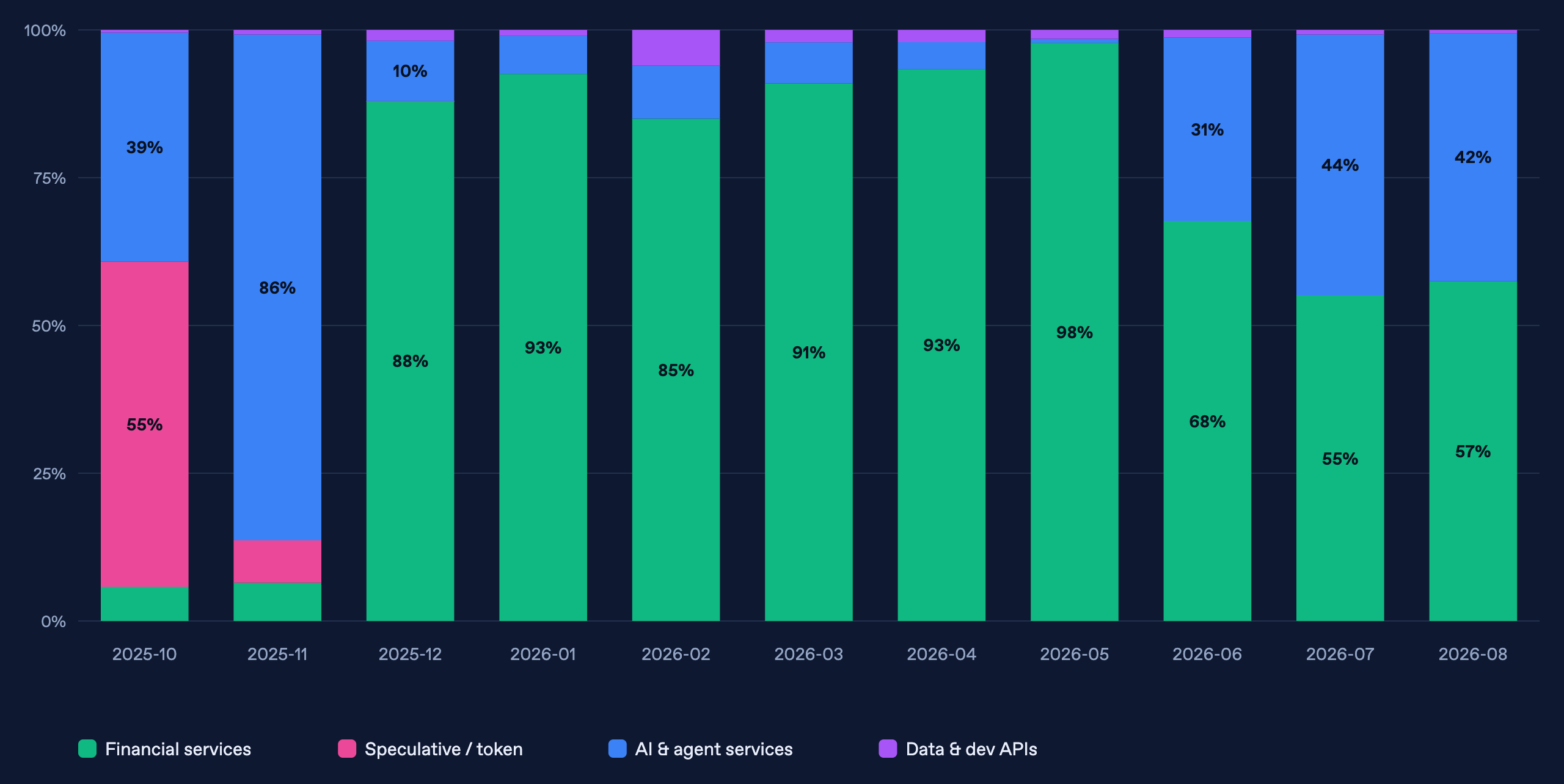
In late 2025, the volume was speculation, much of it consistent with meme-token minting, alongside a burst of activity to a single AI-analysis service. Through the first half of 2026, the volume concentrated heavily in a single payment contract rather than a broad set of merchants. In mid-2026, AI and agent services returned, this time flowing through an agent-payment router rather than a single storefront.
Nearly all of it settles in one asset
x402 value is overwhelmingly denominated in a single stablecoin. Across the full period, on a test that placed no constraint on the asset, USD 52.47 million of USD 52.68 million (99.6%) settled in USDC, and nearly every merchant in the catalog names USDC as the asset it wants to receive. The agent-payment economy on public rails is, today, a stablecoin economy.
Why attribution breaks when an agent is the payer
The x402 protocol wasn’t built to answer, "Who is responsible for this payment?" It was built to make payment infrastructure more accessible.
- Ownership claims are unverified. On-chain agent registries let individuals declare ownership of an agent address. However, this declaration is voluntary and currently not utilized by the majority of participants.
- No human approves the payment. The agent signs and a facilitator broadcasts, with no review in between. Controls that assume a human decision — a confirmation step, a hold, a review queue — have nowhere to sit.
- Value and volume decouple. These payments sit below nearly every value threshold and above nearly every count threshold at once, so controls calibrated for human-scale payments miss them from both directions.
The future, and the risks
The dollars are small today, but the participant count isn’t. The number of agents transacting on x402 has been volatile through 2026 — rising in the spring to a mid-year peak, then falling back — while the volume they move has stayed small, roughly USD 5,000–11,000 a month.
For a merchant, the headline volume of an agent-payment channel is mostly not customers, and attracting agent traffic takes a different design. It needs to be machine-readable and have per-call pricing on an endpoint a buyer can discover without a human ever seeing the page.
The rail already works. What is needed is accurate registration, counterparty reputation an agent can check on its own, and monitoring built for volume rather than value. Agentic commerce will need agentic compliance.