Tackling Crypto Crime: 2023 Survey of Law Enforcement
The experiences of 300+ law enforcement professionals fighting crypto crime in 2023

Key takeaways
- Over 40% of law enforcement cases already involve cryptocurrency, with expectations to surpass 50% by 2027, signaling crypto crime’s mainstream status.
- Complex investigations and cross-chain obfuscation techniques are major challenges, with 73% of respondents citing novel obsfucation tactics as a top barrier.
- Access to blockchain analytics significantly improves investigative outcomes, with 87% of tool users calling them “very” or “extremely” important to success.
- Training and technology gaps persist at the state and local level, where only 11% of agencies reported using blockchain analytics tools, compared to 50%+ at the federal level.
- Public-private partnerships are critical, with 92% of respondents identifying collaboration with blockchain analytics providers and exchanges as key to solving cases.
{{premium-content_chapter-divider}}
Introduction
Once a niche outlier, crime involving cryptocurrency is fast becoming a core focus of law enforcement activity, according to a survey of over 300 US and international law enforcement professionals commissioned by TRM Labs.
Respondents estimated that more than 40% of offenses investigated by their agencies involved cryptocurrency, and expected that to rise to 51% by 2027.
Globally, the numbers speak for themselves: so far in 2023 at least $1.7 billion worth of crypto was stolen through hacks alone. Billions more were lost to a bewildering panoply of frauds and scams. Even the most serious crimes, such as terrorist financing, human trafficking and child sexual abuse, now also often involve cryptocurrencies – as did four of the 10 most prominent and high-profile cases handled by the US Internal Revenue Service (IRS) in 2023.
Investigations involving cryptocurrency present significant technological and personnel challenges for agencies, which increasingly encounter cases demanding detailed knowledge of blockchain technology. The good news is that law enforcement agencies are making unprecedented investments in training and tools. What’s more, eight out of 10 respondents said investigators were highly empowered by their organizations with the decision-making power to pursue cryptocurrency-related offenses.

The survey was conducted by an external polling company between October 18 and November 3, 2023. Respondents had a minimum of one year employment at their current law enforcement organization, and investigated or oversaw at least one criminal offense involving cryptocurrency in the past year. US law enforcement organizations made up 93% of respondents, with over half from federal agencies and the remainder from state, county and local agencies.
{{premium-content_chapter-divider}}
Crypto cases tend to be highly complex, costly to victims
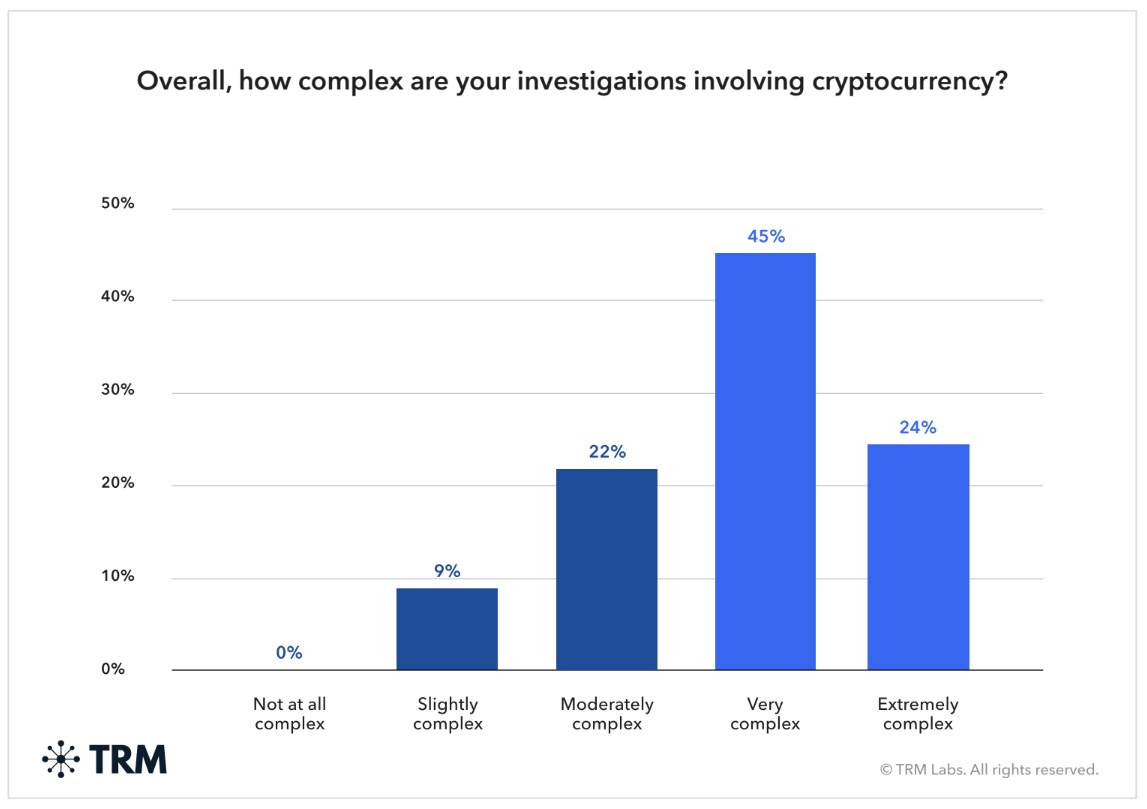
Seven in 10 investigators reported their crypto crime investigations as “very” or “extremely” complex. Yet as many as 60% of crypto investigations started off without an obvious crypto component. This shows the importance of training officers to spot and secure any evidence that could be relevant to a crypto investigation at the early stages of any case.
{{tackling-crypto-crime-2023-survey-of-law-enforcement-callout-1}}
According to survey respondents, individual crypto crimes involved an average of $295,000 in stolen funds.
{{premium-content_chapter-divider}}
Chain-hopping and privacy coins increasing threats
The types of crimes involving cryptocurrency are often familiar. Indeed, some 62% of investigators said that their crypto cases involved money laundering; 55% cited fraud, scams, phishing, and tax evasion. However, as criminals branch out beyond traditional cryptocurrencies and move assets across multiple blockchains, tracing the flow of stolen funds becomes ever more difficult, particularly if using tools that do not support cross-chain swaps.
Respondents named their top major challenges when conducting crypto investigations as dealing with novel obfuscation techniques (73%), tracking assets across blockchains (65%) and negotiating cases involving multiple jurisdictions (60%).
The cross-border aspect of cryptocurrencies can present added complexity for investigators, who must seek formal cooperation with their foreign counterparts before any case information can be shared. Requesting such mutual legal assistance (MLA) can be onerous and time consuming, a particular disadvantage in often fast-moving crypto cases.
{{premium-content_chapter-divider}}
Specialized tools and training provide key advantage to law enforcement
Over half of US federal agencies polled were found already to be using blockchain analytics tools. This matters because the correct equipment can make an enormous difference in achieving a successful outcome. Some 87% of blockchain analytics tool users described the tools as “very” or “extremely” important to successful investigation outcomes.

Nearly 50% of respondents who said they had the right tools viewed crypto investigations as actually easier than conventional ones. Training is also seen as highly important, with almost 90% of respondents saying their organizations provide some degree of training on crypto – either internally or externally.
Yet there is still progress to be made. As many as 61% of respondents said they lack sufficient tools and technology to support crypto investigations; 99% reported the need for more training. Furthermore, US state and local law enforcement agencies remain less well-resourced than federal ones, even though they are on the receiving end of the lion’s share of victim reports. While over half of federal agencies surveyed already use blockchain analytics tools for their investigations, that is the case for just 11% of state agencies surveyed.
{{premium-content_chapter-divider}}
Public-private partnerships are crucial to success
Despite the growing sophistication of criminals, respondents estimated over 60% of crypto investigations conducted by their organizations led to some positive outcome, including convictions and/or confiscation of stolen assets (though not all reported crypto cases are investigated).

Partnerships with the private sector – from blockchain analytics companies to major crypto exchanges – are seen as crucial to success by 92% of respondents; 64% have partnered with blockchain analytics companies to investigate crypto crime. Investigators viewed the largest exchanges as most helpful in collaborating with law enforcement on information sharing and freezing criminal funds.
{{tackling-crypto-crime-2023-survey-of-law-enforcement-callout-2}}
{{premium-content_chapter-divider}}
No turning back
Crypto crime is here to stay, and that demands a commensurate response. Those at state and federal law enforcement organizations expect more than half their investigations to involve crypto by 2027. To meet that challenge, 79% described investment in blockchain analytics as a “critical” or “high” priority.

Yet, not all these intentions have been translated into action. Over half of respondents identified the lack of investigators, expertise and funding as the top three obstacles that remain to be overcome for law enforcement to gain the upper hand in fighting crypto crime. The survey also revealed a training gap between federal agencies, where around two-thirds of staff handling crypto cases are specially trained, verses local ones, where the figure is less than half. Yet the overall trajectory is clear: survey respondents were in no doubt that fighting crypto crime has entered the mainstream.
{{premium-content_chapter-divider}}
Frequently asked questions (FAQs)
1. How much crypto crime are law enforcement agencies handling?
Law enforcement agencies reported that over 40% of their investigations involve crypto today, and they expect that number to rise to 51% by 2027. This shift underscores the growing need for dedicated crypto expertise within investigative teams.
2. What are the most common crypto-related crimes?
According to respondents, the most frequently encountered crypto crimes include money laundering (62%), fraud and scams (55%), phishing, and tax evasion. High-profile crimes such as terrorist financing and human trafficking also increasingly involve digital assets.
3. Why are crypto investigations so complex?
Nearly 70% of respondents described crypto investigations as “very” or “extremely” complex. Challenges include obfuscation tactics like chain hopping and privacy coins, multi-jurisdictional legal hurdles, and a lack of initial crypto indicators in many cases.
4. What tools do law enforcement agencies use for crypto crime?
Blockchain analytics tools are increasingly used, especially at the federal level, where more than half of agencies employ them. Among users, 87% said the tools were essential to achieving successful investigative outcomes.
5. Do law enforcement agencies have the training they need?
Not yet. Although nearly 90% of agencies offer some form of crypto training, 99% of respondents said more is needed. Federal agencies are further ahead, with two-thirds of crypto investigators trained, compared to less than half at the local level.
6. What is chain hopping, and why does it matter in investigations?
Chain hopping refers to the act of moving crypto across multiple blockchains to evade detection. This tactic complicates tracing efforts — especially when using tools that don’t support cross-chain analytics — and was cited as a top investigative challenge by 65% of respondents.
7. How important are public-private partnerships in fighting crypto crime?
Extremely important. 92% of respondents rated public-private partnerships as crucial to investigative success. Exchanges and analytics firms were named as the most helpful private sector collaborators for tracing funds and freezing assets.
8. What are the biggest barriers to fighting crypto crime?
Top obstacles include lack of trained investigators, insufficient tools and funding, and a persistent technology gap between federal and local agencies. Despite these challenges, the majority of law enforcement is prioritizing investment in crypto capabilities.
9. Are crypto crimes being successfully prosecuted?
Yes, to a meaningful extent. Over 60% of crypto-related investigations result in a positive outcome, such as a conviction or asset seizure. However, not all reported cases are actively pursued due to resource limitations.
{{premium-content_chapter-divider}}
About TRM Labs
TRM Labs provides blockchain analytics solutions to help law enforcement and national security agencies, financial institutions, and cryptocurrency businesses detect, investigate, and disrupt crypto-related fraud and financial crime. TRM’s blockchain intelligence platform includes solutions to trace the source and destination of funds, identify illicit activity, build cases, and construct an operating picture of threats. TRM is trusted by leading agencies and businesses worldwide who rely on TRM to enable a safer, more secure crypto ecosystem.
TRM is based in San Francisco, CA, and is hiring across engineering, product, sales, and data science. To learn more, visit www.trmlabs.com.




.svg)

.png)


