DEA and Federal Prosecutors Seize $5.5 Million Linked to Cartel Money Laundering Scheme

Last year, federal prosecutors in the Eastern District of Wisconsin filed a civil forfeiture complaint seeking the seizure of more than USD 5.5 million in USDT alleged to be the proceeds of large-scale international narcotics trafficking. The assets, held across multiple cryptocurrency wallets, were traced through an extensive Drug Enforcement Administration (DEA) investigation that combined undercover operations, confidential sources, and blockchain analytics.
TRM Labs is proud to have supported the DEA in this investigation.
The complaint, filed on November 20, 2024, provides a rare, detailed look at the architecture of a professional money laundering network servicing cartel-linked drug trafficking organizations. It reveals how these networks blend bulk cash pickups, traditional banking, and high-speed cryptocurrency transactions to move illicit proceeds through multiple layers designed to conceal their origin.
How the Scheme Operated
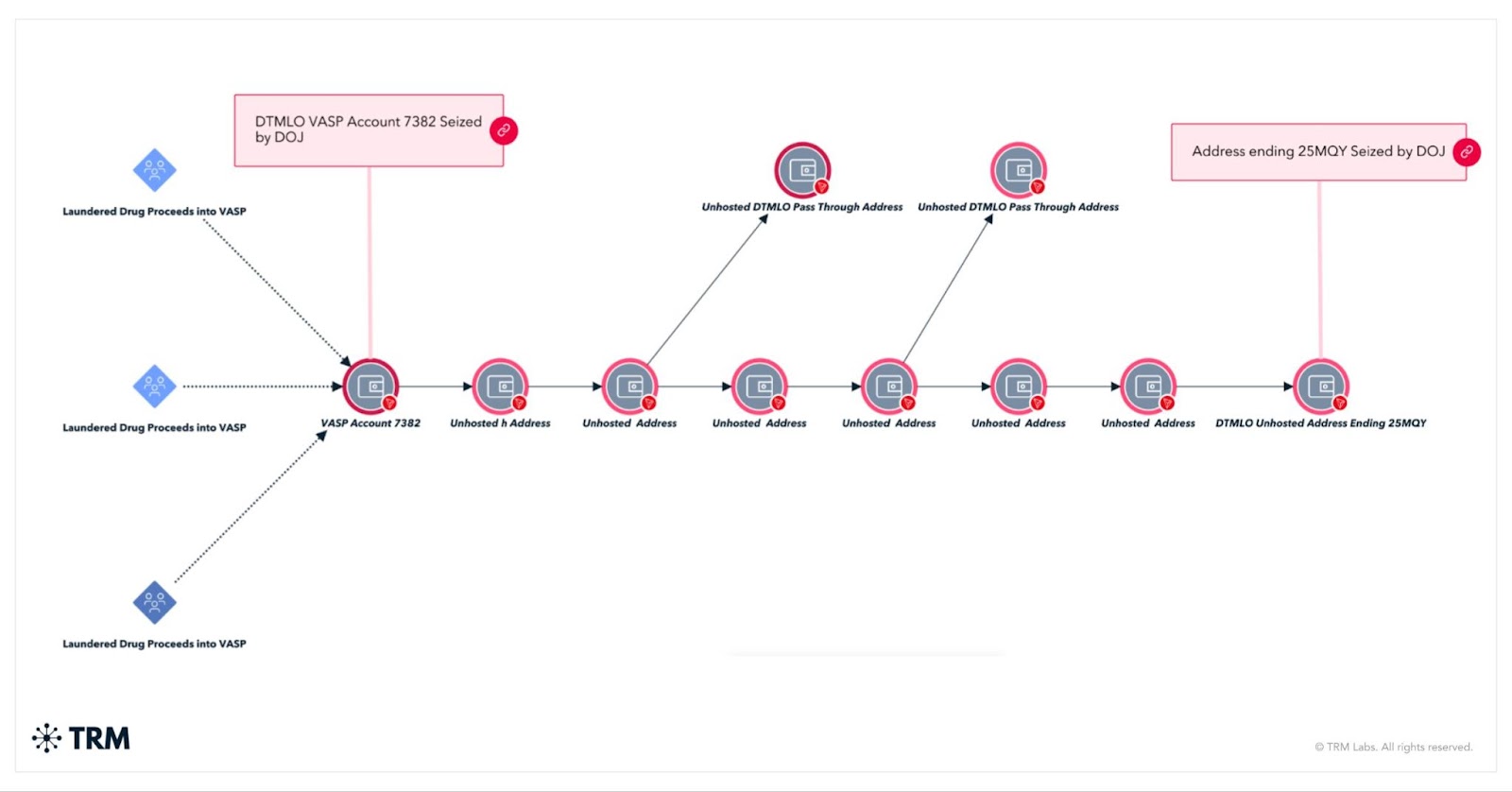
The scheme followed a well-established cartel money laundering blueprint, with cryptocurrency serving as a critical conduit. Bulk cash from cocaine sales in the United States was collected by professional money brokers, who then deployed sophisticated laundering methods, including rapid conversion into multiple cryptocurrencies. These assets were funneled into an international VASP account (Account 7382) controlled by a known member of a drug trafficking money laundering organization (DTMLO). That account alone received and sent more than USD 15 million in cryptocurrency, demonstrating its role as a dedicated channel for obscuring the origin and ownership of illicit proceeds.
To frustrate detection, the funds were moved across blockchain networks—such as TRON and Ethereum—before being routed through a long chain of unhosted, pass-through wallets. The laundering cycle ultimately concentrated the assets in two TRON addresses, ending in 25MQY and YyCSJ, both of which the Department of Justice seized as drug trafficking proceeds.
TRM Labs recently outlined key tactics employed by drug trafficking organizations, including methods favored by South American–based cartels. Just last week, the U.S. Treasury’s Office of Foreign Assets Control (OFAC) sanctioned Mexico-based Cartel del Noreste (CDN), a group with potential ties to international synthetic opioid producers known to accept cryptocurrency as payment.
For more on the use of crypto by cartels, read TRM’s “Understanding the Use of Cryptocurrencies By Cartels” here.
Combining Traditional Investigative Techniques with Blockchain Tracing
The DEA combined traditional investigative techniques with advanced blockchain tracing to dismantle the network and seize its assets. Agents deployed multiple confidential sources, conducted undercover transactions, mapped the money laundering network, and investigated both domestic and foreign shell companies. Financial analysis extended beyond cryptocurrency flows to include traditional banking activity, revealing that in less than a year, a single shell company tied to the operation moved over USD 22 million in suspicious transactions. By integrating this evidence with the immutable transaction records uncovered through blockchain analysis, the government was able to seize more than 5.5 million USDT.
Legal Basis for Forfeiture
The government alleged both traditional drug forfeiture theory (21 U.S.C. § 881) as well as a “proceeds theory” under the money laundering forfeiture statute (18 U.S.C. §§ 981(a)(1)(A) and 984).
Significance for Enforcement and Compliance
This case highlights the critical role stablecoins can play in laundering substantial volumes of cartel proceeds, showing how criminal networks weave together bulk cash pickups, cross-chain swaps, unhosted wallets, and high-risk exchanges into a single, rapid-moving system.
For law enforcement, it illustrates the impact of pairing blockchain tracing with traditional investigative methods to uncover and disrupt complex money laundering operations. While authorities have not disclosed whether international actors in the scheme have been arrested, the Eastern District of Wisconsin’s action represents a significant blow to the network’s operations.
The laundering patterns revealed—rapid turnover of funds, minimal balance retention, and the pooling of large deposits in unhosted wallets—serve as critical red flags for compliance teams. By leveraging blockchain analytics, cryptocurrency businesses can detect and act on these indicators to mitigate high-risk activity among their clients.