How Indonesian Law Enforcement Used On-chain Intelligence to Secure Convictions for Terrorism Financing

TRM User Conference
Which mission will you select?
Key takeaways
- In 2024 and 2025, Indonesian authorities — working with financial intelligence from PPATK, Indonesia's financial intelligence unit — identified and convicted three individuals for financing terrorism, including through cryptocurrency
- All three sent cryptocurrency to Syria-based terrorism fundraising campaigns, reflecting the international reach of these networks and the cross-border mobility that cryptocurrency enables
- The cases are part of a broader regional shift in which terrorist cells are increasingly using cryptocurrency to move funds across borders and evade traditional financial monitoring — a pattern TRM Labs has tracked across multiple jurisdictions
- With Al-Hol camp in Syria – which held ISIS family members – recently closed, continued monitoring of terrorism financing campaigns is critical
{{horizontal-line}}
Indonesia's terrorism financing threat landscape
Since joining the Financial Action Task Force (FATF) in 2023, Indonesia has continued to identify terrorism financing as a national risk, including fundraising campaigns using cryptocurrency.
PPATK (Pusat Pelaporan dan Analisis Transaksi Keuangan), Indonesia's financial intelligence unit, has been central to this effort. In recent years, PPATK has reported an increase in suspicious transaction reports with strong indications of terrorism financing, including a notable uptick in cases involving virtual assets. Its 2023 annual report documented a joint action with Special Detachment 88 of the Indonesian National Police to uncover ISIS terrorism funding sourced from domestic donations using crypto assets — channeled through a humanitarian organization soliciting public donations under the guise of providing aid.
These cases illustrate what modern financial intelligence looks like in practice. PPATK's SIPENDAR platform — a centralized database enabling real-time information sharing between financial institutions and law enforcement — gave Detachment 88, Indonesia's elite counter-terrorism unit, the ability to access financial records and trace networks in near real time.
The three defendants
Each of the three individuals was charged and convicted in separate proceedings before Indonesian courts, with decisions ultimately reviewed by the Supreme Court, for their roles in financing terrorism. One was proven to have sent 15 transactions totaling over 49,000 USDT from his account at an Indonesian exchange to a foreign-based exchange.
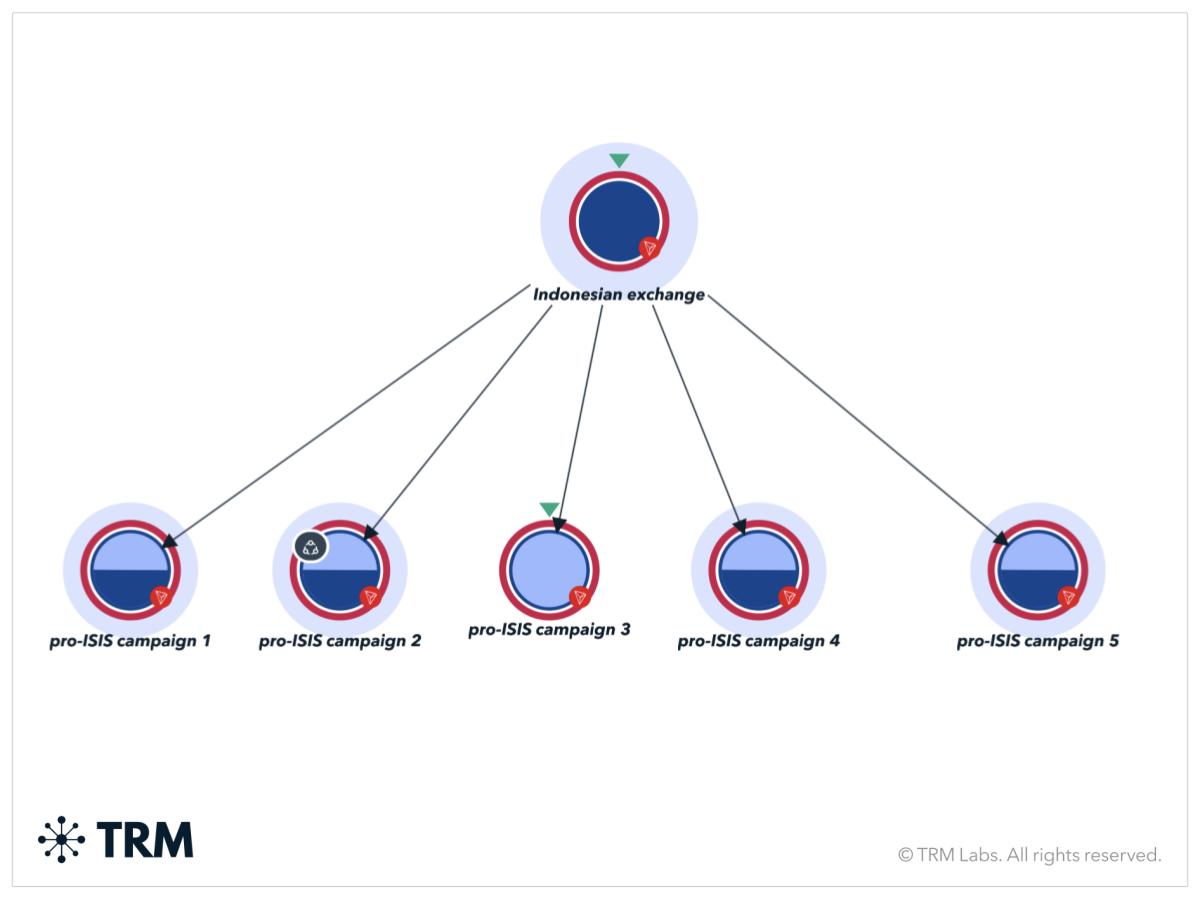
None of the defendants were alleged to have conducted attacks themselves. They occupied a critical link in the financing chain: collecting, transferring, and — in at least one case — converting funds into cryptocurrency to move money to individuals and networks engaged in, or planning, acts of terrorism.
Cryptocurrency — and pseudonymous wallet addresses in particular — was central to the prosecution's case. Investigators traced transactions on-chain, connecting wallet addresses used by the defendants to broader financing networks, and presented that blockchain evidence as part of the evidentiary record at trial.
Implications for financial institutions
The convictions carry concrete implications for banks, virtual asset service providers (VASPs), and compliance professionals operating in or with exposure to Indonesia and the broader Southeast Asian market.
Indonesian courts have demonstrated that cryptocurrency evidence — wallet addresses, transaction histories, on-chain flows — is not only admissible but can anchor a terrorism financing prosecution. Institutions handling virtual assets in this region need to treat blockchain tracing as a core anti-money laundering and countering the financing of terrorism (AML/CFT) capability.
The prosecutions also reflect a broadening of the terrorism financing perimeter. None of the defendants participated directly in terrorist violence — they moved money, converted currencies, and provided financial logistics to terror networks. Compliance programs focused on the most obvious typologies will miss this layer of the ecosystem.
Regulatory exposure is increasing in parallel. Indonesia's OJK (Financial Services Authority) took over supervision of crypto platforms from Bappebti in 2024, bringing VASPs under the same AML/CFT obligations as traditional financial institutions. Suspicious transaction reporting for crypto platforms is now mandatory under SEOJK No. 20 of 2024. These convictions demonstrate that those reports can and do trigger active investigations.
Regional context and how public-private partnerships can counter terror financing
Indonesia's enforcement action fits a pattern TRM has tracked across Southeast Asia: terrorism financing networks are adaptive, and cryptocurrency has become a mechanism of choice precisely because many institutions and regulators were slow to treat it with the same rigor as traditional financial channels.
Across Singapore, Malaysia, and Indonesia, regional financial intelligence units and law enforcement agencies are building the technical capacity to trace virtual assets, share financial intelligence in real time, and construct prosecution-ready cases. These convictions are evidence that investment in that capacity is producing results.
TRM Labs provides blockchain intelligence tools used by law enforcement, financial institutions, and regulatory agencies worldwide. TRM's Beacon network enables government investigators and private sector partners to collaborate across the cryptocurrency ecosystem: when an investigator flags an address, downstream recipients can freeze, seize, and report on the relevant transactions.To learn more about how TRM supports AML/CFT compliance and counter-terrorism financing investigations, contact us.
{{horizontal-line}}
Frequently asked questions (FAQs)
1. What happened in these cases?
Indonesian authorities identified and convicted three individuals between 2024 and 2025 for financing terrorism using cryptocurrency. Each case involved transferring funds to overseas networks, including campaigns linked to Syria.
2. Why is this significant for the crypto ecosystem?
These cases demonstrate that blockchain transactions are traceable and can be used as admissible evidence in court. They reinforce that cryptocurrency does not provide anonymity from law enforcement when proper analytical tools are applied.
3. How did investigators identify the suspects?
Authorities combined financial intelligence with on-chain analysis to trace wallet addresses, transaction flows, and connections to known networks. This allowed them to link individuals to broader financing activity and build prosecution-ready cases.
4. What does this mean for financial institutions and VASPs?
Financial institutions and crypto platforms operating in or exposed to Southeast Asia should:
- Treat blockchain intelligence as a core AML/CFT capability
- Expand monitoring beyond obvious threat actors to include facilitators
- Ensure compliance with evolving regulatory requirements, including suspicious transaction reporting
5. How is regulation evolving in Indonesia?
Indonesia has strengthened oversight of crypto platforms by bringing them under the authority of the Financial Services Authority (OJK) and requiring mandatory reporting of suspicious transactions. This aligns crypto regulation more closely with traditional financial systems.
6. Is this trend limited to Indonesia?
No. Similar patterns are emerging across Southeast Asia, where governments are investing in blockchain intelligence capabilities and enhancing collaboration between public and private sectors to address illicit finance risks.