OFAC Targets Global Network Financing Iran’s IRGC

Today, the Department of the Treasury’s Office of Foreign Assets Control (OFAC) announced sanctions against a pair of Iranian financial facilitators and more than a dozen Hong Kong- and United Arab Emirates (UAE)-based individuals and entities for their roles in coordinating funds transfers, including from the sale of Iranian oil, that benefits the IRGC-Qods Force (QF), and Iran’s Ministry of Defense and Armed Forces Logistics (MODAFL).
According to Treasury, “Iranian “shadow banking” networks like these — run by trusted illicit financial facilitators — abuse the international financial system, and evade sanctions by laundering money through overseas front companies and cryptocurrency. The IRGC-QF and MODAFL use these proceeds to support regional terrorist proxy groups and develop advanced weapons systems, including ballistic missiles and unmanned aerial vehicles (UAVs), which threaten the security of U.S. forces and those of our allies.”
In addition, OFAC added multiple cryptocurrency wallet addresses to its sanctions list. These wallets, holding Bitcoin, Ether, Tether, and Tron, were tied to facilitators and front companies that used blockchain rails to move funds outside of traditional banking systems, underscoring the growing role of digital assets in Iranian sanctions-evasion activity.
While the IRGC has long been a focus of US sanctions, this action shines a light on the network of overseas companies and middlemen who keep its procurement machine running. In China, Shenzhen Jiasibo Technology Co. was exposed for supplying dual-use goods with military applications to Iran, masking the real buyers with mislabeling and circuitous routes. In Hong Kong, Alpha Trading Co. played a parallel role, acting as both a procurement agent and financial hub that disguised DIO’s involvement. In the UAE, Blue Sky General Trading LLC leveraged Dubai’s position as a global commercial center to funnel money and goods while shielding its Iranian beneficiaries. Each of these companies was more than a storefront — they were nodes in a coordinated global supply chain designed to obscure DIO’s fingerprints.
The network also extended into logistics. The vessel M/V Persepolis, now designated, was identified as part of the machinery that physically transported goods bound for DIO. Managed through a series of shell owners and operators, the ship exemplifies the layered tactics Iran employs to continue procurement in defiance of sanctions. Surrounding these entities were individuals across multiple jurisdictions, each acting as brokers, financiers, or procurement specialists. They ensured that revenue generated abroad could be funneled back to Tehran and that sensitive materials kept flowing toward Iran’s defense complex.
In addition, Treasury linked designated individuals and companies to BTC, ETH, USDT, and TRX addresses that had been used to pay for goods, settle invoices, and launder proceeds. The movement often followed a now-familiar pattern: fiat currency converted into USDT or TRX, funds bouncing across multiple wallets to fragment the trail, then off-ramping into exchanges with weaker compliance oversight.
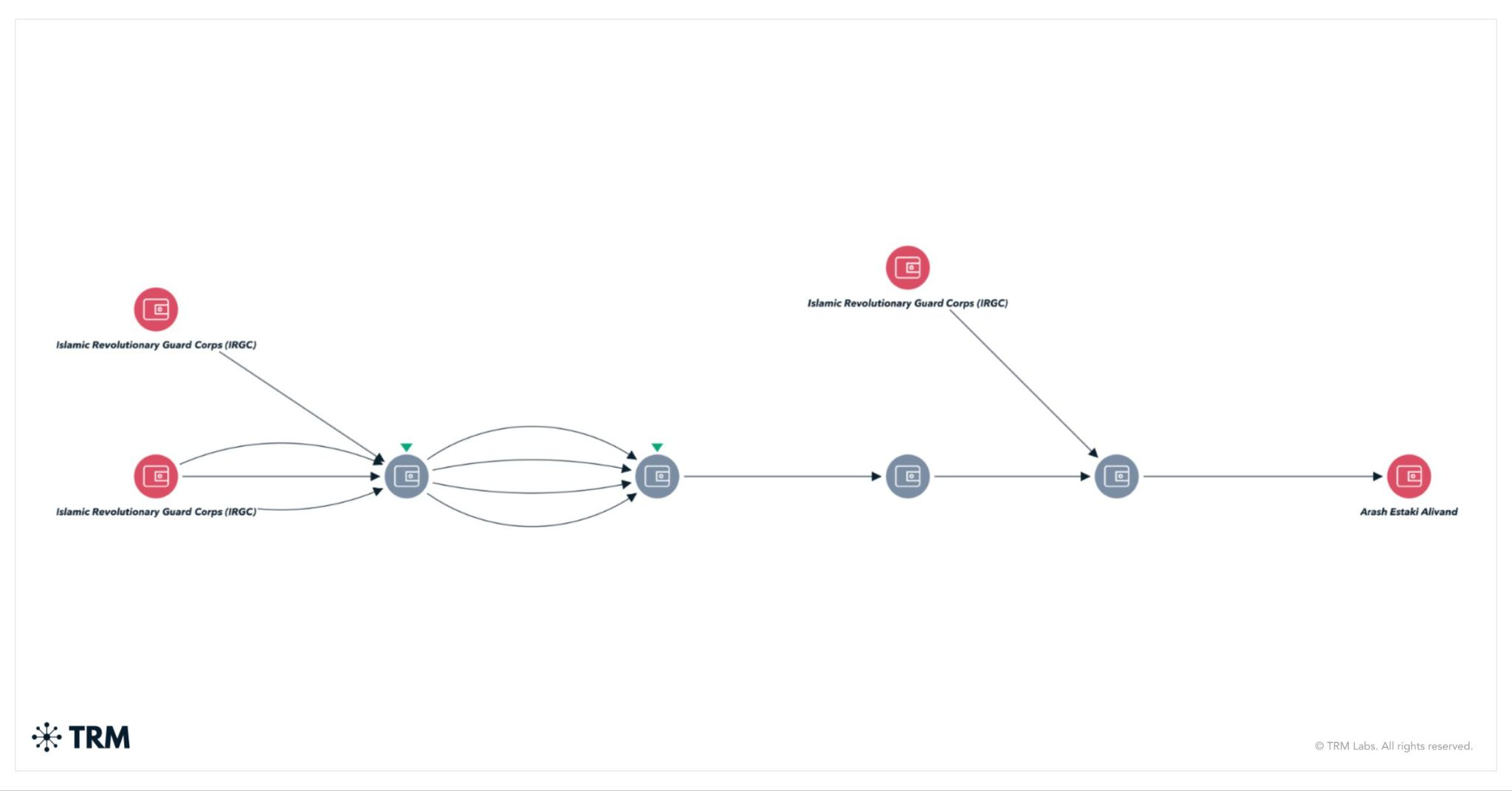
By adding these wallets to the Specially Designated Nationals (SDN) List, OFAC has effectively banned US persons from engaging with them and issued a global compliance signal — anyone transacting with these addresses risks secondary sanctions.
This explicit targeting of blockchain activity reflects a larger strategic shift. Iran’s procurement networks no longer rely solely on front companies and bank transfers. Crypto has become a parallel channel for moving value quickly and discreetly across borders, particularly when banks flag or reject suspicious wires. By sanctioning wallet addresses alongside shipping assets and corporate fronts, Treasury is sending a message that digital rails are a growing focus for sanctions.
Taken together, the action paints a picture of industrial-scale sanctions evasion. Companies in China and Hong Kong sourced and financed goods, UAE firms laundered payments, vessels carried cargo, and digital wallets provided new avenues to move funds. Each component of the network served to insulate Iran’s Defense Industries Organization from the financial isolation imposed on it, keeping materials and money flowing into its weapons programs.
By exposing this web in its entirety — brick-and-mortar companies, maritime assets, individual brokers, and cryptocurrency addresses — OFAC is demonstrating the breadth of its strategy: to deny Iran the ability to exploit both traditional financial systems and new digital tools. It is also a warning to the private sector. Banks, exchanges, shipping firms, and trading companies are all expected to tighten vigilance, screen for these names and wallets, and prevent sanctioned actors from burrowing into the global economy.
This action underscores just how deeply digital assets have become embedded in Iran’s sanctions-evasion playbook. By designating wallet addresses alongside vessels, individuals, and front companies, OFAC is making clear that cryptocurrency is no longer a peripheral tool but a core settlement rail for procurement and finance networks.
Treasury described familiar patterns: fiat converted into stablecoins like USDT or TRX, value moved through layers of intermediary wallets to fragment the trail, and funds ultimately off-ramped through exchanges with weak compliance oversight. These typologies mirror what TRM has documented in prior Iranian cases and reflect the growing sophistication of illicit actors operating on-chain.
For compliance teams, screening can no longer stop with names and legal entities; it must extend to wallet addresses and transaction behavior. These designations function as both a prohibition for U.S. persons and a global compliance signal: continued interaction with the listed wallets or their facilitators carries real and material sanctions risk.