Russia's Global Sanctions Evasion Expands into Uzbekistan via Asterium Exchange

Asterium, Uzbekistan's largest cryptocurrency exchange, is likely a node in Russia's international sanctions evasion network, according to new TRM Labs research. The Uzbek VASP has extensive on-chain exposure to A7 — a Russian cross-border payment system used for sanctions evasion, founded by fugitive Moldovan oligarch Ilan Shor — with USD 742 million in direct exposure and USD 1.1 billion in indirect exposure. Off-chain connections reveal that Asterium shares at least four employees with Octobank, an Uzbek bank also linked to Russian sanctions evasion activity, which issues Asterium's crypto-linked bank cards.
Key takeaways
- Asterium is likely a node in Russia's international sanctions evasion network based on its on-chain connections to A7 and other entities. Addresses show up to USD 742 million in direct exposure to A7, a Russian cross-border payment system used for sanctions evasion, with an additional USD 1.1 billion in indirect exposure.
- On-chain evidence also connects Asterium to sanctioned Russian entity Grinex and TokenSpot — a likely Garantex front company. Asterium's exposure to multiple high-risk counterparties indicates integration into a broader network of interconnected sanctions evasion services.
- Asterium's total on-chain volume supports the conclusion that the VASP is being used for sanctions evasion. Addresses attributed to Asterium have processed USD 20.57 billion in total volume since February 2025 — more than 1,000 times the volume of Uznex, the first exchange licensed in Uzbekistan, which has processed approximately USD 18 million since 2021.
- Asterium has deep operational ties to Uzbek bank Octobank, which has been linked to sanctions evasion. The entities share at least four personnel, according to open-source information, and Octobank is the issuer of Asterium's crypto-linked bank cards.
- The Asterium case illustrates how sanctions evasion networks operate as interconnected, cross-jurisdictional systems, linking financial infrastructure across Russia, Central Asia, and Moldova.
Russian A7 sanctions evasion network broadens reach through Asterium
Asterium has extensive on-chain links to A7, a Russian cross-border payment system used as a sanctions evasion network that was founded by fugitive Moldovan oligarch Ilan Shor. Asterium, launched in April 2025, is Uzbekistan's largest cryptocurrency exchange, offering trading services and crypto-linked bank cards.
Approximately USD 10 million in USDT flows through intermediary addresses connected to A7 that also transacted with Asterium, establishing a direct link between the exchange and the network. Direct exposure to A7 totals USD 742 million, with an additional USD 1.1 billion in indirect exposure.
Timing patterns, transaction behavior, and address clustering surface additional addresses likely controlled by Asterium. The scale of the Asterium network dwarfs the rest of the Uzbek crypto market. A single known Asterium withdrawal address shows over USD 1.29 billion in total volume since March 2025. Across all attributed addresses, total volume has reached USD 20.57 billion since February 2025 — two months before Asterium's formal registration in April 2025. By comparison, Uznex, the only other Uzbek crypto exchange with on-chain attribution, has processed approximately USD 18 million since 2021.
Asterium's transaction activity shows near-complete drops in volume on weekends. This pattern is typical of business-to-business services and is consistent with known A7 activity patterns. The near-complete cessation of weekend activity at Asterium is more consistent with institutional, coordinated fund flows than with retail trading.
Russian sanctions evasion network spans regions through Asterium
Asterium's on-chain activity and exposure indicate it is integrated into a broader network of interconnected services associated with sanctions evasion.
The Uzbek exchange has interacted indirectly with TokenSpot, a Kyrgyz crypto service provider that is a likely Garantex front company, as well as with Grinex, a sanctioned Russian entity, and A7. The convergence of these flows indicates shared infrastructure or coordinated use of overlapping financial channels.
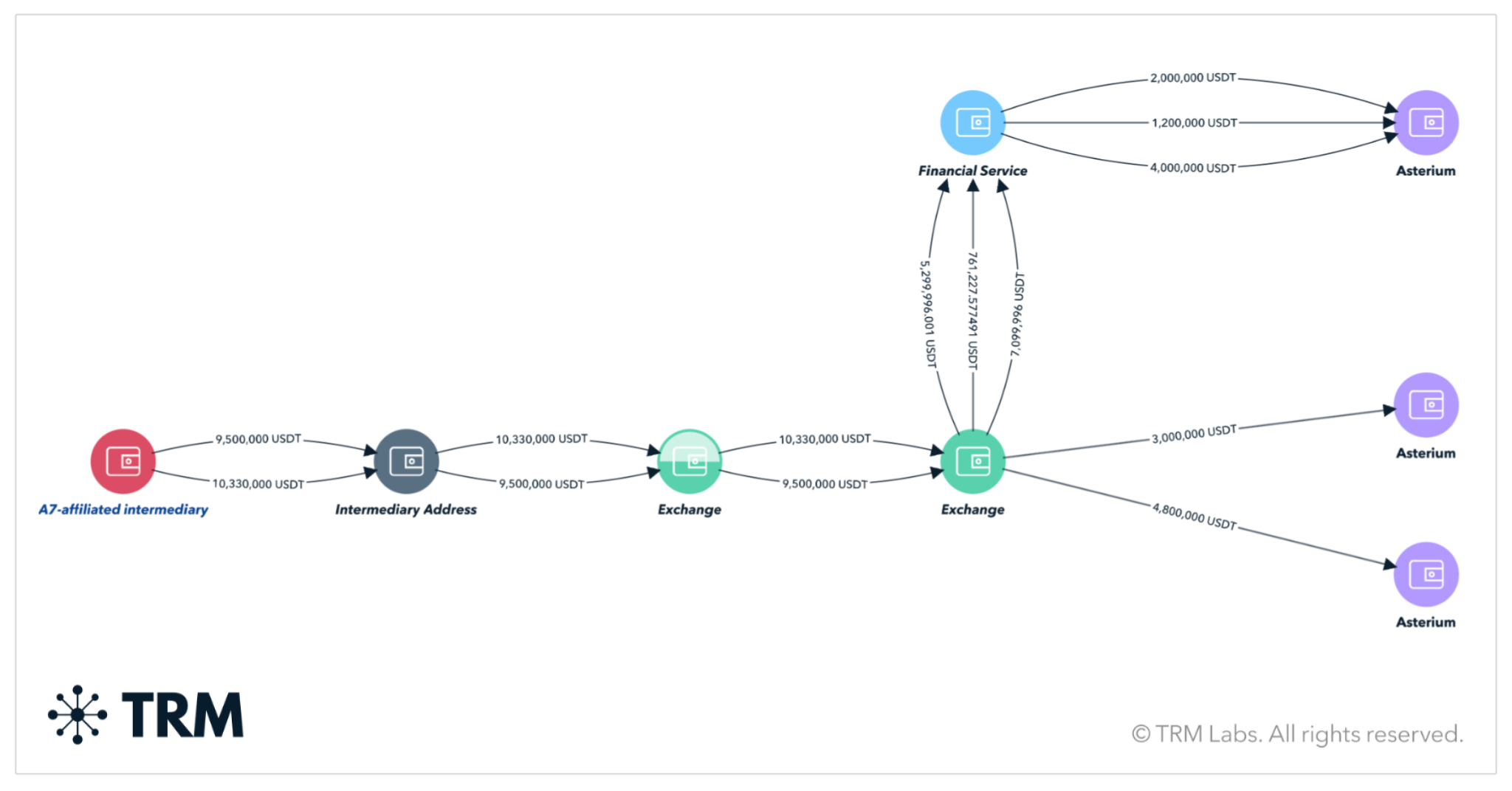
Asterium has also sent over USD 35 million indirectly to TokenSpot, further reinforcing links to this network.
Personnel links extend to Russia and Moldova
Off-chain information, including personnel data, provides additional context for Asterium's operations, connecting the exchange to Russia and Moldova — two jurisdictions central to A7's activity.
Asterium's self-described product owner previously worked for the Russian Defense Ministry and the Economy Ministry in the Russian Republic of Buryatia, and served as a project curator for a regional government communications monitoring center. Asterium's chief commercial officer previously worked at MAIB, a Moldovan bank linked to Ilan Shor and Veaceslav Platon, a former Moldovan MP associated with Russian-backed organized crime networks. A7 has been active in Moldova as part of broader Kremlin-aligned financial and influence operations.
The concentration of Russia and Moldova-linked personnel at Asterium indicates the exchange is connected to the A7 network — a conclusion that becomes stronger when viewed alongside its significant on-chain exposure to A7.
Asterium also connected to Uzbek bank Octobank
Octobank, an Uzbek bank, has notable ties to Asterium, based on multiple personnel overlaps and operational connections between the two entities. Octobank was established in 2001 but has recently pivoted towards digital currencies. As of October 2024, it had been raised for debate in the European Parliament, with lawmakers questioning its role in Russian sanctions evasion activity. Octobank has also been linked to Russian sanctions evasion and Russian-Uzbek oligarch Alisher Usmanov — reportedly close to Russian President Vladimir Putin — in public research.
Asterium and Octobank share at least four employees, according to open source research. Each row below represents one individual; the columns list their corresponding roles at each entity.
Asterium's bank cards, which can be used to access cryptocurrency, are offered through Octobank, as of July 2025.

Outlook
TRM Labs previously documented how Kyrgyzstan's cryptocurrency economy was co-opted by Russian sanctions evasion infrastructure. The Asterium case indicates Russia is running the same playbook in Uzbekistan — integrating a locally licensed exchange into an established cross-border evasion network before regulators adapt.
Asterium demonstrates that formal exchange registration and card integration with mainstream banking networks does not preclude — and may actively facilitate — use as sanctions evasion infrastructure. Asterium operates with crypto-linked bank cards offered by Octobank, presenting a veneer of legitimacy. Both Asterium and Octobank state that they operate KYC processes.
For compliance teams and regulators, this case underscores the importance of examining on-chain fund flows, personnel networks, and institutional relationships rather than accepting surface-level licensing and compliance indicators at face value. Exchanges operating in jurisdictions with growing crypto-friendly regulatory environments and deep economic ties to sanctioned countries warrant careful attention.
{{horizontal-line}}
Frequently asked questions (FAQs)
1. What are the Russian crypto entities that factor most prominently into the A7 network?
Garantex, Grinex.io, TokenSpot, and Meer are closely linked to the A7 sanctions evasion network and are likely operated by the same organization, based on on-chain analysis. These entities collectively comprise a larger infrastructure of Russian state-adjacent financial platforms with a shared purpose: maintaining Russian access to foreign currency outside the international banking system. A7 relies on this exchange ecosystem as a settlement layer, routing funds through accounts at these platforms as part of a cross-chain laundering workflow.
2. What is A7, and how does it operate?
A7 is a cross-border payment system built for Russian sanctions evasion, founded by Ilan Shor, a fugitive Moldovan oligarch with documented ties to the Kremlin. A7 does not operate through a single platform. Instead, it acts as a coordinating layer — using shared deposit addresses and overlapping personnel across affiliated exchanges to move funds across chains and jurisdictions. A7-linked flows extend across Russia, Central Asia, Moldova, and beyond.
3. How does TRM identify on-chain connections to a sanctions evasion network?
TRM uses blockchain analysis to attribute addresses and map fund flows to specific entities or networks. For Asterium, TRM confirmed direct transactions between Asterium-linked addresses and A7-affiliated intermediaries, then expanded the analysis using clustering to attribute additional addresses. Volume anomalies — including the near-complete cessation of weekend activity — provided additional behavioral evidence distinguishing Asterium's activity from retail trading patterns. This combination of flow analysis, clustering, and behavioral profiling is standard methodology for attributing infrastructure to a specific network.
4. Is it unusual for a cryptocurrency exchange to process USD 20.57 billion in volume from a country the size of Uzbekistan?
Yes. Uznex, the only other Uzbek crypto exchange with on-chain attribution, has processed approximately USD 18 million since 2021. Asterium's USD 20.57 billion since February 2025 — two months before its formal registration — exceeds that by more than 1,000x. Volume at this scale is inconsistent with domestic retail demand and is more consistent with Asterium functioning as a transit node for large cross-border flows originating outside the country.
5. What should compliance teams prioritize when assessing exposure to exchanges in high-risk jurisdictions?
On-chain analysis should take precedence over surface-level indicators such as exchange licenses or stated KYC policies. For exchanges in jurisdictions with growing crypto-friendly regulatory environments and deep economic ties to sanctioned countries, relevant checks include: mapping direct and indirect on-chain exposure to sanctioned entities; assessing behavioral patterns in transaction activity such as volume concentration or weekend cessation; and examining personnel networks and institutional affiliations. The Asterium case shows that formal registration and mainstream banking integration can create a false impression of legitimacy that on-chain analysis quickly undermines.
6. How does the Asterium case fit into Russia's broader sanctions evasion strategy?
Russia's sanctions evasion strategy relies on a distributed network of financial infrastructure spanning multiple jurisdictions — reducing exposure to any single enforcement action. TRM documented this approach in Kyrgyzstan; Asterium indicates the same playbook is now operating in Uzbekistan. By integrating Asterium into the A7 network alongside entities connected to Garantex, Grinex, and TokenSpot, Russia maintains access to multiple redundant settlement layers. The cross-jurisdictional nature of the network — spanning Russia, Central Asia, and the post-Soviet financial periphery — complicates enforcement by distributing jurisdictional exposure across countries with varying levels of sanctions alignment.