On September 3, 2025, the US Department of the Treasury’s Office of Foreign Assets Control (OFAC) announced sanctions against Guangzhou Tengyue Chemical Co., Ltd. — a China-based chemical company for its role in the proliferation of illicit drugs to the US.
Guangzhou Tengyue advertised and sold a range of substances, including fentanyl, MDMA, and amphetamine precursors, as well as pharmaceutical intermediates, peptides, organic intermediates, and organic chemicals. The company also advertised nitazenes — a class of synthetic opioids significantly more potent than fentanyl.
As part of the designation, OFAC sanctioned individuals Huang Xiaojun and Huang Zhanpeng, representatives of Guangzhou Tengyue, for their roles in coordinating the shipment of these illicit drugs and chemical cutting agents to the US. According to OFAC, Zhanpeng is listed as the executive director, legal representative, and 50% shareholder of Guangzhou Tengyue. While Xiaojun, who was previously indicted alongside the company, is identified as the account holder for a crypto wallet used by the company in a 2023 attempt to sell controlled substances to a buyer in the US.
OFAC carried out this investigation with support from the Drug Enforcement Administration (DEA) — including the Tampa District Office’s CHEMEX team — as well as the Federal Bureau of Investigation (FBI) and its Cincinnati Field Office.
Today, the FBI also announced a federal criminal indictment against Guangzhou Tengyue, Xiaojun, Zhanpeng, and others for conspiracy to commit drug trafficking under Title 21 U.S. Code 846, charging three individuals in the US and approximately 22 individuals and businesses in China, following a joint investigation with the DEA that began in January 2024.
On-chain activity
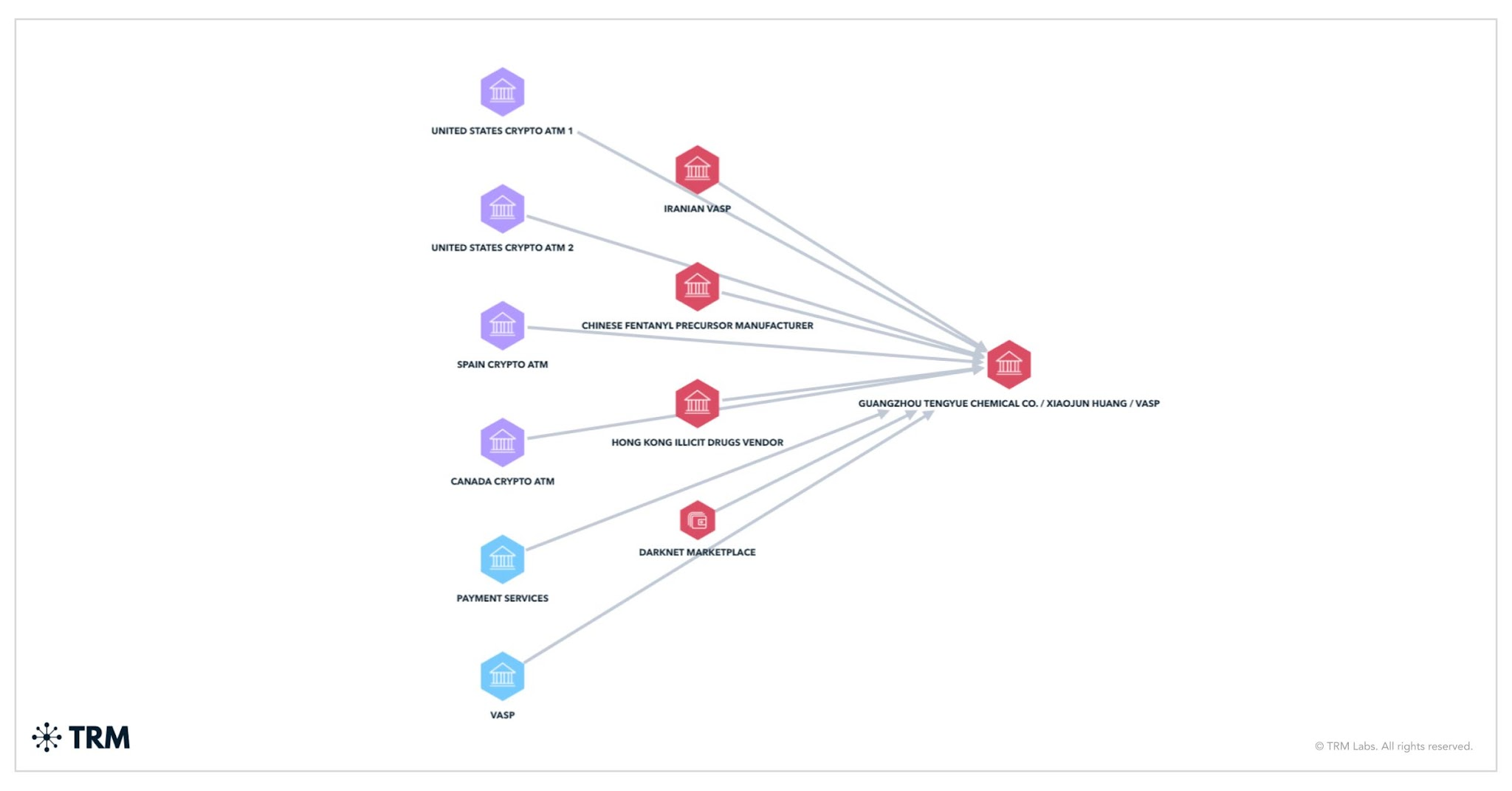
OFAC identified one cryptocurrency address as part of today’s designation. The address — which has been active since January 2021 — had been previously identified by TRM as being linked to Guangzhou Tengyue. It received a total inflow of about USD 1.27 million from multiple entities, including crypto ATMs, darknet marketplaces, and illicit drugs vendors. The last outgoing transaction was on May 19, 2025. TRM is continuing to analyze on-chain activity linked to this address and will add associated wallets to our platform as further connections are identified.
Today’s designation builds on previous US law enforcement actions targeting fentanyl trafficking networks, such as OFAC’s October 3, 2023 designation of individuals and entities associated with the international proliferation of illicit drugs, including a China-based network.
Crypto’s role in illicit drugs trafficking
The inclusion of a cryptocurrency address in today’s designation highlights the role that digital assets play in enabling cross-border fentanyl and nitazene sales. It also underscores the need for crypto compliance teams, investigators, and regulators to stay ahead of evolving typologies and adapt detection strategies for new and emerging threats.
Frequently asked questions (FAQs)
Why did the US Treasury sanction Guangzhou Tengyue Chemical Co., Ltd.?
OFAC sanctioned Guangzhou Tengyue for its role in producing and distributing synthetic opioids and chemical cutting agents. These substances — including fentanyl precursors and nitazenes — were advertised and sold to US-based buyers, contributing to the proliferation of illicit drugs.
Who are Huang Xiaojun and Huang Zhanpeng, and what roles did they play?
Huang Zhanpeng is identified as the executive director, legal representative, and 50 percent shareholder of Guangzhou Tengyue. Huang Xiaojun, previously indicted alongside the company, is named as the account holder of a cryptocurrency wallet used in a 2023 attempt to sell controlled substances to a buyer in the United States.
What role did cryptocurrency play in this fentanyl trafficking case?
OFAC identified a cryptocurrency wallet linked to Guangzhou Tengyue as part of its designation. This reflects a broader trend in which digital assets are used to facilitate cross-border drug transactions — highlighting the importance of transaction monitoring and risk detection for virtual asset service providers and investigators.
How are US authorities responding to international synthetic opioid networks?
US agencies — including OFAC, the DEA, and the FBI — are coordinating sanctions, criminal indictments, and international investigations to disrupt fentanyl trafficking networks. These efforts are focused on identifying and dismantling supply chains and financial infrastructure supporting cross-border drug distribution.
What does this mean for compliance, crypto risk, and investigations teams?
This designation underscores the growing use of cryptocurrency in illicit drug markets. Compliance and intelligence teams should proactively monitor wallet addresses tied to sanctioned entities and update risk models to detect emerging patterns involving digital assets and high-risk counterparties.