Global Crypto Policy Review & Outlook 2023/24
Key regulatory and policy developments from 2023 — and what's in store for 2024

Introduction
2023 began with fear, uncertainty and doubt (or FUD, as it is known in crypto circles) in the wake of the collapse of FTX. However, the following 12 months saw an extraordinary boom in regulation across the globe.
The EU passed the watershed Market in Crypto Assets (MiCA) legislation. Hong Kong’s licensing regime went live. Singapore finalized its stablecoin framework and enhanced consumer protection rules. South Korea passed its first omnibus digital asset legislation. Australia detailed its regulatory framework for digital assets and stablecoins. And in the US, stablecoin and market structure bills progressed out of Congress' House Financial Services Committee.
{{global-crypto-policy-review-outlook-2023-24-call-out-1}}
Clarity and consistency began to emerge as the common themes. While differences in national philosophies and priorities persist, we observed a convergence toward certain standards.
This increasing regulatory maturity and greater focus on compliance by the private sector have already impacted illicit finance activities.
{{global-crypto-policy-review-outlook-2023-24-call-out-2}}
In a year of significant policy action, this report summarizes the key developments and previews the milestones that lie ahead in 2024.
{{premium-content_chapter-divider}}
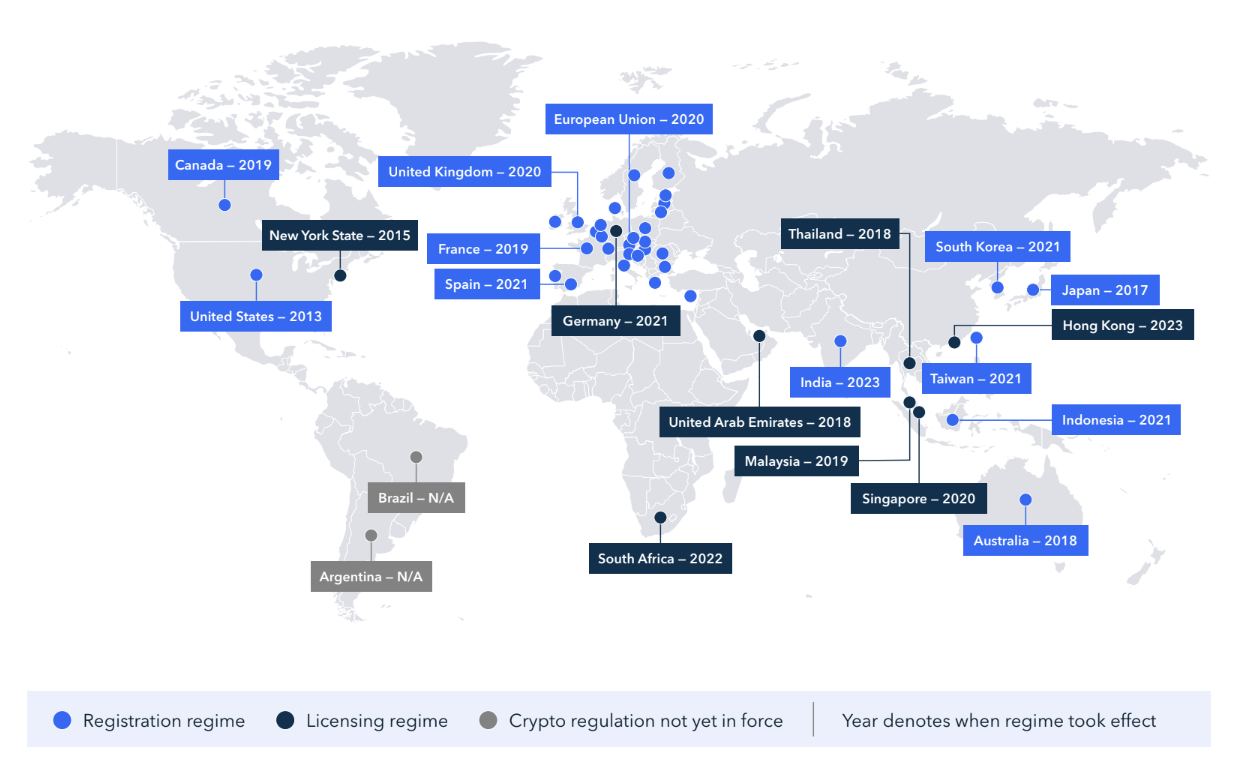
Crypto regulation around the world
We look at the state of crypto regulation across 21 jurisdictions representing about 70%of global crypto exposure.
{{premium-content_chapter-divider}}
2023 highlights
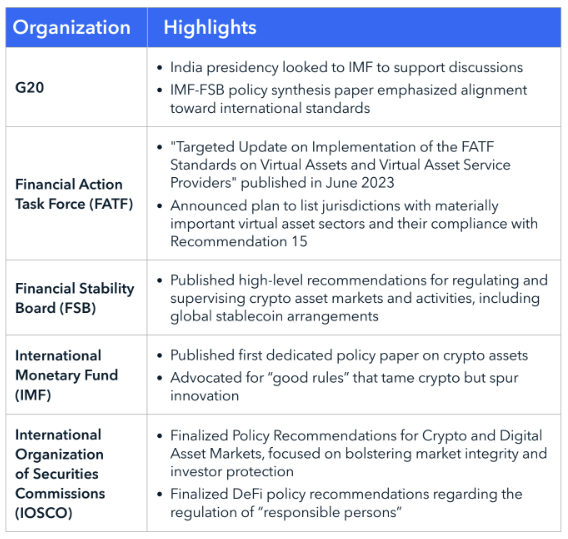
International organizations
Jurisdictional developments

{{premium-content_chapter-divider}}
International organizations
G20
In 2023, the G20 under India’s presidency worked to corral the global community toward common standards for crypto assets. It enlisted the help of the International Monetary Fund (IMF) in setting the global regulatory direction, alongside the Financial Stability Board (FSB).
The year’s discussions culminated in an IMF-FSB synthesis paper marrying the existing positions of both organizations, with an emphasis on alignment toward international standards outlined by the various standard setting bodies (SSBs). In its presidency note, India also called on SSBs to look into technical assistance and guidance as well as implementation monitoring.
With the presidential baton recently passed to Brazil, it remains to be seen how crypto regulation will fit into the G20 agenda for 2024.
Financial Action Task Force (FATF)
FATF’s main crypto event in 2023 was the publication of the “Targeted Update on Implementation of the FATF Standards on Virtual Assets and Virtual Asset Service Providers.” The Targeted Update found that only 25% of member states were fully compliant with FATF’s requirements on virtual assets. The rest struggled with everything from basic risk assessments, regulatory approaches and the implementation of the Travel Rule.
As part of its focus on improving implementation, FATF announced the creation of a table showing which steps different FATF jurisdictions have taken towards compliance. That document, coming in 2024, will shape the provision of outreach and technical assistance programs, with priority given to lower capacity countries.
Other notable FATF reports in 2023 included “Countering Ransomware Finance” and “Illicit Financial Flows from Cyber-enabled Frauds,” which outlined financial trends in ransomware and cyber fraud, including the role of virtual assets.
While Singapore’s FATF presidency will come to an end in June 2024, the progress made on improving cooperation on asset recovery will likely bolster the interception of illicit crypto assets for years to come.
Financial Stability Board (FSB)
In July, the FSB finalized its global regulatory framework for crypto asset activities. It included high-level recommendations for regulation, supervision and oversight of global stablecoin arrangements, as well as crypto asset activities and markets. The framework codified the “same activity, same risk, same regulation” approach that the FSB will apply to its work with other SSBs and international organizations.
The global stablecoin recommendations, which aim to promote consistent and effective regulation to ensure financial stability and innovation, received the most attention. The wide-ranging recommendations covered governance, risk management, data provisions, recovery, disclosures and redemption. We have already started to see these standards influence stablecoin frameworks in jurisdictions like Singapore, Japan, Hong Kong, the UK and the EU.
The final recommendations marked a period of renewed attention to the governance of stablecoins. What will happen next? Although they are not legally binding, the FSB has pledged to conduct a review of the implementation of the recommendations by the end of 2025.
International Monetary Fund (IMF)
In February 2023, the IMF’s first policy paper dedicated to crypto outlined the monetary and fiscal policy implications of crypto adoption. Promoting comprehensive regulation instead of outright bans, the paper emphasized the need to ensure policy levers relating to fiat currencies remain effective as crypto adoption rises. It also recommended against granting cryptocurrencies legal tender status and suggested developing alternative digital infrastructure, especially for cross-border finance.
In her December 2023 speech entitled “Leaving the Wild West: Taming Crypto and Unleashing Blockchain,” IMF managing director Kristalina Georgieva called for “good rules” that could both dampen crypto’s financial stability risks and also “spur and guide innovation.” As regulatory clarity advances worldwide, we hope to see this guiding principle influence policy discussions in 2024 and beyond.
International Organization Of Securities Commissions (IOSCO)
With crypto assets coming under the care of securities regulators in many jurisdictions, IOSCO was a vocal contributor to the global policy dialogue. In line with its 2022/23 roadmap, IOSCO outlined its policy thinking in the areas of crypto market integrity and DeFi.
Its Policy Recommendations for Crypto and Digital Asset Markets, finalized in November 2023, focused on addressing concerns related to market integrity and investor protection. In a nod to consistency across TradFi and crypto, IOSCO’s 18 recommendations reflected the overarching IOSCO principles and covered six key areas: conflicts of interest, market manipulation, custody and client asset protection, cross-border risks and regulatory cooperation, operational and technology risks, and retail distribution.
IOSCO’s Policy Recommendations for Decentralized Finance focused on regulatory parity, anchored on the concept of “responsible persons”. Calling the notion of true decentralization in DeFi a “common misconception,” IOSCO Fintech Task Force Chair and Monetary Authority of Singapore Assistant Managing Director Tuang Lee Lim said that “responsible persons” could be identified “regardless of the operating model”. The recommendations required such persons to identify and address material risks and conflicts of interest and ensure clear and accurate disclosures. However, the devil is in the details when it comes to how regulators and industry will work toward a common understanding of who is responsible in DeFi.
{{premium-content_chapter-divider}}
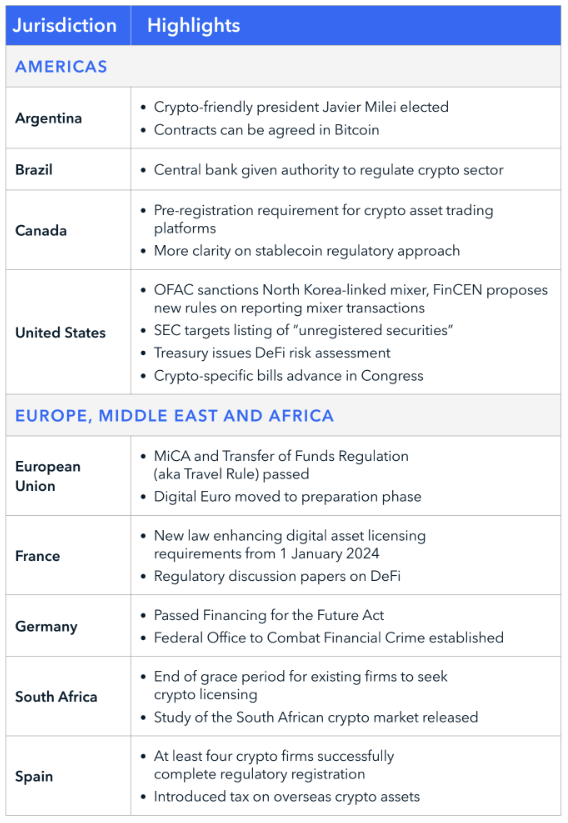
Jurisdictional developments
<h3 class="premium-components_show-toc">Americas</h3>
Argentina
{{23-global-crypto-policy-review-outlook-2023-24-argentina}}
Argentina’s biggest news for crypto in 2023 was the December 2023 election of outspoken libertarian economist Javier Milei as president. Milei, who has called crypto “the return of money to its original creator – the private sector,” could open the door to significantly more crypto activity in 2024 and beyond. With Argentina’s inflation above 140%, Milei has warned of an unavoidable economic shock and devalued the Argentine peso by 54%. He has also introduced a slew of economic reforms that would deregulate Argentina’s economy and incentivize Argentines to declare their crypto holdings. Meanwhile, Milei’s foreign minister Diana Mondino confirmed that Argentina allows contracts to be agreed in Bitcoin. Against this backdrop, we could see crypto adoption in Argentina, already one of the top markets for crypto, continue to pick up.
Prior to Milei’s election, there had been discussions to grant the securities regulator, the Comisión Nacional de Valores (CNV), oversight of the crypto sector ahead of Argentina’s FATF Mutual Evaluation in March 2024. But with policy shifts likely, we will need to wait to see how Argentina’s policy approach to crypto might evolve.
Meanwhile, Argentine law enforcement has made strides in clamping down on illicit finance in crypto, seizing crypto assets as part of a prosecution for the first time. With authorities recognizing the importance of training and education in achieving this milestone, we can look forward to further traction on this front.
Brazil
{{23-global-crypto-policy-review-outlook-2023-24-brazil}}
Latin America’s largest economy and a leader in global crypto adoption took a key step towards regulatory clarity. Following the passage of a landmark legal framework for virtual assets in December 2022, the president designated Brazil’s central bank as the lead regulator for VASPs.
In September 2023, BCB governor Roberto Campos Neto announced plans to tighten crypto regulation and subject platforms to supervision. The BCB is also working on Drex, its central bank digital currency (CBDC), with the pilot slated to conclude by late 2024. With Brazil now at the helm of the G20, it will be interesting to see how developments at home inform its leadership of the global discussion in 2024.
Canada
{{23-global-crypto-policy-review-outlook-2023-24-canada}}
Canada, which regulates virtual currencies as securities, heightened its focus on investor protection. In February the CSA, Canada’s umbrella organization for provincial securities regulators, introduced a pre-registration requirement for crypto asset trading platforms. To continue operating in Canada while their registration applications are under review, platforms must commit to customer asset segregation and custody, retain a chief compliance officer and file financial information with the CSA. They must not offer lines of credit or leverage or allow customers to buy stablecoins without the CSA’s consent.
In October, the CSA clarified its position on stablecoins. Recognizing that stablecoins “may have certain uses” for Canadian crypto customers, the CSA indicated that it may allow the trading of some stablecoins pegged to a single fiat currency, subject to specific requirements.
Canada’s banking and insurance supervisor, the Office of the Superintendent of Financial Institutions, also proposed changes to its capital and liquidity approach to crypto assets in July. The new guidelines would bring local requirements in line with the Basel Committee on Banking Supervision’s December 2022 standards for crypto asset exposures, and provide Canadian financial institutions with more clarity on how to treat crypto assets in their books. They are expected to come into effect in early 2025.
United States (US)
{{23-global-crypto-policy-review-outlook-2023-24-us}}
Continued enforcement activity and some legislative progress characterized crypto in the US over 2023. The SEC targeted cryptocurrency services for alleged misconduct, including fraud and the listing of unregistered securities. It brought fraud charges against Terraform Labs and its founder Do Kwon as well as FTX CEO Samuel Bankman-Fried and other FTX executives. The SEC also charged firms with offering unregistered securities through crypto asset lending and/or staking programs, and filed its first actions against issuers of non-fungible tokens (NFTs) for conducting illegal unregistered offerings of crypto asset securities. Perhaps most significantly, the SEC brought enforcement actions against cryptocurrency exchanges for allegedly listing unregistered securities.
The US Department of the Treasury has been focused on what Deputy Secretary Wally Adeyemo called the need to “prevent bad actors from using the digital asset ecosystem for illicit activity.” Adeyemo requested expanded powers that would allow Treasury to more easily target cryptocurrency exchanges that “facilitate payments to Hamas and other terrorist groups,” and legislation that could bring various DeFi services within the scope of the Bank Secrecy Act.
The Office of Foreign Assets Control (OFAC) sanctioned and used enforcement actions against crypto businesses facilitating illicit activity, underscoring the importance of financial crime compliance. It targeted non-compliant exchanges Bitzlato and Gaza-based BuyCash as well as darknet markets such as Hydra.
Mixers have been a major focus for US authorities combating illicit activity by North Korea and other threat actors. Following OFAC’s 2022 sanctions of Blender.io and Tornado Cash, the Department of Justice led a takedown of ChipMixer while OFAC sanctioned Sinbad – North Korea's latest go-to service. FinCEN also proposed a new rule that would require financial institutions to monitor and report transactions involving mixers.
Treasury weighed in on the future of DeFi regulation with its DeFi risk assessment. While neither regulation nor guidance, the risk assessment stated that DeFi activities could fall under the Bank Secrecy Act, and thus attract anti-money laundering (AML) obligations.
The US also edged toward legislative clarity in 2023. Congress, for the first time, debated and advanced crypto-specific bills on their own merits and not as part of broader legislation. One such bill was the Clarity for Payment Stablecoins Act of 2023, passed by the House Financial Services Committee with bipartisan support. The bill proposed reporting and capital requirements for stablecoin issuers, set parameters for banks issuing stablecoins and introduced consumer protection guardrails. Although the bill could face an uphill journey through the House and Senate, its first steps have been meaningful.
In 2024, we await key rulings from federal courts on whether certain crypto assets are securities, arguably crypto’s most pressing issue in the US. We can also expect the enforcement momentum to continue, especially against mixers and other anonymity enhancing tools.
<h3 class="premium-components_show-toc">Europe, Middle East, and Africa</h3>
European Union (EU)
{{23-global-crypto-policy-review-outlook-2023-24-eu}}
In June 2023, after years of debate, the EU finalized its Market in Crypto-Assets Regulation (MiCA), setting out a comprehensive framework for Europe’s crypto asset market. With its passage, authorities moved on to defining requirements and technical standards. Throughout the summer, EBA and ESMA released consultations on how the regulation will be implemented. Time is tight, with the provisions on stablecoin-like assets coming into force in June 2024 and those on crypto asset service providers in December 2024.
June 2023 also marked the passage of the Transfer of Funds Regulation (TFR) aka Europe’s Travel Rule, which will come into force on December 30, 2024. Though other elements of the bloc’s AML package progressed, a close political agreement on the anti-money laundering regulation eluded EU policymakers, and was pushed into 2024. However the bloc did establish the Anti-Money Laundering Authority, which will be the EU’s central coordinating authority for consistent implementation of anti-money laundering and counter-terrorism financing (AML/CTF) rules.
Other notable activity from the EU in 2023 included DAC8, which unified information-sharing between competent authorities in the EU for tax information for crypto assets. The summer of 2023 saw the passage of the Data Act, which mandated that all smart contracts must have “kill switches,” and the Payment Services Directive 3, which will drastically improve the bloc’s resilience to payments fraud.
The European Central Bank (ECB) progressed its work on the digital euro. In November, the bloc’s CBDC moved into a two-year preparation stage. According to the ECB, it will include “finalizing the digital euro rulebook” and “selecting providers that could potentially develop a digital euro platform and infrastructure.”
The European Parliament will hold elections in June 2024 followed by the appointment of a new college of Commissioners later in the year.
1 Requirement introduced under the EU’s 5th AML Directive issued May 2018
France
{{23-global-crypto-policy-review-outlook-2023-24-france}}
Throughout 2023 France put in place measures to attract firms to register ahead of MiCA. Central to this were the amended registration requirements for crypto firms introduced in August and came into force on January 1, 2024. The new requirements mean that all new firms seeking a license in France will need to operate to MiCA standards, despite MiCA not coming into effect for crypto asset service providers until December 30, 2024. Ahead of these changes, the AMF released new guidance for firms seeking to understand whether they require licensing.
What really shaped the year for France was its exploration of DeFi regulation. Both the AMF and France’s prudential regulator, the Autorité de Contrôle Prudentiel et de Résolution (ACPR), released discussion papers on regulatory approaches to DeFi. The papers front-run any action on DeFi taken at the European level but the findings will help to inform this work. In their report to the consultation, the ACPR found that DeFi is best suited to public blockchains, but could benefit from stronger regulation and controls. The AMF took a more discussive approach, with high-level questions about the nature of decentralization, the market and governance norms.
In 2024, France will be seeking to cement its position as Europe’s crypto hub and MiCA go-to registration site.
Germany
{{23-global-crypto-policy-review-outlook-2023-24-germany}}
Major German financial institutions publicly began to embrace crypto custody businesses in 2023. In September, BaFin, the Federal Financial Supervisory Authority, announced that it issued twice as many crypto custody licenses as during the previous year. This trend was kickstarted by Deutsche Bank, which applied for regulatory permission to operate as a crypto custodian in June. Commerzbank followed suit, gaining a custody license in November. That month, the German parliament also passed the Financing for the Future Act, which would allow electronic shares and crypto securities into the German market and outlined requirements for financial institutions offering crypto asset services in Germany.
Germany boasted significant successes against crypto criminals as well. In March 2023, authorities seized $46 million worth of crypto assets and seven terabytes of data from ChipMixer, taken down by German and US law enforcement over its involvement in money laundering.
Later in the year, Germany’s federal government approved a new law, the Combating Financial Crimes Act. It established the Federal Office to Combat Financial Crime (BBF), a federal authority responsible for strengthening the response to money laundering, terrorist financing and sanctions. The BBF will focus on emerging technologies and crypto-assets, applying data analytics – including artificial intelligence – to follow the money.
South Africa
{{23-global-crypto-policy-review-outlook-2023-24-south-africa}}
In 2023 we began to see South Africa’s new crypto licensing regime play out, with crypto asset providers operating in the country required to submit a license application between June and November 2023. A total of 128 applications were reportedly received, with 19 already withdrawn due to “lack of experience and appropriate operational policies and procedures.” Thirty-six applications were deemed complete and presented for deliberation by the FSCA’s Licensing Executive Committee.
The FSCA also released a "Crypto Assets Market Study" in November 2023, which found that most unbacked crypto assets were used for speculative purposes rather than as a medium of exchange. The findings of the report will be used to inform future regulatory responses to crypto assets in the country.
As the FSCA makes its way through the outstanding license applications, we can expect more clarity on its regulatory expectations and approach in 2024.
Spain
{{23-global-crypto-policy-review-outlook-2023-24-spain}}
In 2023, several crypto firms successfully registered with Spain’s Central Bank, the Banco de España (BDE).2 In October, Spain announced that it would implement MiCA by December 2025, six months earlier than required, in order to foster a “predictable and stable regulatory and supervisory framework.”
In July 2023, Spanish tax authorities also published a new declaration on Spanish residents’ overseas virtual assets holdings, which would see such assets in excess of EUR 50,000 subject to tax. Filings are required within the first quarter of 2024 for holdings as of December 31, 2023.
In 2024, as Spain sees global firms enter the market and moves to implement MiCA, we could see authorities begin to hone regulatory expectations.
2 For example, Coinbase, Crypto.com, Kraken, and Ripio.
United Arab Emirates (UAE)
{{23-global-crypto-policy-review-outlook-2023-24--uae}}
In February 2023, VARA, the world’s first standalone crypto regulator, issued comprehensive guidance for VASPs in the emirate of Dubai. In April, the SCA, the UAE’s federal securities regulator, announced that it would begin accepting license applications from VASPs wishing to do business across the UAE. This followed the introduction of a national-level regulatory regime for virtual assets at the end of 2022, which saw the SCA appointed as federal regulator.
Crypto-friendly UAE was also abuzz with licensing activity in 2023. VARA issued 15 approvals and the DFSA has received over 100 inquiries regarding crypto licensing in the DIFC free trade zone since its crypto regime came into effect in November 2022.4 The ADGM free trade zone, first in UAE to introduce crypto regulation in 2018, also saw a number of fresh approvals5 in 2023.
The Central Bank of the UAE also launched its new CBDC strategy in March. Following a number of CBDC experiments and pilots, the strategy would see the UAE soft launch the mBridge, its multi-CBDC platform with China, Hong Kong and Thailand. It also began proof of concept work on a CBDC bridge with India, as well as domestic CBDC issuance.
In June 2023, FATF recognized the UAE’s progress in strengthening AML/CTF measures with an upward revision of its compliance with three FATF recommendations. In October 2023, FATF acknowledged that the UAE’s efforts to progress AML/CTF reforms were sufficient to warrant an on-site assessment that could see the UAE coming off FATF’s gray list. Consequently, even as the UAE continues to welcome crypto businesses, we could also see a step-up of oversight and enforcement in 2024 as it prepares for the FATF assessment.
3 Abu Dhabi Global Market (ADGM) under FSRA since 2018, Dubai International Financial Centre (DIFC) under DFSA since November 2022, Emirate of Dubai under VARA since February 2023 and the UAE under SCA since January 2023.
4 Includes approvals for both preparatory and full licenses.
5 For example, Zodia Markets, Laser Digital, M2, and Rain. This list includes both in-principle approvals and full licenses.
United Kingdom (UK)
{{23-global-crypto-policy-review-outlook-2023-24-uk}}
In 2023, the passing of the Financial Services and Markets Act formally separated the UK from EU financial regulation. The country also focused on crypto hub ambitions with significant consultations on the future regulatory framework and a potential UK CBDC.
On the financial crime front, the year kicked off with the publication of the Second Economic Crime Plan (ECPII). The ECPII contains a section on combating the criminal use of crypto assets, which calls for coordination of law enforcement resources and greater engagement with the private sector.
The implementation of the UK’s Travel Rule dominated the summer. The final guidance, although a little delayed, provided clarity on key issues such as effective counterparty due diligence and what to do when information is missing.
2023’s anti-financial crime agenda concluded with the passage of the Economic Crime and Corporate Transparency Act (ECCTA) in November. Although the ECCTA took aim at a broad range of economic crime issues, the most relevant to crypto was the expansion of asset seizure powers. This made it considerably easier for UK law enforcement to seize crypto assets in a wide range of cases.
The passage of the Financial Services and Markets Act in June also brought “digital settlement assets” – aka stablecoins – into the UK’s financial regulatory system. With the FSMA, crypto assets fall under the financial promotions regime that came into force on October 8, marking a major step towards protecting UK consumers.
At the end of October, the government published its report on the regulatory framework consultation, setting out the timeline for future regulation. Fiat-backed stablecoins were made a priority, followed by broader crypto assets, with DeFi left out of the regulatory perimeter for the time being. The report set out the regulatory treatment for different activities and also opined on the difference between lending and staking, which set the UK apart from other jurisdictions. The future of the UK CBDC, or digital pound, was unresolved by the end of 2023.
<h3 class="premium-components_show-toc">Asia Pacific</h3>
Australia
{{23-global-crypto-policy-review-outlook-2023-24-australia}}
In a big year for regulatory clarity, Australia proposed frameworks for both digital asset platforms and payment stablecoins. After a detailed token mapping exercise, the government anchored its proposed digital asset regulatory framework on the concept of customer asset holding (aka custody), identified as the highest risk area for Australian consumers. Custody and related activities will be brought under the existing Australian Financial Services License (AFSL) regime and regulated by ASIC. The obligations will run parallel to existing AML registration obligations for digital currency exchanges under AUSTRAC, which apply to a wider set of entities. 2023 saw significant crypto-related enforcement action from ASIC as part of its enforcement priorities for the year.
For stablecoins, the Australian Treasury proposed that payment stablecoin facilities be regulated under the same stored value facility (SVF) framework as other fiat-based payment facilities, citing features that make them “functionally similar to fiat currency held in traditional SVFs.” It also clarified that the digital asset regulatory framework may apply to certain payment stablecoin activities.
Meanwhile, the Reserve Bank of Australia (RBA) continued its exploratory work on a CBDC, running an eAUD pilot with 14 use cases from wholesale to retail. Notably, the eAUD in the pilot program represented a real legal claim on the central bank. The pilot also looked at legal and regulatory considerations – a key barrier to CBDC implementation.
Australia stepped up resources to combat fraud and illicit finance, establishing the cross-agency Taskforce Avarus to crack down on money laundering by organized crime groups. Avarus announced its first large-scale crackdown in October 2023, involving money remitter Changjiang Currency Exchange. Australian authorities alleged that Changjiang was secretly owned by a Chinese organized crime syndicate and helped launder over AUD 229 million (approx. USD 145 million) in criminal proceeds, including AUD 100 million (approx. USD 66 million) from crypto and forex investment scams.
Crypto scams were a hot topic of discussion, and various initiatives were launched to combat them. The government invested AUD 86 million (approx. USD 56 million) to address its AUD 3.1 billion (USD 2.8 billion) scam problem, establishing a dedicated National Anti-Scam Centre.
In 2024, we can expect draft legislation for both the digital asset and payment stablecoin frameworks. Concurrently, we will see ASIC’s existing enforcement actions play out, even as AUSTRAC increases its regulatory focus on the sector. As Australian law enforcement continues to build up its crypto-related capabilities and expertise, more crypto criminals will be taken to task as well.
Hong Kong
{{23-global-crypto-policy-review-outlook-2023-24-hong-kong}}
In 2023, Hong Kong turbocharged its crypto hub ambitions, first articulated in October 2022. The SFC moved its regulatory framework for virtual asset trading platforms from consultation to implementation within three months. This mandatory licensing regime, which came into force on June 1, 2023, allowed retail crypto trading in Hong Kong for the first time. The SFC wasted no time in issuing four approvals for crypto retail licenses within two months of the framework coming into force.6 The HKMA also proposed stablecoin legislation that would see stablecoin issuers subject to licensing.
The government continued to drive innovation projects, such as Hong Kong’s first tokenized green bond and a pilot program for its CBDC, the e-HKD. Both the HKMA and the SFC have reportedly facilitated dialogue between banks and crypto businesses to improve the crypto industry’s access to banking services, with the HKMA reminding banks to assess crypto businesses fairly and transparently.
While it wooed crypto businesses, Hong Kong emphasized that it would not be lowering regulatory expectations. HKMA Chief Eddie Yue stressed that Hong Kong wanted to grow its crypto ecosystem in a “healthy and sustainable way,” with participants who thought regulation was too tight “welcome to go elsewhere.” Retail trading comes with stringent guardrails, such as a knowledge assessment for investors, and a requirement for retail traded tokens to be listed on two qualifying independent indices.7 Licensed platforms must also comply with the FATF Travel Rule and store 98% of client crypto assets in onshore cold wallets. Finally, the SFC clarified that DeFi activities that fall within the scope of securities and futures would be subject to the same requirements as their centralized counterparts.
The SFC also picked up the pace on enforcement. It issued a warning on improper practices by unlicensed platforms and published a list of suspicious virtual asset platforms operating in Hong Kong. Most notably, authorities cracked down on JPEX, an unlicensed crypto exchange that has been on the SFC’s Investor Alert List since July 2022. The Hong Kong Police Force arrested numerous individuals, including social media influencers, in connection with alleged fraud totalling around HKD 1.6 billion (approx. USD 200 million) linked to JPEX.
In 2024, we can expect continued momentum in both regulation and innovation, with the HKMA talking more tokenization use cases and the SFC issuing its tokenization guidelines. The HKMA can also be expected to implement its stablecoin framework. The SFC might clarify its bar for virtual asset licensing as Hong Kong moves toward the end of the transitional grace period for existing platforms by May 31, 2024. All platforms that are still in the licensing process on June 1, 2024 will be deemed licensed by the SFC, which is likely to weed out subpar platforms before then.
6 OSL and HashKey, which were already licensed under SFC’s opt-in licensing regime in 2020 and 2022 respectively, received uplifts to their licenses to offer retail trading, while HKVAX received an in-principle approval. AMINA Bank (fka SEBA Bank) also received an in-principle approval to provide services to institutional and professional investors.
7 SFC clarified that indices must comply with the IOSCO Principles for Financial Benchmarks in order to qualify.
India
{{23-global-crypto-policy-review-outlook-2023-24-india}}
During India’s G20 presidency in 2022/23, crypto regulation remained a topic of conversation for Indian policymakers both at home and abroad. India had previously deliberated a crypto ban, but held back citing the need for “significant international collaboration” in order for such legislation to be effective. Despite the crypto-skepticism of its central bank, India did not call for bans at G20, advocating instead for global standards.
In a step toward regulatory clarity, AML registration requirements came into force in March 2023. As of December 2023, 31 crypto service providers had registered, and FIU-India has taken action against nine exchanges for alleged illegal operations. India’s Directorate of Enforcement has also seized more than INR 1144 crore (approx. USD 130 million) in connection with crypto-related money laundering offenses to date. Yet although India’s Supreme Court has criticized the government for the absence of a legislative mechanism to handle crypto-related investigations, a crypto bill is unlikely to be passed in the next 12 to 18 months.
Indonesia
{{23-global-crypto-policy-review-outlook-2023-24-indonesia}}
Indonesia kicked off 2023 with an omnibus financial sector reform bill. Among other things, it will see crypto regulatory oversight move from the commodities regulator, Bappebti, to OJK, its securities regulator. The transition is ongoing.
Indonesia also launched its national crypto exchange, supervised by Bappebti, in order to “create a reasonable and fair crypto asset trading ecosystem,” guarantee “legal certainty” and “prioritize protection for the public.” As the country continues its regulatory transition, it remains to be seen if more regulatory clarity is on the cards for 2024.
Japan
{{23-global-crypto-policy-review-outlook-2023-24-japan}}
One of the first jurisdictions to introduce bespoke crypto regulation, Japan emerged relatively unscathed from the collapse of FTX. Its strict rules governing customer asset custody saw FTX Japan customers being one of the first to have their money returned. Since then, as others rushed to tighten consumer protections, Japan enjoyed the unique position of being able to focus on other regulatory priorities.
In particular, June 2023 saw both the Travel Rule and stablecoin regulation come into force. Japan’s Virtual Currency Exchange Association (JVCEA) had already introduced Travel Rule requirements on a self regulatory basis from April 2022, at the request of the JFSA. However, the new legislation created a legal obligation for compliance. Rules passed by the Japanese parliament a year earlier provide for stablecoins to be issued only by licensed banks, registered money transfer agents and trust companies. Numerous financial institutions are preparing to issue stablecoins in 2024.
Japan’s ruling party also promulgated measures to galvanize growth in its Web3 and crypto sector, articulated in a whitepaper titled “Japan is back, again.” Proposals include further tax reforms, crypto-specific accounting standards and legal status for decentralized autonomous organizations (DAOs). Japan already relaxed capital gains tax policies in 2023, and the JVCEA eased stringent token listing approval procedures in December 2022. Japan also continued with CBDC experimentation, launching its first pilot program with the private sector in April 2023. In 2024, we can expect a continued balancing of oversight and innovation in search of the whitepaper’s hope that Japan may become “the first to welcome spring after the crypto winter.”
Korea
{{23-global-crypto-policy-review-outlook-2023-24-korea}}
In June 2023, South Korea passed the Virtual Asset User Protection Act, its first piece of omnibus digital asset legislation. It had been in the works since 2022, following the collapse of Terra, the algorithmic stablecoin created by Korean entrepreneur Do Kwon. The Act made the FSC the lead regulator for virtual assets, with information gathering powers given to the Bank of Korea. Reflecting the Act’s consumer protection focus, there are heavy penalties for market abuse and manipulation. It was the first of an expected three phases of crypto legislation.
Earlier in the year, the FSC also published details of its regulatory framework for security token offerings. The framework captured tokens whose underlying assets meet the definition of securities, while other tokens are addressed by wider digital asset legislation.
Korea also stepped up its efforts to police illicit finance, establishing a joint investigation team for virtual asset crimes consisting of 30 experts across seven government agencies. Crypto-related criminal damages over the last five years totalled KRW 5.3 trillion (approx. USD 4.1 billion), and had more than doubled during the same period, from KRW 467 billion (approx. USD 365 million) in 2017 to KRW 1.02 trillion (approx. USD 800 million) in 2022.
The country also issued its first independent sanctions against North Korea in February 2023, and was the first to sanction North Korean hacking group Kimsuky in June 2023 (the US and Japan followed in November 2023). North Korea stole more than USD 2 billion in cryptocurrencies across over 30 attacks in the last five years.
In 2024, South Korea is set to continue its drive to combat crypto crime, especially by North Korea. With the FSC releasing more implementation details for the new Act that are slated to go live from July 2024, and work ongoing on the second phase of legislation, we can also expect more regulatory clarity. Appetite for innovation and growth remains in some quarters, with the city of Busan pursuing its vision to become a blockchain hub.
Malaysia
{{23-global-crypto-policy-review-outlook-2023-24-malaysia}}
2023 saw a bumper crop of new approvals in Malaysia’s digital asset space, on the back of its October 2022 announcement of digital-related capital market development initiatives. The SC issued approvals for Malaysia’s first new digital asset exchange since 2021, its first digital-asset focused fund manager and its first digital asset custodians.
At the same time, the country’s crypto players grappled with an October 2023 landmark court ruling requiring a crypto exchange to compensate one of its customers for assets lost to hackers following apparent identity theft.
In 2024, the themes of balancing growth with consumer protection are likely to remain relevant.
Singapore
{{23-global-crypto-policy-review-outlook-2023-24-singapore}}
For Singapore, an early adopter of crypto regulation, 2023 was about putting the finishing touches on its policy moves for consumer protection. This reflected MAS’ long-held opposition to speculative retail trading, particularly following 2022’s Terra and FTX collapses. The new rules, which were finalized in November 2023 following an October 2022 consultation, introduce stringent guardrails for retail investors to access regulated crypto services. For example, MAS-licensed crypto service providers will not be able to offer incentives, accept local credit card payments or provide lending/staking services to retail customers. MAS will also require retail customers to take a risk awareness test before investing in crypto. In line with its leadership of IOSCO’s Fintech Task Force, MAS has also started to sketch out policy thinking in emerging areas such as market integrity and DeFi.
Singapore’s policy approach makes room for digital asset innovation. In a nod to interoperability, MAS said that it is promoting three forms of digital money: tokenized bank liabilities, wholesale CBDCs and regulated stablecoins. MAS also finalized its framework for stablecoin issuance. This opt-in framework allowed companies to earn the prestigious “MAS-regulated stablecoin” label by complying with a suite of stringent requirements such as 100% liquid asset backing and timely redeemability at par.
Crypto licensing also continued apace, with six licenses issued in 2023 bringing the total tally of licensed crypto providers to 17.8 A further six entities have been issued in-principle approvals, the final precursor to a full MAS license.9
On the illicit finance front, a massive money laundering crackdown linked to Chinese organized crime grabbed local and international headlines. The Singapore Police seized over SGD 3.8 billion (approx. USD 2.8 billion) in assets, including cryptocurrencies worth more than SGD 38 million (approx. USD 28 million). These developments reflect Singapore law enforcement’s capabilities in crypto asset recovery, as well as the challenges associated with cryptocurrency seizures due to the ease and speed with which they can be moved.
To help financial institutions better assess money laundering and terrorism financing (ML/TF) risks in digital assets, an industry working group comprising most major Singapore banks, together with representatives from MAS and the Singapore Police, released a guidance document on how to manage such risks. The guidance contains detailed case studies on how ML/TF controls could be practically implemented, including through the use of blockchain analytics tools.
Looking ahead to 2024, implementation is likely to be a theme. MAS plans to implement its consumer protection measures starting in early to mid-2024, with a nine-month transition period. It is also looking to widen the scope of AML/CTF licensing and supervision for Singapore-incorporated DPT service providers by end-2024, under the Financial Services Markets Act.10 The enhancement seeks to achieve alignment with the latest FATF standards, ahead of Singapore’s FATF mutual evaluation in 2025.
8 Circle, Crypto.com, Blockchain.com, Ripple, Coinbase, Sygnum Bank
9 Upbit, XREX, GSR, StraitsX SGD Issuance, StraitsX USD Issuance, Paxos Digital Singapore. This is based on announcements made by MAS and these entities, as in-principle approvals are not comprehensively made public.
10 Currently the Singapore Payment Services Act only covers DPT service providers who buy, sell or provide a platform for the exchange of DPTs in Singapore. The FSMA expands the scope of AML/CFT regulation to (i) the full scope of digital token services in the enhanced Financial Action Task Force (FATF) standards (i.e. dealing in, facilitating exchange of, inducing/offering persons to enter into buy/sell agreements, transmission/arranging the transmission of, safeguarding and financial advice), and (ii) any service provider created in Singapore, regardless of whether they provide services in Singapore.
Taiwan
{{23-global-crypto-policy-review-outlook-2023-24-taiwan}}
In 2023, Taiwan made progress in establishing self-regulation for the crypto sector. The FSC, which was formally designated as the sector’s lead regulator in March 2023, issued nine guiding principles for self-regulation, encompassing segregation of customer and proprietary assets as well as controls around token listing, customer protection, market integrity and cyber security. Several industry players are preparing to launch the Taiwan VASP Association to formulate self-regulatory norms based on the FSC principles.
At the same time, a group of Taiwanese lawmakers mooted a dedicated regulatory framework for virtual assets, which passed its first reading in parliament in October 2023. However, no date has been set for the subsequent two readings required for the bill to be made law, ahead of Taiwan’s next election in January 2024. Meanwhile, we can expect Taiwan to continue on its self-regulatory journey in 2024, as the VASP Association takes shape and begins to detail industry standards.
Thailand
{{23-global-crypto-policy-review-outlook-2023-24-thailand}}
With Thailand’s second-largest crypto exchange, Zipmex, heavily impacted by the crypto failures of 2022, Thai regulators focused on consumer protection in 2023. In January, the Thai SEC issued new rules on digital asset custody, requiring custody providers to put in place policies and procedures for crypto wallets, their development and design, access, and risk management. In addition, the SEC introduced a customer risk disclosure requirement on its licensed digital asset operators and banned them from offering lending and staking services.
Thailand also stepped up education and enforcement efforts to combat crypto-related scams. In January 2023, the SEC launched a free Crypto Academy to educate consumers on digital assets and help the public keep abreast of frauds and scams. In August, the Ministry of Digital Economy and Society directed Facebook to rein in crypto scams on its platform or face expulsion from the country. The following month, the Cyber Crime Investigation Bureau also arrested five individuals in connection with a crypto investment scam that has duped at least 3,280 victims of over THB 2.7 billion (approx. USD 75 million). Consumer protection and scam disruption will continue to loom large in 2024.
{{premium-content_chapter-divider}}
Conclusion
2023 began with the crypto ecosystem reeling from the collapse of FTX and ended with a wave of global standards and regulatory frameworks sweeping almost every major market.
As we move into 2024, the foundations are in place for a path to clarity in most areas of crypto asset regulations. Where questions still remain is in the DeFi space – for example, where responsibility and accountability lie, and how regulators can practically exercise oversight and authority. While 2024 will likely not answer these questions, it will be a year of implementation and benchmark setting in the next, hopefully less wild, chapter of digital assets.
With continued policy action on the horizon, we are already tracking notable dates in 2024 as set forth in our 2024 Policy Calendar. In 2024, FATF will be implementing its roadmap for improving the implementation of standards on crypto assets. It will also be the year the US makes moves on mixers and refreshes national risk assessments on money laundering and terrorist financing.
Outside of financial crime, the continued implementation of regulatory frameworks will mean that regulators and regulated entities will have an increased need to track the impact of their efforts. Blockchain intelligence, originally built for anti-financial crime purposes, will be adopted more broadly to meet the needs of regulatory frameworks. In doing so, we are likely to move into 2025 not only with clearer regulatory expectations but also the data insights to better understand their impact.
{{premium-content_chapter-divider}}
Key dates for 2024
2024 will be another year for the development and implementation of crypto asset policy both at an international and national level. Below are key dates of events that we know will happen which will impact future anti-financial crime policies for crypto assets. Many other events will take place in 2024 that will shape the year, such as the UK’s General Election and the introduction of stablecoin regulation in Hong Kong, but their dates have not yet been set.

{{premium-content_chapter-divider}}
About TRM Labs
TRM Labs provides blockchain analytics solutions to help law enforcement and national security agencies, financial institutions, and cryptocurrency businesses detect, investigate, and disrupt crypto-related fraud and financial crime. TRM’s blockchain intelligence platform includes solutions to trace the source and destination of funds, identify illicit activity, build cases, and construct an operating picture of threats. TRM is trusted by leading agencies and businesses worldwide who rely on TRM to enable a safer, more secure crypto ecosystem. TRM is based in San Francisco, CA, and is hiring across engineering, product, sales, and data science. To learn more, visit www.trmlabs.com.



.svg)

.png)


