Become a GENIUS: Key Insights from TRM's Webinar on Stablecoin Risk and Compliance

Key takeaways
- The GENIUS Act marks a pivotal shift in the US regulatory posture toward digital assets, introducing first-of-its-kind, concrete oversight mechanisms for stablecoins.
- The Act seeks to establish foundational safeguards that allow stablecoin adoption to scale responsibly.
- Enforcement priorities around stablecoins are evolving, and blockchain intelligence will be instrumental in tracing illicit flows and mitigating systemic risk.
- Institutions, exchanges, and protocols must begin auditing their exposure, strengthening their controls, and preparing for likely supervisory changes.
{{horizontal-line}}
Why stablecoin legislation is no longer hypothetical
Stablecoins have long occupied a gray zone in the United States — functionally critical to crypto markets, but structurally unregulated. Now, that liminal status is shifting.
In TRM’s recent webinar, “Become a GENIUS,” Ari Redbord (Global Head of Policy) and Tom Armstrong (Head of Compliance Advisory) broke it all down: the fundamentals of stablecoins, why the US is accelerating toward regulatory clarity, why the GENIUS Act represents more than just another bill, and the “so what” behind the provisions compliance teams need to pay attention to.
Read on for the recap, or watch the recording below.
Redbord opened the discussion with a candid framing: "This isn’t just about one asset class. It’s about the infrastructure of future financial systems. The stakes are high — and policymakers are starting to act accordingly."
Armstrong added that the GENIUS Act offers something rare in Washington: bipartisan traction. “The bill signals real momentum and acts as a blueprint that could shape stablecoin policy for years.”
The discussion underscored an important truth: stablecoins are no longer experimental. They are embedded in payment systems, leveraged by consumers and institutions worldwide, and, increasingly, observed by regulators as both presenting opportunity and risk.
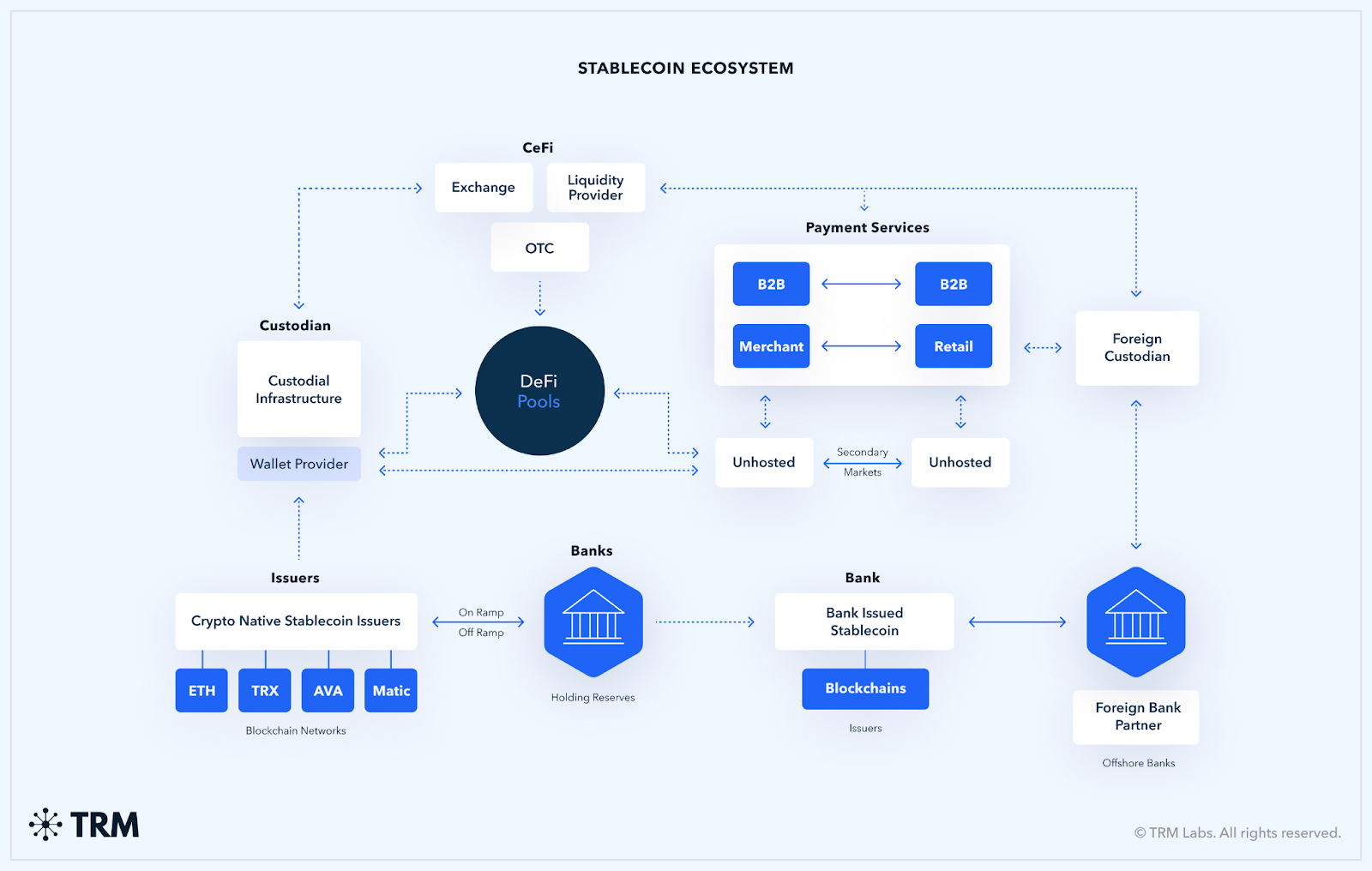
Decoding the GENIUS Act: Key provisions and their implications
The GENIUS Act — short for Guiding and Establishing National Innovation for US Stablecoins — introduces a tiered supervisory framework that covers four key areas:
1. Issuer requirements
Stablecoin providers must maintain full reserves, subject to independent audits. That’s more than an accounting standard — it’s a trust-building mechanism, especially for institutions holding stablecoins at scale. Additionally, issuers will need to have robust anti-money laundering (AML) and sanctions programs in place, very similar to what one would expect at a financial institution.
2. Regulatory oversight
Supervision authority would depend on the issuer’s entity type. Federally chartered banks would work with the OCC, while state-chartered entities might report to the Federal Reserve. This dual model provides optionality while ensuring no issuer escapes scrutiny.
3. Redemption protections
Consumers must be able to redeem stablecoins at par — a direct response to past volatility and depegging events.
4. Enforcement clarity
The bill defines enforcement pathways more cleanly than past legislative attempts. This is crucial for avoiding agency turf wars and regulatory arbitrage.
Armstrong noted, “The GENIUS Act legitimizes stablecoins with the expectation that they’ll be regulated to the same degree as other financial products.”
Where compliance teams should focus first
The time to get ahead of the changing compliance expectations laid out by the GENIUS Act is now. “Historically, compliance teams have waited for final rules,” Redbord noted. “But blockchain technology moves so fast that compliance teams need to prepare now in order to keep pace.”
He outlined three areas that demand immediate attention:
1. Risk exposure
Financial institutions should understand what specific nexus points they have to stablecoin issuers (e.g. banking reserves, operating account, on and off-ramp settlement accounts) and have controls commensurate with that exact risk profile. To help in the diligence process for relationships with issuers, the GENIUS Act lays out the specific requirements that issuers must have in their anti-money laundering program.
2. On-chain behavioral monitoring
Due to the complexity of illicit laundering typologies, merely screening addresses is unlikely to be sufficient. Blockchain intelligence should augment how you monitor transaction behavior, frequency, counterparty types, and deviations from normal and expected activity.
3. Lawful order ready
The GENIUS Act contains unique provisions focused on the technical capability to seize, freeze, burn or prevent transactions. Issuers need to have the right procedures in place in order to be compliant with those express provisions.
The upshot? Institutions either partnering with stablecoin issuers or considering becoming an issuer themselves can implement best practices today to immediately mitigate risks and bolster their control environments.
Zooming out: Global regulatory harmonization is accelerating
Both Armstrong and Redbord agreed that the GENIUS Act is part of a much broader trend — one that spans jurisdictions. Redbord drew comparisons with the EU’s Markets in Crypto Assets (MiCA) framework, which imposes reserve disclosure and authorization requirements on stablecoin issuers. In Singapore, the Monetary Authority has introduced similar requirements. And the UK is also moving to bring certain fiat-backed stablecoins into systemic regulation.
“This is not a US-only question,” Armstrong said. “We’re seeing regulatory regimes start to align on core principles: 1:1 backing, robust AML controls, and auditability.”
Redbord added that this convergence is an opportunity — not a threat. "Smart firms are mapping requirements across jurisdictions now so they can scale compliance, not just react to it."
In practice, that means compliance teams must start evaluating how their internal controls and vendor stack support multi-jurisdictional risk monitoring. For example, does your screening solution flag entities sanctioned by multiple regimes? Can you detect unusual stablecoin flows in real time? If the answer is no, it may be time to reassess.
{{blogad-become-a-genius-stablecoin-risk-management}}
Illicit finance isn’t just a talking point — it’s a policy driver
While fiat-backed coins are overwhelmingly used for legitimate activity, they are also attractive to bad actors because of their liquidity and borderless nature. "We’re seeing stablecoins in everything from phishing scams to ransomware payouts," Redbord noted. “And regulators are watching. That’s part of what’s motivating the GENIUS Act.”
He walked through a few trends law enforcement and policymakers are tracking:
- Use of stablecoins by sanctioned groups to avoid fiat rails
- Mule accounts linked to romance and impersonation scams
- Flash laundering, wherein stablecoins move across multiple chains in seconds
Armstrong highlighted that future compliance and enforcement trends may look not just at individual transactions with illicit actors, but at larger threat networks where funds move across borders at the speed of the internet. “When laundering typologies move this quickly, information and intelligence sharing between public and private sectors becomes absolutely essential.”
To counter the speed and agility of threat actors with intelligence sharing, TRM recently launched the Beacon Network, the industry’s first real-time crypto crime response network — built in collaboration with both public sector enforcement agencies as well as some of the largest exchanges in the world.
Proactive steps for a post-GENIUS world
The GENIUS Act may now be the law of the land, but the real work lies in implementation — a responsibility that falls in part to the US Treasury, which has already issued a request for information and is looking to market participants to help shape the rules.
Redbord and Armstrong offered a checklist of proactive steps:
- Inventory your stablecoin exposure across products, users, and counterparties
- Benchmark your controls and diligence frameworks against the standards proposed in the bill
- Invest in blockchain intelligence that supports cross-chain, real-time monitoring — especially as illicit actors become more nimble
- Educate your stakeholders — including product, legal, and executive teams — on the implications of the upcoming legislation
“Use this moment to upgrade,” Armstrong advised. “The GENIUS Act makes clear that technical compliance with regulations is not the bar — it’s effectiveness. You have to show your program works.”
Looking ahead: Enforcement clarity, market stability, and responsible innovation
To close out the session, Redbord emphasized that the goal of regulation is not to stifle innovation, but to secure it. “The GENIUS Act is a recognition that this space is real. That it’s important. And that it needs rules of the road.”
Armstrong agreed. "What we need is regulatory certainty. Markets hate ambiguity. This bill helps fill in the blanks."
For crypto compliance teams, this isn’t the end of the story — it’s the beginning. As the GENIUS Act implementation evolves, so will the expectations around what strong compliance looks like in a stablecoin-centric world.
TRM will continue to track the legislation, publish insights, and support teams preparing for this next chapter in crypto regulation.
More resources for stablecoin compliance and risk management
- Learn how TRM helps compliance teams manage stablecoin risk and maintain compliance
- Banking on Stablecoins: A risk mitigation blueprint for financial institutions
- TRM Talks: The Road to CLARITY: Talking Crypto Legislation with Congressman Bryan Steil
- TRM Talks: Former Treasury Official and Circle's Caroline Hill Talks Stablecoin Compliance, Policy, and Regulation
- TRM Talks: Covering Crypto in America — From Stablecoins to the SEC, Eleanor Terrett Tracks a Shifting Policy Landscape
- TRM Talks: Financial Inclusion and the Case for Stablecoins with Circle’s Dante Disparte
- Glossary: Stablecoins 101
{{horizontal-line}}
Frequently asked questions (FAQs)
1. What is the GENIUS Act?
The GENIUS Act (Guaranteeing Effective National Innovation Using Stablecoins Act) is a proposed US law that would establish reserve requirements, oversight mechanisms, and consumer protections for stablecoin issuers.
2. What types of stablecoin issuers would be regulated?
Both bank and non-bank issuers. Regulatory oversight would depend on the issuer's charter — e.g. the OCC for national banks or the Federal Reserve for non-bank entities.
3. Is this aligned with global frameworks like MiCA?
Yes. Like MiCA, the GENIUS Act includes 1:1 reserve requirements, audit standards, and redemption assurances.
4. How does this affect exchanges or DeFi protocols?
Any platform interacting with stablecoins must assess exposure to non-compliant or offshore issuers. Risk management policies will likely require updates.
5. Are stablecoins used in illicit finance?
Yes. They are often used in fraud schemes, ransomware payments, and cross-border evasion. For example, a 2024 analysis from TRM found that, despite growing interest in privacy coins like Monero, stablecoins remain the primary choice for terrorist financing organizations. Blockchain intelligence helps detect and mitigate such risks.
6. What is behavioral intelligence in the context of stablecoin compliance?
Rather than focusing solely on wallet addresses, behavioral intelligence analyzes transaction patterns, counterparties, and flows to surface risk more accurately.
7. What should compliance teams do now?
Conduct a stablecoin exposure audit, invest in transaction monitoring tools, and begin mapping controls to the proposed standards.
8. Will there be more guidance from regulatory agencies?
Likely. While GENIUS has passed and is the law of the land, regulatory agencies will issue rules, examination procedures, and interpretive guidance to implement the law.
9. How can TRM help?
TRM Labs provides real-time blockchain intelligence that helps compliance teams monitor stablecoin flows, detect anomalies, and meet evolving regulatory expectations.