Historic U.S.–U.K. Operation Targets Southeast Asia’s Scam Compounds with Record $15 Billion Bitcoin Seizure

In an unprecedented show of force, the United States and United Kingdom today announced the largest coordinated action ever targeting Southeast Asia’s vast scam-compound economy — an intertwined web of online fraud, human trafficking, and cryptocurrency-based money laundering.
The operation marks a historic convergence of criminal charges, sanctions, and regulatory measures: U.S. prosecutors unsealed an indictment charging Cambodian tycoon Chen Zhi, chair of the Prince Group, with orchestrating a global “pig-butchering” empire built on forced labor and fraud; the U.S. Department of Justice announced the largest forfeiture in history — 127,271 bitcoin worth roughly USD 15 billion; the U.S. Treasury’s Office of Foreign Assets Control imposed sanctions on 146 individuals and entities tied to the Prince Group network; and the Financial Crimes Enforcement Network invoked Section 311 of the USA PATRIOT Act to designate the Huione Group — a key financial enabler of the region’s scam ecosystem — as a primary money-laundering concern.
Together with parallel U.K. asset freezes and travel bans, these actions reflect a unified, whole-of-government and multilateral strategy to dismantle transnational criminal infrastructure. According to TRM research, since 2023, at least USD 53 billion in cryptocurrency was sent to fraud-related addresses — a figure that is likely still underreported. Over the past few years, we’ve seen thousands of new investment scam and phishing websites being deployed each month, and received thousands of reports from Chainabuse, the largest publicly available reporting platform for illicit crypto activity. Fraud figures are also likely to rise over time as more instances are found, due to delayed fraud reporting by victims.
The Network
The network at the center of the operation is controlled by Chen Zhi, a Cambodian national and chair of The Prince Group, one of Cambodia’s largest corporate conglomerates. U.K. and U.S. authorities accuse Chen and his associates of orchestrating a multi-billion-dollar enterprise that used fraud compounds across Cambodia, Myanmar, and Laos to enslave and coerce victims into perpetrating global “pig-butchering” scams—large-scale online fraud schemes in which victims are groomed through fake relationships and tricked into investing in bogus cryptocurrency platforms. These centers were allegedly guarded by armed personnel, with workers beaten, trafficked, or sold between compounds if they resisted.
U.K. Actions
In the United Kingdom, the Foreign, Commonwealth & Development Office (FCDO) and the Home Office imposed asset freezes and travel bans on Chen Zhi, his wife Sumi Zhi, and a web of affiliated companies and associates. The action specifically targets The Prince Group, Jin Bei Group, Golden Fortune Resorts World Ltd., and Byex Exchange, which investigators believe laundered profits through complex shell structures and high-value U.K. real estate. British authorities froze a £12 million mansion in North London, alongside several additional assets connected to The Prince Group’s executives. The U.K. government said the measures were designed to sever the syndicate’s access to the U.K. financial system, disrupt money-laundering operations, and send a clear message that “the U.K. will not be a safe haven for proceeds of modern slavery.”
OFAC Sanctions
In parallel, the U.S. Department of the Treasury’s Office of Foreign Assets Control (OFAC) issued sweeping sanctions designating 146 individuals and entities tied to what it calls the Prince Group Transnational Criminal Organization (TCO). Among those sanctioned are Chen Zhi himself, senior executives, and dozens of shell and holding companies registered across Cambodia, Hong Kong, Singapore, the British Virgin Islands, and the United Arab Emirates. Treasury identified key front entities used to conceal illicit flows, including Prince Bank Plc, Prince Real Estate Group, and numerous affiliates under the Prince corporate umbrella. OFAC’s designations block all property and interests of the listed persons and entities in the U.S. and prohibit any dealings with U.S. persons or through the U.S. financial system.
Notably, the Treasury action also added four Bitcoin addresses associated with the network to the Specially Designated Nationals (SDN) List, cutting them off from compliant exchanges and virtual asset service providers worldwide. These addresses were linked to wallets that received, mixed, and redistributed millions in proceeds from investment and romance scams operated out of the Prince Group’s compounds.
FinCEN Designates Huione as a Primary Money-Laundering Concern
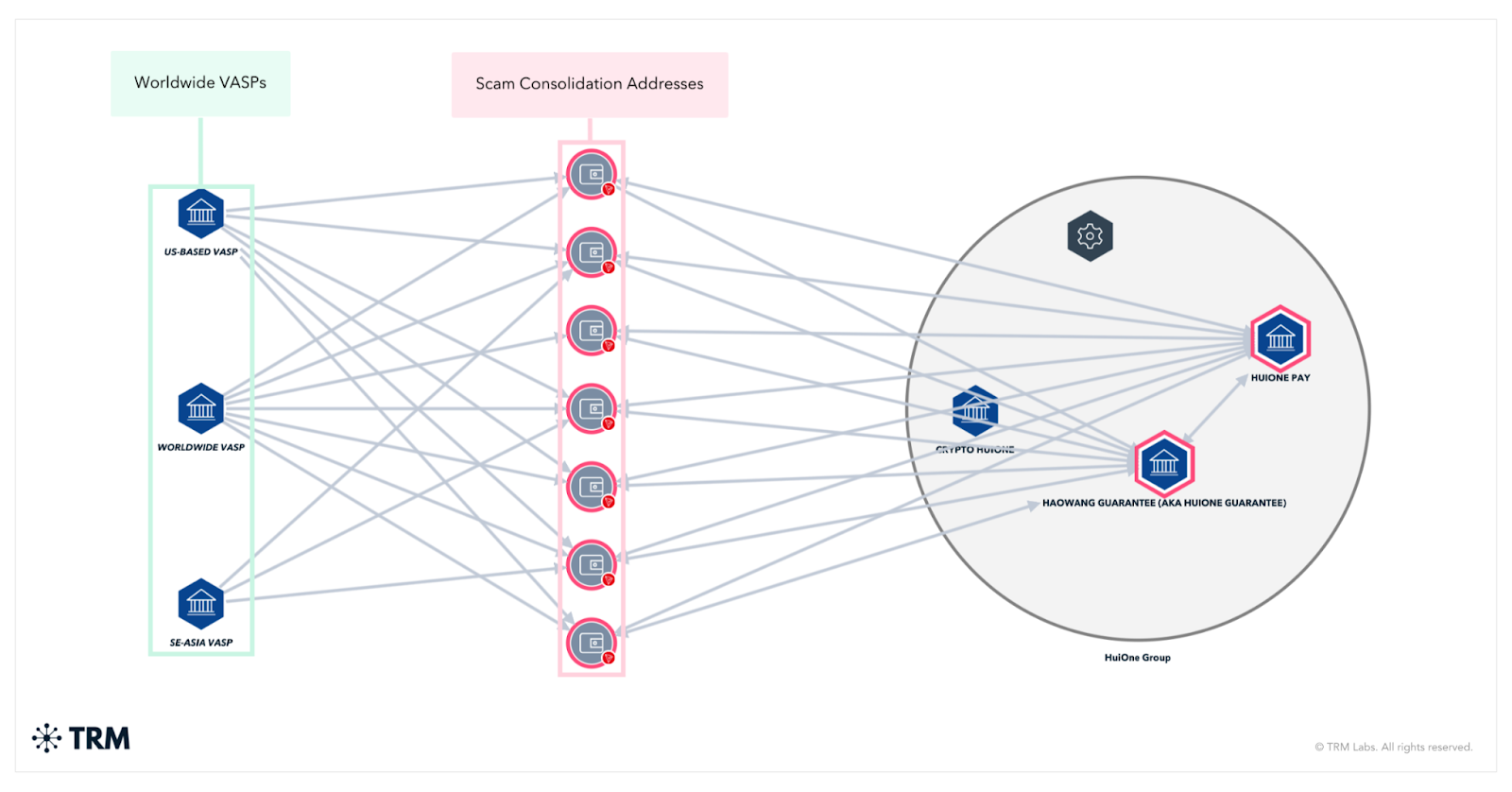
Alongside OFAC’s designations, FinCEN took an additional step by invoking Section 311 of the USA PATRIOT Act to designate Huione Group, another Cambodia-based financial and communications conglomerate, as a primary money-laundering concern. FinCEN found that Huione provided financial infrastructure to multiple Southeast Asian fraud networks, facilitating over USD 4 billion in suspicious transactions linked to online investment fraud, human trafficking, and cybercrime—including laundering proceeds for actors tied to North Korean cyber-heist activity. The 311 designation effectively prohibits U.S. financial institutions from maintaining correspondent accounts for Huione or processing any transactions on its behalf, cutting the company off from the global banking system.
US DOJ Unseals Indictment and Files Record Forfeiture Action
In addition to Treasury’s actions, the U.S. Department of Justice announced that an indictment was unsealed today in federal court in Brooklyn charging Prince Group founder Chen Zhi with wire fraud conspiracy and money laundering conspiracy for directing Prince Group’s operation of forced-labor scam compounds across Cambodia. Individuals held against their will in the compounds engaged in cryptocurrency investment fraud schemes, known as “pig butchering” scams, that stole billions of dollars from victims in the United States and around the world. The release mentioned that the defendant is at large.
Perhaps most notably, in addition to the criminal charges, the U.S. Attorney’s Office for the Eastern District of New York and the Justice Department’s National Security Division also filed a civil forfeiture complaint against approximately 127,271 Bitcoin, currently worth approximately USD 15 billion, that are proceeds and instrumentalities of the defendant’s fraud and money laundering schemes, and were previously stored in 25 unhosted cryptocurrency wallets whose private keys the defendant had in his possession. Those funds are presently in the custody of the U.S. government. The complaint is the largest forfeiture action in the history of the Department of Justice.
According to TRM, the majority of funds tied to these addresses consolidate almost immediately into a single cluster currently holding approximately USD 14.13 billion in Bitcoin, with the remainder routed through intermediary hops to other unhosted wallets and global exchanges before reconnecting to the same cluster. The Department of Justice confirmed that this cluster corresponds to roughly 127,271 Bitcoin, valued at nearly USD 15 billion, which are alleged proceeds of Chen Zhi’s fraud and money laundering schemes. Dormant since December 2020, the funds are now believed to be under U.S. government control—enabling what is officially the largest civil forfeiture action in Department of Justice history.
.png)
A Model for Transnational Enforcement
The U.S. Treasury emphasized that the combined OFAC and FinCEN actions reflect a whole-of-government strategy to dismantle networks that merge forced labor, digital fraud, and cryptocurrency-based laundering into a single criminal ecosystem. Officials said the coordinated campaign—undertaken in collaboration with the U.K., Australia, and other allies—represents the largest joint sanctions action ever against a scam-compound network.
Both governments underscored that the victims of these operations include people from across Asia, Africa, and Latin America who were trafficked and enslaved, as well as millions of global investors defrauded through sophisticated online schemes.
Taken together, the U.K. and U.S. actions represent a new model of transnational enforcement that fuses financial intelligence, sanctions, and anti-trafficking measures to pursue illicit finance at its source. By striking simultaneously at the criminal leadership, its commercial fronts, its blockchain-based wallets, and its laundering pipelines, the operation aims to degrade both the human and financial dimensions of the network. Officials from both countries signaled that additional multilateral actions, including further sanctions and asset seizures, are expected in the coming months as part of an ongoing global campaign to eliminate the scam-compound economy.