Joining Forces to Combat Wildlife Trafficking: How Technology and Shared Intelligence Can Disrupt a Global Scourge

TRM User Conference
Which mission will you select?
Wildlife trafficking is one of the largest criminal enterprises on earth. It’s estimated to generate between USD 23 billion and USD 281 billion annually — with the lower band counting only direct trade, and the upper band counting the full web of connected crimes, including drug trafficking, arms dealing, money laundering, corruption, and other environmental crimes. It affects roughly 4,000 plant and animal species, spreads zoonotic disease, and finances the same transnational criminal networks that also move fentanyl, weapons, and people across borders.
TRM Labs is partnering with United for Wildlife, founded by Prince William and The Royal Foundation, to use blockchain intelligence and financial network analysis to combat this problem at scale for the first time. The partnership includes a new intelligence-sharing platform operated by TRM called Project Pangolin and an extension of TRM's Beacon Network to include wildlife trafficking proceeds. An additional working group of six crypto analytics firms and exchanges will partner to identify and disrupt the digital financial infrastructure behind the trade.
{{horizontal-line}}
Key takeaways
- Wildlife trafficking generates up to USD 281 billion annually when linked crimes are included, making it one of the largest criminal enterprises on earth. To date, the financial side of this trade has been almost entirely absent from enforcement efforts.
- Traffickers are increasingly using cryptocurrency to fund their activities because blockchain transactions are fast, borderless, and bypass traditional financial surveillance.
- TRM Labs is partnering with United for Wildlife to map trafficking financial networks, extend the Beacon Network to freeze wildlife trafficking proceeds, and launch Project Pangolin as a free intelligence-sharing platform for governments, companies, and nonprofits.
{{horizontal-line}}
The shape and size of the problem
Between 2015 and 2024, approximately 370 metric tonnes of pangolin scales and 193 metric tons of rhino horn were confiscated around the globe.
Vietnam was implicated in at least 30% of elephant ivory seizures and 24% of pangolin scale seizures by weight, functioning as the primary transit point for products flowing from Africa into China. South Africa — home to an estimated 54% of the world's remaining rhino population — reported 420 rhinos poached in 2024 alone, which translates to more than one rhino killed every single day.
The broader environmental crime ecosystem anchored by wildlife trafficking generates up to USD 281 billion annually. Transnational organized crime groups have embedded themselves so deeply in this trade that the Wildlife Justice Commission (WJC) has documented extensive convergence. The same networks that ship ivory also traffic narcotics, run extortion operations, and engage in corrupt facilitation across multiple countries. One Vietnamese national investigated by the WJC held assets including a USD 12 million mansion, multiple farms, luxury vehicles, and financial interests spanning Africa and Southeast Asia.
How the trade works and how the money moves
Wildlife trafficking is structured, hierarchical, and financially sophisticated. The networks dominating the trade of high-value animals and materials — including ivory, rhino horn, tiger parts, and live great apes — operate across multiple continents, rely on professional logistics infrastructure, and launder their proceeds through the same layering techniques utilized in drug trafficking and sanctions evasion. Corruption is a foundational operational mechanism, enabled by officials, port inspectors, and customs agents who enable shipments to move.
As noted in a 2022 report by the Wildlife Justice Commission, a typical ivory or rhino horn operation involves poaching crews paid in cash across sub-Saharan Africa; brokers who aggregate product and arrange export logistics; shipping networks that use containerized freight to conceal goods within legitimate commercial cargo including frozen food, timber, and construction materials; and importers concentrated in Southeast Asia and China who facilitate retail distribution and final payment. Each handoff in that chain involves a financial transaction. Some move through wire transfers or mobile money. But an increasing number move through cryptocurrency.
Cryptocurrency has become attractive to wildlife trafficking networks for the same reasons it has attracted other transnational criminal enterprises: it is fast, borderless, and requires no correspondent banking relationship. Funds can move from Mozambique to Vietnam in seconds without passing through a financial institution required to file a suspicious activity report. For networks that have historically relied on cash and informal value transfer, it provides the speed of wire transfer without the surveillance exposure.
Embracing a digital marketplace
The trade has also moved online in ways that simultaneously complicate enforcement and create new analytical opportunities. Wildlife products are now advertised on large e-commerce platforms alongside ordinary consumer goods — sometimes coded in language designed to evade automated detection, sometimes openly listed in jurisdictions with weak enforcement.
Consumer demand can vary by geography. For example, wildlife products are rarely advertised on Western darknet marketplaces. This appears to be driven primarily by a lack of consumer demand, as the typical user base is generally focused on drugs, cybercrime-related services, and other illicit goods rather than wildlife products. In addition, many Western darknet marketplaces maintain rules that prohibit or discourage listings likely to attract controversy or increased law enforcement scrutiny, creating further disincentives for wildlife trafficking vendors. By contrast, wildlife products are more commonly observed on Chinese guarantee services and darknet marketplaces, where consumer demand for such items is higher.
The prolific rise of Chinese guarantee services has also further facilitated the growth of the digital sales of illegal wildlife products. As documented in TRM’s 2025 Crypto Crime Report, guarantee services have become a central layer of cross-border laundering, especially for Chinese money laundering organizations (CMLOs) operating across Asia-Pacific. These services have processed over USD 135 billion since 2022.
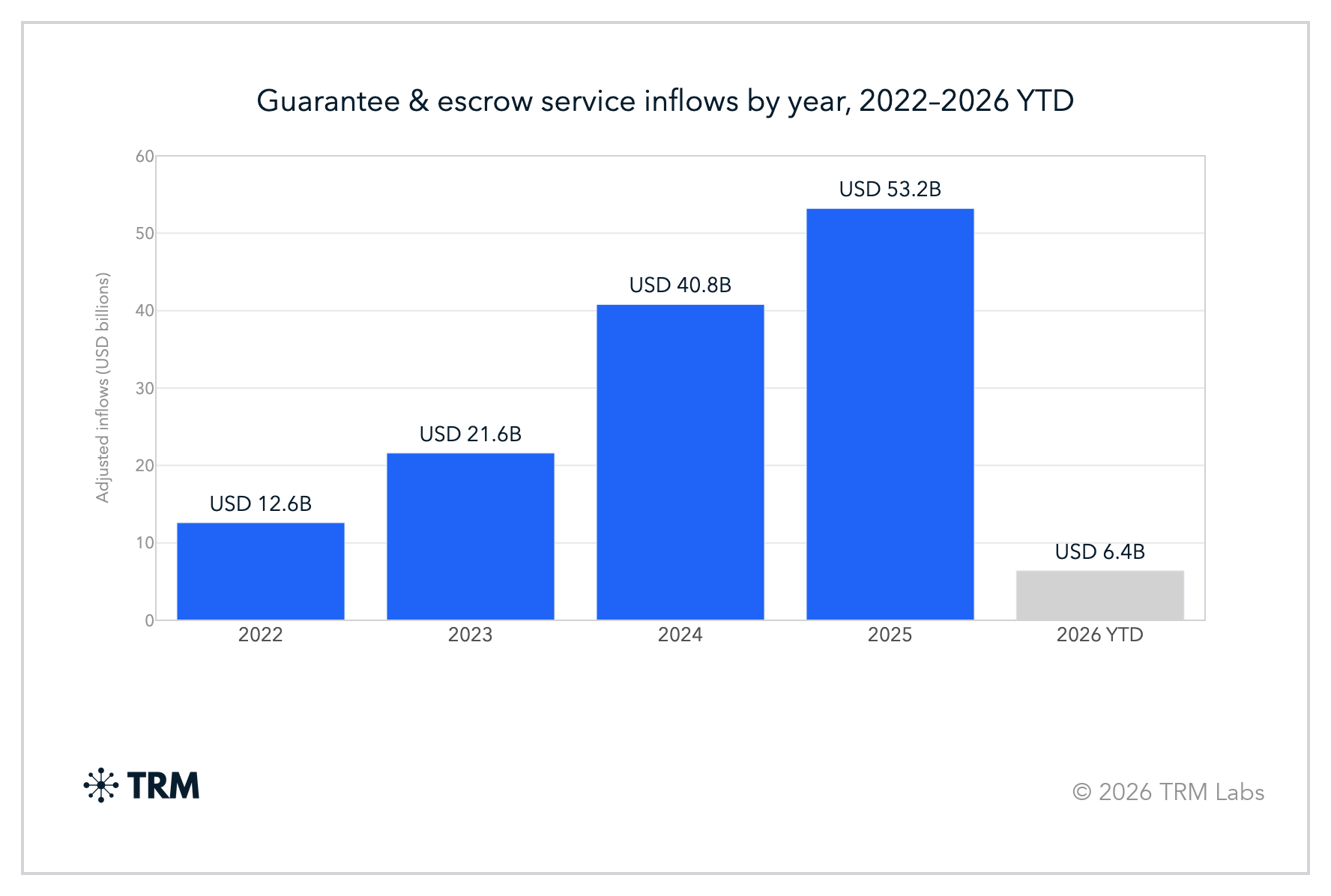
These guarantee services are now advertising for the sale of these wildlife poached products. Vendors that operate through guarantee may benefit from the platform's reputation as a trusted intermediary, which can increase buyer confidence and reduce concerns about fraud when purchasing illicit wildlife products. For larger transactions, routing through Guarantee-associated wallets may also add an additional layer of separation between counterparties, making transaction flows more difficult to trace.
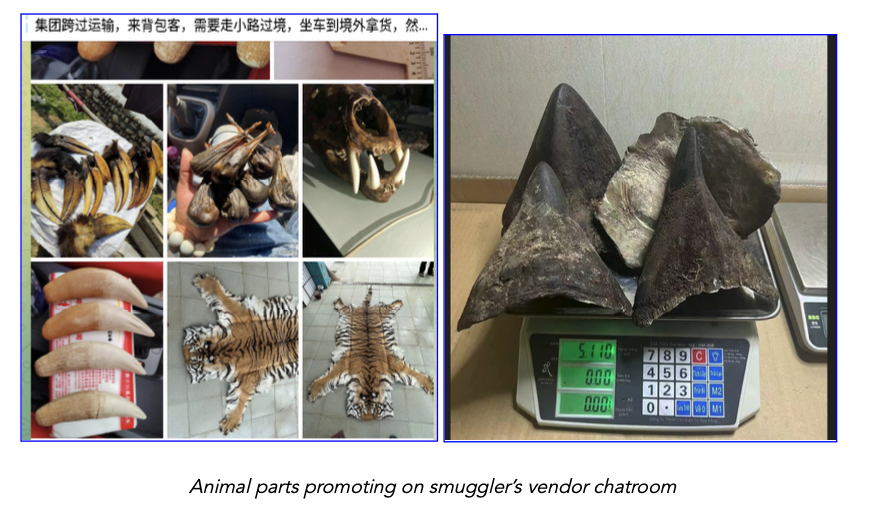
Another Chinese-language wildlife-product vendor operates an open storefront on Telegram under the brand “DNY” (东南亚野生土特产 / “Southeast Asian Wild Local Specialties”; also advertised as 钰龙东南亚野生土特产). The vendor advertises a full catalogue of products derived from CITES Appendix I endangered species and openly publishes photographs of carcasses, skins, bones, and horns alongside a single TRON (TRC-20 USDT) payment address.

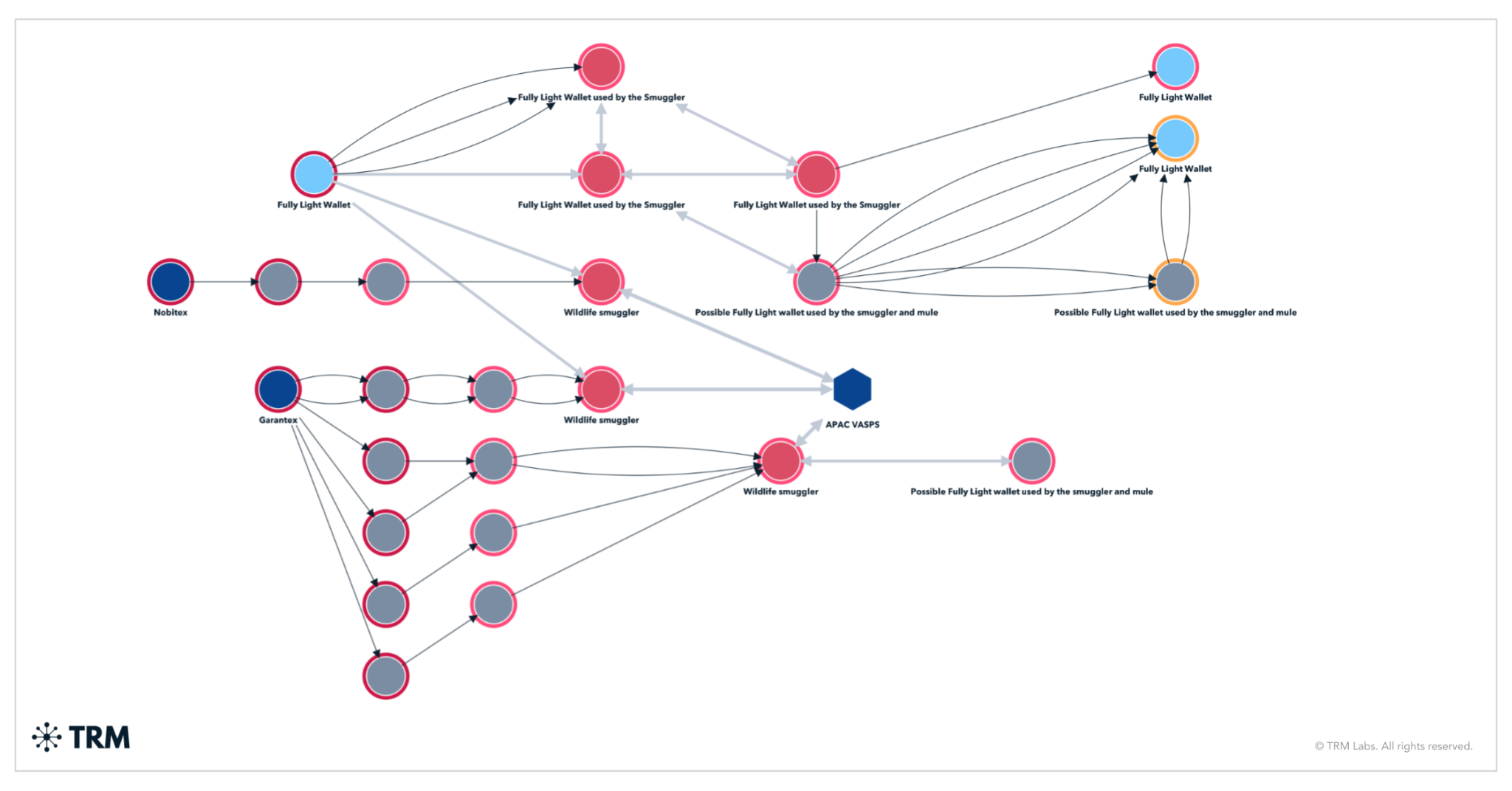
Smugglers and distributors plug into preexisting financial networks such as guarantee services and proceed to move money through a network of wallets.
In one case (shown below), TRM traced roughly USD 15 million in cryptocurrency through five wallets tied to the smugglers, almost entirely in USDT, moving through Fully Light — a no-KYC (Know Your Customer) wallet and guarantee service run by a casino conglomerate in Myanmar's Kokang region. The flows form a recognizable laundering pattern. Funds enter from Fully Light wallets, pass into wallets the smugglers control, and are then split across smaller wallets likely shared with mules before being cashed out through other Fully Light wallets. Individual transfers range from a few thousand dollars to tens of thousands of USDT, small enough to blend into the service's broader traffic, but visible and traceable on-chain from beginning to end.
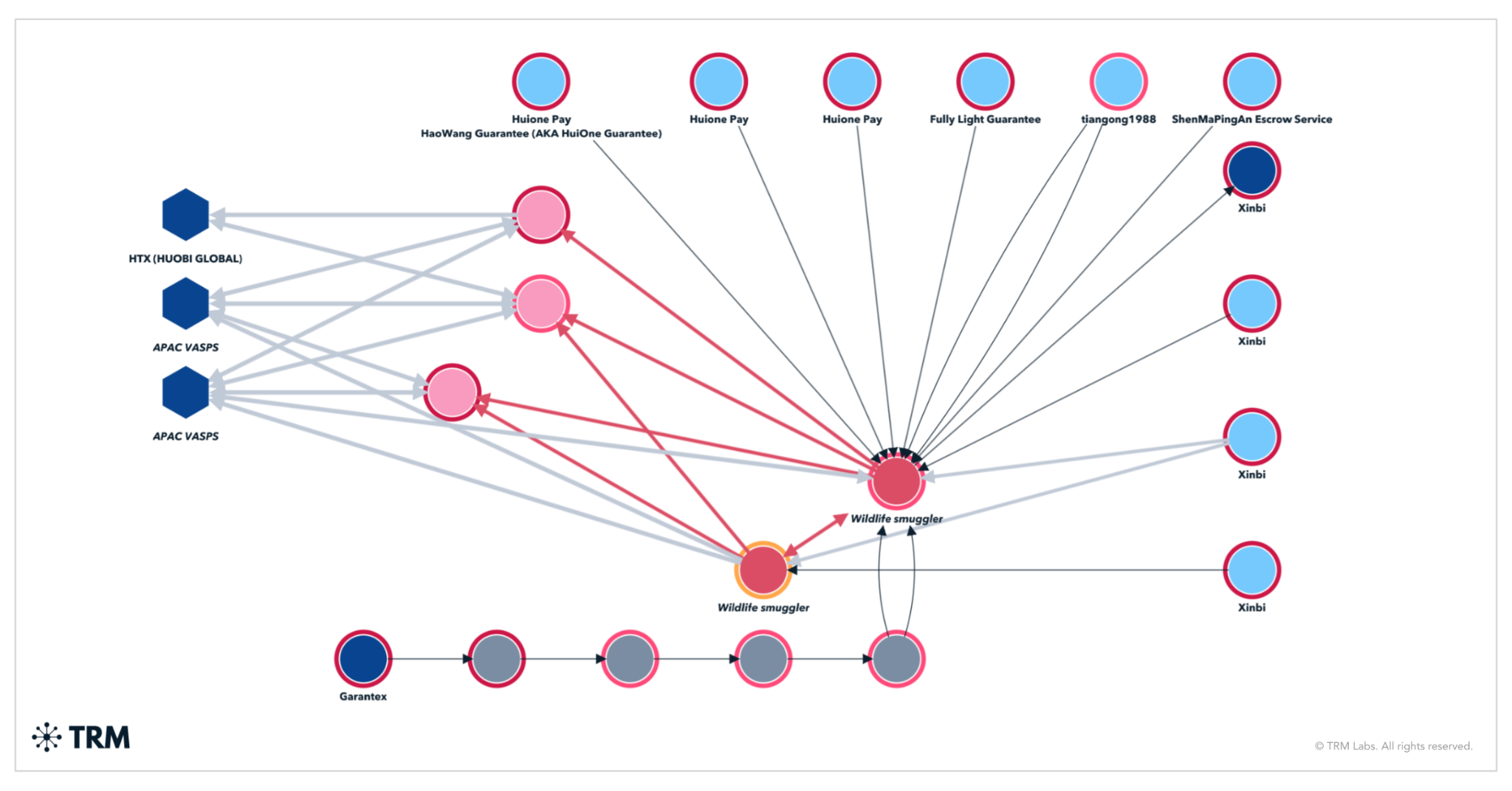
Some of the identified traffickers are connected to high-risk financial networks that include not only guarantee services, but also now-sanctioned entities like Garantex. These virtual asset service providers (VASPs) are shown on the left in the figure below. The smuggler — shown in red — uses pass-through wallets (in pink) to send funds prior to cashing out at these VASPs. In the case below, a security deposit was also sent to the blue Xinbi wallet on the right. The Garantex connection could also indicate a potential Russia-based buyer, although this is unconfirmed. The wallet labelled “tiangong1988” provides bailout services, which help smugglers or criminals who get caught and sent to jail.
How AI is enabling progress for protectors
There has already been success in using AI capabilities to combat wildlife trafficking. In 2024, members of the Coalition to End Wildlife Trafficking Online reported blocking 24.1 million prohibited wildlife listings and suspected illicit sellers since 2018. By the end of 2025, that number had climbed to 63.3 million, driven significantly by AI-powered detection tools deployed by Alibaba, Meta, and others.
LLM-based classifiers trained on marketplace listings are now achieving up to 95 percent accuracy in identifying wildlife trafficking advertisements at a scale no human review team could approach. Now, image detection models are being integrated into platform enforcement workflows. The digital surface area of this crime is, for the first time, readable at scale.
But identifying and removing a listing leaves other critical infrastructure intact. The wallets, exchange accounts, and layering infrastructure remain operational after the seller disappears from a platform. Closing that gap is precisely what TRM's partnership with United for Wildlife is designed to accomplish.
TRM's platform uses machine learning to identify behavioral patterns in blockchain data that correlate with illicit activity — clustering algorithms that group wallets controlled by the same entity, anomaly detection that flags unusual transaction patterns, and graph analytics that trace the movement of funds through complex layering structures. These tools were built and refined against the most sophisticated crypto-native crime typologies, including darknet market activity, ransomware payments, state-sponsored theft, and obfuscation services.
Applying them to wildlife trafficking means training models on the specific financial signatures of this crime category — the payment patterns between poaching networks and their brokers, the off-ramp behavior of trafficking proceeds, and the geographic clustering of wallet activity around known trafficking corridors.
That training depends on financial intelligence data, which is one reason the Project Pangolin intelligence-sharing platform is central to the effort. The more data that flows into a shared analytical environment, the more precisely the models can identify previously unknown trafficking wallets and networks. This is the same feedback loop that has made TRM's tools effective against other crime types over years of deployment.
Why disrupting the financial infrastructure is critical
For most of the history of wildlife enforcement, success was measured in physical seizures — tonnes of ivory, kilograms of rhino horn, numbers of live animals rescued. Seizure-focused enforcement, even when operationally successful, leaves the financial infrastructure of trafficking networks untouched. The WJC's sustained disruption of Lagos-based ivory and pangolin networks drove trafficking activity almost to a halt in Nigeria — but those networks shifted to other corridors and countries.
Follow-the-money enforcement in other crime domains — drug trafficking, terrorism financing, sanctions evasion — has proven consistently more durable than seizure-focused approaches. Dismantling the financial network makes the crime unprofitable. It raises the cost and risk of participation at every level of the hierarchy, and creates conditions under which criminal organizations stop operating rather than simply rerouting a specific shipment.
What TRM is building
TRM's work with United for Wildlife centers on three interconnected capabilities.
1. Financial network mapping
TRM is building a dedicated analytical team to trace the financial flows behind the global wildlife trade — identifying who pays whom, how proceeds are moved and laundered, which wallets and exchange accounts are being used, and how the financial infrastructure of specific networks is structured.
TRM has already analyzed one network moving tiger parts, ivory, and rhino horn across Southeast Asia, operating across China, Myanmar, Vietnam, and Thailand and coordinated from Cambodia. That analysis traced approximately USD 15 million in cryptocurrency through network accounts. Applied systematically across the major trafficking corridors, this kind of work produces the financial intelligence picture that enforcement agencies currently lack.
2. Network-level disruption through Beacon Network
TRM's Beacon Network connects more than 150 organizations — covering roughly three-quarters of all global crypto trading volume — in a real-time alert system that enables participating institutions to freeze criminal funds before they can be cashed out. When illicit funds are identified and flagged by one Beacon member, the intelligence moves through the network so other members can act quickly before the funds move again.
3. Intelligence-sharing through Project Pangolin
Project Pangolin is a free-to-join intelligence workspace where governments, companies, and nonprofits pool data on wildlife trafficking and convert it into cases law enforcement can act on. Financial intelligence about this crime typology currently exists in fragments across dozens of organizations. Connecting blockchain data with seizure records, financial institution intelligence, and open-source information produces a picture that no single organization can develop alone.
TRM is also participating in a working group of technology, payments, and crypto companies, coordinated by United for Wildlife, to develop shared typologies and red flags for wildlife trafficking activity on crypto platforms. The goal is for compliance teams at financial institutions and fintechs to treat wildlife trafficking proceeds the same way they currently treat ransomware payments or darknet market transactions — with detection tools, alert systems, and a clear obligation to act.
What success looks like
The lesson from other financial crime domains is consistent: sustained, financially focused, intelligence-led disruption changes the economics of criminal activity. When proceeds can be frozen before conversion to cash, financial network maps drive prosecutions of money managers alongside poachers, and crypto exchanges treat wildlife trafficking proceeds as seriously as sanctions violations, the calculus for criminal network participation shifts.
{{horizontal-line}}
Frequently asked questions (FAQs)
1. What is wildlife trafficking and why is it considered a financial crime?
Wildlife trafficking is the illegal trade in protected plants and animals — ivory, rhino horn, tiger parts, live great apes, pangolin scales, and thousands of other species. It generates between USD 23 billion and USD 281 billion annually, depending on whether linked crimes are included, making it one of the largest criminal enterprises on earth.
It's a financial crime because the networks behind it operate like transnational organized crime groups: they use professional logistics infrastructure, launder proceeds through the same techniques as drug trafficking and sanctions evasion, and rely on corruption at every level — from poaching crews to port inspectors to customs agents. Despite this, financial enforcement has been almost entirely absent from wildlife crime efforts. Historically, success was measured in physical seizures — tonnes of ivory, kilograms of rhino horn — while the financial networks behind the trade were left intact and free to fund the next shipment.
2. How are traffickers using cryptocurrency to move money across borders?
Cryptocurrency has become attractive to wildlife trafficking networks for the same reasons it has attracted other transnational criminal enterprises: it's fast, borderless, and requires no correspondent banking relationship. Funds can move from Mozambique to Vietnam in seconds without passing through a financial institution required to file a suspicious activity report.
TRM has traced wildlife trafficking proceeds moving in USDT, routed through no-KYC wallets and guarantee services — most notably Fully Light, a wallet and escrow service operated out of Myanmar's Kokang region. Funds enter from those services, pass through wallets controlled by smugglers, and are then split across smaller wallets — likely shared with mules — before being cashed out. Individual transfers range from a few thousand to tens of thousands of dollars, small enough to blend into the platform's broader traffic but fully visible and traceable on-chain.
3. What is the Beacon Network and how does it freeze criminal funds?
The Beacon Network is TRM's real-time alert system connecting more than 150 organizations — collectively covering roughly three-quarters of all global crypto trading volume. When a Beacon member identifies and flags illicit funds, that intelligence moves immediately through the network so other participating institutions can freeze those funds before they're cashed out or moved again.
The network was designed to close one of the core weaknesses of traditional enforcement: by the time a seizure occurs and intelligence reaches other agencies through official channels, criminal funds have often already been converted. TRM is extending the Beacon Network to include wildlife trafficking proceeds, so exchanges and financial institutions can treat those funds the same way they currently treat ransomware payments or sanctions violations.
4. What is Project Pangolin and who can join?
Project Pangolin is a free-to-join intelligence-sharing platform operated by TRM Labs, launched in partnership with United for Wildlife. It creates a shared analytical workspace where governments, companies, and nonprofits can pool data on wildlife trafficking and convert it into actionable cases for law enforcement.
Financial intelligence on this crime currently exists in fragments across dozens of organizations — no single entity has the complete picture. Project Pangolin connects blockchain data with seizure records, financial institution intelligence, and open-source information to build the kind of comprehensive map that enforcement agencies currently lack. Any government agency, NGO, or company working on wildlife crime or financial crime can join for free.
5. How does TRM's blockchain intelligence work differ from traditional wildlife enforcement?
Traditional wildlife enforcement measures success in physical seizures — intercepting ivory shipments, rescuing live animals, confiscating rhino horn. These operations are critical, but leave the financial infrastructure of trafficking networks untouched. When enforcement disrupts one corridor, networks reroute, enabling the financial managers, brokers, and money launderers that make the trade viable to continue operating.
TRM's approach follows the money. Using machine learning, clustering algorithms, graph analytics, and anomaly detection, TRM maps the financial networks behind the trade — identifying which wallets traffickers use, how proceeds move through layering structures, and which VASPs are enabling cash-out. TRM has already traced approximately USD 15 million in cryptocurrency through one Southeast Asia-based network spanning China, Myanmar, Vietnam, Thailand, and Cambodia. The goal is to dismantle financial infrastructure, not just intercept individual shipments — making the crime unprofitable at the network level.