Crypto Regulation and Illicit Finance in Canada
Canada's evolving crypto risk landscape, recent enforcement actions, and how regulatory measures are reshaping compliance obligations

Key takeaways
- Illicit crypto exposure in Canada is rising: Canada ranked 9th globally on TRM’s 2024 Illicit Crypto Exposure Index, driven primarily by transactions with sanctioned services like Garantex.
- Canadian regulators have implemented a robust crypto framework: Since 2019, crypto exchanges and service providers must register with FINTRAC as money service businesses and comply with AML and securities laws.
- Canada enforces strict guardrails around stablecoins: The Canadian Securities Administrators (CSA) paused stablecoin trading in 2023, pending new safeguards. A provisional framework allows fiat-backed stablecoins under strict conditions.
- Crypto is being used in the fentanyl and synthetic drug trade: Crypto payments to Chinese precursor chemical suppliers surged 600% from 2022 to 2023, with Canada identified as a key destination market.
- Cross-border enforcement is a growing priority: Canadian authorities are increasingly collaborating with global counterparts to trace funds and disrupt illicit crypto flows — as seen in cases like Garantex and the indictment of Andean “Andy” Medjedovic.
{{premium-content_chapter-divider}}
Cryptocurrency adoption in Canada is growing rapidly, bringing both innovative finance opportunities and new risks of illicit abuse. Canadian regulators and law enforcement, in particular, are grappling with how to oversee the crypto sector while preventing crimes like scams, drug trafficking, finance, and sanctions evasion.
According to TRM Labs, Canada ranked #9 on the 2024 Illicit Crypto Exposure Index, meaning Canadian-linked crypto entities had one of the higher proportions of illicit exposure globally. Notably, this exposure was driven in large part by transactions with sanctioned crypto services (e.g. Russian exchange Garantex).
This report provides an overview of Canada’s current crypto regulatory regime and recent updates; the scope of illicit crypto activity affecting Canadian citizens, law enforcement, and regulatory bodies; and how authorities are responding with enforcement and international collaboration.
{{premium-content_chapter-divider}}
Canada’s evolving crypto regulatory regime
Canadian authorities have established a comprehensive regulatory framework for cryptocurrency over the past few years. Since 2019, Canada has required businesses dealing in virtual currency (such as exchanges and payment processors) to register as money service businesses (MSBs) with the federal Financial Transactions and Reports Analysis Centre of Canada (FINTRAC) for anti-money laundering (AML) compliance.
This brought crypto platforms under AML obligations like record-keeping, reporting large or suspicious transactions, and the “Travel Rule” (transmitting sender/receiver information for crypto transfers above CAD 1,000). In addition, since March 2021, Canada has mandated that crypto asset trading platforms comply with securities laws. In practice, the Canadian Securities Administrators (CSA) — the umbrella body of provincial securities regulators — treats most crypto assets as securities and requires exchanges to register as dealers or regulated marketplaces.
The pre-registration undertaking (PRU) requirement
In the wake of high-profile global crypto collapses and scams, Canadian regulators tightened oversight in 2022–2023 to bolster consumer protection. In February 2023, the CSA introduced a new pre-registration undertaking (PRU) requirement for crypto trading platforms seeking registration.
Platforms had to agree to certain conditions while their applications were under review, or exit the Canadian market. These PRU conditions included:
- Segregating client assets with qualified custodians
- Maintaining a chief compliance officer and audited financial statements
- Prohibiting risky services
Stricter guardrails around stablecoins
Notably, platforms were forbidden from offering margin or leverage — or from facilitating purchases of stablecoins — without CSA consent. This effectively put a temporary ban on trading stablecoins (termed “value-referenced crypto assets” by the CSA) until appropriate safeguards were defined.
In October 2023, the CSA acknowledged that stablecoins “may have certain uses” for Canadian users and signaled willingness to allow fiat-backed stablecoins pegged 1:1 to a single currency, subject to strict conditions and transparency. These conditions include being fully reserved by highly liquid assets held with a custodian, redeemable on demand at par value, and accompanied by adequate public disclosure of operations and reserves.
The CSA extended the compliance deadline for platforms to meet stablecoin conditions from April 2024 to December 31, 2024, citing technical integration challenges and inviting industry input on a long-term stablecoin framework.
2024 regulatory actions on crypto exchanges and banks
Canada’s regulatory regime continued to mature through 2024. The year was relatively quiet for new legislation, as many rules were already in place. However, the first major foreign exchange came under the framework: Coinbase successfully registered as a restricted dealer in Canada in April 2024.
In mid-2023, the federal banking regulator — the Office of the Superintendent of Financial Institutions (OSFI) — proposed updated capital and liquidity guidelines to align banks’ crypto asset treatment with international Basel III standards. This would clarify how Canadian banks can hold or deal with crypto (including stablecoins) on their balance sheets and is expected to take effect in 2025. Overall, Canada’s approach balances innovation with a strong emphasis on compliance and investor protection, requiring registration and transparency from crypto businesses and setting standards (such as the stablecoin rules) to mitigate risks to consumers and the financial system.
{{premium-content_chapter-divider}}
Illicit crypto activity in Canada: Scams, drugs, and sanctions exposure
By volume, illicit crypto activity linked to Canada remains a relatively small fraction of overall crypto usage. However, it continues to grow as crypto adoption increases. TRM Labs estimates that 1–5% of the crypto transaction volume received by entities in Canada between January and October 2024 was tied to illicit activity, up from under 1% in 2023.
This pushed Canada into the top ten countries on TRM’s Illicit Crypto Exposure Index for the first time. The illicit activity manifests through multiple threat vectors, notably scams and fraud schemes, financing of the fentanyl and synthetic drug trade, and exposure to sanctioned actors. These often involve cross-border elements, requiring Canadian authorities to coordinate internationally.
Scam-related activity
Investment scams, fraud schemes, and related cybercrime have been a major source of illicit crypto flows globally and within Canada. In 2024, scams and frauds comprised roughly 24% of illicit crypto volume worldwide (second only to sanctions-related volume). Canada has also seen a proliferation of so-called “pig butchering” scams (long-con romance/investment frauds), fake crypto investment platforms, and impersonation scams targeting retail investors. While precise Canada-only figures are scarce, Canadian police and the Canadian Anti-Fraud Centre report millions in losses annually to crypto fraud.
Blockchain data reinforces that scam infrastructure is a significant threat. For example, TRM has identified that one high-volume scam entity contributed heavily to Nigeria’s illicit crypto exposure; similar networks have victimized Canadians. Public reporting tools like Chainabuse also received a steady stream of fraud reports through 2024, indicating scam activity remained persistent.
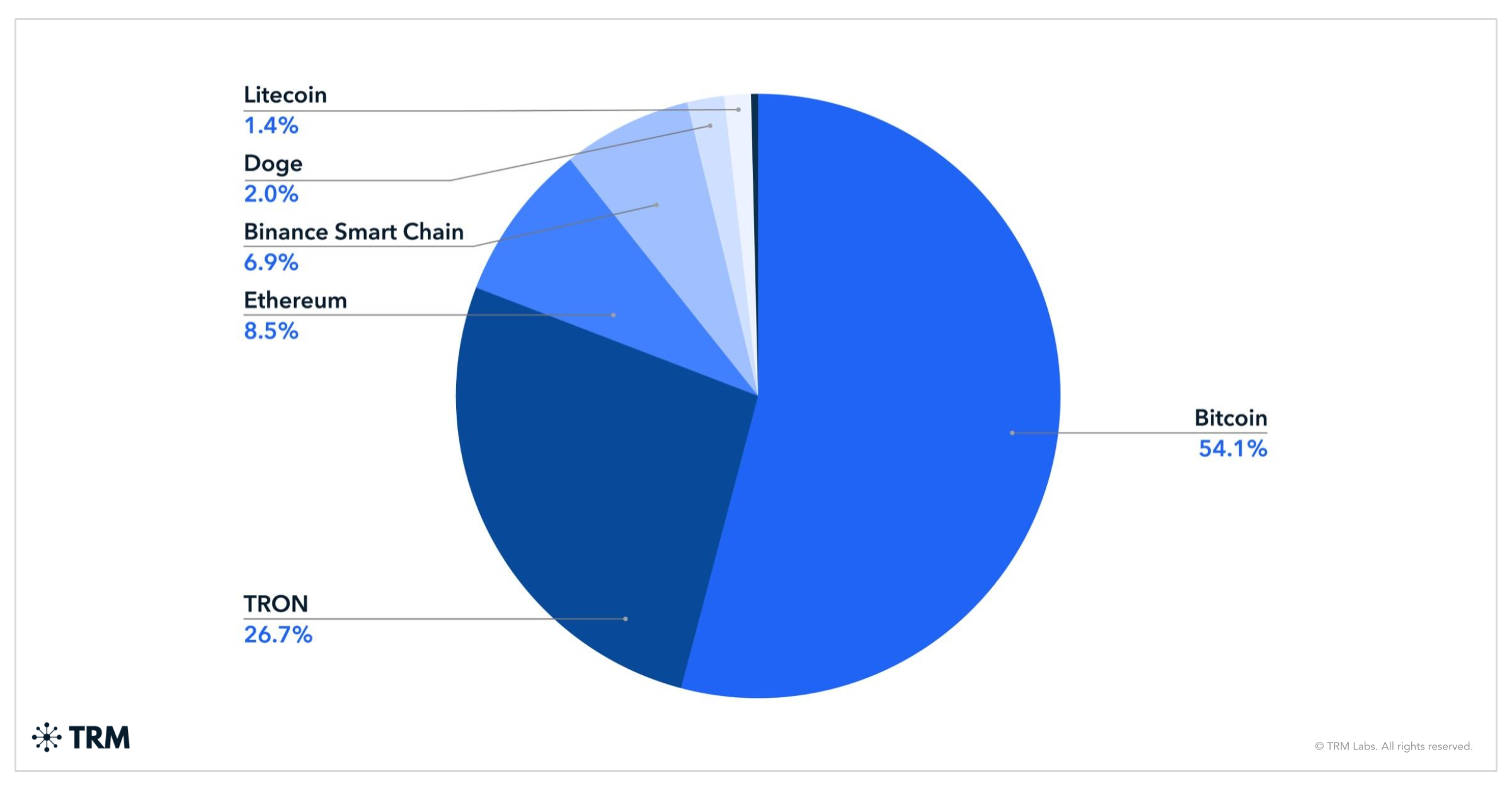
Bitcoin remains the most common cryptocurrency demanded by scammers, though its dominance is slowly decreasing as criminals adopt alternatives. These trends underscore that Canadian citizens and businesses continue to be targeted by global fraud operations leveraging crypto, necessitating strong cyber fraud prevention and victim awareness campaigns.
Crypto’s role in the fentanyl and synthetic drug trade
The opioid overdose crisis — driven by fentanyl and other synthetic drugs — is increasingly funded with cryptocurrency. Of particular concern for Canadian law enforcement is how domestic fentanyl traffickers and precursor chemical importers are using crypto to pay overseas suppliers, obscuring money trails.
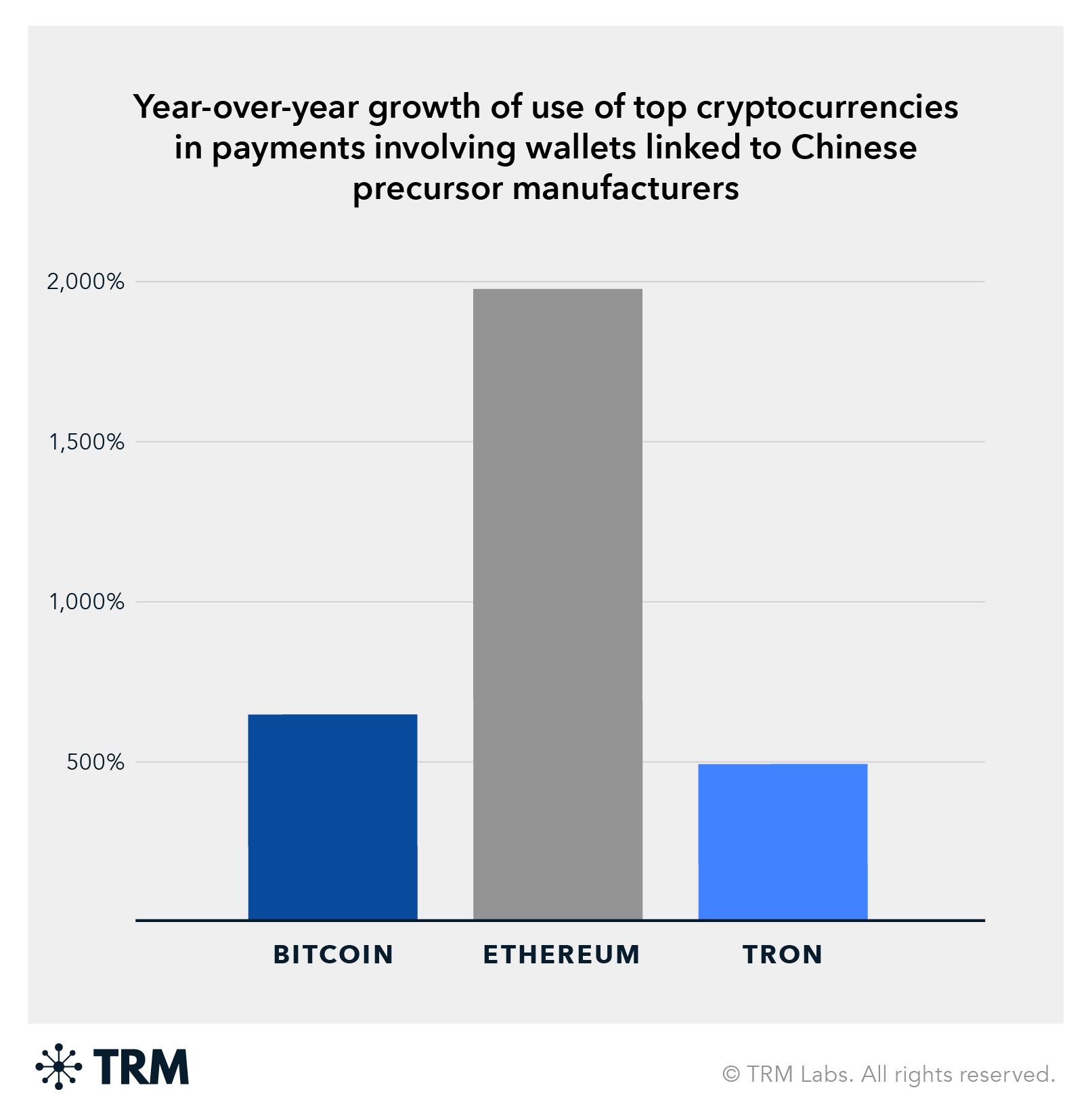
TRM Labs research indicates that Chinese drug precursor manufacturers (key suppliers of fentanyl ingredients) heavily utilize cryptocurrency. Nearly two-thirds of fentanyl precursor sellers studied by TRM advertise to markets including Canada. In 2023, these Chinese suppliers received over USD 26 million in cryptocurrency payments — a 600% increase from 2022.
The first months of 2024 saw volumes continuing to surge year-on-year, until new Chinese government bans on fentanyl precursors in mid-2024 helped dampen crypto flows to these suppliers. Even so, the crypto-fueled synthetic drug trade remains active. TRM’s 2025 Crypto Crime Report noted that online crypto-denominated drug sales by individual vendors (on clearnet websites, social media, etc. — not just the dark web) more than doubled, from USD 289 million in 2023 to over USD 600 million in 2024.
{{managing-risk-in-the-crypto-regulation-and-illicit-finance-in-canada-report-ad}}
This decentralization of drug markets — with vendors embracing crypto and new platforms — enables Canadian traffickers and buyers to transact more covertly. Canadian authorities have linked cases where crypto wallets were used to purchase opioid precursors or launder proceeds of domestic drug sales. Disrupting these flows is challenging, as they span jurisdictions and involve anonymous crypto addresses. However, blockchain intelligence has proven useful: by tracing payments from known precursor supplier wallets, investigators can identify downstream buyers (potentially in Canada) and collaborate with foreign counterparts.
Sanctions exposure: The Garantex connection
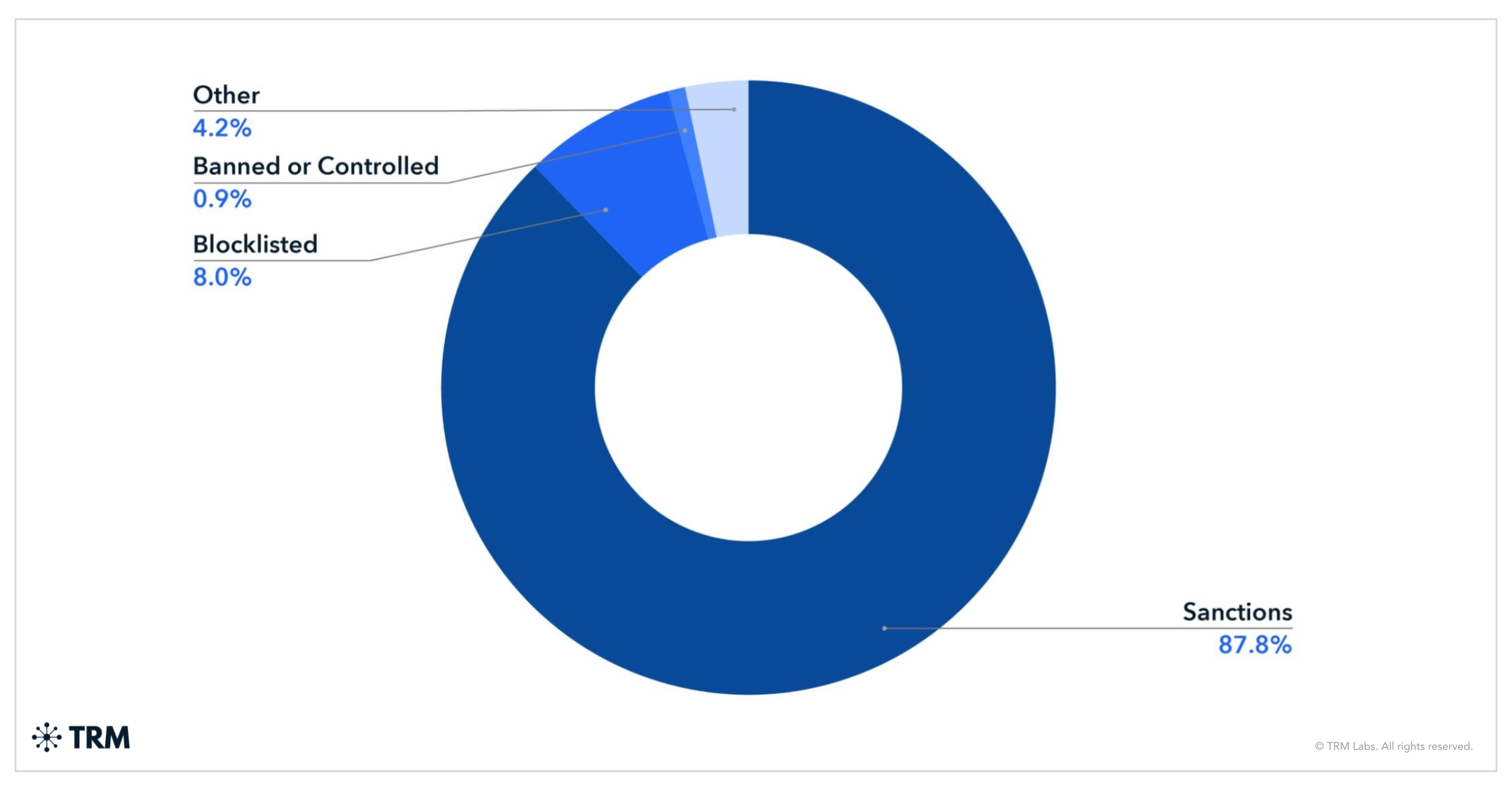
A defining factor in Canada’s illicit crypto risk profile in 2024 was exposure to sanctioned entities. In particular, Canadian-linked crypto addresses transacted with the now-defunct Russian exchange Garantex, which was first sanctioned by the United States in April 2022.
Garantex was infamous as a hub for criminal crypto activity. By 2023, it was responsible for 82% of all crypto volume associated with sanctioned entities worldwide. Even after it was sanctioned, Garantex continued to facilitate ransomware, darknet market, and money laundering transactions on a massive scale.
Some of Garantex’s counterparts were users and businesses in Canada — both wittingly and unwittingly. TRM Labs found that entities in Canada (as well as Georgia, Russia, and others) had significant crypto dealings with sanctioned Russian services like Garantex and associated mixers. This counterparty exposure pushed up Canada’s illicit index ranking, highlighting a broader challenge: even if Canadian exchanges and institutions follow sanctions, individuals can directly access offshore rogue exchanges. It only takes a portion of users engaging in arbitrage or criminal commerce via exchanges like Garantex to taint Canada’s aggregate exposure.
TRM’s Illicit Crypto Exposure Index flagged Canada’s situation as a cautionary example of how gaps in global enforcement can reverberate back home. Notably, Canada’s domestic illicit crypto typologies differ from some peers: unlike jurisdictions whose risk is mostly scam-related, Canada’s 2024 illicit exposure was primarily from sanctions. This suggests Canadian exchanges and banks generally have strong fraud controls, but cross-border sanctions evasion — often involving sophisticated actors — is a weakness that can be exploited by malign actors.
{{premium-content_chapter-divider}}
Enforcement actions and international collaboration
Canadian authorities, together with international partners, have been actively working to disrupt illicit crypto activity through intelligence-led operations and enforcement. Throughout 2024, this took form through multilateral collaboration, reflecting the borderless nature of crypto crime. Law enforcement teams in Canada — including Royal Canadian Mounted Police (RCMP) federal units, provincial police cybercrime teams, and others — are increasingly leveraging blockchain tracing tools and cooperating with foreign agencies to follow the money.
Case study: The indictment of Andean “Andy” Medjedovic
One prominent case illustrating cross-border cooperation was the indictment of a Canadian national, Andean “Andy” Medjedovic, in the United States for a USD 65 million DeFi hack. In 2023, Medjedovic exploited two decentralized finance protocols and laundered the proceeds through complex transactions. The investigation was led by US agencies — Internal Revenue Service Criminal Investigation (IRS-CI), Federal Bureau of Investigation (FBI), and Homeland Security Investigations (HSI) — with critical support from international partners, including the Dutch National Police. Canadian authorities assisted their US counterparts in tracing funds and information sharing.
This example shows Canada’s willingness to pursue its citizens for crypto crimes abroad and to contribute to global enforcement outcomes. It also underscores the value of real-time intelligence: Medjedovic was identified and charged despite attempts to obfuscate his loot through mixers and cross-chain hops.
Case study: Seizing Garantex
Canada has also been involved in global takedowns of illicit crypto infrastructure. In early 2025, an international operation spanning the United States, Europe, and likely other allies targeted the Garantex exchange that had contributed to Canada’s illicit exposure.
The US Department of Justice announced that US, German, and Finnish authorities seized Garantex’s website domains and charged its administrators. While Canada was not explicitly named in that operation, Canadian intelligence undoubtedly benefited from Garantex’s disruption. The takedown of Garantex marks a major milestone in the fight against illicit finance, though it is not uncommon for such illicit exchanges to attempt to reconstitute themselves under new fronts.
For Canadian compliance teams, this case was a stark reminder to remain vigilant about indirect exposure. Even if a Canadian exchange is not directly using Garantex, its customers may be interacting with wallets that ultimately lead there. Tools like TRM allow compliance professionals to trace indirect risk paths with multiple hops, enabling more proactive risk management.
Canada’s increasingly robust crypto enforcement
Domestically, Canadian law enforcement has stepped up crypto-focused investigations:
- The RCMP and local police forces have begun training crypto experts and establishing specialized units
- In 2024, Canadian police participated in joint crackdowns on darknet drug markets and fraud rings involving crypto, often as part of larger FBI and Interpol operations
- FINTRAC has ramped up financial intelligence sharing on crypto transactions with both domestic law enforcement and foreign financial intelligence units (FIUs)
Canadian regulators are also coordinating with international standard-setters. For example, Canada played an active role in the Financial Action Task Force (FATF)’s evaluations of crypto AML standards and in the annual "Counter Ransomware Initiative" meetings that include cryptocurrency elements. This collaborative approach recognizes that no country can tackle crypto crime in isolation. Real-time information sharing, joint task forces, and public-private partnerships have become the modus operandi for effective crypto enforcement.
{{premium-content_chapter-divider}}
Conclusion: Fostering a strong crypto economy in Canada
The Canadian experience in 2024 and early 2025 — from the evolution of stablecoin policy to the Garantex exposure and subsequent takedown — shows both progress made and challenges still ahead. Continued vigilance, adaptive regulation, and strong collaboration between the public and private sectors will be essential to keep crypto asset markets in Canada transparent and accountable, denying criminals the ability to exploit this technology for harm.
As criminals evolve their tactics, so too must Canada’s regulatory and enforcement response, ensuring that the country remains at the forefront of combating cryptocurrency-assisted crime. With clear policy direction and collective action, Canada can both reap the benefits of the crypto economy and mitigate risks to its financial integrity and public safety.
{{premium-content_chapter-divider}}
Frequently asked questions (FAQs)
1. How is cryptocurrency regulated in Canada?
Canada requires crypto exchanges and payment processors to register with FINTRAC and comply with AML obligations. Most crypto assets are also regulated as securities under CSA rules.
2. What is the Pre-Registration Undertaking (PRU)?
The PRU is a regulatory requirement introduced in 2023. It mandates crypto platforms to meet conditions like asset segregation and compliance oversight while their registration applications are reviewed.
3. Why did Canada restrict stablecoin trading?
In 2023, CSA restricted platforms from offering stablecoins without approval. This was a precautionary move to ensure proper safeguards around fiat-backed tokens, with an updated framework in progress.
4. What are the top crypto-related crime threats in Canada?
Scams, synthetic drug financing, and exposure to sanctioned actors are the leading threat vectors. Notably, scam activity often targets retail users, while fentanyl precursor transactions involve global supply chains.
5. What percentage of crypto activity in Canada is illicit?
Between January and October 2024, TRM Labs estimates that 1–5% of crypto volume received by Canadian-linked entities was tied to illicit activity.
6. What role does cryptocurrency play in fentanyl trafficking?
Crypto is used to purchase precursor chemicals from suppliers abroad, particularly in China. These transactions complicate enforcement and highlight the need for cross-border blockchain intelligence.
7. How did Garantex affect Canada's illicit exposure ranking?
Garantex, a sanctioned Russian exchange, accounted for a significant share of Canada-linked illicit crypto transactions. This pushed Canada into the top 10 of TRM’s 2024 Illicit Crypto Exposure Index.
8. How are Canadian authorities responding to crypto crime?
Law enforcement and regulatory agencies have increased collaboration with global partners, invested in blockchain intelligence tools, and contributed to international task forces like the FATF and Counter Ransomware Initiative.
{{premium-content_chapter-divider}}
About TRM Labs
TRM Labs provides blockchain analytics solutions to help law enforcement and national security agencies, financial institutions, and cryptocurrency businesses detect, investigate, and disrupt crypto-related fraud and financial crime. TRM’s blockchain intelligence platform includes solutions to trace the source and destination of funds, identify illicit activity, build cases, and construct an operating picture of threats. TRM is trusted by leading agencies and businesses worldwide who rely on TRM to enable a safer, more secure crypto ecosystem. TRM is based in San Francisco, CA, and is hiring across engineering, product, sales, and data science. To learn more, visit www.trmlabs.com.



.svg)


