Australia’s Crypto Economy: Disrupting Illicit Finance and Enabling a Secure Digital Asset Economy

Key takeaways
- Australia’s crypto economy is expanding rapidly. TRM analysis shows Australian crypto entities processed approximately USD 50 billion (AUD 71 billion) in on-chain transaction volume between March 2025 and February 2026.
- Domestic adoption is also growing. Australia ranks twentieth globally for total crypto value received among ninety-five countries tracked, with approximately USD 15 billion (AUD 22 billion) in incoming volume to centralized exchanges and decentralized finance services in the same time period.
- Market activity has grown significantly over the past year. Monthly transaction volumes increased from about USD 800 million (AUD 1.1 billion) in March 2025 to about USD 4.5 billion (AUD 6.5 billion) by February 2026, reflecting both global market recovery and increasing domestic participation.
- Ethereum dominates Australia’s blockchain activity. Approximately 80% of total transaction volume occurred in the Ethereum ecosystem, largely driven by the widespread use of ERC-20 tokens — including stablecoins such as USDT and USDC — as well as the presence of major decentralized finance protocols associated with Australia.
- In tandem with overall crypto adoption, we have seen digital assets appear across a much broader range of crime types. However, illicit activity represents a very small share of the ecosystem. TRM estimates that less than 1% of total activity between March 2025 and February 2026 was linked to illicit counterparties.
- Australia stands at an important moment in the evolution of the digital asset economy. For Australian policymakers and regulators, the central task is determining how best to engage with digital assets in a way that balances innovation, financial integrity, and national security.
{{horizontal-line}}
Australia is seeing steady growth in the adoption of digital assets as cryptocurrencies and stablecoins become more integrated into everyday financial activity. Once considered a fringe technology, digital assets are now increasingly used globally for payments, investment, and financial infrastructure.
Recent blockchain analysis illustrates the scale of this shift. According to TRM, between March 2025 and February 2026, Australian crypto entities processed approximately USD 50 billion (AUD 71 billion) in total on-chain transaction volume. Australia ranks twentieth globally for total crypto value received among ninety-five countries tracked, with approximately USD 15 billion (AUD 22 billion) in incoming volume to centralized exchanges and decentralized finance services. This places Australia firmly within the top quartile of global crypto markets and reflects the country’s increasing integration into the global digital asset economy.
This transition presents both opportunity and risk. Blockchain-based financial infrastructure can reduce settlement times in cross-border trade, increase transparency in supply chains, and enable new forms of financial innovation. For an economy deeply integrated into Asia-Pacific markets, these technologies could reduce friction in trade corridors and support participation in global digital financial markets.
At the same time, digital assets are increasingly appearing within existing criminal ecosystems. The same technologies that enable faster and more efficient financial activity can also be misused by criminal networks seeking to move value across borders, launder illicit proceeds, or evade traditional financial controls. Importantly, illicit activity represents only a small share of overall cryptocurrency volume. Australian data reflects this global trend with total illicit exposure over the twelve-month period representing less than 1 percent of total crypto activity.
Australia enters this next phase from a position of relative strength. The country was among the earliest jurisdictions to bring digital currency exchanges under anti-money laundering regulation, and law enforcement agencies have increasingly integrated blockchain analysis into investigative workflows. Policymakers are also advancing reforms to clarify the regulatory treatment of digital asset platforms, custodians, and stablecoin issuers.
The challenge now is ensuring that Australia can both disrupt illicit financial activity and support the responsible development of a digital asset economy.
Australia’s digital asset landscape
Crypto adoption in Australia remains strong relative to other developed economies. Australia ranks twentieth globally by value received through cryptocurrency services, and nineteenth when focusing specifically on centralized exchanges.
These rankings place Australia alongside peers such as Canada, South Africa, and Taiwan in the global adoption landscape. While not among the largest global crypto markets, Australia has established itself as an active and technologically sophisticated participant in the digital asset ecosystem.
Domestic transaction volumes show rapid expansion over the past year. Monthly volumes grew from approximately USD 800 million (AUD 1.1 billion) in March 2025 to about USD 4.5 billion (AUD 6.5 billion) by February 2026, representing a more than four-fold increase over the period. Although there was a significant spike in August 2025 — when monthly volume surged to more than USD 20 billion (AUD 28 billion). Even excluding the August outlier, Australian crypto activity expanded roughly four to five times over the twelve-month period.
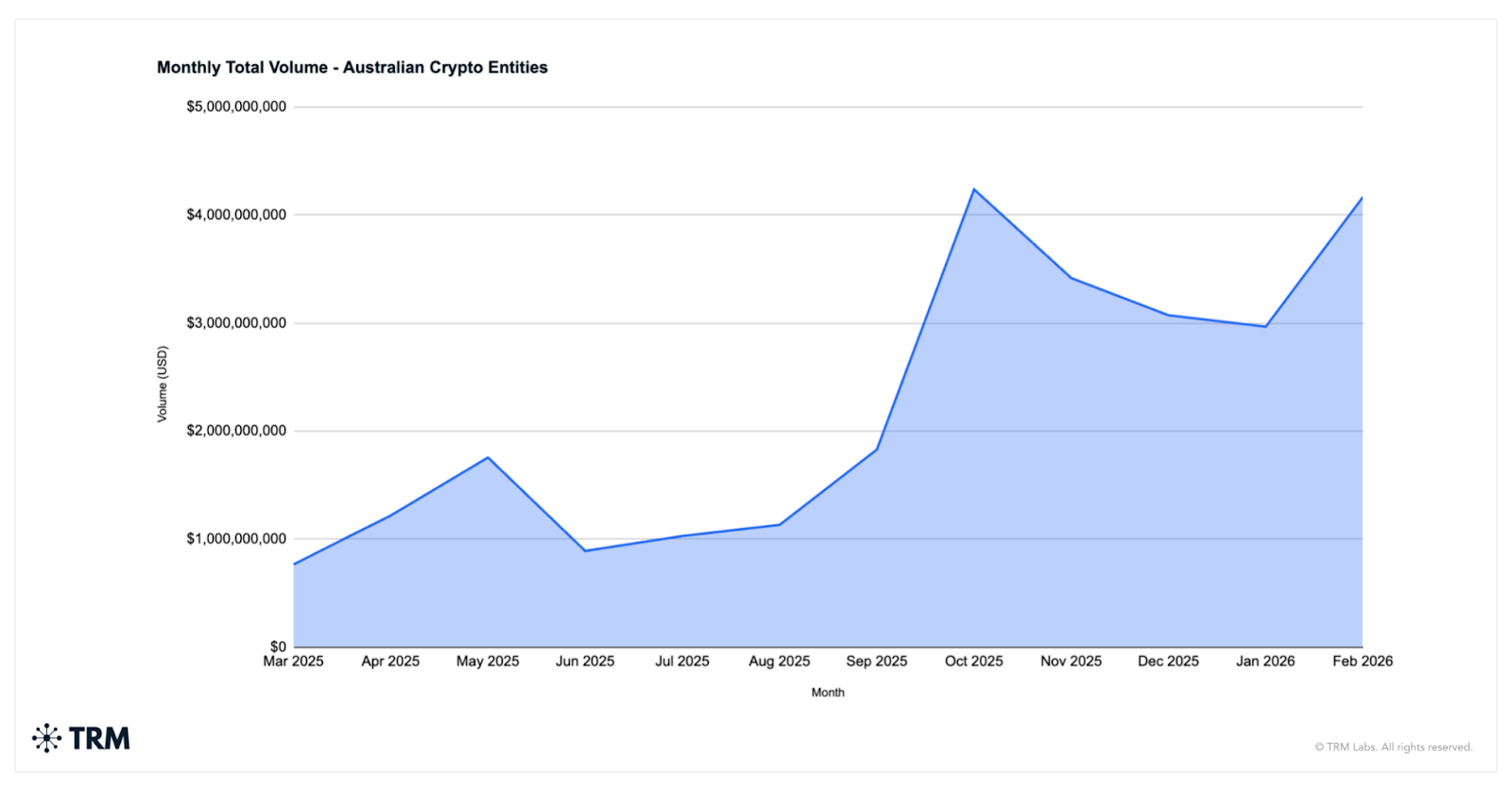
This growth reflects both global market recovery and increasing participation in digital asset markets within Australia.
Blockchain usage patterns further illustrate the structure of the Australian crypto ecosystem. The Ethereum ecosystem dominates activity, accounting for roughly 80 percent of total volume. This dominance reflects the widespread use of ERC-20 tokens — including stablecoins such as USDT and USDC — as well as the presence of major decentralized finance protocols associated with Australia.
Tron represents the second-largest network by volume driven primarily by stablecoin transfers. Bitcoin is in the third spot while smaller volumes appear across networks such as XRP, BNB Chain, Base, Optimism, and Solana.
Policy and regulatory environment
Australia currently regulates digital assets primarily through existing financial regulatory frameworks, while more comprehensive legislation continues to evolve.
The Australian Transaction Reports and Analysis Centre (AUSTRAC) has regulated digital currency exchanges since April 2018. Exchanges must register with AUSTRAC and comply with anti-money laundering and counter-terrorism financing obligations, including customer due diligence, transaction monitoring, and suspicious matter reporting.
The Australian Securities and Investments Commission (ASIC) oversees crypto activities that fall within existing definitions of financial products or services. In the absence of a dedicated digital asset regime, determining whether a firm requires an Australian Financial Services Licence (AFSL) has often depended on case-by-case interpretation. ASIC has indicated that many crypto assets may already qualify as financial products under current law.
Greater regulatory certainty may be afoot in the near future, with a bespoke digital asset regulatory framework currently before Parliament. Under the proposal, digital asset platforms and custody-related services would be regulated as financial products under the AFSL regime and supervised by ASIC, operating alongside AUSTRAC’s AML registration requirements.
Stablecoins are also being addressed through broader payments reform. Treasury has proposed regulating payment stablecoins as tokenised stored-value facilities, effectively treating them as a form of digital payment instrument within the financial services framework.
Australia has additionally expanded its AML regime through reforms passed in 2024, including implementation of the Financial Action Task Force Travel Rule beginning in July 2026.
Crypto-related crime in Australia
The evolution of crypto-enabled crime in Australia mirrors global trends. As digital assets have become more widely adopted, criminal actors have incorporated them into existing financial crime typologies rather than creating entirely new ones.
In the early stages of adoption, most Australian cases involving cryptocurrency were linked to drug markets.
Today, digital assets appear across a much broader range of crime types. Cryptocurrency has been associated with scams and fraud, trade-based money laundering, illicit tobacco markets, narcotics supply chains, ransomware attacks, and terrorist financing networks.
This shift is reflected in enforcement outcomes. In mid-2025, Australia secured its first major crypto-related money laundering conviction following Operation Taipan, a multi-year investigation led by Victoria Police into a Chinese-linked laundering syndicate using digital asset infrastructure.
Watch TRM’s in-depth case study on Operation Taipan here.
Importantly, however, illicit exposure within Australia’s crypto ecosystem remains extremely small relative to overall activity. Of the approximately USD 50 billion (AUD 71 billion) in transaction volume recorded between March 2025 and February 2026, less than 1 percent was linked to illicit counterparties.
Sanctions-related exposure accounts for the largest share of this activity representing roughly 70 percent of total illicit exposure. Darknet markets represent the second largest category followed by investment fraud and illicit goods and services.
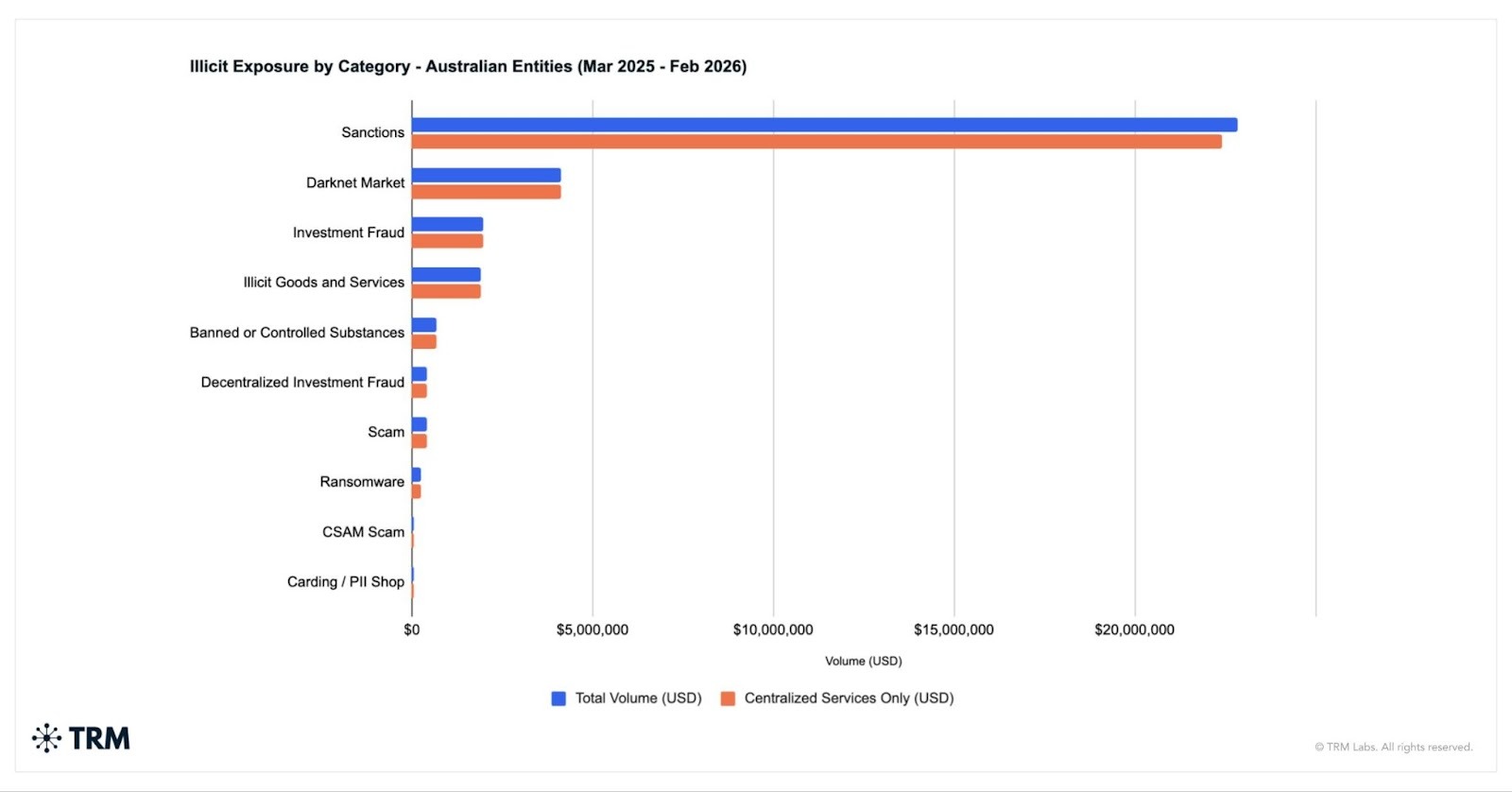
Smaller volumes appear across categories such as banned substances, ransomware, scams, terrorist financing, and cybercrime.
Economic opportunity and national security risk
As crypto adoption grows, digital assets increasingly intersect with Australia’s economic strategy and national security environment.
Blockchain-based payments and stablecoins offer the potential to reduce settlement times and transaction costs in cross-border trade. For Australian exporters and service providers operating across Asia-Pacific markets, these technologies could improve liquidity management and streamline financial operations.
Tokenisation of assets — including securities, commodities, and trade documentation — may also improve transparency and efficiency across financial markets and supply chains.
However, the same features that make digital assets attractive for legitimate commerce can also create opportunities for misuse. Cryptocurrency enables the rapid movement of value across borders outside traditional banking systems. Stablecoins in particular act as bridges between the traditional financial sector and crypto-native infrastructure.
From a national security perspective, crypto infrastructure should increasingly be viewed as part of Australia’s critical economic and information environment. Public blockchains generate extensive transaction records that allow investigators to identify financial relationships, trace cross-border flows, and reconstruct criminal networks. At the same time, concentrated infrastructure, cross-border dependencies, and foreign exposure introduce resilience considerations similar to those present in traditional financial market infrastructure.
Taken together, these dynamics highlight the dual role digital assets now play in Australia’s economic landscape. While digital assets can improve efficiency in trade, payments, and financial markets, they also introduce new pathways for financial crime and systemic risk as their integration into the financial system deepens.
For Australian policymakers and regulators, the central task is determining how best to engage with digital assets in a way that balances innovation, financial integrity, and national security.
The Beacon Network and real-time disruption
A major development in combating crypto-enabled crime has been the creation of real-time intelligence sharing networks linking law enforcement and cryptocurrency exchanges.
The TRM Beacon Network represents the best example to date. The Beacon Network allows law enforcement agencies to flag wallet addresses associated with criminal investigations. These alerts are distributed to participating exchanges, enabling compliance teams to detect and freeze illicit funds when they appear on their platforms.
Unlike traditional financial intelligence processes, which often involve delayed reporting and lengthy legal procedures, the Beacon Network enables near-real-time coordination.
The Australian Federal Police participates in this network alongside other global law enforcement partners. By sharing wallet intelligence through Beacon, investigators can prevent criminals from cashing out stolen cryptocurrency.
This model reflects a broader shift in financial crime enforcement. Blockchain transparency allows investigators to observe transactions as they occur. Combined with cooperative networks like Beacon, this visibility enables proactive disruption of illicit financial flows rather than purely retrospective investigation.
Securing Australia’s digital asset future
Australia stands at an important moment in the evolution of the digital asset economy.
Cryptocurrency is increasingly embedded within global commerce, financial markets, and payment infrastructure. While illicit activity represents only a small share of overall usage, digital assets now intersect with multiple crime typologies relevant to Australia.
Australia has already taken important steps through early AML regulation, growing investigative expertise, and strong public-private collaboration.
The next phase will require continued investment in blockchain intelligence capabilities, expanded training for investigators, and stronger coordination between regulators, law enforcement agencies, and industry.
If implemented effectively, these measures can allow Australia to leverage the transparency of blockchain technology to disrupt illicit finance while supporting responsible digital asset innovation.
By combining regulatory clarity, investigative capability, and international cooperation, Australia can strengthen financial integrity while enabling the secure growth of its digital asset economy.
{{horizontal-line}}
Frequently asked questions (FAQs)
1. What is the total on-chain transaction volume for Australian crypto entities?
Australian crypto entities processed approximately USD 50 billion (AUD 71 billion) in total on-chain transaction volume between March 2025 and February 2026.
2. Where does Australia rank globally for total crypto value received?
Australia ranks twentieth globally for total crypto value received among ninety-five countries tracked, with approximately USD 15 billion (AUD 22 billion) in incoming volume to centralized exchanges and decentralized finance services.
3. Which blockchain ecosystem dominates Australia's crypto activity?
The Ethereum ecosystem dominates activity, accounting for roughly 80% of total transaction volume, largely driven by the use of ERC-20 tokens, including stablecoins like USDT and USDC.
4. What percentage of total crypto activity in Australia is linked to illicit counterparties?
Illicit activity represents a very small share of the ecosystem, with less than 1% of total activity between March 2025 and February 2026 linked to illicit counterparties.
5. Which Australian government bodies regulate digital assets?
The Australian Transaction Reports and Analysis Centre (AUSTRAC) regulates digital currency exchanges for anti-money laundering (AML) compliance, and the Australian Securities and Investments Commission (ASIC) oversees crypto activities that fall under existing financial products or services definitions. A bespoke digital asset regulatory framework is currently before Parliament.