Beyond Drug Trafficking: A New Federal Indictment Charges Chinese Fentanyl Suppliers with Terrorism Financing

Key takeaways
- A federal grand jury in the Southern District of Ohio indicted two China-based chemical companies and six Chinese nationals on charges including fentanyl conspiracy, money laundering, and material support to a foreign terrorist organization
- The indictment names the Cártel del Golfo (CDG) as the intended recipient of fentanyl precursors and cutting agents, including medetomidine, a veterinary tranquilizer that can multiply a single kilogram of fentanyl into dozens of kilograms of street-ready mixture
- The material support to FTO charge (18 USC 2339B) was available because the US designated the CDG as a foreign terrorist organization on February 20, 2025
- Cryptocurrency was central to the alleged payment infrastructure, with funds flowing through a multi-wallet layering chain before conversion to foreign currency — consistent with laundering typologies TRM has documented across cartel-linked networks
- TRM's research shows approximately 97% of Chinese drug precursor manufacturers (DPMs) accept cryptocurrency, with on-chain inflows to these vendors growing from USD 30.9 million in 2023 to USD 39.1 million in 2025
- For compliance teams and VASPs, the FTO designations of major Mexican cartels mean that transactions linked to these networks now carry potential exposure under terrorism financing statutes alongside drug trafficking and AML frameworks
{{horizontal-line}}
Chinese chemical companies, individuals hit with drug and terrorism charges
On March 24, 2026, a federal grand jury in the Southern District of Ohio unsealed an indictment charging two Chinese chemical companies and six Chinese nationals with conspiracy to distribute fentanyl, money laundering conspiracy, material support to a foreign terrorist organization (FTO), and obstruction of justice. The defendants — Shandong Believe Chemical Company PTE Ltd. and Shandong Ranhang Biotechnology Co. Ltd. (collectively, the Shandong Companies), along with individual defendants Hanson Zhao, Gao Yanpeng, Xia Yi, Zhang Jian, Wang Zhaolan, and Zhang Chunhai — are alleged to have knowingly supplied fentanyl precursors and cutting agents to drug traffickers in the United States, including the Cártel del Golfo (CDG), also known as the Gulf Cartel.
According to the indictment, the Shandong Companies presented themselves as legitimate online pharmacies and chemical suppliers. In reality, prosecutors allege, both companies knowingly marketed and exported fentanyl precursors to drug traffickers with full awareness that customers intended to manufacture fentanyl for distribution in the United States.
The indictment goes one step further than precursor supply. Prosecutors allege the companies also sold cutting agents — specifically medetomidine, a veterinary tranquilizer unapproved for human consumption in the United States. One kilogram of medetomidine can transform a single kilogram of fentanyl and inert filler into dozens of kilograms of fentanyl mixture ready for street-level sale, while maintaining or increasing its potency.
Chinese DPMs, cryptocurrency, and the laundering cycle
This combination of precursor supply and performance-enhancing cutting agents is consistent with the DPM typology TRM has documented through blockchain intelligence. TRM's research has found that approximately 97% of Chinese DPMs accept cryptocurrency as payment and that nearly 60% market additional substances alongside fentanyl precursors, including xylazine and nitazene-related compounds. The Shandong Companies are headquartered in Shandong province, consistent with TRM's geographic mapping of DPM activity concentrated in central and eastern China, particularly Hubei and Hebei provinces.

On-chain inflows to Chinese DPMs have grown steadily year over year: USD 30.9 million in 2023, USD 34.7 million in 2024, and USD 39.1 million in 2025. The Shandong indictment illustrates where those payments come from and how they move once received.
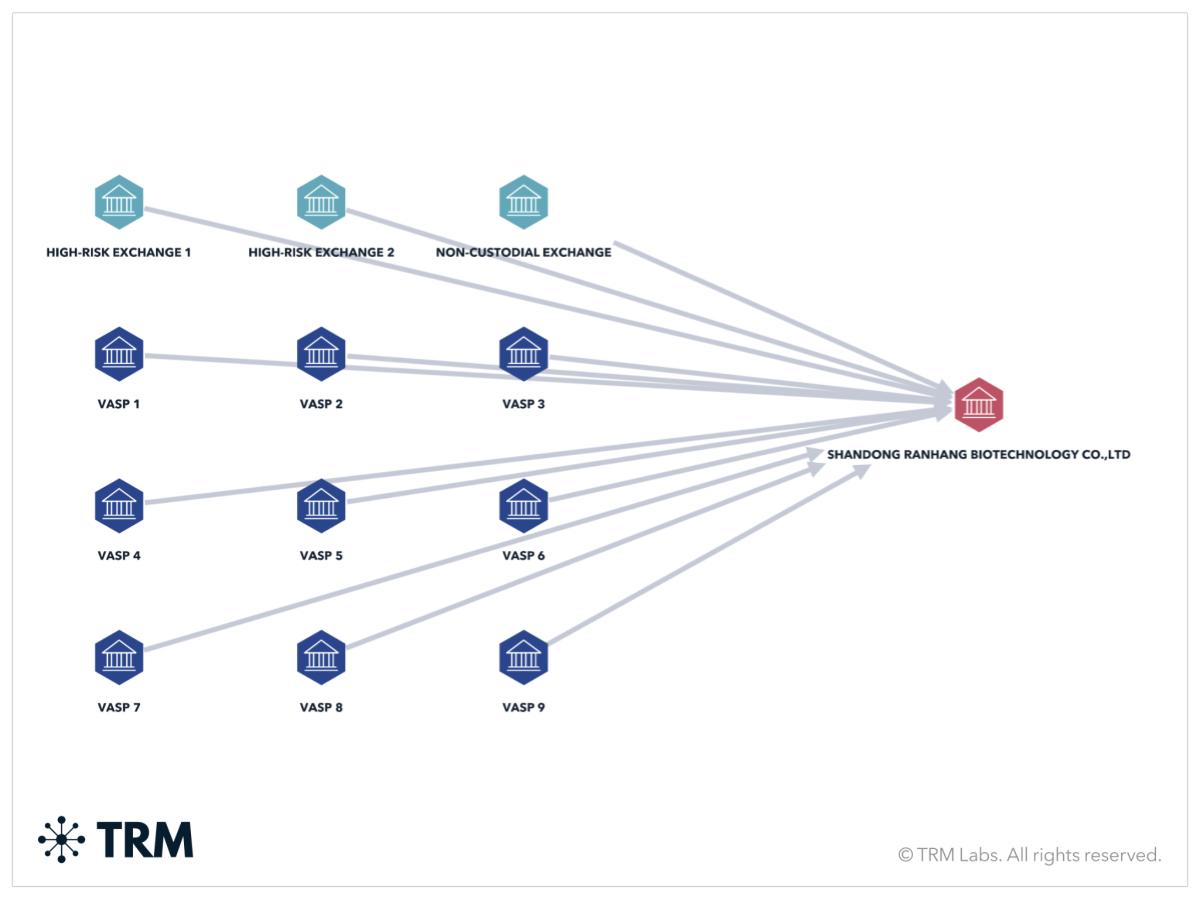
The money laundering count (18 USC 1956(h)) lays out the mechanics — defendant Zhao and the Shandong Companies allegedly directed drug trafficker customers to transfer cryptocurrency into wallets under the defendants' control. From there, defendants Gao, Xia, Zhang Jian, Wang, and Zhang Chunhai are alleged to have held additional wallets and bank accounts specifically to facilitate the movement of those digital assets — layering the funds across addresses until they could be converted to foreign currency and routed to international banks, concealing the source and ownership of the proceeds along the way.
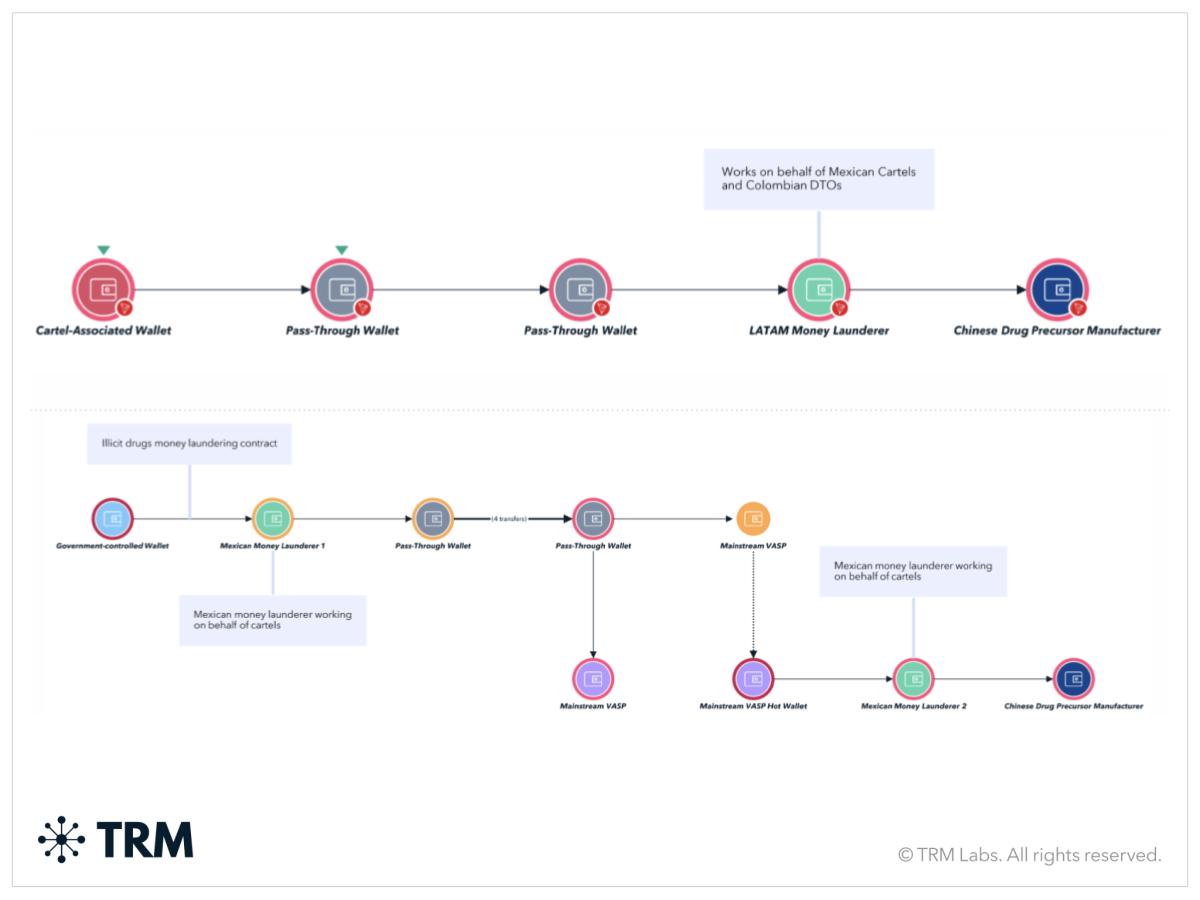
This layering pattern starts with stablecoins received at an initial collection address that are then fragmented and passed through a chain of pass-through wallets, then converted to fiat at a cross-border exit point. This reflects the broader laundering workflow TRM has tracked across cartel-associated money laundering (CAML) networks. TRM estimates that cartel-linked laundering networks have moved more than USD 3 billion on-chain, with the majority of that activity occurring in the past two years. The forfeiture allegation in the indictment names one specific seized asset: approximately USD 26,000 in cryptocurrency held in a Binance account registered to defendant Wang.
Use of social media and messaging platforms to advertise
Defendant Zhao's role in the alleged scheme reflects a broader pattern TRM has observed in how DPMs acquire customers. According to the indictment, Zhao used social media and messaging platforms to recruit individuals he believed to be drug traffickers, promoted available precursor and cutting agent inventories — including to the CDG — negotiated terms, and then allegedly moved hundreds of kilograms of materials to Mexico and to the United States, including to southern Ohio, via international freight and domestic carriers. Zhao also faces a separate obstruction charge (18 USC 1512(c)(1)) for allegedly attempting to delete or conceal communications with a purported drug trafficker in March 2026.
Cartels and enablers now subject to terrorism charges post-designation
The material support charge was used in this case because the US Secretary of State designated the CDG as an FTO on February 20, 2025. Under 18 USC 2339B, it is a federal crime to knowingly provide material support or resources — including things like property, services, and chemical compounds — to a designated FTO, with knowledge of both the designation and the organization's engagement in terrorist activity. Prosecutors allege that the Shandong Companies and Zhao continued to supply the CDG with precursors and cutting agents after that designation and with knowledge of it, satisfying the statutory requirements.
The Cártel de Sinaloa (CDS) and Cártel de Jalisco Nueva Generación (CJNG) were also designated as FTOs in early 2025. The Shandong case represents an early signal of how prosecutors intend to apply those designations against the upstream supply chain — not just against cartel members or their direct associates, but against foreign suppliers who knowingly provide material support with awareness of the designations.
Implications for regulators and compliance teams
For compliance teams and VASPs, this indictment carries a practical implication. The FTO designations of the CDG, CDS, and CJNG have elevated the risk profile of transactions linked to cartel-associated networks. Processing transactions tied to a designated FTO, even through intermediary wallets or accounts, can now create exposure under terrorism financing statutes in addition to drug trafficking and AML frameworks. The two carry different regulatory and criminal implications, and the distinction is increasingly worth understanding before a transaction occurs rather than after. The Shandong indictment is a reminder that the financial infrastructure supporting those networks is visible, traceable, and now the subject of enforcement action that extends well beyond the US border.
{{horizontal-line}}
Frequently asked questions (FAQs)
1. Who are the defendants in the Shandong indictment?
The indictment names eight defendants: two Chinese chemical companies, Shandong Believe Chemical Company PTE Ltd. and Shandong Ranhang Biotechnology Co. Ltd., and six Chinese nationals — Hanson Zhao, Gao Yanpeng, Xia Yi, Zhang Jian, Wang Zhaolan, and Zhang Chunhai. The companies are alleged to have operated as legitimate chemical suppliers while knowingly marketing fentanyl precursors and cutting agents to drug traffickers.
2. What is a drug precursor manufacturer (DPM)?
In the context of TRM's research, drug precursor manufacturers (DPMs) are chemical companies — primarily China-based — that supply the raw chemical inputs used to synthesize fentanyl and other synthetic opioids. Many DPMs present as legitimate pharmaceutical or chemical businesses. TRM's research has found that approximately 97% accept cryptocurrency as payment.
3. What is medetomidine, and why does it matter?
Medetomidine is a veterinary sedative that is unapproved for human consumption in the United States. The indictment alleges the Shandong Companies sold it as a cutting agent — a substance mixed with fentanyl to increase yield. According to the indictment, one kilogram of medetomidine can transform a single kilogram of fentanyl into dozens of kilograms of fentanyl mixture, while maintaining or increasing its potency.
4. What is the material support to FTO charge, and why does it apply here?
Under 18 USC 2339B, knowingly providing material support or resources to a designated FTO — with knowledge of the designation and the organization's terrorist activity — is a federal crime. The Cártel del Golfo was designated as an FTO by the US Secretary of State on February 20, 2025. Prosecutors allege the Shandong Companies and defendant Zhao continued to supply the CDG with precursors and cutting agents after that designation and with knowledge of it, satisfying the elements of the charge.
5. How does cryptocurrency factor into the alleged scheme?
The indictment alleges that drug trafficker customers transferred cryptocurrency to wallets controlled by the defendants as payment for precursors and cutting agents. The defendants then allegedly moved those funds through a series of crypto wallets and bank accounts — held by the individual defendants — before converting them to foreign currency for transfer to international banks. This multi-wallet layering structure is designed to obscure the origin and ownership of the proceeds.
6. What should compliance teams take away from this case?
The FTO designations of the Cártel del Golfo, Cártel de Sinaloa, and Cártel de Jalisco Nueva Generación mean that transactions linked to these networks now carry potential exposure under terrorism financing statutes in addition to drug trafficking and AML frameworks. For financial institutions and VASPs, the Shandong indictment illustrates that enforcement is increasingly targeting the upstream supply chain — foreign suppliers, payment facilitators, and wallet holders — not just cartel members directly. Robust transaction monitoring and screening against designated entities and associated addresses are key tools for managing this exposure.