Europe Announces 19th Sanctions Package on Russia — Including First-Ever Crypto Asset Designations Linked to Moscow

Today, the European Union adopted its 19th sanctions package against Russia, expanding restrictive measures on sectors that continue to fuel the war in Ukraine. The new package targets individuals and entities tied to Russia’s energy, financial, and military-industrial sectors, while introducing tighter controls on the movement of Russian diplomats within the EU. It also includes measures against those involved in the unlawful deportation and abduction of Ukrainian children, underscoring the EU’s ongoing commitment to hold perpetrators accountable and constrain the resources sustaining Russia’s invasion.
For the first time since Russia’s invasion of Ukraine, the European Union has imposed sanctions directly targeting crypto assets linked to Moscow. Among those designated are A7 LLC—the developer of the A7A5 stablecoin—and its Kyrgyzstan-based issuer, Old Vector LLC. A7 LLC, a Russian cross-border settlement platform owned by sanctioned Moldovan oligarch Ilan Shor and Russia’s state-linked Promsvyazbank, was first sanctioned by the EU on July 15, 2025, for its role in election disinformation campaigns and has now been re-designated for supporting Russia’s ongoing invasion of Ukraine.
These entities have been previously designated by the United States and United Kingdom and are therefore already labeled as sanctions in TRM.
According to TRM reporting, the A7A5 stablecoin was jointly developed by A7 LLC and Old Vector LLC and was first registered on December 13, 2024. In a first-of-its-kind action, the EU has prohibited all transactions involving the A7A5 stablecoin, with the restriction set to take effect on November 12, 2025.
Following the takedown of Garantex in March 2025, TRM conducted an in-depth analysis of what appears to be the exchange’s rebrand to Grinex—a platform registered in December 2024 with an interface nearly identical to Garantex. TRM’s analysis found that A7A5 was a key component of this transition, facilitating the movement of funds from Garantex to Grinex in the weeks leading up to the Garantex takedown. Together, these developments underscore how sanctioned Russian-linked entities have sought to leverage stablecoins and rebranded platforms to maintain access to the digital asset ecosystem—and how coordinated sanctions are beginning to close those channels.
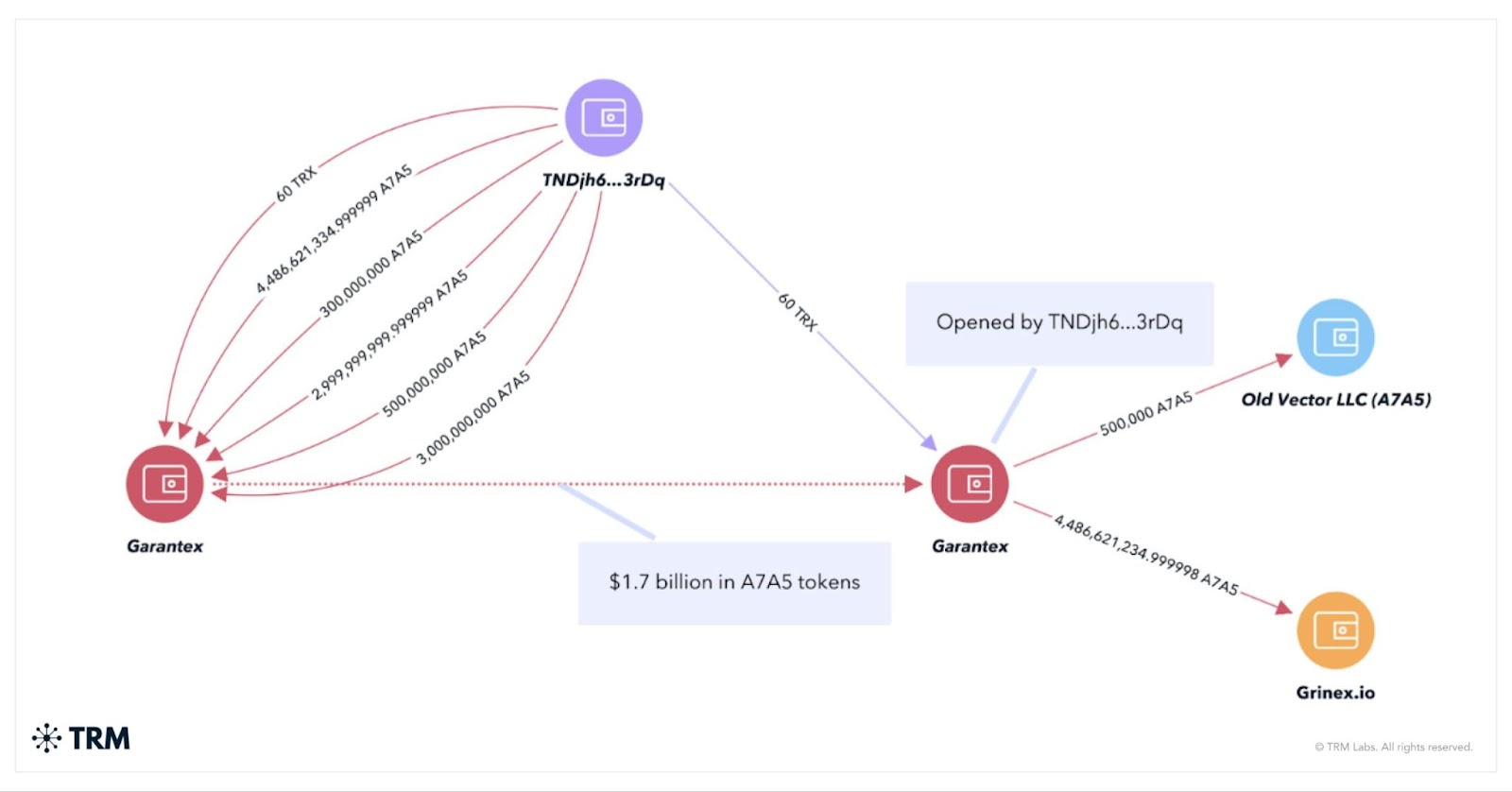
Read TRM’s full breakdown of the Garantex, Grinex, and A7A5 ecosystem here.
Today’s sanctions package also includes a transaction ban on Payeer, a payment services platform long associated with Russian-linked activity.
According to TRM analysis, Payeer originated in Russia and operated through a network of legal entities across multiple jurisdictions, including well-known offshore privacy hubs. In July 2024, Lithuania’s Financial Crime Investigation Service (FCIS) fined Payeer EUR 9.3 million for violations of anti–money laundering and counter–terrorist financing laws, citing failures in due diligence, risk assessment, and suspicious activity reporting. That enforcement action followed mounting concerns over Payeer’s role in enabling Russian sanctions evasion, with Lithuanian authorities noting that the platform processed transactions involving sanctioned entities. TRM’s analysis further shows that Payeer facilitated millions of dollars in transfers to Russian entities and individuals, including the sanctioned cryptocurrency exchange Garantex.
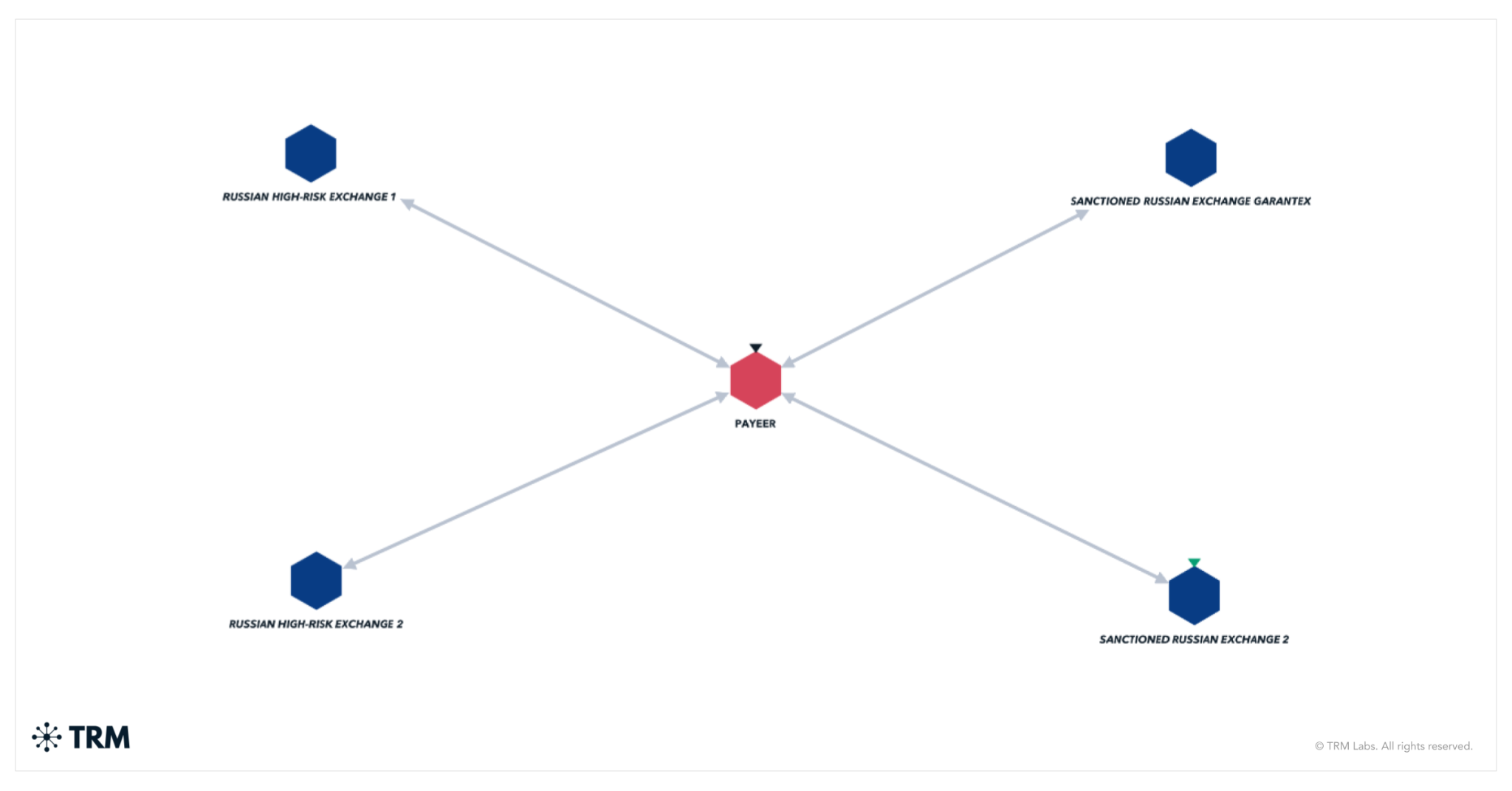
As Russia continues to evolve its sanctions evasion tactics, the EU’s 19th sanctions package reflects a recognition that enforcement must advance just as quickly—extending beyond traditional finance to encompass digital assets and information operations.
By targeting actors across the energy, defense, and crypto ecosystems, the EU is signaling a more integrated approach to disrupting the networks that sustain Russia’s war economy. The expansion of these measures marks a shift toward a more adaptive model of financial statecraft—one that depends on close collaboration between regulators, blockchain intelligence firms, and financial institutions to deliver real-world impact and lasting accountability.