FATF’s Asset Recovery Guidance and the Move Toward Real-time Interdiction and Disruption

Key takeaways
- Asset recovery is now a real-time operational objective. FATF is clear that asset recovery can no longer be treated as a post-investigation exercise. In crypto-enabled cases, recovery must run in parallel with the investigation from the earliest stage, or value will be lost before authorities can act.
- Speed — not jurisdiction or theory — is the decisive factor. Virtual assets compress timelines and erase traditional buffers. FATF’s guidance reflects the reality that minutes matter, and that delays caused by fragmented authority, slow data access, or unclear procedures directly undermine recovery outcomes.
- Public–private collaboration is no longer optional. FATF explicitly recognizes that law enforcement acting alone cannot keep pace with the movement of digital assets. Real-time coordination with exchanges, stablecoin issuers, fintechs, and blockchain intelligence providers is essential to restrain funds while they are still reachable.
- TRM’s capabilities closely align with FATF’s asset recovery guidance. TRM’s tools reflect the same emphasis on early identification, rapid restraint, interagency coordination, and evidence-grade tracing, translating FATF’s principles into operational workflows used today.
- Outcomes — not just prosecutions — are the new benchmark. FATF is shifting the measure of effectiveness toward tangible results: value restrained, losses prevented, assets returned, and criminal networks financially disrupted. Recovery itself is treated as a primary objective, not a byproduct of enforcement.
{{horizontal-line}}
Introduction: The global standard in asset recovery is real time interdiction
In November 2025, FATF released its Asset Recovery Guidance and Best Practices, setting out a modern playbook for how jurisdictions should identify, restrain, confiscate, and ultimately return criminal proceeds. What stands out is not just how strongly FATF elevates asset recovery as a core outcome of financial-crime work, but how directly it speaks to the realities of virtual assets: speed, cross-border movement, rapid layering, and the shrinking window in which investigators can still recover value.
Just as important, FATF highlights the practical importance of public–private collaboration and points to emerging “disruption” models like T3 and the Beacon Network as examples of the kind of coordinated, real time response that can actually stop losses while funds are still in motion.
Read through an operational lens, the FATF guidance closely tracks the end-to-end workflows required for modern crypto seizures: early identification of virtual asset exposure, rapid prioritization before dissipation, evidence-quality tracing, interagency coordination, and real-time engagement with private-sector control points.
TRM’s capabilities map directly to that playbook — from first-contact readiness and rapid triage, to forensic tracing that withstands courtroom scrutiny, to deconfliction and real-time public–private disruption that enables lawful restraint while funds are still in flight. In that sense, FATF is not describing a theoretical future state, but codifying the operational model that effective crypto asset recovery already requires.
What FATF is trying to change: Asset recovery as an operational objective, not an afterthought
A central throughline of the guidance is that asset recovery cannot be treated as something that happens after a case is built. FATF frames recovery as an operational objective that should run in parallel with the investigation from the earliest stage, with financial investigation embedded into investigative planning rather than bolted on later. This is a shift in mindset as much as doctrine: the goal is not simply to prosecute, but to prevent criminals from retaining the proceeds and to reduce future harm by weakening the financial capacity of criminal networks.
FATF also treats asset recovery as a “system,” not a single power. It emphasizes the need for coherent legal authorities across the lifecycle of a case, from provisional measures (freezing, restraining, seizing) through confiscation (conviction-based and, where permitted, non-conviction-based pathways), and then into asset management and disposition. The guidance is explicit that weak points anywhere in that chain can collapse outcomes: a jurisdiction can have strong tracing capability but lose value through poor custody; it can have strong seizure powers but lack mechanisms to manage, preserve, and liquidate assets; it can have prosecutors ready to act but no reliable pipelines for timely data access.
Legal and institutional foundations: Making the toolkit usable in practice
Across the guidance, FATF pushes jurisdictions to modernize and clarify legal frameworks so investigators and prosecutors can act quickly, confidently, and lawfully. That includes clear authority to identify assets, to restrain assets early (including on an emergency basis when appropriate), and to confiscate proceeds and instrumentalities. FATF also underscores that effective asset recovery depends on institutional design: specialized capability, clear ownership of tasks, and operating procedures that reduce friction between agencies.
The guidance repeatedly returns to interagency coordination as a force-multiplier. Asset recovery is not one unit’s job; it sits at the intersection of investigative authorities, prosecutors, FIUs, regulators, and, often, asset management offices. FATF highlights the value of dedicated structures and specialized teams, not for prestige, but because financial investigations and asset recovery require skills and workflows that are distinct from general policing. This includes operational planning that pairs “what happened” with “where the money went,” and that keeps restraint options open before assets dissipate.
Financial investigations: Data access and technology as the difference between success and regret
FATF is unambiguous that financial investigations depend on timely access to data. It describes the recurring obstacles: scattered data held by many domestic entities, partial availability, and delays caused by slow access processes. It points to mechanisms that make identification and tracing faster and more routine, including integrated databases, streamlined record access, and standardized formats that reduce the burden of analysis. It also frames “financial profiling” as a practical discipline: building a coherent picture of a target’s assets, liabilities, relationships, and movement patterns so investigators can spot restraint opportunities and anticipate dissipation.
Technology is a core theme, but FATF treats it as operational infrastructure, not a buzzword. It emphasizes that the volume of records in modern cases routinely outstrips manual analysis, making scanning software and advanced analytics necessary even for moderately complex investigations. Just as importantly, FATF highlights the practical value of visualizations—link charts that help investigators communicate complex financial structures to prosecutors and judges who need to make rapid tactical and legal decisions.
Virtual assets: Operational reality, not theoretical risk
FATF’s virtual asset sections read like a field manual for how crypto-enabled cases actually unfold. It stresses that virtual assets change the tempo of asset recovery because value can be moved globally in minutes, across multiple platforms and jurisdictions, and through obfuscation services that compress investigative timelines. The guidance therefore prioritizes three practical needs.
First, “first contact” awareness is treated as a core operational capability. FATF emphasizes that the ability to seize virtual assets often hinges on immediate recognition and handling of crypto-specific evidence—seed phrases, hardware wallets, wallet files, QR codes, exchange apps, and remote access pathways. In FATF’s framing, delays are not measured in days; in crypto cases, delays can be measured in minutes.
Second, FATF calls for clear domestic procedures for search and seizure of virtual assets. It notes that many legal frameworks were not drafted with remote access, key custody, and instantaneous transfers in mind, and that operational confusion about sequencing of powers can itself become the reason assets escape. FATF’s solution is pragmatic: map how domestic procedural codes apply to virtual assets, train broadly (not just financial specialists), and standardize response protocols.
Third, FATF describes three common pathways for seizing virtual assets: direct acquisition of private keys (including by legally compelled access or key recovery), recovery from exchange-based wallets, and freezing functionality in cooperation with stablecoin providers. The common factor across all three is speed and coordination, because once assets move beyond reachable control points, recovery becomes exponentially harder.
Blockchain tracing: from investigative tool to court-tested evidence
TRM Forensics
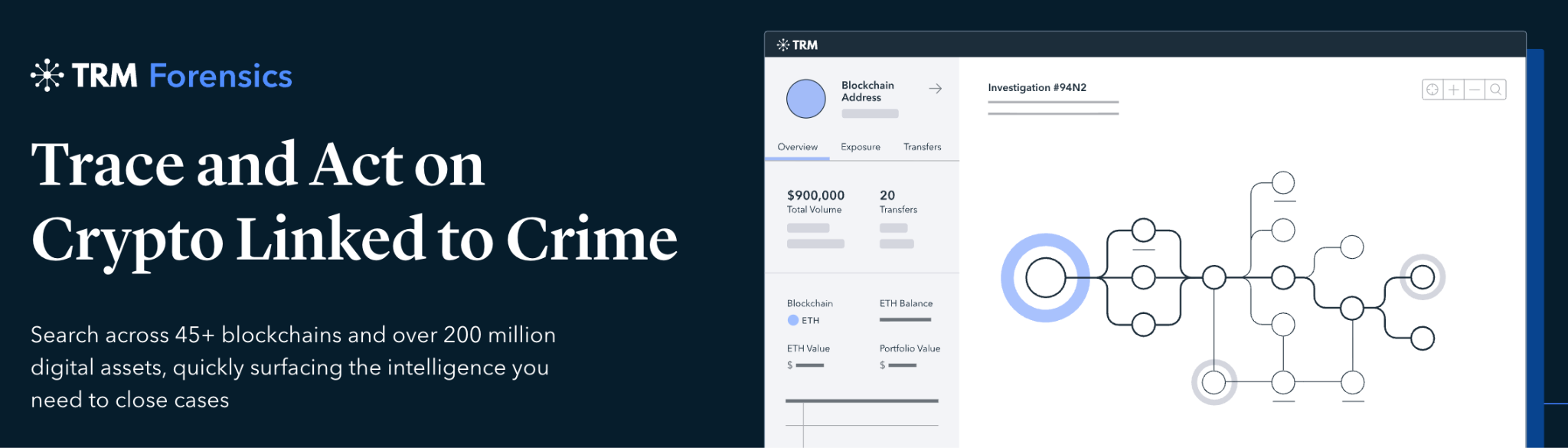
FATF elevates blockchain analytics as an essential capability for tracing, identifying, and attributing ownership or control. It notes the unique advantage of public blockchains: immutable records that can support rapid tracing and recovery, and in some cases may even make assets easier to track than traditional high-value goods. FATF also highlights that blockchain analytics can help solve the “needle in the haystack” problem when investigators face terabytes of seized digital data that cannot be searched manually.
Crucially, FATF includes a detailed court example that illustrates how blockchain tracing is not just operationally useful, but increasingly litigated and tested under evidentiary standards. In a U.S. federal case involving allegations of a virtual asset tumbling service that commingled bitcoin, investigators faced massive scale—over 900,000 transactions and roughly USD 400 million. Software developed by a blockchain analytics firm was used to analyze transactions across multiple addresses and connect activity to the defendant and several darknet markets. The court analyzed the admissibility of the blockchain expert testimony under Federal Rule of Evidence 702 and the Daubert reliability framework, examining how clustering heuristics were explained, corroborated, and validated. The discussion matters because it signals what investigators and prosecutors must be prepared to show: sufficient data, reliable methods, transparent explanation of techniques, and validation through corroborating evidence and legal process. In plain terms, blockchain tracing is not just “seeing funds move”; it is building findings that can survive rigorous challenge.
Public–private partnerships and real-time disruption: why FATF cites T3 and the Beacon Network
Beacon Network | T3 Financial Crime Unit
FATF’s guidance recognizes a hard truth: traditional international cooperation mechanisms and sequential investigative workflows often cannot keep pace with the movement of virtual assets. That is why FATF emphasizes public–private partnerships that can operate at operational speed, not just strategic speed.
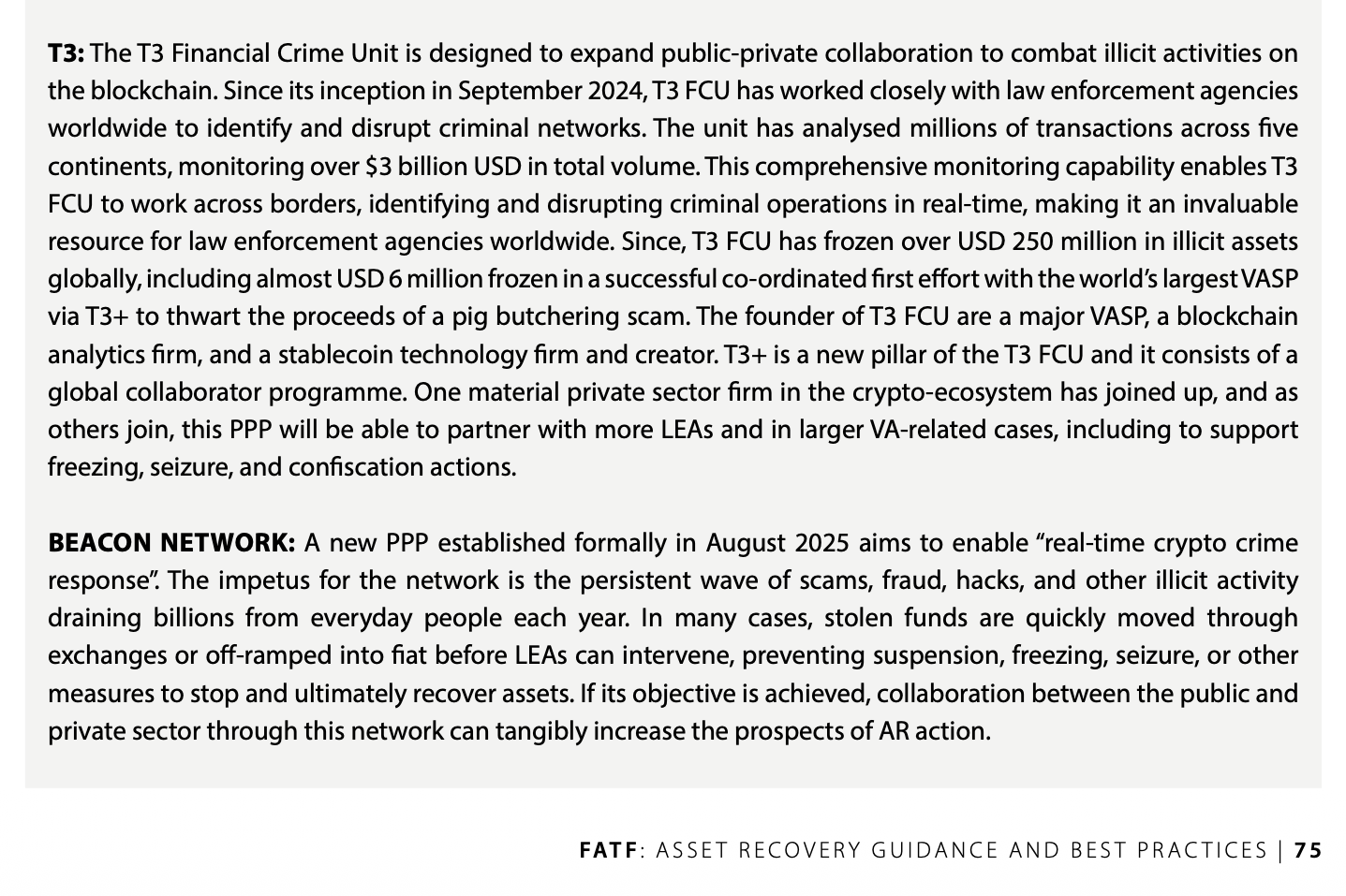
In that context, FATF references T3 as a model designed to expand public–private collaboration to combat illicit activity on-chain. FATF notes that, since its inception in September 2024, T3 has worked with law enforcement globally, analyzed millions of transactions across five continents, monitored over USD 3 billion in total volume, and frozen over USD 250 million in illicit assets (that number is now close to USD 350 million), including a coordinated effort that froze nearly USD 6 million linked to a pig-butchering scam.
FATF also points to TRM’s Beacon Network as a “real-time crypto crime response” network, describing a growing collaboration across exchanges, fintechs, law enforcement, security researchers, and blockchain intelligence providers with an emphasis on moving “from detection to action in minutes rather than days” and focusing on high-impact threats including North Korea disruption, ransomware payment interdiction, terrorism financing prevention, scam victim recovery, and child sexual exploitation-related financial flows.
FATF is effectively endorsing an operating concept: rapid detection, rapid deconfliction, rapid action at control points, and fast escalation to lawful restraint.
How TRM’s capabilities map to FATF best practices
TRM Academy: Institutional readiness and first-contact awareness
FATF’s guidance describes what good looks like; operationalizing it requires tools and workflows that turn principles into action across the full lifecycle of a case. This begins with readiness: TRM Academy aligns with FATF’s call for specialized institutional capability, ensuring that teams are trained to recognize virtual asset evidence at the point of first contact.
TRM Triage and Chainabuse: Speed, prioritization, and early restraint
Moving into discovery, TRM Triage enables the speed FATF demands, prioritizing cases where there is a realistic chance to restrain value before dissipation and focusing resources where recovery is most likely. This is complemented by Chainabuse, the world’s largest database of crypto scams, which empowers agencies to rapidly identify illicit actors and connect victim reports to broader fraud networks.
TRM Forensics: Evidence-grade tracing and attribution
For the core investigation, TRM Forensics supports the essential requirement to trace assets quickly, identify control points, and produce evidence-quality outputs that prosecutors can stand behind.
TRM Deconflict: Interagency coordination and operational clarity
This is bolstered by the TRM Deconflict network, which maps directly to FATF’s focus on coordination — reducing duplication, avoiding cross-purpose actions across agencies, and enabling faster, cleaner operational decisions when multiple stakeholders are touching the same wallets or subjects.

Seed Analysis, Beacon Network, and T3: Real-time disruption and seizure
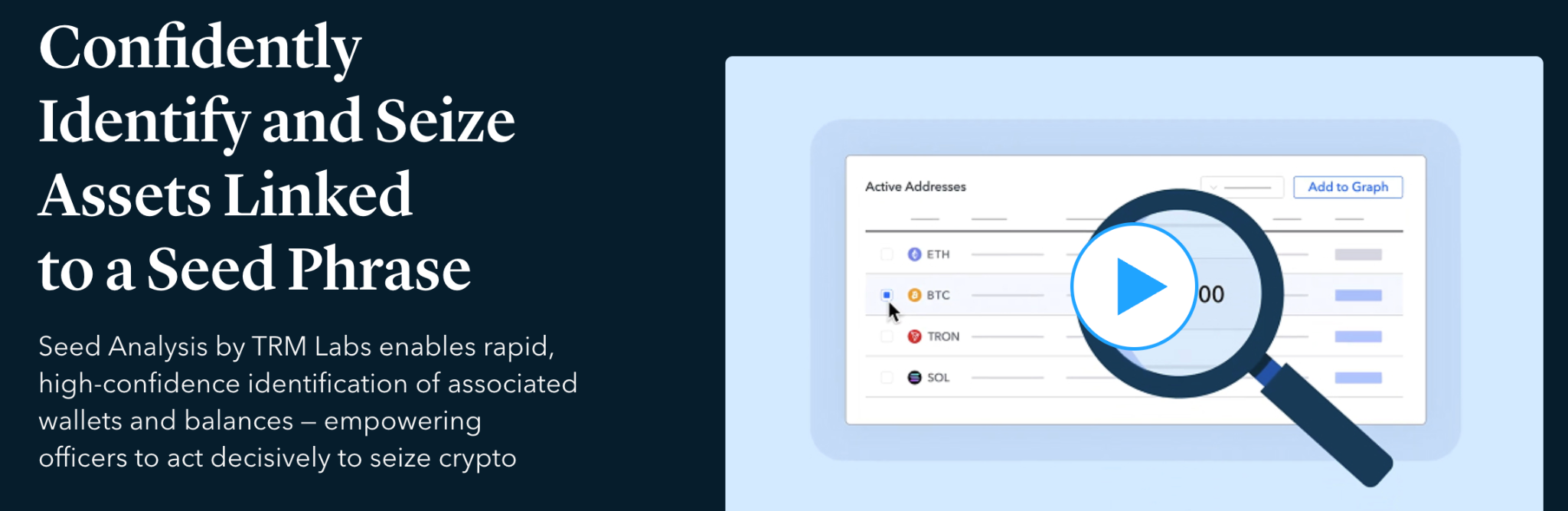
Finally, effective operationalization requires the real-time disruption capabilities FATF highlights as critical for stopping funds in flight. Seed Analysis addresses the “first contact” necessity of immediately seizing assets from raw evidence and self-custodial wallets, while the Beacon Network answers the call for real-time public–private collaboration that can stop custodial funds mid-transaction. The T3 Financial Crime Unit reflects FATF’s emphasis on rapid operational partnership for cross-border disruption and freezing, particularly in stablecoin-heavy scam and fraud ecosystems.
Conclusion: FATF is describing the future as the standard
The core message of the FATF guidance is that modern financial crime—especially crypto-enabled crime—demands asset recovery that is faster, more coordinated, and more operationally integrated than the traditional model. Virtual assets compress timelines, multiply jurisdictions, and raise the stakes of early mistakes. FATF’s answer is a full-stack approach: legal clarity, specialized capability, streamlined data access, technology-enabled tracing, credible custody and asset management, and real-time public–private action. Read through that lens, the guidance is not just a summary of best practices; it is a blueprint for how jurisdictions will be measured going forward, and a signal that “minutes not days” is becoming the new expectation for effective crypto asset recovery.
{{horizontal-line}}
Frequently asked questions (FAQs)
1. What does FATF mean by “real-time interdiction” in asset recovery?
FATF is signaling a shift away from purely retrospective recovery toward stopping illicit funds while they are still moving. In practice, this means identifying exposure early, prioritizing cases where value can still be restrained, and acting at control points—exchanges, stablecoin issuers, or self-custody access—before assets dissipate across jurisdictions or obfuscation layers.
2. How is this guidance different from previous FATF asset recovery standards?
Earlier guidance focused primarily on legal powers and post-investigation confiscation. The 2025 guidance treats asset recovery as an operational objective that must run in parallel with investigations from the outset, with a strong emphasis on speed, coordination, technology, and public–private workflows that reflect how virtual assets actually move.
3. Why does FATF place so much emphasis on public–private partnerships
Because traditional, sequential cooperation mechanisms often cannot keep pace with crypto transactions that move globally in minutes. FATF recognizes that effective recovery increasingly depends on trusted, real-time collaboration between law enforcement, prosecutors, exchanges, fintechs, stablecoin providers, and blockchain intelligence firms that can lawfully act while funds are still reachable.
4. Why does FATF specifically reference initiatives like T3 and the Beacon Network?
FATF cites T3 and the Beacon Network as concrete examples of how public–private collaboration can operate at operational speed. These initiatives demonstrate an end-to-end model: rapid detection, fast deconfliction across stakeholders, and timely lawful action at key control points to freeze or restrain assets before they disappear.
5. What does FATF expect jurisdictions to do differently in crypto cases?
FATF expects jurisdictions to be operationally ready: train frontline officers to recognize crypto evidence at first contact, clarify legal procedures for virtual asset seizure, enable rapid and reliable data access, and deploy blockchain analytics that can support both fast action and courtroom scrutiny. Delay or institutional friction is treated as a systemic risk to recovery outcomes.
6. How important is speed in virtual asset recovery?
Speed is decisive. FATF makes clear that in crypto cases the difference between recovery and loss is often measured in minutes, not days. Early identification, rapid prioritization, and immediate coordination are what keep assets within reach of lawful restraint.
7. How does this guidance change how success is measured?
Success is no longer defined primarily by prosecutions or case counts. FATF is effectively shifting the benchmark toward outcomes: value restrained, losses prevented, assets returned to victims, and criminal networks weakened by removing their financial capacity.