UK Designates Huobi, Exmo, Bitpapa, and 11 Other Entities for Russian Crypto Sanctions Evasion

Key takeaways
- The UK designated 18 entities and individuals on May 26, 2026 — including Huobi Global, Exmo, Bitpapa, Rapira, and Aifory Pro — under the Russia (Sanctions) (EU Exit) Regulations 2019, targeting the A7 network of crypto and banking infrastructure the UK says fuels Russia's war economy.
- TRM data shows Huobi alone has sent more than USD 4.9 billion to UK-sanctioned and A7-network entities since 2021, with USD 1.13 billion of that flowing in just the 14 months after Garantex's March 2025 takedown.
- Huobi flows to the specific successor-exchange set named today (Rapira, Aifory Pro, Grinex.io, ABCex, A7, A7A5) grew 10x post-takedown, from USD 111 million to USD 1.13 billion — with the A7 network alone absorbing USD 838 million (a 193x jump).
- Bitpapa is now under a third national sanctions regime (OFAC March 2024, Ukraine July 2025, UK May 2026), reflecting the limits of unilateral enforcement and signaling that multilateral coordination is the response.
- Compliance teams should monitor transaction flows to "successor" exchanges and service providers — not just sanctioned entity names.
{{horizontal-line}}
Overview
On May 26, 2026, the UK government designated 18 entities and individuals — including Huobi Global (HTX), Exmo Exchange, Bitpapa, and Rapira Group — as part of a package targeting cryptocurrency exchanges and illicit networks exploited by Russia. The action focuses on the exchanges, banks, and corporate vehicles helping channel value through cryptocurrency to fund Russia's war economy. The designations largely track the pattern TRM has documented across the post-Garantex sanctions-evasion ecosystem — high-volume exchanges, ruble-onramp peer-to-peer platforms, and the A7 corporate-and-token infrastructure that emerged after the March 2025 Garantex takedown.
TRM data shows Huobi alone has sent more than USD 4.9 billion in direct on-chain transactions to the entities the UK sanctioned today, the previously sanctioned Russia-linked exchanges they succeeded, and a smaller set of related Russia-linked high-risk platforms — including USD 1.2 billion in the 14 months following Garantex's takedown, with USD 838 million of that flowing to the A7 network specifically.
What happened
The UK Foreign, Commonwealth and Development Office (FCDO) issued the designations under the Russia (Sanctions) (EU Exit) Regulations 2019, citing what officials called the "A7 network" — a Kremlin-backed infrastructure system that moved over USD 90 billion in the previous year, roughly equivalent to half of Russia's annual military budget.
The designations cover cryptocurrency exchanges, a Kyrgyz bank, Georgia-registered trading platforms, corporate vehicles, and a virtual asset issuer. All listed entities are subject to asset freezes; UK-regulated firms are prohibited from making funds or economic resources available to them.
Foreign Secretary Yvette Cooper said: "If the Kremlin thinks it can evade our sanctions by hiding behind crypto networks and shadow financial systems, it is gravely mistaken."
The published list includes the following 14 entities:
- Exmo Exchange Limited
- Nueva Cryptologia, Sociedad Por Acciones Simplificada de Capital Variable (S.A.S. de C.V.), d.b.a. ABCex
- Arvix Limited Liability Company
- Rapira Group LLC
- Alistera Limited
- Open Joint Stock Company "Eurasian Savings Bank"
- Bitpapa IC FZC LLC
- Sooty Limited
- Aifory Limited Liability Company
- Open Joint-Stock Company "State Brokerage Company"
- Limited Liability Company "Diamond Estate"
- Trace Road Limited Liability Company
- Open Joint-Stock Company "Virtual Assets Issuer"
- Huobi Global S.A.
What we know about the key entities
The most consistent on-chain pattern across the group is the Huobi-to-Russian-network flow: TRM data shows Huobi Global has been a persistent counterparty to nearly every entity in today's UK package, with the shape of that activity shifting dramatically after Garantex's March 2025 takedown.
Huobi Global S.A.
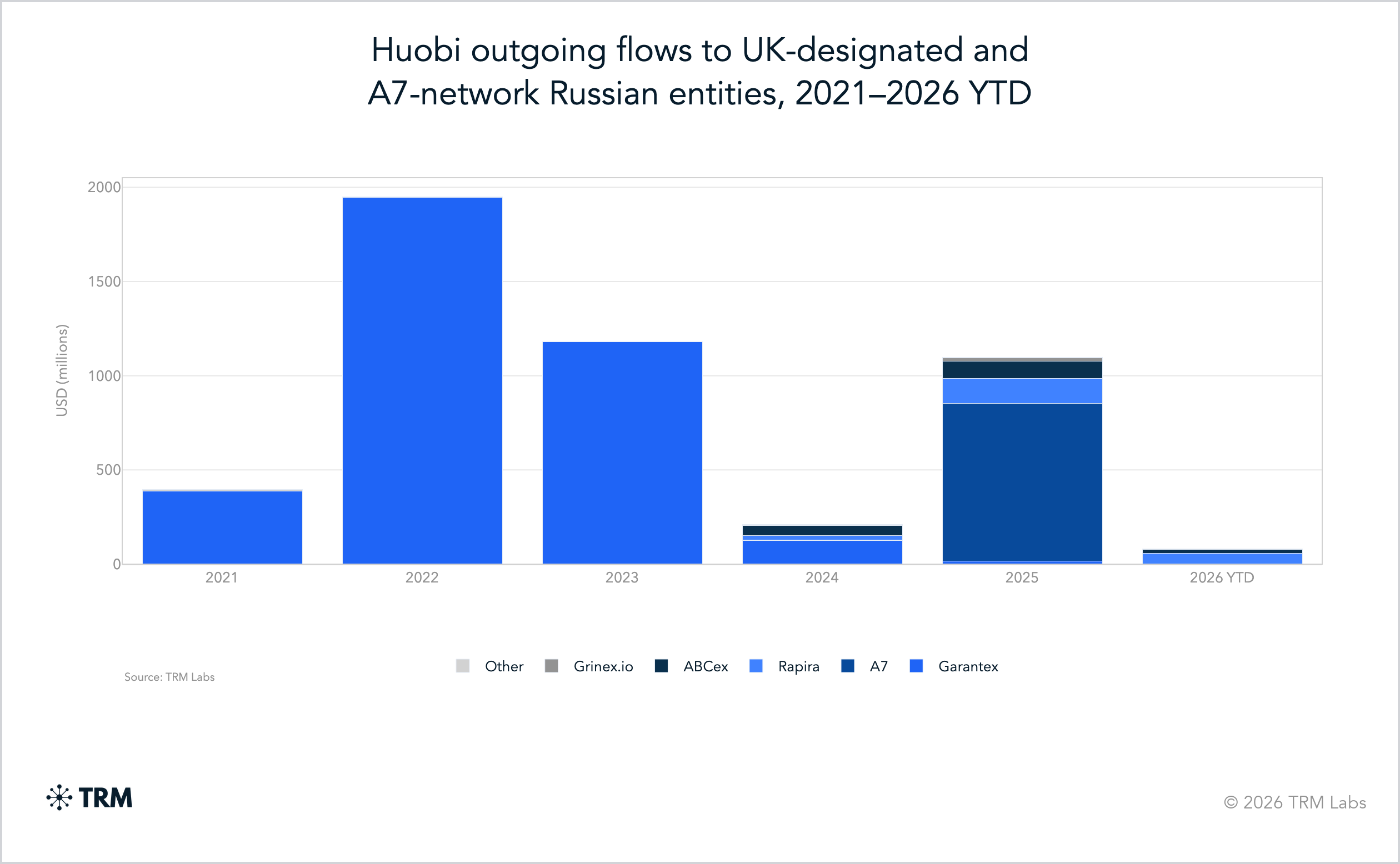
Since 2021, Huobi (HTX) has sent more than USD 4.9 billion in direct on-chain transactions to the entities the UK sanctioned today, the previously sanctioned Russia-linked exchanges they succeeded, and a smaller set of related Russia-linked high-risk platforms — including USD 1.95 billion to Garantex in 2022, USD 1.18 billion in 2023, and USD 838 million to A7 in 2025 alone. The designation applies to a globally operating exchange with material transaction volume across multiple jurisdictions, and any UK-nexus transaction involving the platform is now prohibited.
Exmo Exchange Limited
Exmo, a Russian-founded exchange, claimed to have exited Russia following the 2022 invasion by selling its Russia-facing operations under the rebranded Exmo.me entity. TRM's blockchain analysis found the two platforms sharing custodial wallet infrastructure, indicating that corporate separation did not produce operational separation. Exmo conducted more than USD 19.5 million in direct transactions with sanctioned entities including Garantex, Grinex, and Chatex. Ukraine sanctioned the Kazakhstan-registered Exmo entity in July 2025.

Bitpapa IC FZC LLC
Bitpapa, a UAE-registered peer-to-peer exchange, was designated by OFAC in March 2024 for facilitating millions of dollars in transactions with sanctioned entities, including Hydra Market and Garantex. TRM's analysis of that action assessed Bitpapa as a high-risk platform operating alongside other Russia-linked exchanges in the broader evasion ecosystem. Ukraine sanctioned the same entity in July 2025. The UK action brings Bitpapa under a third national sanctions regime — a pattern that leaves the entity subject to enforcement across three separate national regimes.
Rapira Group LLC
Rapira is a Georgia-incorporated exchange with a Moscow office that facilitates ruble-based crypto trading. TRM data shows extensive on-chain exposure across the broader Russia-linked sanctions ecosystem: Rapira has transacted more than USD 543 million bilaterally with the entities the UK targeted today and the pre-existing sanctioned Russian network. The largest single relationship — USD 375.6 million with Garantex's named successor Grinex.io — began on March 10, 2025, three days after Garantex was taken down.
Aifory Pro Limited Liability Company
Aifory Pro is a ruble-to-crypto onramp active since mid-2023 with incoming and outgoing volume reaching over USD 3 billion. TRM data shows USD 189 million in bilateral exposure across the broader Russia-linked sanctions ecosystem, with USD 175.2 million of that — 93% — coming from ABCex (mostly inbound: USD 168.7 million from ABCex to Aifory, USD 6.5 million outbound). Aifory also has bilateral exposure to Garantex (USD 9.6 million), Rapira (USD 2.9 million), and the A7 corporate-and-token infrastructure (USD 0.6 million). The pattern positions Aifory as a downstream node receiving value from ABCex's larger operation, not as a primary settlement venue.
ABCex
ABCex is a Russia-based cryptocurrency exchange with historic ties to Garantex co-founder Sergey Mendeleev. TRM has previously identified ABCex as Garantex's third-largest on-chain counterparty and reported that the platform is under investigation for facilitating transactions linked to the March 2024 Crocus City Hall terrorist attack. ABCex's on-chain relationship with Garantex began in October 2023, well before Garantex's takedown.
On-chain data shows ABCex sits at the center of the post-Garantex ecosystem. TRM data shows USD 355 million in bilateral exposure to the UK-sanctioned and A7-network set since 2023, including USD 175.2 million with Aifory Pro (designated today), USD 133.4 million with Garantex, and USD 38.1 million with Rapira. ABCex is the dominant source of inflows to Aifory Pro from the entities designated today — accounting for 96% of Aifory's incoming volume from sanctioned counterparties, including A7.
Eurasian Savings Bank
Eurasian Savings Bank is designated by the UK for supporting the Russian financial sector. Kyrgyzstan has become a key hub for Russia-linked crypto infrastructure since Garantex's disruption — TRM's analysis of the Garantex-to-Grinex transition documented how A7 LLC, co-owned by sanctioned Moldovan oligarch Ilan Shor and state bank Promsvyazbank, relied on Kyrgyz-registered entities for exchange infrastructure and token issuance. The A7A5 ruble-pegged stablecoin processed USD 9.3 billion in four months, according to UK government figures.
The post-Garantex pivot — what the data shows
When an international law enforcement operation led by the US Department of Justice, Germany, and Finland disrupted Garantex on March 7, 2025, TRM tracked whether the ruble-onramp ecosystem would shrink, splinter, or reconstitute. TRM's on-chain data shows the ecosystem reconstituted. Across the broader set of Russian-tagged and A7-network entities, Huobi's monthly flow rate accelerated by 43% in the months following the takedown — from USD 60 million per month before Garantex's disruption to USD 86 million per month after — even as one of the largest individual venues was removed from the network.

Concentrated within that broader figure is the specific successor-exchange set the UK designations name today. Huobi flows to the six entities that absorbed Garantex's function — Rapira, Aifory Pro, Grinex.io, ABCex, A7, and Old Vector LLC (A7A5) — grew more than tenfold, from USD 111 million in the 26 months before takedown to USD 1.13 billion in the 14 months after. A7 alone went from USD 4.3 million to USD 838 million — a 193x jump. Grinex.io grew from USD 139,000 to USD 18 million. Rapira from USD 30 million to USD 184 million. The UK designations target this exact set of successor exchanges plus the A7 infrastructure layer.
What this means for compliance teams
All entities in today's action are on the UK Consolidated List. UK-regulated firms must screen against the updated list and freeze any assets or transactions connected to these entities immediately.
The Huobi designation warrants particular attention. TRM data shows the scale of Huobi's Russian-network exposure exceeds the figure cited in the UK press release. Institutions with a UK nexus should assess their Huobi exposure and consider remediating both historical and current exposure points. Moreover, compliance teams should note that the UK ownership test requires more than 50% control by a single designated person, with aggregation across multiple designated owners applying only where a joint arrangement can be evidenced — making ownership structure a key consideration when assessing whether Huobi-related entities fall within automatic asset freeze obligations.
The 10x post-Garantex growth in Huobi flows to successor exchanges, and the 43% acceleration across the broader Russian-network counterparty list, show the same pattern: Russia-linked exchanges have consistently rebuilt after enforcement, replicating interfaces, onboarding former customers, and preserving underlying blockchain infrastructure. The entities in today's action represent the current layer of that pattern, not the end of it.
Compliance programs should monitor for behavioral signals beyond entity names: ruble-to-crypto onramps, P2P platforms serving sanctioned-bank customers, and shared on-chain infrastructure with previously designated entities. Sanctions screening that layers behavioral signals on top of static list matching is essential for detecting successor-flow patterns before the next designation cycle.
TRM's blockchain intelligence covers the A7A5 ecosystem, Garantex's successor exchanges, and Russia-linked virtual asset providers. For questions about coverage of the newly designated entities or transaction exposure analysis, contact TRM.
{{horizontal-line}}
Frequently asked questions (FAQs)
1. What does the UK designation actually require, and who has to act?
The 18 entities are on the UK Consolidated List, and UK-regulated firms are prohibited from making funds or economic resources available to them. Asset-freeze obligations attach immediately. Non-UK firms with UK customers, UK legal entities, or transactions routed through UK infrastructure face direct exposure; firms outside that perimeter still carry reputational and counterparty risk by continuing to transact with the listed entities.
2. What is the A7 network, and why does it keep appearing in Russia sanctions actions?
The A7 network is the corporate, banking, and stablecoin infrastructure that emerged to reconstitute ruble-onramp flows after Garantex's March 2025 takedown. TRM's prior coverage documented how A7 LLC — co-owned by sanctioned Moldovan oligarch Ilan Shor and state bank Promsvyazbank — relied on Kyrgyz-registered entities for exchange infrastructure and issued the A7A5 ruble-pegged stablecoin. Today's UK action designates A7 itself, the A7A5 issuer (Old Vector LLC), and the Kyrgyz bank suspected of facilitating A7 network payments — the first time the network's full stack has been targeted in a single action.
3. Why is Bitpapa now under three different sanctions regimes?
Bitpapa was designated by OFAC in March 2024, by Ukraine in July 2025, and by the UK in May 2026 — the same UAE-registered entity, three separate national regimes, two intervening years of continued operation. The pattern reflects the limits of any single jurisdiction acting alone against a P2P platform with global reach, and it signals that multilateral enforcement is the response. Compliance programs should treat any entity that has absorbed designations across multiple regimes as high-risk regardless of which jurisdiction governs the firm.
4. Did Huobi actually leave Russia after the 2022 invasion?
Public statements from Huobi described a wind-down of Russia-facing activity following the 2022 invasion. TRM's blockchain data shows a different picture. Since 2021, Huobi has sent more than USD 4.9 billion to UK-designated and A7-network Russian entities — including USD 1.18 billion to Garantex in 2023, after the stated wind-down was supposed to be in effect, and USD 838 million to A7 in 2025. The on-chain data shows sustained counterparty exposure to the Russia-linked ecosystem across the full period.
5. How should compliance teams adapt screening to the successor-flow pattern?
Entity-name screening alone misses the pattern this action targets. TRM data shows that when one Russia-linked exchange is taken down, flows route to its successors within months — often to entities not yet sanctioned. Compliance programs should layer behavioral signals on top of name screening: monitoring for ruble-to-crypto onramps, P2P platforms servicing sanctioned-bank customers, and shared on-chain infrastructure with previously designated entities. The entities in today's UK action are the current layer of that pattern, not the end of it.