How HIFI Built Compliance Into Stablecoin Infrastructure From Day Zero


Problem
As a new money services business (MSB), HIFI needed to quickly build a compliance program that could withstand scrutiny from banking partners and institutional clients, while scaling as they grew
Results
- Two weeks to implement support for new blockchains, on average
- Added USDT on TRON support — including cross-network swap capabilities — without needing increased compliance resources
- Onboarding controls surfaced and rejected high-risk applications consistent with known typologies
The next generation of financial applications — from remittances and payroll to marketplace payouts and treasury operations — is increasingly built on stablecoin rails. However, developers still need to coordinate wallets, payment orchestration, fiat on- and off-ramps, local payment rails, banking partners, and compliance workflows. Expanding into new markets compounds this complexity.
HIFI abstracts that complexity. It provides developers with a unified platform to program money, build financial workflows, and launch new fintech products without having to build and operate the underlying financial infrastructure themselves.
For HIFI, this means their compliance program has to withstand not just global regulatory scrutiny, but also meet the requirements of its federally chartered banking partners. To earn and keep those banking relationships, HIFI had to build compliance-first thinking into the business from day zero.
HIFI underwent extensive diligence from its banking partners. And they maintain those relationships by continuously demonstrating high compliance standards.
The early test of HIFI’s defenses
Every new money service business becomes a target for illicit actors. Money launderers look to exploit weak spots in compliance programs, moving quickly before detection systems catch up. HIFI was no exception; shortly after its launch, the team identified a wave of suspicious businesses attempting to onboard.
The pattern was deliberate. But HIFI’s onboarding controls and experienced compliance team blocked these onboarding attempts.After the initial wave of rejections, attempted fraudulent onboarding dropped off sharply — a signal that HIFI had established it was not an easy target.
Detecting behavioral risk and anomalous patterns
Because HIFI serves only institutional clients, their customer risk profiles look different than those of retail platforms. Rather than focusing on whether a wallet is directly tied to illicit activity, Demehri and his team constantly look for signals that tell them when a customer’s behavior is inconsistent with what’s expected.
HIFI uses TRM to surface patterns and red flags like repeated bridge activity occurring over a short timespan or repeated exposure to gambling wallets. Every transaction moving through HIFI’s platform is screened against predefined risk rules. "TRM's wallet attribution is one of the key inputs underpinning our entire transaction monitoring operation," said Arya Demehri, compliance lead at HIFI.
For high-risk alerts, Demehri and his team investigate and trace the flow of funds to assess whether exposure was intentional or incidental.
In one case, Demehri's team identified a wallet with high-risk exposure connected to a client and issued an RFI asking about their relationship to it. HIFI offboarded the client after the disclosure revealed misrepresentation in their original onboarding — a risk that behavioral monitoring surfaced.
Scaling to support new blockchain networks
Over the past year, the global stablecoin landscape has shifted meaningfully toward high-throughput, low-cost networks like TRON to support payment flows. In a 12-month period, USDT on TRON accounted for USD 3.5 trillion in volume across more than 560 million transactions — with flows concentrated in Latin America, Sub-Saharan Africa, and Southeast Asia, where demand for efficient cross-border payments is high.
In early 2026, HIFI announced support for USDT on TRON, expanding to its ninth supported blockchain network. As a high-velocity chain with low transaction costs, TRON adds meaningful compliance complexity.
TRM's unique TRON attribution labels and Graph Visualizer enable Demehri and his team to manage the complexity and evaluate the intentionality of exposure across chains where high volume and dense wallet networks can obscure risk signals.
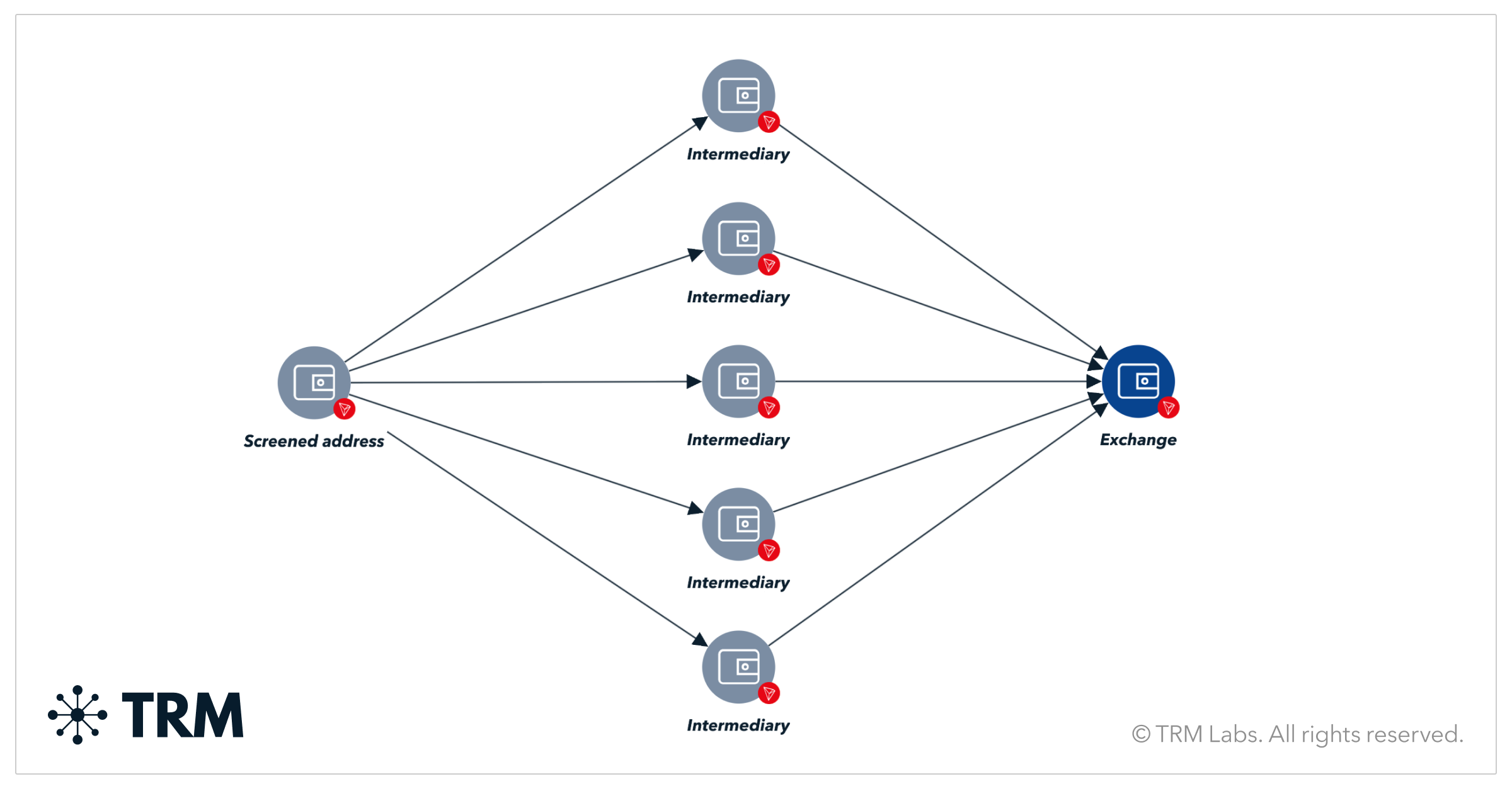
Despite the network’s complexity, adding TRON support didn’t require HIFI to adjust their compliance controls or hire more analysts. “As we add support for new networks like TRON, we don’t have to adjust our compliance operations," said Demehri. “We’ve built our compliance program to scale from day one, because it’s extremely difficult and costly to run with the bare minimum and then have to build out additional processes every time the business grows.”
Building compliance into the business foundation
HIFI’s ability to support networks like TRON while maintaining compliance standards is rooted in its broader operating model.
From the outset, the company designed its compliance program to meet the expectations of banking partners who are regulated financial institutions and global financial regulators. HIFI’s compliance culture spans beyond Demehri and his team. Sales screens prospects for any compliance red flags before kicking off formal onboarding processes, and engineers consult compliance early in product development.
Demehri’s team enables HIFI to accelerate sustainable growth. Demehri’s guidance to other digital asset compliance leaders is direct: don’t launch until you’re ready, and don’t plan on building in compliance later. “It’s much easier to build the right foundations from day zero than to retrofit them later. Remediation is significantly more complex than getting it right from the start.”
That means having everything in place before going live — compliance tooling, policies and procedures, risk appetite documentation, SAR filing protocols, OFAC procedures, and team training on complex investigations. “The business is focused on growth and execution,” said Demehri. “Our role is to ensure the underlying systems support that so teams can move forward without unnecessary friction.”
By embedding blockchain intelligence into its workflows, HIFI is able to evaluate risk in real time without slowing down transaction processing or onboarding. This allows the team to scale transaction volume and expand to new networks without proportionally increasing operational overhead — a critical advantage as stablecoin payment flows continue to grow.
Learn more about HIFI on their website.


