Crypto compliance
Policy and regulation
Sanctions
Crypto business
Financial institution
Regulatory agency
Tax authority
Track crypto policy developments
Home
/
Resources
/
Reports and White Papers
/
Global Crypto Policy Review & Outlook 2024/25 Report
Report

Global Crypto Policy Review & Outlook 2024/25 Report

Navigating the winds and waves of change

December 12, 2024
Table of Contents
Download the PDF for later

What shaped crypto policy in 2024?

{{global-crypto-policy-review-outlook-2024-25-key-highlights}}

2024 was a big year for crypto policy. For the first ten months, crypto policy was shaped by two forces:

  1. The growing waves of regulatory implementation, institutional adoption, and innovation
  2. Strong headwinds caused by elections, the geopolitical climate, and the increasingly stretched resources of regulators

The last two months were dominated by the US election, and an all-time valuation high for Bitcoin. 

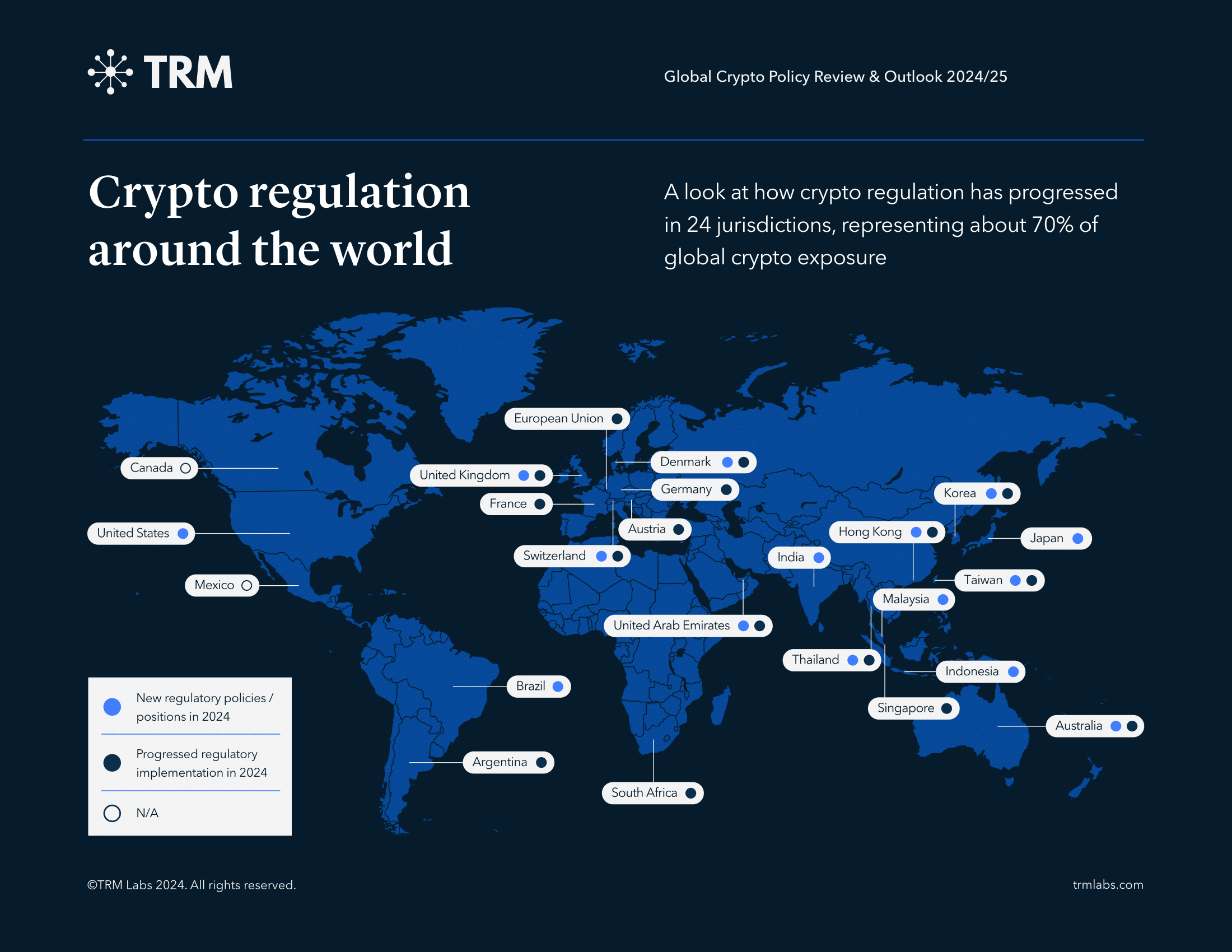
In this year’s Global Crypto Policy Review & Outlook 2024/25 report, TRM reviewed crypto policy developments in 24 jurisdictions, representing approximately 70% of global crypto exposure — covering the major policy, enforcement, and innovation developments in each jurisdiction.

For the first time, we’ve also included data from TRM’s Crypto Adoption and Illicit Exposure Report, which aims to capture the penetration of cryptocurrency usage in different jurisdictions, taking into account each jurisdiction’s overall economic conditions. We found that there is not necessarily a direct link between crypto adoption and regulatory maturity. Interestingly, crypto hubs like Singapore, Hong Kong, the UAE, and Switzerland have lower domestic adoption, which may reflect the global nature of their digital asset ecosystem, as well as already sophisticated digital payment landscapes. 

So what macro themes shaped the global crypto policy landscape in 2024?

Waves of adoption 

Implementation of regulatory frameworks

If 2023 was about writing frameworks, 2024 was about implementing them. Across Europe, the Middle East, and Asia, significant regulatory frameworks came into force this year. 

Out of the 24 jurisdictions we reviewed — representing about 70% of global crypto exposure — about 70% made progress implementing regulations. At the same time, policymaking continues apace, with over 60% of these jurisdictions introducing new policies or positions for digital assets. 

ETFs and institutional adoption

The approval of Bitcoin ETFs in January and the market reaction to the US election were perhaps the biggest market events of 2024. ETF approval and the continued move toward tokenization made 2024 the year in which institutions leaned further into crypto assets.

Continued innovation

2024 also saw a proliferation of pilots, sandboxes, and calls for information on digital asset topics. Combined with a growing acceptance for Supervisory Technology (SupTech), we saw regulators across the globe look to technology to solve their challenges. Out of the 24 jurisdictions we reviewed, just under half made moves to support digital asset innovation.

Winds of change 

Elections

In 2024, two billion people across 50 nations participated in elections, with varying impacts from cryptocurrency issues on voting behavior. Out of the 24 jurisdictions we reviewed, almost 60% went to the polls this year

While early predictions suggested digital assets could be a significant influence, crypto largely remained a secondary concern. Notably, in major elections across the UK, France, India, and South Africa, crypto received limited attention, with few mentions during campaigns. Even post-election, newly formed administrations in these countries took minimal steps to actively support or regulate cryptocurrency, indicating that broader economic and social issues continued to dominate political priorities. 

The outlier was the US election — where although crypto was a secondary issue, the outcome previews potential movement on crypto legislation and changes in policy and enforcement in 2025 and beyond.

Geopolitical climate

2024 was an increasingly tense year geopolitically, with conflicts intensifying across the Middle East, Africa, and within Europe. Sanctions were used to constrain malign actors who increasingly turned to crypto assets to evade sanctions. As of November 2024, 82 crypto addresses were sanctioned by the US, compared to 60 addresses in 2023.

And, unlike 2023, which saw a downturn in crypto hacks and ransomware, 2024 saw a proliferation of attacks. As of early November, the number of hacks that occurred in 2024 was nearly 25% higher than the same period in 2023.

Regulatory capacity

Regulators around the world began feeling their limits as artificial intelligence, digital assets, and tokenization all competed for tight resources amidst the cost of living crisis, the need to remain competitive, and a flagging green transition. The ever-growing challenge of fraud and consumer protection also weighed heavily on regulators, who sought to use different regulatory and technology levers to contain these problems. 

Across the globe, 2024 was a year of massive change in crypto policy and, more broadly, financial regulations. And almost every jurisdiction in the world is in the midst of regulatory discussions about what their future digital financial system will look like. 

As jurisdictions apply their own approaches, let's ride the crypto policy and regulation winds and waves around the world — and look ahead to what 2025 has in store. 

{{global-crypto-policy-review-outlook-2024-25-disclaimers}}

{{premium-content_chapter-divider}}
{{premium-content_chapter-divider}}

2024 highlights

{{premium-content_chapter-divider}}

Jurisdictional developments

Americas

Argentina

{{global-crypto-policy-review-outlook-2024-25-argentina}}

In 2024, Argentina’s regulatory approach to cryptocurrency saw significant evolution, prioritizing stricter oversight and economic integration amid a high-inflation environment and increasing public demand for digital currency alternatives. 

In March 2024, CNV mandated that all Virtual Asset Service Providers (VASPs) register under its purview to comply with the Financial Action Task Force (FATF)’s anti-money laundering standards. This move is in response to concerns over money laundering and aims to create a regulatory framework that aligns with international standards — while recognizing crypto's potential to address Argentina’s economic challenges. 

President Javier Milei's administration also introduced tax amnesty on crypto holdings declared before March 31, 2025, to encourage individuals to declare their crypto assets without fear of immediate tax consequences. This move was met with mixed reactions from the crypto community, with detractors saying that taxing crypto contradicted President Milei’s pro-crypto stance. Nonetheless, Milei continues to encourage crypto adoption, highlighting cryptocurrencies as a means of exchange autonomous from the state, but “still trustworthy.” 

Amidst a mixed policy backdrop, one thing remains clear: Argentina continues to have a strong trend of crypto adoption. This trend highlights crypto’s popularity for practical uses, such as mitigating inflation and enabling financial independence.

Brazil

{{global-crypto-policy-review-outlook-2024-25-brazil}}

Registration requirements for VASPs in Brazil were slated to come into force this year, following the passage of a virtual asset law in December 2022 and the designation of BCB as the competent regulator for VASPs in June 2023. 

However, implementation of the registration regime, which BCB had originally projected for June 2024, has been postponed. The Bank had opened an initial consultation in December 2023 to develop more comprehensive rules covering digital assets and VASP activities. However, in mid-2024, the Bank announced it would delay the rollout of the new laws to allow for further consultation. 

While we are still awaiting details on the broader regulatory framework, in December 2024, the Bank released a consultation on foreign exchange and rules for VASPs’ foreign exchange activities. These include restrictions and reporting requirements on cross-border crypto transactions and non-resident trading activity, and perhaps most notably, a ban on stablecoin transfers to unhosted wallets. BCB Governor Roberto Campos Neto has also said that the Bank plans to regulate stablecoins and asset tokenization in 2025. 

In addition to regulatory measures, Brazil, like many other jurisdictions in this report, is proactively exploring central bank digital currency (CBDC) integration through its Digital Real (Drex) pilot, with a wider rollout expected soon. Pix, Brazil’s instant payment system, gained rapid adoption following its November 2020 introduction, and is now used by 99% of the adult population in Brazil. A similar trajectory might be expected for Drex, given Brazil’s high digital and crypto adoption rates. 

We will be watching out for more Drex action in 2025, as well as details of the various regulatory frameworks.

Canada

{{global-crypto-policy-review-outlook-2024-25-canada}}

2024 was a pretty quiet year for crypto regulation in Canada, which has a relatively established regime. That said, we did mark the first international exchange registration in Canada this year, with Coinbase successfully registering as a Restricted Dealer with the CSA in April.  

CSA also extended its deadline for crypto asset trading platforms (CTPs) to cease offering stablecoins that do not meet CSA-specified conditions. These conditions include being pegged to either the US dollar or Canadian dollar, redeemable for the underlying fiat currency at par value within a reasonable period, fully backed by liquid assets held with a qualified custodian for the benefit of the stablecoin holder, with adequate public disclosures on governance, operations and reserve assets. 

While the CSA recognized that stablecoins “may have certain uses” for Canadian crypto customers, these conditions were put in place with “certain standards to help ensure that investors receive the information they need about the assets they are purchasing, including the risks associated with them.”

Citing technical issues highlighted by CTPs, the CSA has extended the compliance deadline of April 30, 2024 to December 31, 2024. It has also invited submissions on an appropriate long-term regulatory framework for stablecoins; we will be watching for further developments here in 2025. 

Mexico

{{global-crypto-policy-review-outlook-2024-25-mexico}}

2024 saw Mexico take the FATF helm, with Eliza de Anda Madrazo, Director-General at the Mexican Ministry of Finance and Public Credit, succeeding Singapore’s T. Raja Kumar in July. With an emphasis on financial inclusion, the Mexican presidency has pledged to support “low-capacity” jurisdictions in implementing regulation for VASPs. Mexico itself is currently rated “largely compliant” on FATF Recommendation 15 regarding virtual assets, with Travel Rule implementation being the key outstanding item. Mexico is currently in the process of implementing the Travel Rule, and we will be watching for progress on this front in 2025.

In June, Mexico also elected its first female president, Claudia Sheinbaum, from the ruling Morena party. Morena has not articulated any policy stance on crypto, although it did introduce a 20% capital gains tax on crypto, on top of a 16% VAT and up to 35% in income tax. Sheinbaum is expected to maintain party positions, although it remains to be seen if Mexico’s stance on crypto will be influenced by the outcome of the US elections.

United States (US)

{{global-crypto-policy-review-outlook-2024-25-united-states}}

In 2024, the US government advanced a tri-branch effort to regulate and enforce digital asset compliance across agencies, Congress, and the judiciary. But the biggest event was the November 2024 election that saw a decisive victory for Donald Trump and Republican lawmakers up and down the ballot.

Elections 

The 2024 US election results could significantly reshape the future of cryptocurrency regulation in America. With Trump’s victory, alongside Republican control of both the House and Senate, the stage appears set for accelerated progress on crypto-related legislation. 

A Republican-led government is likely to prioritize economic growth and innovation, viewing digital assets as a strategic opportunity to boost US competitiveness. Under this administration, we may see a shift toward policies that focus on providing clear regulatory frameworks for crypto rather than the restrictive enforcement that has defined the past few years.

With a Republican majority in Congress, key crypto-related bills — particularly those on stablecoins and market structure — are expected to gain momentum. Stablecoin regulations have garnered bipartisan interest, as lawmakers seek to establish standards for reserve-backed digital assets, ensuring safer and more transparent markets. 

Additionally, market structure reforms could become a legislative priority. These reforms would help clarify the roles and responsibilities of regulatory agencies like the SEC and CFTC, creating defined guidelines that would make it easier for crypto companies to comply and innovate. Such clarity would not only streamline regulatory processes, but also provide businesses with the confidence to invest in long-term growth and innovation within the US market. While stablecoin and market structure bills have been voted out of committee, a Republican-controlled Congress could push them toward passage.

The new administration — which has touted Bitcoin as a strategic reserve and talked about making the US the world leader in cryptocurrency innovation — is also anticipated to adopt a more lenient approach to enforcement, which could be a game-changer for crypto businesses in the US. Reduced enforcement actions would signal a friendlier regulatory environment, encouraging companies to expand and innovate domestically without the fear of sudden punitive measures. 

This shift could attract more capital and talent to the US, countering the competitive regulatory environments of regions like Europe and Asia, which have recently drawn in crypto companies. In short, Trump’s win and a supportive Republican Congress may foster a favorable climate for the US crypto industry, where legislative clarity and a pro-business approach could spur growth, cementing America’s leadership in blockchain innovation on the global stage. 

But, prior to the election, there was increased activity in the regulatory, legislative, and judicial branches.

Executive branch

In the executive branch, agencies like the Department of Justice (DOJ), Financial Crimes Enforcement Network (FinCEN), and Office of Foreign Assets Control (OFAC) used criminal prosecutions, sanctions, enforcement actions, and other authorities to target mixing services, ransomware groups, non-compliant exchanges, and other entities.

US authorities were focused on the Russian illicit finance ecosystem, with FinCEN naming PM2BTC a primary money-laundering threat under Section 311 of the USA PATRIOT Act due to its extensive ties to Russian cybercrime. OFAC also imposed sanctions on Russian-based exchanges Netex24 and Bitpapa, underscoring a focused effort to disrupt the financing channels for cybercriminal groups​.

US regulators also collected a record-breaking USD 19 billion in settlements from crypto companies, marking nearly two-thirds of the total USD 31.92 billion accumulated since 2019. If you add the over USD 4 billion settlement with Binance (which occurred in November 2023), the 2024 totals are even more daunting.  

This surge in settlement figures underscores a sharp uptick in regulatory enforcement. The primary contributor to 2024’s high settlement total was FTX and its affiliated trading firm, Alameda, which paid a substantial USD 12.7 billion to the CFTC in an August settlement. This figure contributed to an overall 78% increase in settlement values compared to 2023, which recorded USD 10.87 billion in payments. Notably, this year’s figures reflect an astounding 8,327% rise from 2022, highlighting a recent regulatory clampdown on crypto-related activities.

Alongside FTX, other high-profile cases included Terraform Labs, which settled with the SEC for USD 4.47 billion over its algorithmic stablecoin TerraUSD (UST) collapse in 2022, and Genesis, which paid USD 2 billion in a settlement with the Office of the Attorney General after its bankruptcy filing in January 2023. 

However, while enforcement actions were the focus, the SEC approved the first Bitcoin ETFs on January 10, 2024, setting forth a flurry of institutional activity.

Legislative branch

The legislative branch pushed forward new digital asset laws to clarify regulatory standards and protect consumers. The Stablecoin Trust Act, projected to pass in 2025, would introduce federal licensing for stablecoin issuers, with strict requirements for reserve transparency, segregated reserves, and audits overseen by the Federal Reserve and Office of the Comptroller of the Currency (OCC). 

Alongside this, the Financial Innovation and Technology for the 21st Century (FIT) Act progressed through committee, proposing a dual-regulatory framework to address digital asset classifications as either securities or commodities. This framework would designate oversight to the SEC for securities-like tokens and to the CFTC for commodities — aiming to enhance clarity and support market stability while fostering innovation in the crypto sector​.

Judicial branch

In the judicial branch, federal courts played a pivotal role — particularly through the Ripple case, which provided a nuanced interpretation of securities laws as applied to digital assets. Judge Analisa Torres’ ruling divided Ripple’s XRP sales into programmatic sales (on exchanges) and institutional sales (with direct contracts), determining that only the latter met the criteria of an "investment contract" under the Howey Test. 

This decision suggests that certain digital asset transactions may not inherently qualify as securities, depending on transaction structure and investor expectations. However, this ruling is case-specific and is already facing an appeal from the SEC, leaving room for further judicial scrutiny. 

Looking ahead to 2025, key policy questions will center on the new administration and Republican-led Congress. Will this be the year the US finally designates a primary regulator and passes a comprehensive market structure bill? Could stablecoin legislation reach the President’s desk? And critically, will the SEC and other executive agencies maintain their aggressive enforcement stance, or shift toward a more collaborative approach in regulating this emerging sector? While the answers remain uncertain, one thing is clear: 2025 promises to be a pivotal, unpredictable year for crypto policy in the US.

Europe, Middle East, and Africa

Austria

{{global-crypto-policy-review-outlook-2024-25-austria}}

Like many EU member states, Austria spent much of 2024 actively laying the groundwork for the Market in Cryptoasset Regulations (MiCA) implementation. In August, the government formally designated the FMA as the country’s national competent authority for MiCA, initiating its authorization process. The FMA issued an information document to assist Crypto Aasset Service Providers (CASPs) in developing their authorization applications. At present, there are two CASPs registered under the former regime who will have to seek reauthorization under MiCA. Austria is applying a 12-month grandfathering period until the end of 2025. 

In May, Austrian authorities coordinated a major enforcement action against a crypto investment scam. The scam, which operated from December 2017 to February 2018, stole EUR 6 million from investors. This resulted in six arrests and the seizure of EUR 750,000, plus EUR 1.4 million in property and vehicles.

Austria’s crypto market also made significant strides in integrating with traditional financial services this year. In January, Raiffeisen Bank launched crypto trading for retail customers through a partnership with Bitpanda. Later in the year, the bank expanded this product to 55 banks across Austria.

Much like other EU member states, Austria will spend 2025 putting MiCA into practice and ironing out its authorization and supervision practices. 

Denmark

{{global-crypto-policy-review-outlook-2024-25-denmark}}

When is a DeFi project decentralized enough to be exempt from MiCA? This was the big question that Denmark tried to answer in 2024. 

In June, the Danish FSA published a paper on this topic, which attracted significant interest. The paper presented a principle-based approach to evaluating whether a project is genuinely decentralized, considering the project’s architecture and management. The DFSA paper went on to emphasize that determining the legal status of a project currently requires a case-by-case assessment. This paper will likely be used by the EU Commission, who will produce a report on the developments in the crypto asset market by the end of 2024 or early 2025. 

In May, the Danish parliament passed legislation to make the necessary amendments for the introduction of MiCA and the Transfer of Funds Regulation by their respective deadlines. The government appointed the DFSA as the competent authority, granting pre-existing CASPs an 18-month grandfathering period to transition to MiCA. As with Austria, 2025 will be about MiCA requirements bedding into Denmark’s cryptoasset framework. 

European Union (EU)

{{global-crypto-policy-review-outlook-2024-25-european-union}}

Two dates in 2024 defined the year for crypto assets in Europe: June 30 and December 30, when the two halves of the Market in Crypto Assets Regulation (MiCA) came into force. 

The first half of MiCA introduced rules for stablecoins, while the second focused on regulations for CASPs. Almost all of the year’s policy work centered around these two dates — but the EU also prepared for the Travel Rule and the transition to the Anti-Money Laundering Authority (AMLA). This summary provides a brief overview of the developments related to MiCA and the Anti-Money Laundering Package. For brevity, we have skipped other noteworthy files, such as the AI Act, DORA, and DAC8.

MiCA and stablecoins

As a reminder, MiCA — the EU’s flagship regulation on crypto assets — creates a new regulated asset class for crypto assets and establishes a regulatory framework tailored to their nuances. While the MiCA text has been available since 2023, 2024 focused on finalizing its details through technical rules and guidance documents. The EU Commission delegated the task of creating these documents to the EBA and ESMA.

The EBA produced guidance for stablecoin issuers to meet the June 30 implementation deadline. The EBA released technical requirements covering authorizations, governance, white papers, recovery plans, and reporting requirements. The June 30 implementation, however, was not as smooth as anticipated. Confusion arose over whether Electronic Money Token issuers needed an Electronic Money License in addition to a MiCA authorization to operate. This caused uncertainty and could necessitate an amendment to the Payment Services Regulation to help clarify when transfers are payments — and thus require additional licensing. Despite this, several ‘MiCA compliant” stablecoins were announced in 2024, including the first from Circle. 

ESMA handled the rules related to CASPs. Two packages of rules were finalized ahead of December, with a third on market abuse, investor protection, and operational resilience finalized just weeks ahead of the December 30 deadline. The first package on authorizations was challenged by the EU Commission, which led to delays to the authorization processes in several member states. In addition to its core MiCA work, ESMA also published a paper on the categorization of smart contracts in 2024, dividing them into five distinct categories.

Illicit finance

It was also a busy year in the EU on the illicit finance front. 

In January, the EBA issued new guidance on AML/CFT risk factors including details for crypto, which included requirements for self-hosted wallets and the treatment of DeFi. Significant progress was made on the Anti-Money Laundering Package (AMLP), with Frankfurt chosen as the headquarters for the new Anti-Money Laundering Authority and three candidates shortlisted to lead the organization. The Anti-Money Laundering Regulation (AMLR) entered into force on July 9, and will apply from July 10, 2027.

In addition, the implementation of the EU’s Transfer of Funds Regulation (also known as the Travel Rule) is due to be completed on December 30. The guidance for this is available here

Sanctions

One unexpected development in 2024 was a clause within the 14th Sanctions Package against Russia’s war of aggression. While additional packages were expected, the 14th stood out because it gave the EU the ability to designate crypto asset service providers (among other entities) outside the EU if they facilitated the transfer of dual-use goods or weapons to the Russian state. Although no CASPs were listed, this is an area to watch closely in the coming year. This work was further complemented by the EBA’s new guidance on EU restrictive measures which will further assist CASPs in meeting EU sanctions obligations. 

Looking to 2025, the next major event for the EU will be the EU Commission’s report on developments in the crypto asset market. This report will assess changes in the market since MiCA was first written, and may suggest regulatory approaches to DeFi, NFTs, lending, and staking — ranging from additional guidance to a potential MiCA II.

Whether a MiCA II emerges will depend largely on the priorities of the new European Commissioners. Maria Luis Albuquerque will serve as the Commissioner for Financial Services and the Savings and Investments Union. Her broad portfolio includes digital finance, payments, anti-money laundering (where she will oversee the introduction of the new AML Authority), and external security, where she will ensure the effectiveness of EU sanctions. Valdis Dombrovskis is slated to take on the role of Commissioner for Economic Affairs and Productivity, which will include overseeing the next steps on the digital Euro.

France

{{global-crypto-policy-review-outlook-2024-25-france}}

The snap elections in June and July certainly stood out as the biggest policy event for France's calendar this year. 

Despite overlapping with the first implementation deadline of MiCA, the snap election didn’t significantly impact the country’s work on crypto assets. Ahead of the June 30 stablecoin kick-off, French authorities granted Circle an Electronic Money Institution (EMI) License, which allowed Circle to announce its status as the first “MiCA compliant” stablecoin issuer in Europe.

In August, the AMF further advanced its framework for MiCA readiness by announcing the opening of applications for authorization for CASPs. CASPs or DASPs (Digital Asset Services Providers), as they are known in France, that are already operational will have an 18-month grandfathering period to transition to a MiCA authorization, during which time they will not be able to passport their services into other countries. 

France also contributed to the DeFi discussion. In June, the AMF published a summary of responses to its 2023 discussion paper on DeFi, which you might remember from last year’s report. Respondents generally supported the idea of developing a separate regulatory framework for DeFi to enable growth, while also managing risk appropriately.

On tokenization, Deputy Governor of the Banque de France, Denis Beau, gave a speech in April acknowledging the opportunities DLT holds for financial services. But he stressed that these must be balanced with financial stability and the need for central bank money.

As we look towards 2025, the big policy question will be whether Macron calls another election in June 2025. In the intervening months, it is unlikely that the current government does much on digital assets other than continue to implement MiCA. 

Germany

{{global-crypto-policy-review-outlook-2024-25-germany}}

Enforcement actions

Germany had an especially strong year for enforcement against the illicit use of cryptocurrencies. Starting in February, law enforcement in Saxony reportedly seized 50,000 BTC, worth over USD 2 billion. The seizure related to an ongoing case involving two individuals who ran a piracy site until 2013. Interestingly, the accused voluntarily transferred the funds to a wallet controlled by the German federal police, the BKA.

In June, German authorities announced the arrest of an individual — who had applied to be a security guard at the European Football Championship — for suspected terrorism. The individual was accused of sending USD 1,700 in cryptocurrency to an address linked to the Islamic State Khorasan Province (ISKP)

In August, Germany announced a significant sting operation targeting illicit crypto ATMs operating in the country, resulting in the seizure of 35 machines. 

And finally, in September, authorities turned their eye to illegal cryptocurrency exchanges, closing 47 for facilitating the “underground economy.” 

In related news, another big win this year for Germany was Frankfurt being chosen to be the home of the EU’s new Anti-Money Laundering Authority (AMLA). From mid-2025, AMLA will set the AML rules in Europe and be the supervisor of the bloc’s riskiest institutions. 

The crypto market

Germany’s crypto market also enjoyed a good year. In April, Germany’s largest state-backed lender, Landesbank Baden-Württemberg (LBBW), announced a partnership with Austrian exchange Bitpanda to offer crypto custody services to customers. Later in the year, Germany’s second-largest financial institution, DZ Bank, partnered with Boerse Stuttgart Digital to provide customers with custody and trading services. Commerzbank followed suit, with a trading offering for its institutional clients. 

More broadly on crypto regulation, like its fellow member states, Germany spent much of the year preparing for the implementation of MiCA and the Travel Rule. BaFin will be the country’s national competent authority, and there will be a 12-month grandfathering period.

South Africa

{{global-crypto-policy-review-outlook-2024-25-south-africa}}

In 2023, South Africa introduced a regulatory framework that integrates cryptocurrency into its financial system. 

As of April 2024, the Financial Sector Conduct Authority (FSCA) has licensed 138 CASPs. These regulations require platforms to meet strict anti-money laundering (AML) and counter-terrorist financing (CTF) standards, improving consumer protection and market integrity. This makes South Africa one of the first countries in Africa to mandate licenses for crypto exchanges. In April, the country’s Financial Intelligence Centre (FIC) issued a draft directive to strengthen the implementation of the Travel Rule — a key issue that must be resolved if South Africa is to be removed from FATF’s gray list in 2025. 

Throughout the year, South Africa’s central bank also continued work on its CBDC project. In May, it progressed to the next phase.The project looks at the development of both a retail and a separate wholesale CBDC — to better understand whether or not these are appropriate for the country.

In 2025, South Africa will be evaluating the impact of its initial service provider licenses and how these drive legitimate activity in the jurisdiction. 

Switzerland

{{global-crypto-policy-review-outlook-2024-25-switzerland}}

Switzerland continues to establish itself as a prominent hub for crypto asset activity. In spring 2024, FINMA's annual report detailed its 2023 efforts in overseeing trading, custody of payment tokens, and staking. For 2024, FINMA focused on refining the country's regulatory landscape, particularly concerning tax policies and stablecoins.

In May, the Federal Council launched a consultation on whether Switzerland should join the 

Organisation for Economic Co-operation and Development’s (OECD) Crypto Asset Reporting Framework (CARF), aimed at ensuring equal treatment of crypto assets under tax reporting laws. This consultation, which closed in September, is expected to report early next year. Another consultation in August sought to determine which countries Switzerland would exchange information with, regarding crypto tax data.

In July, FINMA issued guidance to mitigate the risks associated with stablecoins, particularly for issuers and banks providing guarantees. The guidance highlighted concerns about stablecoins using bank guarantees to bypass obtaining a banking license, as well as the money laundering risks posed by the secondary market for stablecoins. 

Regarding financial crime, a significant event occurred in January, when the Federal Office of Police released a National AML/CFT risk assessment for crypto assets. The report noted that since the first crypto risk assessment in 2018, there have been notable developments, such as an increase in Swiss crypto users, more financial institutions engaging in crypto activities, and rising reports of suspicious activity related to crypto misuse. The assessment called for improved data sharing, enhanced domestic and international cooperation, and stronger oversight by authorities due to the increasing money laundering and terrorist financing risks associated with virtual assets.

The regulator’s pragmatic approach led to increased participation from traditional financial institutions in 2024. For instance, in January, FINMA approved the retail tokenized securities trading platform Taurus, expanding Switzerland's offerings to retail customers. And in September, it was reported that the country’s stock exchange was exploring the launch of a platform for trading digital assets. In 2025, it is likely that Switzerland will continue to support the adoption of digital assets by financial institutions.

United Arab Emirates (UAE)

{{global-crypto-policy-review-outlook-2024-25-uae}}

Licensing and regulation

The UAE continued to refine its regulatory approach to digital assets this year, maintaining its status as the region's leading crypto hub.

A major theme in 2024 was the UAE’s efforts to perfect its digital assets payments landscape. In March, the country advanced its CBDC project towards the creation of a digital Dirham, launching cross-border CBDC pilots with India and a proof of concept for a domestic CBDC. 

The Central Bank of the UAE (CBUAE) introduced a comprehensive licensing system for stablecoins. This system requires stablecoins to be backed by UAE Dirhams, stabilizing them and enhancing consumer protection. The CBUAE expects this framework to boost the domestic cryptocurrency market, attract international players, and facilitate the adoption of stablecoins by major financial institutions. This appeared to be working in August, when Tether announced that it plans to offer a Dirham-backed stablecoin in the near future. 

In June, the DFSA actively amended its Crypto Token Framework. These changes apply to crypto tokens within the DIFC, and address areas such as funds, custody, financial crime, and token recognition. By aligning with the latest international standards set by the International Organization of Securities Commissions (IOSCO) and the Basel Committee, these updates ensure the framework keeps pace with market developments. 

Lastly, in October, the UAE introduced a legal status for DAOs operating in the RAK Digital Asset Oasis, providing further clarity regarding tax obligations and governance structures. 

Illicit finance

Regarding illicit finance, the UAE began witnessing the impact of the Travel Rule, which authorities implemented in late December 2023. That month, the Abu Dhabi Global Market (ADGM) issued fresh guidance to help firms navigate the Rule. The UAE’s successful implementation of the Travel Rule was vital in securing its removal from the FATF gray list in February 2024, a considerable achievement. 

Innovation and sustainability

While promoting innovation, the UAE also introduced some restrictions. In May, the Abu Dhabi Agriculture and Food Safety Authority (ADAFSA) banned cryptocurrency mining on agricultural farms, citing concerns about energy consumption and its potential impact on food production. This decision highlights the delicate balance the UAE must strike between fostering innovation and maintaining sustainability.

Additionally, in September, the Virtual Assets Regulatory Authority (VARA) revised rules on financial promotions, requiring companies promoting digital asset investments to include a disclaimer warning about the extreme volatility of such investments.

1 Abu Dhabi Global Market (ADGM) under FSRA since 2018, Dubai International Financial Centre (DIFC) under DFSA since November 2022, Emirate of Dubai under VARA since February 2023, and the UAE under SCA since January 2023.

United Kingdom

{{global-crypto-policy-review-outlook-2024-25-united-kingdom}}

The UK had a slightly mixed year on crypto. New legislation was frustrated by the election, but law enforcement had several successes disrupting the illicit use of crypto. 

Regulatory framework

Despite promises back in February that the UK would have legislation on stablecoins — and potentially a position on staking — both of these motions were put on ice by the country’s June election. The new Labour government did refocus the government on crypto and digital assets in November, announcing a timeline for a full regulatory framework. The framework will be based on consultations that will happen throughout 2025 and should set up the new framework to be operational from 2026.

Consumer protections

Consumer protection, including market abuse and financial promotions, remained a core focus for the FCA. While firms continued to adjust to last year's financial promotion regime, some began to regain momentum — with a few resuming their product offerings to consumers. This was aided in August by the FCA’s review of compliance with the financial promotions regime, which offered firms useful examples of what good and bad implementation looks like. 

In September 2024, the UK introduced the Property (Digital Assets Etc.) Bill, which aims to clarify the legal status of digital assets, such as cryptocurrencies, non-fungible tokens (NFTs), and carbon credits. These assets will now be considered personal property under English law, giving owners better legal protection against fraud and disputes.

Tokenization

The UK saw progress on tokenization throughout the year. The Investment Association published its second report, which further underscored the government’s support for tokenization and the lack of perceived legislative barriers to tokenization.

In September, the Bank of England began accepting applications for its Digital Securities Sandbox (DSS), which will provide a "live environment" for firms to test distributed ledger technology (DLT) as the infrastructure for trading digital securities. In November, the government announced it would pilot a “Digital Gilt” that would be issued within the DSS.

The UK also continued its work on the digital pound in 2024, which remains in the design phase, expected to take two to three years.

Illicit finance

The UK had a successful year in combating the illicit use of cryptocurrencies. 

In April, authorities convicted Jian Wan for attempting to launder billions of pounds worth of illicit funds linked to scams in China through UK property and luxury goods. Alongside this conviction, GBP 2 billion in crypto assets were seized. This coincided with the introduction of new asset seizure powers for crypto assets, which expanded the ability of enforcement agencies to seize these assets, and introduced a civil forfeiture regime alongside the criminal one.

In September, the UK achieved another milestone by convicting the operator of illegal crypto ATMs, marking the FCA's first criminal prosecution for unregistered crypto asset activity and demonstrating the strength of regulatory oversight.

Another major focus for UK enforcement in 2024 was limiting the use of crypto assets by malign state actors and sanctioned entities. In collaboration with international partners, the UK targeted numerous ransomware and cybercrime groups, including the successful takedowns of REvil, Lockbit, Russian Coms, and Evil Corp.

Looking ahead, the industry awaits the UK's positions on stablecoins and staking — critical steps for advancing the regulatory regime and enhancing the UK's competitiveness in the crypto sector.

Asia Pacific

Australia

{{global-crypto-policy-review-outlook-2024-25-australia}}

Australia saw a slowdown in digital asset policymaking in 2024, as the regulatory frameworks for digital asset platforms and stablecoins that were proposed in 2023 moved into the legislative drafting process, which is still ongoing. 

In the meantime, we have seen some of ASIC’s ongoing enforcement actions — intended to obtain legal clarity on “what is a regulated product [under existing laws] and when the provider needs a license" — play out before the courts, with mixed results. In March, Commissioner Alan Kirland said that ASIC was “not afraid to pursue cases where the law might be considered unclear,” but noted that “the courts are the ultimate arbiter of these matters.” 

Nevertheless, the regulator seems to be doubling down on its oversight of crypto under current law. In September, Commissioner Kirkland shared the regulator’s view that “many widely traded crypto assets are a financial product” under the current law, and a “significant number of crypto-asset firms” likely already require ASIC licensing. 

In December, ASIC issued a consultation on revisions to its digital asset guidance that provide more color to this position. The revised guidance includes case studies on digital asset business models that may fall within scope of existing laws. These include exchange tokens, tokenized securities, and potentially, stablecoins. As part of the revision, ASIC is also considering an enforcement reprieve for existing digital asset businesses while they are applying for an ASIC license. 

We also saw AML reform make progress, with a wide-ranging reform bill passed in November. The reforms will see Australia expand the scope of AML/CFT regulation for virtual assets and implement the FATF Travel Rule in March 2026, ahead of its FATF mutual evaluation in December 2026. To better combat crypto-enabled crime, Australia also strengthened digital asset seizure powers for law enforcement.

On the innovation front, Australia saw some ETF action, with the Australian Securities Exchange approving its first spot Bitcoin ETF this year. The Reserve Bank of Australia (RBA) and the Commonwealth Treasury also released a joint report on the CBDCs and future of digital money in Australia, where it indicated that it would prioritize a wholesale CBDC over a retail CBDC, as there was “no clear public interest case to issue a retail CBDC in Australia as yet.” While this means the RBA will focus its research efforts on wholesale use cases, it has not made any decision on whether to issue a wholesale CBDC.

In 2025, we look forward to seeing exposure drafts for both digital asset and payment stablecoin regulatory frameworks in the first quarter, which will hopefully herald further regulatory clarity in the subsequent months.

Hong Kong

{{global-crypto-policy-review-outlook-2024-25-hong-kong}}

In 2024, Hong Kong saw significant progress in regulatory implementation that made clear its overall approach to the crypto sector. 

Swift licensing process

In the days leading up to the end of its transitional grace period for grandfathered VASPs on June 1, there was a flurry of VATPs withdrawing their license applications, likely in anticipation of unsuccessful application outcomes. 

The significant whittling of VATPs from application to approval should be seen as a barometer of the SFC’s regulatory expectations. Crypto hub ambitions notwithstanding, the SFC has maintained a high standard for VATPs in Hong Kong, which has been criticized by some local lawmakers as “excessively stringent.”

The remaining applicants were subject to onsite inspections by the SFC, who completed the inspection process and provided feedback to applicants in a short span of five months. The SFC also promised a “swift licensing process,” which will take place in two phases. VATPs will be granted a restricted license after inspection feedback is addressed, followed by an unrestricted license once the licensed VATPs have “strengthen[ed] their robustness through an external, third party review.”

Nonetheless, SFC is keeping an eye on how its regulatory framework could support market development. In a keynote speech at Hong Kong Fintech Week, Executive Director (Intermediaries) Eric Yip stressed the need to “balance between regulatory perfection and market development.” SFC plans to "join forces" with licensed VATPs to "strengthen their robustness," and will establish an official consultative panel of licensed entities next year so "all their voices will be heard and considered." SFC also indicated that it was studying the market with the goal of expanding its crypto regulatory framework to other parts of the crypto ecosystem.

Stablecoin policy

The city also saw continued momentum on the policy front. 

The HKMA finalized its stablecoin regulatory framework and launched its stablecoin issuer sandbox. The new framework would bring all stablecoin issuers who issue or actively market the issuance of their fiat-referenced stablecoins (FRS) in Hong Kong under the oversight of the HKMA. In December, the framework was detailed in the Stablecoins Bill, which will need to pass through the legislative process before it becomes law.

In order to access Hong Kong retail investors, stablecoins must be regulated under this framework. In the meantime, there have been three successful applicants admitted to its sandbox, which is intended to align regulatory expectations between the HKMA and would-be issuers.

Regulation of OTC venues

The government also consulted on a proposal to regulate virtual asset over-the-counter (VA OTC) trading venues. 

The proposed framework would bring all VA OTC spot trading services under the ambit of the Hong Kong Customs and Excise Department (C&ED), which also regulates money service businesses. This includes crypto ATMs, as well as other physical shops and online platforms that provide VA spot trading services. 

Consumer protection seems to be the main impetus for the new regime, with the government highlighting that “some VA OTC shops have served as one of the main avenues for channeling retail investors’ funds to the suspected fraudulent schemes.” Following feedback from industry players about potentially confusing rules, the government is reportedly considering whether the SFC should regulate OTC venues alongside the C&ED. 

Crypto ETFs

True to Hong Kong’s crypto hub ambitions, we saw policy moves to encourage growth and innovation in the industry. Notably, Hong Kong was the first jurisdiction in Asia to greenlight spot crypto ETFs, with a number of asset managers receiving SFC approval to offer spot Bitcoin and Ether ETFs, including to retail investors. However, the ETFs have been met with a lukewarm reception, with USD 12 million in trading on launch day, compared to USD 4.6 billion for the US Bitcoin ETFs. 

In 2025, we can expect regulatory implementation to continue apace, with stablecoins and, potentially, OTC frameworks coming into place. We may also see some policy movement on broader crypto regulation, and will be watching how the newly licensed VATPs fare from both a commercial and compliance perspective.

India

{{global-crypto-policy-review-outlook-2024-25-india}}

India ended 2023 with enforcement actions against nine overseas crypto exchanges for unlicensed operations in the country. In 2024, after paying significant fines, two of these exchanges were granted FIU-India approval to operate as VASPs in India. Commenting on the approvals, FIU-India director Vivek Aggarwal said that the registrations would “enhance transparency” of these platforms and facilitate submission of suspicious transaction reports. 

Meanwhile, India continues to struggle with broader regulatory clarity. Reserve Bank of India Governor Shaktikanta Das remains hawkish on the risks of crypto investing, but seems to have pulled back on his earlier calls for a ban on crypto, noting a “greater amount of realism” in the market. In contrast, the Securities and Exchange Board of India recommended shared oversight of the crypto sector. 

Only time will tell whether 2025 will bring greater regulatory clarity. In the meantime, crypto adoption in India continues to soar, taking top spot in our crypto adoption index.

Indonesia

{{global-crypto-policy-review-outlook-2024-25-indonesia}}

As Indonesia gears up for a transition of crypto regulatory oversight from Bappebti (its commodities regulator) to OJK (its securities regulator) in January 2025, we are getting more clarity on what the OJK’s approach to crypto regulation will be. 

In August 2024, OJK issued a comprehensive roadmap for development and strengthening Indonesia’s fintech and crypto industry. It will see OJK establishing an innovation center and strengthening its regulatory sandbox program. It had earlier said that it would require all crypto firms to be evaluated in a sandbox environment before full licensing. At the same time, OJK plans to recognize permits and approvals from Bappebti in order to facilitate a smooth transition. As of the end of November, eight firms have secured a full license from Bappebti, and 27 applications remain pending.

In 2025, we look forward to seeing how OJK will implement its regulatory regime. 

Japan

{{global-crypto-policy-review-outlook-2024-25-japan}}

Japan, home to the world’s oldest crypto regulatory framework — and one of its most robust — has enjoyed relative regulatory stability in a period where most other jurisdictions are working to introduce and implement new regulation. 

Innovation-forward policies

In 2024, we saw Japan turn its eye toward encouraging growth and innovation in Web3. In March, the JFSA hosted its inaugural Japan Fintech Week, aimed at showcasing opportunities in Japan to the international community, and vice versa. Speaking at one of the week’s events, JFSA Deputy Director General Mamoru Yanase emphasized the role of the regulator in creating trust, but also the importance of listening to the industry and understanding new technologies, in order to support innovation. 

Japan’s ruling party also published a new Web3 white paper with a call to “make our country the center of Web3.” The paper called for continued crypto tax reform, regulatory leadership, a legal framework for decentralized autonomous organizations, and potentially, the issuance of a Bitcoin ETF in Japan. JFSA Commissioner Hideki Ito later said that “cautious consideration” was required in deciding whether to allow crypto ETFs. However, the JFSA maintains a “pro-technology stance,” and will not rule out the possibility of a crypto ETF entirely. 

The Web3 community in Japan also received a boost in October with the appointment of industry advocate and chair of the ruling party’s Web3 committee, Masaaki Taira, as the Minister for Digital Transformation. Industry watchers are hopeful that Taira will continue to support industry development from his new position.

Web3 development initiatives

Against this backdrop, Japanese conglomerate Sony announced the launch of its public blockchain, Soneium, with the aim of providing “comprehensive Web3 solutions from the infrastructure to the application layer.” The company hopes to encourage the development of Web3 games, NFT marketplaces, and entertainment-related services on Soneium. 

In its work plan for the 2024/25 fiscal year, the JFSA laid out several initiatives for the “sound development of cryptocurrency trading and Web3.” 

Noting that “the public understands and trusts that [crypto] assets will contribute to the convenience of daily life and the economic growth of Japan,” the JFSA plans to “provide support for new Web 3.0 business initiatives [...] while also taking into account the protection of users.” Specifically, it will work to “strengthen security measures” in light of the USD 300 million hack on Japanese crypto exchange DMM in May 2024. At the same time, it is committed to leveraging its regulatory experience to provide international thought leadership at FATF and other global platforms, and expediting the registration of stablecoin intermediaries.

With Japan’s positive attitude toward emerging technologies, we hope to see more exciting developments in 2025.

Korea

{{global-crypto-policy-review-outlook-2024-25-korea}}

2024 was a big year for crypto regulation in Korea, with the implementation of the Virtual Asset User Protection Act on July 19. The Act, which is Korea’s first omnibus digital asset legislation, focuses on strengthening consumer protection and market integrity by imposing additional requirements on registered VASPs. In addition to the FSC, the new Act sees the FSS assuming responsibility for day-to-day supervision of VASPs.

Regulatory implementation

After setting out detailed rules at the end of 2023, the FSC and FSS have focused on ensuring VASP compliance and shoring up their own capabilities, with the goal of “a supervision and inspection system equivalent to that of financial institutions.” 

In addition to establishing a dedicated team and monitoring system, the FSS provided VASPs with a checklist and consultation process to align implementation expectations. It also conducted onsite visits with VASPs ahead of the Act’s go-live date. The FSS generally found that structures and resources were in place to comply with the Act, but identified deficiencies in areas such as customer asset segregation and cold wallet management. 

In November, the FSC’s Virtual Asset Advisory Committee also convened for the first time. The Committee, which comprises policymakers, academia, lawyers and consumer protection experts, will advise the FSC on virtual asset policy. Notably, the Committee’s first order of business was to deliberate lifting the ban on institutional crypto participation in Korea, a move eagerly anticipated by the local market.

Market consolidation

A number of Korean VASPs also shuttered in 2024, due to worsening market conditions. The FSC expects this trend to continue with the increased regulatory compliance burdens under the new Act. A second phase of legislation is currently in the works — the new laws could see the regulatory remit expand to stablecoins and other types of crypto businesses, as well as introduce additional rules in areas such as information disclosures and token listing. 

Nonetheless, Korean VASPs reported a 106% increase in operating profits in 1H2024, compared to the same period last year. At the same time, there has been a consolidation of players and types of virtual assets offered, as many "coin-only" exchanges (i.e. without local currency on/off ramps) have closed. Employment across the sector is down 5%, driven by a 51% drop in employment at coin-only exchanges due to business closures. Conversely, employment at Korean won-based exchanges (i.e. exchanges with local on/off ramps) was up 6%.

2024 has tested the resilience of Korean VASPs, and 2025 is likely to test it further, as regulators seek to strengthen rules and ensure robust risk management and compliance. But those that succeed could find themselves with a competitive edge in a global crypto landscape trending toward more robust regulation.

Malaysia

{{global-crypto-policy-review-outlook-2024-25-malaysia}}

Malaysia continued to see new players enter the industry in 2024, with the SC granting licenses to a new digital asset exchange and a new digital asset custodian

The government continues to be welcoming of digital asset innovation, with Digital Minister Gobind Singh Deo highlighting that “Malaysia has emerged as one of the top ten crypto-friendly destinations for digital nomads and companies.” This aligns with the country’s goal of becoming one of the top 20 global startup hubs by 2030, through a slew of initiatives launched at its KL20 Summit in April 2024 — aimed at attracting startup founders, investors, and tech professionals. 

The SC also announced three new initiatives to spur innovation in Malaysia’s capital markets, particularly in the area of tokenization: a regulatory sandbox, a tokenized bond pilot with the Malaysian sovereign wealth fund, and regulatory guidance for securities tokenization.

At the same time, SC maintains rigorous regulatory oversight of the space, noting in its latest Annual Report that it had “intensified its oversight on operators of digital asset exchanges” due to growth in the segment. 

In 2025, the twin goals of promoting innovation while managing risk are likely to remain relevant.

Singapore

{{global-crypto-policy-review-outlook-2024-25-singapore}}

Regulatory implementation

2024 saw Singapore implementing a number of long-awaited regulatory frameworks. 

In April, the regulatory regime for crypto custody services, which had been passed in 2021, finally went live. Over thirty crypto custodians already operating in the city state have successfully filed for a licensing exemption while their applications are being reviewed. 

MAS also finalized its guidelines on crypto consumer protection measures — including the segregation and custody of customer assets, as well as barriers to entry for retail investors such as knowledge tests, prohibition of sign-up and referral incentives, and prohibition of the use of credit cards and any forms of leverage for crypto purchases. These requirements are coming into force between October 2024 and June 2025. 

While the substance of these frameworks has been known to the industry for some time, the guidelines provided detail and clarity on MAS’ expectations on how these requirements should be implemented. 

We also saw greater clarity and more rigor under existing regulatory frameworks.

In August, MAS shored up requirements for crypto license hopefuls, introducing a requirement to secure legal opinions on its business models and regulatory obligations, as well as an independent external audit of AML/CFT and consumer protection policies. It also updated its licensing guidelines to detail rules of engagements for license applicants, with the guiding principle that an applicant is expected to "conduct itself as if it were already a regulated financial institution,” or face a rejection. Meanwhile, the pace of crypto licensing has accelerated. As of the end of November, MAS has issued a record 13 new DPT licenses in 2024, raising the total number of DPT licensees from 16 to 29.

Financial Services and Markets Act 

MAS also laid the groundwork for further implementation in 2025, issuing a consultation paper on the proposed regulatory framework for digital token service providers under the Financial Services and Markets Act (FSMA). 

The FSMA, which was passed in 2022, expands MAS' oversight of digital token services to include provision of services by Singapore-based individuals, partnerships, and companies outside of Singapore. Existing regulatory frameworks focus on regulating the provision of services in Singapore. The main aim of the FSMA is to deter such business models. MAS makes clear in the consultation that it expects most digital token businesses to be providing services in Singapore, and therefore anticipates "extremely limited circumstances" under which it will issue FSMA licenses.

Digital asset innovation

Digital asset innovation also continues apace, with MAS completing the first phase of its Global Layer 1 initiative in collaboration with global banks. 

The GL1 initiative explores a single new blockchain infrastructure for financial institutions to work together and prevent the fragmentation of global liquidity. The first phase saw participants look at potential business use cases, aligning on the governance model and completing preliminary legal, risk, and technical assessments. Phase two, which is currently underway, focuses on developing common operating principles, policies, and standards. MAS also announced plans to support the commercialization of trials from Project Guardian, a collaboration with several financial institutions to develop tokenization use cases.

Looking ahead to 2025, we can expect more clarity as regulatory frameworks under the FSMA get finalized and more businesses complete the crypto licensing application process. We could also see MAS finalize its crypto market integrity guidelines. As implementation guidance gets translated into action, both industry and regulators will gain more insight into what robust implementation looks like. Here, Singapore’s approach of maintaining close public-private dialogue will be instrumental in driving good compliance outcomes.

Taiwan

{{global-crypto-policy-review-outlook-2024-25-taiwan}}

In 2024, Taiwan significantly strengthened oversight of the crypto industry by passing a legislative amendment expanding the scope of its VASP registration regime, as well as registration requirements. The new law, which came into effect November 30, requires overseas VASPs to establish local entities and register with the FSC by September 2025. Failure to do so is punishable by up to two years’ imprisonment or a fine of up to TWD 5 million (USD 153,800). 

The new rules also include additional requirements for registered VASPs in areas such as consumer protection and cyber security. All VASPs currently registered with the FSC will be required to comply with the new requirements. In the meantime, they will be allowed to continue providing virtual asset services in Taiwan. The FSC is also drafting a special law on crypto assets, which it plans to table to the Legislative Yuan, Taiwan’s top legislative body, by June 2025.

Meanwhile, Taiwanese VASPs have come together to establish a self-regulatory body, the Taiwan VASP Association. The Association is focused on formulating self-regulatory guidelines to “cater to the interests and development of the industry, while also meeting government expectations and protecting consumer rights.” At the association’s launch, the FSC expressed its support for the sector, saying that it places “great importance on the development of the virtual asset industry.” 

At the same time, the regulator has opened up crypto access in some areas, such as allowing professional investors to invest in overseas crypto ETFs, and announcing a pilot for local banks to provide crypto custody services. 

With crypto policy action picking up, 2025 is shaping up to be a year to watch for Taiwan.

Thailand

{{global-crypto-policy-review-outlook-2024-25-thailand}}

After shoring up consumer protection measures in 2023, 2024 saw Thai regulators start to lean into digital asset innovation. 

In June, the SEC approved Thailand’s first Bitcoin ETF for distribution to high net worth and institutional investors. In August, it launched a digital asset regulatory sandbox to facilitate experiments and innovations across six digital asset services. In order to qualify, businesses must contribute to the innovative development of digital assets in the Thai capital market or participate in a pilot project with a financial market regulator. It also consulted on measures to promote the use of investment tokens, and to allow mutual and private funds to invest in digital assets.     

The Bank of Thailand (BOT) also launched a regulatory sandbox for Thai Baht-pegged programmable payments, leveraging distributed ledger technology, smart contracts, and similar technologies. Announcing the sandbox, Assistant Governor Dr Daranee Saeju said that the BOT recognized “the potential and benefits of these technologies in reducing operational costs of financial service providers and addressing the needs of financial service users.” The sandbox would “demonstrate the potential” of the technology, “accompanied by appropriate risk management processes.” In support of the initiative, the SEC also revised its prohibition on the use of digital assets for payment, in order to allow SEC-supervised digital asset operators to participate in the BOT sandbox. 

While supporting responsible innovation, Thai authorities are not taking their eyes off enforcement. In April, the SEC took action to block access to unlicensed crypto platforms. Thai authorities have also conducted onsite inspections at local events, and taken action against exhibitors and participants found to be conducting unlicensed business.

In 2025, we can expect Thailand to continue with robust consumer protection and enforcement measures. We will also be watching developments in both sandboxes, and the innovations that emerge from participants.

International organizations

Financial Action Task Force (FATF)

Table of Jurisdictions with Materially Important Virtual Asset Sectors

2024 was another busy year for FATF and virtual assets. 

In March, FATF published the long-awaited “Table of Jurisdictions with Materially Important Virtual Asset Sectors.” 

The table, which assessed 58 jurisdictions, evaluated how effectively these crypto hubs were implementing Recommendation 15, which applies financial crime measures to new technologies, including virtual assets. The table aimed to make it easier for jurisdictions to identify areas for improvement. It found that all 58 jurisdictions had completed a crypto asset risk assessment, and 91% had either enacted or were in the process of enacting an AML/CFT registration regime. Additionally, 84% had implemented the Travel Rule.

Targeted Report on the Implementation of Recommendation 15

However, the results of this table somewhat conflicted with the findings of the fifth Targeted Report on the Implementation of Recommendation 15, released after the June 2024 plenary. 

This report revealed that, when jurisdictions are considered collectively, the world is lagging in its implementation of the recommendation — with risk assessments and Travel Rule implementation being critical concerns. Jurisdictions continue to face a range of challenges that prevent effective transmission of information under the Travel Rule. These challenges include delayed rule implementation (the "Sunrise" issue), lack of enforcement, data quality problems, and ongoing difficulties with counterparty VASP due diligence.

Beyond the implementation of Recommendation 15, in 2024, FATF focused on stablecoins, DeFi, NFTs, “unhosted wallets,” P2P transactions, and the use of virtual assets by terrorists. These topics featured prominently in the Targeted Report, which found that they continue to pose financial crime risks and should be closely monitored by FATF and its member states. On a positive note, the report encouraged jurisdictions that have successfully managed these risk areas to share best practices.

Looking ahead

As we approach 2025, the question arises of how central crypto assets and the implementation of Recommendation 15 will remain on FATF's increasingly packed agenda. 

The June report, combined with new presidential priorities, suggests that FATF will continue monitoring market developments and the extent of Recommendation 15’s implementation. The release of the materially important jurisdictions table, the commencement of the fifth round of mutual evaluations, and the new president’s emphasis on strengthening FATF’s global network may also lead to more capacity-building initiatives on crypto assets in emerging economies. 

Apart from these actions and the commitment to a sixth implementation report, FATF may not take any major steps in this sector over the next 12 months — unless, of course, unforeseen events necessitate further action.

International Monetary Fund (IMF) and Financial Stability Board (FSB)

The IMF’s and FSB’s 2024 work on crypto, part of a broader effort requested by the G20, highlights the need for coordinated international efforts to mitigate the global risks posed by the rapid adoption of digital assets. This includes ongoing monitoring, policy updates, and capacity-building support for member countries — especially those most vulnerable to economic disruption from crypto activities. In particular, three papers stood out. 

Stablecoin risks

The first, published in July, highlighted the risks that stablecoins pose to emerging and developing economies. It argued that in emerging markets (EMDEs), global stablecoins — particularly those pegged to foreign currencies — can exacerbate financial and fiscal instability. Such risks include disrupted capital flows and currency devaluation, intensified by EMDEs’ limited regulatory and enforcement capabilities compared to where GSCs are domiciled. 

The Financial Stability Board (FSB) advises EMDEs to adopt its high-level recommendations on GSCs and crypto assets, emphasizing cross-border regulatory collaboration, infrastructure development, and policy adjustments to address unique local conditions. Increased regulatory focus on transparency, AML, and cooperation between EMDE and advanced economy regulators is recommended to mitigate risks, including illicit finance, market volatility, and systemic threats from GSC activity in underregulated regions.

G20 roadmap update

In October, the IMF and FSB published a status report on the G20 roadmap on crypto asset policy implementation. The report found that while the financial stability risks had not changed, the increasing interlinkages with traditional markets could present systemic risks. 

Implementation of regulatory frameworks has improved, with nearly all FSB member states having put in place plans for a regulatory framework for both centralized service providers and stablecoins. However, challenges remain — especially regarding the risk presented by “offshore” jurisdictions and cross-border transactions. This status report will be followed by a further review at the end of the 2025 implementation of the FSB framework.

Tokenization 

Finally, the FSB also published a report on the financial stability implications of the tokenization of financial assets. It found that although adoption is currently low, it is growing — with increased efficiency being the main benefit. Vulnerabilities stem from the quality of the underlying asset, project participants, and the interaction between new technology and legacy systems. The report finds that at its current scale, tokenization doesn’t pose a material risk to financial stability. 

In its 2024 Annual Report, the FSB said in 2025 it would continue to monitor the implementation of its recommendations on crypto asset activities and global stablecoin arrangements, and will continue to monitor financial stability issues. 

International Organization of Securities Commissions (IOSCO)  

2024 was a quieter year for IOSCO on digital assets than 2023, when it published significant recommendations for both centralized and decentralized service providers. 

In April, IOSCO added tokenization to its work plan for the year, alongside the latest buzzword: artificial intelligence. IOSCO’s work on tokenization will focus on use cases and issuance of capital markets products, and may lead to a new set of policy recommendations published in late 2025. 

The organization also published a final report on investor education in October, which recommended that retail investors need more education on the risks of crypto investments, especially when they are promoted on social media.  

Bank for International Settlements (BIS)

In 2024, the Bank for International Settlements (BIS) focused on several key areas regarding crypto assets, with initiatives primarily from the Basel Committee on Banking Supervision and the BIS Innovation Hub. 

The Basel Committee finalized a disclosure framework for banks’ crypto asset exposures. This framework requires banks to disclose both qualitative and quantitative data on their crypto holdings, aiming to enhance transparency and market discipline. Furthermore, the Committee has refined prudential standards to address specific risks associated with stablecoins, particularly around stability mechanisms and reserve asset quality. These standards will take effect from January 1, 2026.​

{{premium-content_chapter-divider}}

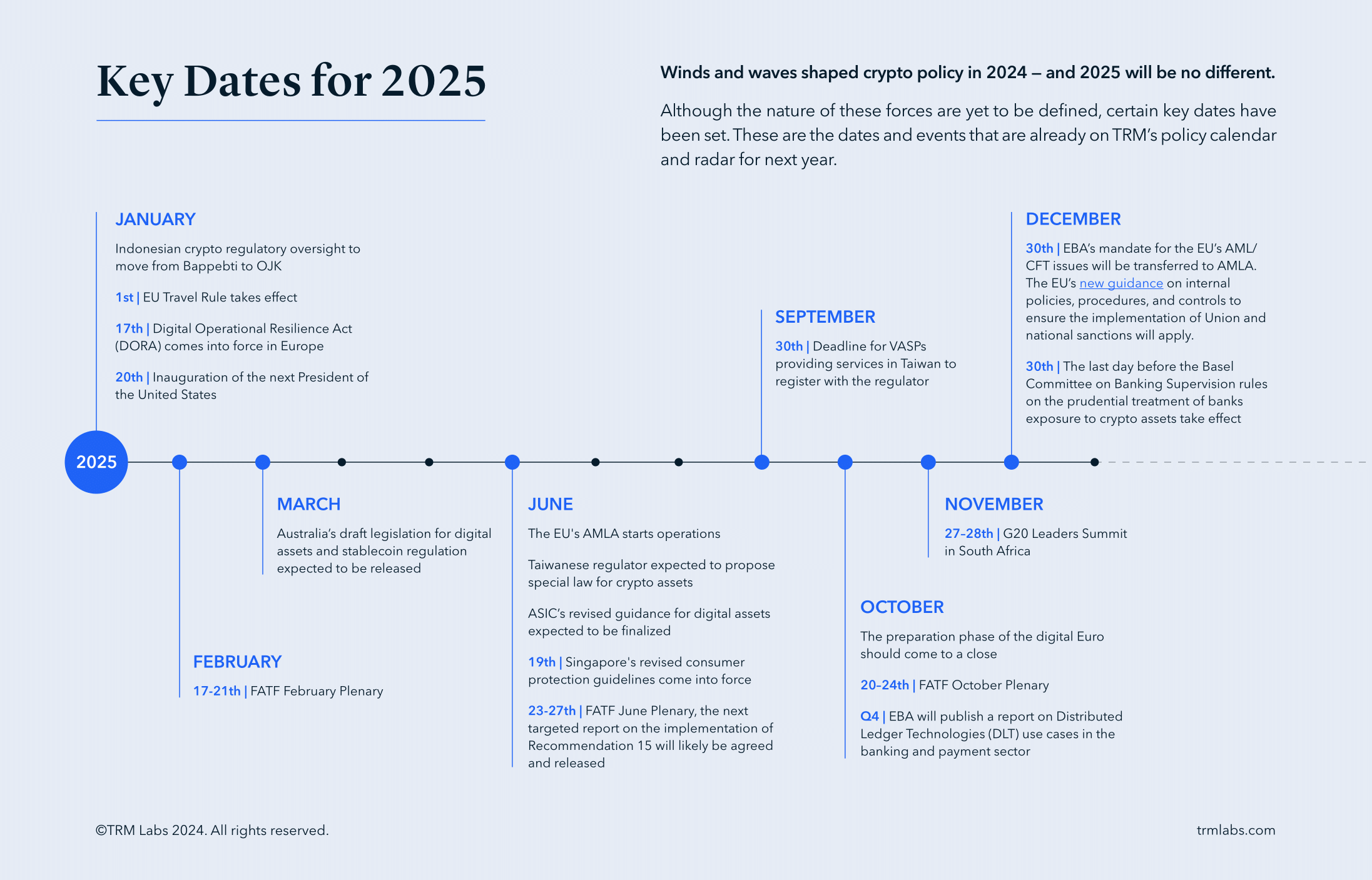
Key dates for 2025
{{premium-content_chapter-divider}}

About TRM Labs

TRM Labs provides blockchain analytics solutions to help law enforcement and national security agencies, financial institutions, and cryptocurrency businesses detect, investigate, and disrupt crypto-related fraud and financial crime. TRM’s blockchain intelligence platform includes solutions to trace the source and destination of funds, identify illicit activity, build cases, and construct an operating picture of threats. TRM is trusted by leading agencies and businesses worldwide who rely on TRM to enable a safer, more secure crypto ecosystem. TRM is based in San Francisco, CA, and is hiring across engineering, product, sales, and data science. To learn more, visit www.trmlabs.com.

This is some text inside of a div block.

Key highlights

  • TRM Labs reviewed 2024 crypto policy developments in 24 jurisdictions, representing approximately 70% of global crypto exposure
  • Over 60% introduced new policies or positions for digital assets, and about 70% made progress implementing regulations 
  • Just under half made moves to support digital asset innovation

Key highlights

  • TRM Labs reviewed 2024 crypto policy developments in 24 jurisdictions, representing approximately 70% of global crypto exposure
  • Over 60% introduced new policies or positions for digital assets, and about 70% made progress implementing regulations 
  • Just under half made moves to support digital asset innovation

Key highlights

  • TRM Labs reviewed 2024 crypto policy developments in 24 jurisdictions, representing approximately 70% of global crypto exposure
  • Over 60% introduced new policies or positions for digital assets, and about 70% made progress implementing regulations 
  • Just under half made moves to support digital asset innovation

Key highlights

  • TRM Labs reviewed 2024 crypto policy developments in 24 jurisdictions, representing approximately 70% of global crypto exposure
  • Over 60% introduced new policies or positions for digital assets, and about 70% made progress implementing regulations 
  • Just under half made moves to support digital asset innovation

Key highlights

  • TRM Labs reviewed 2024 crypto policy developments in 24 jurisdictions, representing approximately 70% of global crypto exposure
  • Over 60% introduced new policies or positions for digital assets, and about 70% made progress implementing regulations 
  • Just under half made moves to support digital asset innovation

Key highlights

  • TRM Labs reviewed 2024 crypto policy developments in 24 jurisdictions, representing approximately 70% of global crypto exposure
  • Over 60% introduced new policies or positions for digital assets, and about 70% made progress implementing regulations 
  • Just under half made moves to support digital asset innovation

Key highlights

  • TRM Labs reviewed 2024 crypto policy developments in 24 jurisdictions, representing approximately 70% of global crypto exposure
  • Over 60% introduced new policies or positions for digital assets, and about 70% made progress implementing regulations 
  • Just under half made moves to support digital asset innovation

Key highlights

  • TRM Labs reviewed 2024 crypto policy developments in 24 jurisdictions, representing approximately 70% of global crypto exposure
  • Over 60% introduced new policies or positions for digital assets, and about 70% made progress implementing regulations 
  • Just under half made moves to support digital asset innovation

Key highlights

  • TRM Labs reviewed 2024 crypto policy developments in 24 jurisdictions, representing approximately 70% of global crypto exposure
  • Over 60% introduced new policies or positions for digital assets, and about 70% made progress implementing regulations 
  • Just under half made moves to support digital asset innovation

Key highlights

  • TRM Labs reviewed 2024 crypto policy developments in 24 jurisdictions, representing approximately 70% of global crypto exposure
  • Over 60% introduced new policies or positions for digital assets, and about 70% made progress implementing regulations 
  • Just under half made moves to support digital asset innovation

Key highlights

  • TRM Labs reviewed 2024 crypto policy developments in 24 jurisdictions, representing approximately 70% of global crypto exposure
  • Over 60% introduced new policies or positions for digital assets, and about 70% made progress implementing regulations 
  • Just under half made moves to support digital asset innovation

Key highlights

  • TRM Labs reviewed 2024 crypto policy developments in 24 jurisdictions, representing approximately 70% of global crypto exposure
  • Over 60% introduced new policies or positions for digital assets, and about 70% made progress implementing regulations 
  • Just under half made moves to support digital asset innovation

Key highlights

  • TRM Labs reviewed 2024 crypto policy developments in 24 jurisdictions, representing approximately 70% of global crypto exposure
  • Over 60% introduced new policies or positions for digital assets, and about 70% made progress implementing regulations 
  • Just under half made moves to support digital asset innovation

Key highlights

  • TRM Labs reviewed 2024 crypto policy developments in 24 jurisdictions, representing approximately 70% of global crypto exposure
  • Over 60% introduced new policies or positions for digital assets, and about 70% made progress implementing regulations 
  • Just under half made moves to support digital asset innovation

Key highlights

  • TRM Labs reviewed 2024 crypto policy developments in 24 jurisdictions, representing approximately 70% of global crypto exposure
  • Over 60% introduced new policies or positions for digital assets, and about 70% made progress implementing regulations 
  • Just under half made moves to support digital asset innovation

Key highlights

  • TRM Labs reviewed 2024 crypto policy developments in 24 jurisdictions, representing approximately 70% of global crypto exposure
  • Over 60% introduced new policies or positions for digital assets, and about 70% made progress implementing regulations 
  • Just under half made moves to support digital asset innovation

Key highlights

  • TRM Labs reviewed 2024 crypto policy developments in 24 jurisdictions, representing approximately 70% of global crypto exposure
  • Over 60% introduced new policies or positions for digital assets, and about 70% made progress implementing regulations 
  • Just under half made moves to support digital asset innovation

Key highlights

  • TRM Labs reviewed 2024 crypto policy developments in 24 jurisdictions, representing approximately 70% of global crypto exposure
  • Over 60% introduced new policies or positions for digital assets, and about 70% made progress implementing regulations 
  • Just under half made moves to support digital asset innovation

Key highlights

  • TRM Labs reviewed 2024 crypto policy developments in 24 jurisdictions, representing approximately 70% of global crypto exposure
  • Over 60% introduced new policies or positions for digital assets, and about 70% made progress implementing regulations 
  • Just under half made moves to support digital asset innovation

Key highlights

  • TRM Labs reviewed 2024 crypto policy developments in 24 jurisdictions, representing approximately 70% of global crypto exposure
  • Over 60% introduced new policies or positions for digital assets, and about 70% made progress implementing regulations 
  • Just under half made moves to support digital asset innovation

Key highlights

  • TRM Labs reviewed 2024 crypto policy developments in 24 jurisdictions, representing approximately 70% of global crypto exposure
  • Over 60% introduced new policies or positions for digital assets, and about 70% made progress implementing regulations 
  • Just under half made moves to support digital asset innovation

Crypto adoption ranking: 19

Main regulator(s): National Securities Commission (CNV)

Status: AML registration for VASPs since March 2024

Crypto adoption ranking: 19

Main regulator(s): National Securities Commission (CNV)

Status: AML registration for VASPs since March 2024

Crypto adoption ranking: 19

Main regulator(s): National Securities Commission (CNV)

Status: AML registration for VASPs since March 2024

Crypto adoption ranking: 19

Main regulator(s): National Securities Commission (CNV)

Status: AML registration for VASPs since March 2024

Crypto adoption ranking: 19

Main regulator(s): National Securities Commission (CNV)

Status: AML registration for VASPs since March 2024

Crypto adoption ranking: 19

Main regulator(s): National Securities Commission (CNV)

Status: AML registration for VASPs since March 2024

Crypto adoption ranking: 19

Main regulator(s): National Securities Commission (CNV)

Status: AML registration for VASPs since March 2024

Crypto adoption ranking: 19

Main regulator(s): National Securities Commission (CNV)

Status: AML registration for VASPs since March 2024

Crypto adoption ranking: 19

Main regulator(s): National Securities Commission (CNV)

Status: AML registration for VASPs since March 2024

Crypto adoption ranking: 19

Main regulator(s): National Securities Commission (CNV)

Status: AML registration for VASPs since March 2024

Crypto adoption ranking: 19

Main regulator(s): National Securities Commission (CNV)

Status: AML registration for VASPs since March 2024

Crypto adoption ranking: 19

Main regulator(s): National Securities Commission (CNV)

Status: AML registration for VASPs since March 2024

Crypto adoption ranking: 19

Main regulator(s): National Securities Commission (CNV)

Status: AML registration for VASPs since March 2024

Crypto adoption ranking: 19

Main regulator(s): National Securities Commission (CNV)

Status: AML registration for VASPs since March 2024

Crypto adoption ranking: 19

Main regulator(s): National Securities Commission (CNV)

Status: AML registration for VASPs since March 2024

Crypto adoption ranking: 19

Main regulator(s): National Securities Commission (CNV)

Status: AML registration for VASPs since March 2024

Crypto adoption ranking: 19

Main regulator(s): National Securities Commission (CNV)

Status: AML registration for VASPs since March 2024

Crypto adoption ranking: 19

Main regulator(s): National Securities Commission (CNV)

Status: AML registration for VASPs since March 2024

Crypto adoption ranking: 19

Main regulator(s): National Securities Commission (CNV)

Status: AML registration for VASPs since March 2024

Crypto adoption ranking: 19

Main regulator(s): National Securities Commission (CNV)

Status: AML registration for VASPs since March 2024

Crypto adoption ranking: 19

Main regulator(s): National Securities Commission (CNV)

Status: AML registration for VASPs since March 2024

Crypto adoption ranking: 35

Main regulator(s): AUSTRAC; Australian Securities and Investments Commission (ASIC) — Prospective

Status: AML registration for digital currency exchanges since April 2018

Crypto adoption ranking: 35

Main regulator(s): AUSTRAC; Australian Securities and Investments Commission (ASIC) — Prospective

Status: AML registration for digital currency exchanges since April 2018

Crypto adoption ranking: 35

Main regulator(s): AUSTRAC; Australian Securities and Investments Commission (ASIC) — Prospective

Status: AML registration for digital currency exchanges since April 2018

Crypto adoption ranking: 35

Main regulator(s): AUSTRAC; Australian Securities and Investments Commission (ASIC) — Prospective

Status: AML registration for digital currency exchanges since April 2018

Crypto adoption ranking: 35

Main regulator(s): AUSTRAC; Australian Securities and Investments Commission (ASIC) — Prospective

Status: AML registration for digital currency exchanges since April 2018

Crypto adoption ranking: 35

Main regulator(s): AUSTRAC; Australian Securities and Investments Commission (ASIC) — Prospective

Status: AML registration for digital currency exchanges since April 2018

Crypto adoption ranking: 35

Main regulator(s): AUSTRAC; Australian Securities and Investments Commission (ASIC) — Prospective

Status: AML registration for digital currency exchanges since April 2018

Crypto adoption ranking: 35

Main regulator(s): AUSTRAC; Australian Securities and Investments Commission (ASIC) — Prospective

Status: AML registration for digital currency exchanges since April 2018

Crypto adoption ranking: 35

Main regulator(s): AUSTRAC; Australian Securities and Investments Commission (ASIC) — Prospective

Status: AML registration for digital currency exchanges since April 2018

Crypto adoption ranking: 35

Main regulator(s): AUSTRAC; Australian Securities and Investments Commission (ASIC) — Prospective

Status: AML registration for digital currency exchanges since April 2018

Crypto adoption ranking: 35

Main regulator(s): AUSTRAC; Australian Securities and Investments Commission (ASIC) — Prospective

Status: AML registration for digital currency exchanges since April 2018

Crypto adoption ranking: 35

Main regulator(s): AUSTRAC; Australian Securities and Investments Commission (ASIC) — Prospective

Status: AML registration for digital currency exchanges since April 2018

Crypto adoption ranking: 35

Main regulator(s): AUSTRAC; Australian Securities and Investments Commission (ASIC) — Prospective

Status: AML registration for digital currency exchanges since April 2018

Crypto adoption ranking: 35

Main regulator(s): AUSTRAC; Australian Securities and Investments Commission (ASIC) — Prospective

Status: AML registration for digital currency exchanges since April 2018

Crypto adoption ranking: 35

Main regulator(s): AUSTRAC; Australian Securities and Investments Commission (ASIC) — Prospective

Status: AML registration for digital currency exchanges since April 2018

Crypto adoption ranking: 35

Main regulator(s): AUSTRAC; Australian Securities and Investments Commission (ASIC) — Prospective

Status: AML registration for digital currency exchanges since April 2018

Crypto adoption ranking: 35

Main regulator(s): AUSTRAC; Australian Securities and Investments Commission (ASIC) — Prospective

Status: AML registration for digital currency exchanges since April 2018

Crypto adoption ranking: 35

Main regulator(s): AUSTRAC; Australian Securities and Investments Commission (ASIC) — Prospective

Status: AML registration for digital currency exchanges since April 2018

Crypto adoption ranking: 35

Main regulator(s): AUSTRAC; Australian Securities and Investments Commission (ASIC) — Prospective

Status: AML registration for digital currency exchanges since April 2018

Crypto adoption ranking: 35

Main regulator(s): AUSTRAC; Australian Securities and Investments Commission (ASIC) — Prospective

Status: AML registration for digital currency exchanges since April 2018

Crypto adoption ranking: 35

Main regulator(s): AUSTRAC; Australian Securities and Investments Commission (ASIC) — Prospective

Status: AML registration for digital currency exchanges since April 2018

Crypto adoption ranking: 9

Main regulator(s): Banco Central do Brasil (BCB) — Prospective

Status: Crypto regulation not yet in force

Crypto adoption ranking: 9

Main regulator(s): Banco Central do Brasil (BCB) — Prospective

Status: Crypto regulation not yet in force

Crypto adoption ranking: 9

Main regulator(s): Banco Central do Brasil (BCB) — Prospective

Status: Crypto regulation not yet in force

Crypto adoption ranking: 9

Main regulator(s): Banco Central do Brasil (BCB) — Prospective

Status: Crypto regulation not yet in force

Crypto adoption ranking: 9

Main regulator(s): Banco Central do Brasil (BCB) — Prospective

Status: Crypto regulation not yet in force

Crypto adoption ranking: 9

Main regulator(s): Banco Central do Brasil (BCB) — Prospective

Status: Crypto regulation not yet in force

Crypto adoption ranking: 9

Main regulator(s): Banco Central do Brasil (BCB) — Prospective

Status: Crypto regulation not yet in force

Crypto adoption ranking: 9

Main regulator(s): Banco Central do Brasil (BCB) — Prospective

Status: Crypto regulation not yet in force

Crypto adoption ranking: 9

Main regulator(s): Banco Central do Brasil (BCB) — Prospective

Status: Crypto regulation not yet in force

Crypto adoption ranking: 9

Main regulator(s): Banco Central do Brasil (BCB) — Prospective

Status: Crypto regulation not yet in force

Crypto adoption ranking: 9

Main regulator(s): Banco Central do Brasil (BCB) — Prospective

Status: Crypto regulation not yet in force

Crypto adoption ranking: 9

Main regulator(s): Banco Central do Brasil (BCB) — Prospective

Status: Crypto regulation not yet in force

Crypto adoption ranking: 9

Main regulator(s): Banco Central do Brasil (BCB) — Prospective

Status: Crypto regulation not yet in force

Crypto adoption ranking: 9

Main regulator(s): Banco Central do Brasil (BCB) — Prospective

Status: Crypto regulation not yet in force

Crypto adoption ranking: 9

Main regulator(s): Banco Central do Brasil (BCB) — Prospective

Status: Crypto regulation not yet in force

Crypto adoption ranking: 9

Main regulator(s): Banco Central do Brasil (BCB) — Prospective

Status: Crypto regulation not yet in force

Crypto adoption ranking: 9

Main regulator(s): Banco Central do Brasil (BCB) — Prospective

Status: Crypto regulation not yet in force

Crypto adoption ranking: 9

Main regulator(s): Banco Central do Brasil (BCB) — Prospective

Status: Crypto regulation not yet in force

Crypto adoption ranking: 9

Main regulator(s): Banco Central do Brasil (BCB) — Prospective

Status: Crypto regulation not yet in force

Crypto adoption ranking: 9

Main regulator(s): Banco Central do Brasil (BCB) — Prospective

Status: Crypto regulation not yet in force

Crypto adoption ranking: 9

Main regulator(s): Banco Central do Brasil (BCB) — Prospective

Status: Crypto regulation not yet in force

Crypto adoption ranking: 24

Main regulator(s): Canadian Securities Administrators (CSA); Financial Transactions and Reports Analysis Centre of Canada (FINTRAC)

Status: AML registration for virtual currency dealers since June 2019, and crypto asset trading platforms since March 2021

Crypto adoption ranking: 24

Main regulator(s): Canadian Securities Administrators (CSA); Financial Transactions and Reports Analysis Centre of Canada (FINTRAC)

Status: AML registration for virtual currency dealers since June 2019, and crypto asset trading platforms since March 2021

Crypto adoption ranking: 24

Main regulator(s): Canadian Securities Administrators (CSA); Financial Transactions and Reports Analysis Centre of Canada (FINTRAC)

Status: AML registration for virtual currency dealers since June 2019, and crypto asset trading platforms since March 2021

Crypto adoption ranking: 24

Main regulator(s): Canadian Securities Administrators (CSA); Financial Transactions and Reports Analysis Centre of Canada (FINTRAC)

Status: AML registration for virtual currency dealers since June 2019, and crypto asset trading platforms since March 2021

Crypto adoption ranking: 24

Main regulator(s): Canadian Securities Administrators (CSA); Financial Transactions and Reports Analysis Centre of Canada (FINTRAC)

Status: AML registration for virtual currency dealers since June 2019, and crypto asset trading platforms since March 2021

Crypto adoption ranking: 24

Main regulator(s): Canadian Securities Administrators (CSA); Financial Transactions and Reports Analysis Centre of Canada (FINTRAC)

Status: AML registration for virtual currency dealers since June 2019, and crypto asset trading platforms since March 2021

Crypto adoption ranking: 24

Main regulator(s): Canadian Securities Administrators (CSA); Financial Transactions and Reports Analysis Centre of Canada (FINTRAC)

Status: AML registration for virtual currency dealers since June 2019, and crypto asset trading platforms since March 2021

Crypto adoption ranking: 24

Main regulator(s): Canadian Securities Administrators (CSA); Financial Transactions and Reports Analysis Centre of Canada (FINTRAC)

Status: AML registration for virtual currency dealers since June 2019, and crypto asset trading platforms since March 2021

Crypto adoption ranking: 24

Main regulator(s): Canadian Securities Administrators (CSA); Financial Transactions and Reports Analysis Centre of Canada (FINTRAC)

Status: AML registration for virtual currency dealers since June 2019, and crypto asset trading platforms since March 2021

Crypto adoption ranking: 24

Main regulator(s): Canadian Securities Administrators (CSA); Financial Transactions and Reports Analysis Centre of Canada (FINTRAC)

Status: AML registration for virtual currency dealers since June 2019, and crypto asset trading platforms since March 2021

Crypto adoption ranking: 24

Main regulator(s): Canadian Securities Administrators (CSA); Financial Transactions and Reports Analysis Centre of Canada (FINTRAC)

Status: AML registration for virtual currency dealers since June 2019, and crypto asset trading platforms since March 2021

Crypto adoption ranking: 24

Main regulator(s): Canadian Securities Administrators (CSA); Financial Transactions and Reports Analysis Centre of Canada (FINTRAC)

Status: AML registration for virtual currency dealers since June 2019, and crypto asset trading platforms since March 2021

Crypto adoption ranking: 24

Main regulator(s): Canadian Securities Administrators (CSA); Financial Transactions and Reports Analysis Centre of Canada (FINTRAC)

Status: AML registration for virtual currency dealers since June 2019, and crypto asset trading platforms since March 2021

Crypto adoption ranking: 24

Main regulator(s): Canadian Securities Administrators (CSA); Financial Transactions and Reports Analysis Centre of Canada (FINTRAC)

Status: AML registration for virtual currency dealers since June 2019, and crypto asset trading platforms since March 2021

Crypto adoption ranking: 24

Main regulator(s): Canadian Securities Administrators (CSA); Financial Transactions and Reports Analysis Centre of Canada (FINTRAC)

Status: AML registration for virtual currency dealers since June 2019, and crypto asset trading platforms since March 2021

Crypto adoption ranking: 24

Main regulator(s): Canadian Securities Administrators (CSA); Financial Transactions and Reports Analysis Centre of Canada (FINTRAC)

Status: AML registration for virtual currency dealers since June 2019, and crypto asset trading platforms since March 2021

Crypto adoption ranking: 24

Main regulator(s): Canadian Securities Administrators (CSA); Financial Transactions and Reports Analysis Centre of Canada (FINTRAC)

Status: AML registration for virtual currency dealers since June 2019, and crypto asset trading platforms since March 2021

Crypto adoption ranking: 24

Main regulator(s): Canadian Securities Administrators (CSA); Financial Transactions and Reports Analysis Centre of Canada (FINTRAC)

Status: AML registration for virtual currency dealers since June 2019, and crypto asset trading platforms since March 2021

Crypto adoption ranking: 24

Main regulator(s): Canadian Securities Administrators (CSA); Financial Transactions and Reports Analysis Centre of Canada (FINTRAC)

Status: AML registration for virtual currency dealers since June 2019, and crypto asset trading platforms since March 2021

Crypto adoption ranking: 24

Main regulator(s): Canadian Securities Administrators (CSA); Financial Transactions and Reports Analysis Centre of Canada (FINTRAC)

Status: AML registration for virtual currency dealers since June 2019, and crypto asset trading platforms since March 2021

Crypto adoption ranking: 24

Main regulator(s): Canadian Securities Administrators (CSA); Financial Transactions and Reports Analysis Centre of Canada (FINTRAC)

Status: AML registration for virtual currency dealers since June 2019, and crypto asset trading platforms since March 2021

Crypto adoption ranking: 102

Main regulator(s): Danish Financial Supervisory Authority (FSA)

Status: AML registration for VASPs since January 2020

Crypto adoption ranking: 102

Main regulator(s): Danish Financial Supervisory Authority (FSA)

Status: AML registration for VASPs since January 2020

Crypto adoption ranking: 102

Main regulator(s): Danish Financial Supervisory Authority (FSA)

Status: AML registration for VASPs since January 2020

Crypto adoption ranking: 102

Main regulator(s): Danish Financial Supervisory Authority (FSA)

Status: AML registration for VASPs since January 2020

Crypto adoption ranking: 102

Main regulator(s): Danish Financial Supervisory Authority (FSA)

Status: AML registration for VASPs since January 2020

Crypto adoption ranking: 102

Main regulator(s): Danish Financial Supervisory Authority (FSA)

Status: AML registration for VASPs since January 2020

Crypto adoption ranking: 102

Main regulator(s): Danish Financial Supervisory Authority (FSA)

Status: AML registration for VASPs since January 2020

Crypto adoption ranking: 102

Main regulator(s): Danish Financial Supervisory Authority (FSA)

Status: AML registration for VASPs since January 2020

Crypto adoption ranking: 102

Main regulator(s): Danish Financial Supervisory Authority (FSA)

Status: AML registration for VASPs since January 2020

Crypto adoption ranking: 102

Main regulator(s): Danish Financial Supervisory Authority (FSA)

Status: AML registration for VASPs since January 2020

Crypto adoption ranking: 102

Main regulator(s): Danish Financial Supervisory Authority (FSA)

Status: AML registration for VASPs since January 2020

Crypto adoption ranking: 102

Main regulator(s): Danish Financial Supervisory Authority (FSA)

Status: AML registration for VASPs since January 2020

Crypto adoption ranking: 102

Main regulator(s): Danish Financial Supervisory Authority (FSA)

Status: AML registration for VASPs since January 2020

Crypto adoption ranking: 102

Main regulator(s): Danish Financial Supervisory Authority (FSA)

Status: AML registration for VASPs since January 2020

Crypto adoption ranking: 102

Main regulator(s): Danish Financial Supervisory Authority (FSA)

Status: AML registration for VASPs since January 2020

Crypto adoption ranking: 102

Main regulator(s): Danish Financial Supervisory Authority (FSA)

Status: AML registration for VASPs since January 2020

Crypto adoption ranking: 102

Main regulator(s): Danish Financial Supervisory Authority (FSA)

Status: AML registration for VASPs since January 2020

Crypto adoption ranking: 102

Main regulator(s): Danish Financial Supervisory Authority (FSA)

Status: AML registration for VASPs since January 2020

Crypto adoption ranking: 102

Main regulator(s): Danish Financial Supervisory Authority (FSA)

Status: AML registration for VASPs since January 2020

Crypto adoption ranking: 102

Main regulator(s): Danish Financial Supervisory Authority (FSA)

Status: AML registration for VASPs since January 2020

Crypto adoption ranking: 102

Main regulator(s): Danish Financial Supervisory Authority (FSA)

Status: AML registration for VASPs since January 2020

Disclaimers: 

Crypto adoption ranking: For the purpose of this report, TRM has used our January–October 2024 ranking of jurisdictions. For more information on our ranking methodology, please consult our 2024 Crypto Adoption and Illicit Exposure Report. 

Please note that this report is a summary of the policy events that occurred in 2024 and not a comprehensive list. The contents of this report should never be taken as legal or compliance advice.

Disclaimers: 

Crypto adoption ranking: For the purpose of this report, TRM has used our January–October 2024 ranking of jurisdictions. For more information on our ranking methodology, please consult our 2024 Crypto Adoption and Illicit Exposure Report. 

Please note that this report is a summary of the policy events that occurred in 2024 and not a comprehensive list. The contents of this report should never be taken as legal or compliance advice.

Disclaimers: 

Crypto adoption ranking: For the purpose of this report, TRM has used our January–October 2024 ranking of jurisdictions. For more information on our ranking methodology, please consult our 2024 Crypto Adoption and Illicit Exposure Report. 

Please note that this report is a summary of the policy events that occurred in 2024 and not a comprehensive list. The contents of this report should never be taken as legal or compliance advice.

Disclaimers: 

Crypto adoption ranking: For the purpose of this report, TRM has used our January–October 2024 ranking of jurisdictions. For more information on our ranking methodology, please consult our 2024 Crypto Adoption and Illicit Exposure Report. 

Please note that this report is a summary of the policy events that occurred in 2024 and not a comprehensive list. The contents of this report should never be taken as legal or compliance advice.

Disclaimers: 

Crypto adoption ranking: For the purpose of this report, TRM has used our January–October 2024 ranking of jurisdictions. For more information on our ranking methodology, please consult our 2024 Crypto Adoption and Illicit Exposure Report. 

Please note that this report is a summary of the policy events that occurred in 2024 and not a comprehensive list. The contents of this report should never be taken as legal or compliance advice.

Disclaimers: 

Crypto adoption ranking: For the purpose of this report, TRM has used our January–October 2024 ranking of jurisdictions. For more information on our ranking methodology, please consult our 2024 Crypto Adoption and Illicit Exposure Report. 

Please note that this report is a summary of the policy events that occurred in 2024 and not a comprehensive list. The contents of this report should never be taken as legal or compliance advice.

Disclaimers: 

Crypto adoption ranking: For the purpose of this report, TRM has used our January–October 2024 ranking of jurisdictions. For more information on our ranking methodology, please consult our 2024 Crypto Adoption and Illicit Exposure Report. 

Please note that this report is a summary of the policy events that occurred in 2024 and not a comprehensive list. The contents of this report should never be taken as legal or compliance advice.

Disclaimers: 

Crypto adoption ranking: For the purpose of this report, TRM has used our January–October 2024 ranking of jurisdictions. For more information on our ranking methodology, please consult our 2024 Crypto Adoption and Illicit Exposure Report. 

Please note that this report is a summary of the policy events that occurred in 2024 and not a comprehensive list. The contents of this report should never be taken as legal or compliance advice.

Disclaimers: 

Crypto adoption ranking: For the purpose of this report, TRM has used our January–October 2024 ranking of jurisdictions. For more information on our ranking methodology, please consult our 2024 Crypto Adoption and Illicit Exposure Report. 

Please note that this report is a summary of the policy events that occurred in 2024 and not a comprehensive list. The contents of this report should never be taken as legal or compliance advice.

Disclaimers: 

Crypto adoption ranking: For the purpose of this report, TRM has used our January–October 2024 ranking of jurisdictions. For more information on our ranking methodology, please consult our 2024 Crypto Adoption and Illicit Exposure Report. 

Please note that this report is a summary of the policy events that occurred in 2024 and not a comprehensive list. The contents of this report should never be taken as legal or compliance advice.

Disclaimers: 

Crypto adoption ranking: For the purpose of this report, TRM has used our January–October 2024 ranking of jurisdictions. For more information on our ranking methodology, please consult our 2024 Crypto Adoption and Illicit Exposure Report. 

Please note that this report is a summary of the policy events that occurred in 2024 and not a comprehensive list. The contents of this report should never be taken as legal or compliance advice.

Disclaimers: 

Crypto adoption ranking: For the purpose of this report, TRM has used our January–October 2024 ranking of jurisdictions. For more information on our ranking methodology, please consult our 2024 Crypto Adoption and Illicit Exposure Report. 

Please note that this report is a summary of the policy events that occurred in 2024 and not a comprehensive list. The contents of this report should never be taken as legal or compliance advice.

Disclaimers: 

Crypto adoption ranking: For the purpose of this report, TRM has used our January–October 2024 ranking of jurisdictions. For more information on our ranking methodology, please consult our 2024 Crypto Adoption and Illicit Exposure Report. 

Please note that this report is a summary of the policy events that occurred in 2024 and not a comprehensive list. The contents of this report should never be taken as legal or compliance advice.

Disclaimers: 

Crypto adoption ranking: For the purpose of this report, TRM has used our January–October 2024 ranking of jurisdictions. For more information on our ranking methodology, please consult our 2024 Crypto Adoption and Illicit Exposure Report. 

Please note that this report is a summary of the policy events that occurred in 2024 and not a comprehensive list. The contents of this report should never be taken as legal or compliance advice.

Disclaimers: 

Crypto adoption ranking: For the purpose of this report, TRM has used our January–October 2024 ranking of jurisdictions. For more information on our ranking methodology, please consult our 2024 Crypto Adoption and Illicit Exposure Report. 

Please note that this report is a summary of the policy events that occurred in 2024 and not a comprehensive list. The contents of this report should never be taken as legal or compliance advice.

Disclaimers: 

Crypto adoption ranking: For the purpose of this report, TRM has used our January–October 2024 ranking of jurisdictions. For more information on our ranking methodology, please consult our 2024 Crypto Adoption and Illicit Exposure Report. 

Please note that this report is a summary of the policy events that occurred in 2024 and not a comprehensive list. The contents of this report should never be taken as legal or compliance advice.

Disclaimers: 

Crypto adoption ranking: For the purpose of this report, TRM has used our January–October 2024 ranking of jurisdictions. For more information on our ranking methodology, please consult our 2024 Crypto Adoption and Illicit Exposure Report. 

Please note that this report is a summary of the policy events that occurred in 2024 and not a comprehensive list. The contents of this report should never be taken as legal or compliance advice.

Disclaimers: 

Crypto adoption ranking: For the purpose of this report, TRM has used our January–October 2024 ranking of jurisdictions. For more information on our ranking methodology, please consult our 2024 Crypto Adoption and Illicit Exposure Report. 

Please note that this report is a summary of the policy events that occurred in 2024 and not a comprehensive list. The contents of this report should never be taken as legal or compliance advice.

Disclaimers: 

Crypto adoption ranking: For the purpose of this report, TRM has used our January–October 2024 ranking of jurisdictions. For more information on our ranking methodology, please consult our 2024 Crypto Adoption and Illicit Exposure Report. 

Please note that this report is a summary of the policy events that occurred in 2024 and not a comprehensive list. The contents of this report should never be taken as legal or compliance advice.

Disclaimers: 

Crypto adoption ranking: For the purpose of this report, TRM has used our January–October 2024 ranking of jurisdictions. For more information on our ranking methodology, please consult our 2024 Crypto Adoption and Illicit Exposure Report. 

Please note that this report is a summary of the policy events that occurred in 2024 and not a comprehensive list. The contents of this report should never be taken as legal or compliance advice.

Disclaimers: 

Crypto adoption ranking: For the purpose of this report, TRM has used our January–October 2024 ranking of jurisdictions. For more information on our ranking methodology, please consult our 2024 Crypto Adoption and Illicit Exposure Report. 

Please note that this report is a summary of the policy events that occurred in 2024 and not a comprehensive list. The contents of this report should never be taken as legal or compliance advice.

Main regulator(s): European Banking Authority (EBA); European Securities and Markets Authority (ESMA)

Status: MiCA regime for stablecoin issuers since June 2024; regime for crypto asset service providers coming December 30, 2024

Main regulator(s): European Banking Authority (EBA); European Securities and Markets Authority (ESMA)

Status: MiCA regime for stablecoin issuers since June 2024; regime for crypto asset service providers coming December 30, 2024

Main regulator(s): European Banking Authority (EBA); European Securities and Markets Authority (ESMA)

Status: MiCA regime for stablecoin issuers since June 2024; regime for crypto asset service providers coming December 30, 2024

Main regulator(s): European Banking Authority (EBA); European Securities and Markets Authority (ESMA)

Status: MiCA regime for stablecoin issuers since June 2024; regime for crypto asset service providers coming December 30, 2024

Main regulator(s): European Banking Authority (EBA); European Securities and Markets Authority (ESMA)

Status: MiCA regime for stablecoin issuers since June 2024; regime for crypto asset service providers coming December 30, 2024

Main regulator(s): European Banking Authority (EBA); European Securities and Markets Authority (ESMA)

Status: MiCA regime for stablecoin issuers since June 2024; regime for crypto asset service providers coming December 30, 2024

Main regulator(s): European Banking Authority (EBA); European Securities and Markets Authority (ESMA)

Status: MiCA regime for stablecoin issuers since June 2024; regime for crypto asset service providers coming December 30, 2024

Main regulator(s): European Banking Authority (EBA); European Securities and Markets Authority (ESMA)

Status: MiCA regime for stablecoin issuers since June 2024; regime for crypto asset service providers coming December 30, 2024

Main regulator(s): European Banking Authority (EBA); European Securities and Markets Authority (ESMA)

Status: MiCA regime for stablecoin issuers since June 2024; regime for crypto asset service providers coming December 30, 2024

Main regulator(s): European Banking Authority (EBA); European Securities and Markets Authority (ESMA)

Status: MiCA regime for stablecoin issuers since June 2024; regime for crypto asset service providers coming December 30, 2024

Main regulator(s): European Banking Authority (EBA); European Securities and Markets Authority (ESMA)

Status: MiCA regime for stablecoin issuers since June 2024; regime for crypto asset service providers coming December 30, 2024

Main regulator(s): European Banking Authority (EBA); European Securities and Markets Authority (ESMA)

Status: MiCA regime for stablecoin issuers since June 2024; regime for crypto asset service providers coming December 30, 2024

Main regulator(s): European Banking Authority (EBA); European Securities and Markets Authority (ESMA)

Status: MiCA regime for stablecoin issuers since June 2024; regime for crypto asset service providers coming December 30, 2024

Main regulator(s): European Banking Authority (EBA); European Securities and Markets Authority (ESMA)

Status: MiCA regime for stablecoin issuers since June 2024; regime for crypto asset service providers coming December 30, 2024

Main regulator(s): European Banking Authority (EBA); European Securities and Markets Authority (ESMA)

Status: MiCA regime for stablecoin issuers since June 2024; regime for crypto asset service providers coming December 30, 2024

Main regulator(s): European Banking Authority (EBA); European Securities and Markets Authority (ESMA)

Status: MiCA regime for stablecoin issuers since June 2024; regime for crypto asset service providers coming December 30, 2024

Main regulator(s): European Banking Authority (EBA); European Securities and Markets Authority (ESMA)

Status: MiCA regime for stablecoin issuers since June 2024; regime for crypto asset service providers coming December 30, 2024

Main regulator(s): European Banking Authority (EBA); European Securities and Markets Authority (ESMA)

Status: MiCA regime for stablecoin issuers since June 2024; regime for crypto asset service providers coming December 30, 2024

Main regulator(s): European Banking Authority (EBA); European Securities and Markets Authority (ESMA)

Status: MiCA regime for stablecoin issuers since June 2024; regime for crypto asset service providers coming December 30, 2024

Main regulator(s): European Banking Authority (EBA); European Securities and Markets Authority (ESMA)

Status: MiCA regime for stablecoin issuers since June 2024; regime for crypto asset service providers coming December 30, 2024

Main regulator(s): European Banking Authority (EBA); European Securities and Markets Authority (ESMA)

Status: MiCA regime for stablecoin issuers since June 2024; regime for crypto asset service providers coming December 30, 2024

Crypto adoption ranking: 21

Main regulator(s): Autorité des marchés financiers (AMF)

Status: Registration and/or optional licensing for digital asset service providers since May 2019

Crypto adoption ranking: 21

Main regulator(s): Autorité des marchés financiers (AMF)

Status: Registration and/or optional licensing for digital asset service providers since May 2019

Crypto adoption ranking: 21

Main regulator(s): Autorité des marchés financiers (AMF)

Status: Registration and/or optional licensing for digital asset service providers since May 2019

Crypto adoption ranking: 21

Main regulator(s): Autorité des marchés financiers (AMF)

Status: Registration and/or optional licensing for digital asset service providers since May 2019

Crypto adoption ranking: 21

Main regulator(s): Autorité des marchés financiers (AMF)

Status: Registration and/or optional licensing for digital asset service providers since May 2019

Crypto adoption ranking: 21

Main regulator(s): Autorité des marchés financiers (AMF)

Status: Registration and/or optional licensing for digital asset service providers since May 2019

Crypto adoption ranking: 21

Main regulator(s): Autorité des marchés financiers (AMF)

Status: Registration and/or optional licensing for digital asset service providers since May 2019

Crypto adoption ranking: 21

Main regulator(s): Autorité des marchés financiers (AMF)

Status: Registration and/or optional licensing for digital asset service providers since May 2019

Crypto adoption ranking: 21

Main regulator(s): Autorité des marchés financiers (AMF)

Status: Registration and/or optional licensing for digital asset service providers since May 2019

Crypto adoption ranking: 21

Main regulator(s): Autorité des marchés financiers (AMF)

Status: Registration and/or optional licensing for digital asset service providers since May 2019

Crypto adoption ranking: 21

Main regulator(s): Autorité des marchés financiers (AMF)

Status: Registration and/or optional licensing for digital asset service providers since May 2019

Crypto adoption ranking: 21

Main regulator(s): Autorité des marchés financiers (AMF)

Status: Registration and/or optional licensing for digital asset service providers since May 2019

Crypto adoption ranking: 21

Main regulator(s): Autorité des marchés financiers (AMF)

Status: Registration and/or optional licensing for digital asset service providers since May 2019

Crypto adoption ranking: 21

Main regulator(s): Autorité des marchés financiers (AMF)

Status: Registration and/or optional licensing for digital asset service providers since May 2019

Crypto adoption ranking: 21

Main regulator(s): Autorité des marchés financiers (AMF)

Status: Registration and/or optional licensing for digital asset service providers since May 2019

Crypto adoption ranking: 21

Main regulator(s): Autorité des marchés financiers (AMF)

Status: Registration and/or optional licensing for digital asset service providers since May 2019

Crypto adoption ranking: 21

Main regulator(s): Autorité des marchés financiers (AMF)

Status: Registration and/or optional licensing for digital asset service providers since May 2019

Crypto adoption ranking: 21

Main regulator(s): Autorité des marchés financiers (AMF)

Status: Registration and/or optional licensing for digital asset service providers since May 2019

Crypto adoption ranking: 21

Main regulator(s): Autorité des marchés financiers (AMF)

Status: Registration and/or optional licensing for digital asset service providers since May 2019

Crypto adoption ranking: 21

Main regulator(s): Autorité des marchés financiers (AMF)

Status: Registration and/or optional licensing for digital asset service providers since May 2019

Crypto adoption ranking: 21

Main regulator(s): Autorité des marchés financiers (AMF)

Status: Registration and/or optional licensing for digital asset service providers since May 2019

Crypto adoption ranking: 22

Main regulator(s): Federal Financial Supervisory Authority (BaFin)

Status: Licensing for crypto custody business since January 2020, crypto securities registration since June 2021

Crypto adoption ranking: 22

Main regulator(s): Federal Financial Supervisory Authority (BaFin)

Status: Licensing for crypto custody business since January 2020, crypto securities registration since June 2021

Crypto adoption ranking: 22

Main regulator(s): Federal Financial Supervisory Authority (BaFin)

Status: Licensing for crypto custody business since January 2020, crypto securities registration since June 2021

Crypto adoption ranking: 22

Main regulator(s): Federal Financial Supervisory Authority (BaFin)

Status: Licensing for crypto custody business since January 2020, crypto securities registration since June 2021

Crypto adoption ranking: 22

Main regulator(s): Federal Financial Supervisory Authority (BaFin)

Status: Licensing for crypto custody business since January 2020, crypto securities registration since June 2021

Crypto adoption ranking: 22

Main regulator(s): Federal Financial Supervisory Authority (BaFin)

Status: Licensing for crypto custody business since January 2020, crypto securities registration since June 2021

Crypto adoption ranking: 22

Main regulator(s): Federal Financial Supervisory Authority (BaFin)

Status: Licensing for crypto custody business since January 2020, crypto securities registration since June 2021

Crypto adoption ranking: 22

Main regulator(s): Federal Financial Supervisory Authority (BaFin)

Status: Licensing for crypto custody business since January 2020, crypto securities registration since June 2021

Crypto adoption ranking: 22

Main regulator(s): Federal Financial Supervisory Authority (BaFin)

Status: Licensing for crypto custody business since January 2020, crypto securities registration since June 2021

Crypto adoption ranking: 22

Main regulator(s): Federal Financial Supervisory Authority (BaFin)

Status: Licensing for crypto custody business since January 2020, crypto securities registration since June 2021

Crypto adoption ranking: 22

Main regulator(s): Federal Financial Supervisory Authority (BaFin)

Status: Licensing for crypto custody business since January 2020, crypto securities registration since June 2021

Crypto adoption ranking: 22

Main regulator(s): Federal Financial Supervisory Authority (BaFin)

Status: Licensing for crypto custody business since January 2020, crypto securities registration since June 2021

Crypto adoption ranking: 22

Main regulator(s): Federal Financial Supervisory Authority (BaFin)

Status: Licensing for crypto custody business since January 2020, crypto securities registration since June 2021

Crypto adoption ranking: 22

Main regulator(s): Federal Financial Supervisory Authority (BaFin)

Status: Licensing for crypto custody business since January 2020, crypto securities registration since June 2021

Crypto adoption ranking: 22

Main regulator(s): Federal Financial Supervisory Authority (BaFin)

Status: Licensing for crypto custody business since January 2020, crypto securities registration since June 2021

Crypto adoption ranking: 22

Main regulator(s): Federal Financial Supervisory Authority (BaFin)

Status: Licensing for crypto custody business since January 2020, crypto securities registration since June 2021

Crypto adoption ranking: 22

Main regulator(s): Federal Financial Supervisory Authority (BaFin)

Status: Licensing for crypto custody business since January 2020, crypto securities registration since June 2021

Crypto adoption ranking: 22

Main regulator(s): Federal Financial Supervisory Authority (BaFin)

Status: Licensing for crypto custody business since January 2020, crypto securities registration since June 2021

Crypto adoption ranking: 22

Main regulator(s): Federal Financial Supervisory Authority (BaFin)

Status: Licensing for crypto custody business since January 2020, crypto securities registration since June 2021

Crypto adoption ranking: 22

Main regulator(s): Federal Financial Supervisory Authority (BaFin)

Status: Licensing for crypto custody business since January 2020, crypto securities registration since June 2021

Crypto adoption ranking: 22

Main regulator(s): Federal Financial Supervisory Authority (BaFin)

Status: Licensing for crypto custody business since January 2020, crypto securities registration since June 2021

Crypto adoption ranking: 42

Main regulator(s): Securities and Futures Commission (SFC); Hong Kong Monetary Authority (HKMA)

Status: Licensing for virtual asset trading platforms (VATPs) since June 2023

Crypto adoption ranking: 42

Main regulator(s): Securities and Futures Commission (SFC); Hong Kong Monetary Authority (HKMA)

Status: Licensing for virtual asset trading platforms (VATPs) since June 2023

Crypto adoption ranking: 42

Main regulator(s): Securities and Futures Commission (SFC); Hong Kong Monetary Authority (HKMA)

Status: Licensing for virtual asset trading platforms (VATPs) since June 2023

Crypto adoption ranking: 42

Main regulator(s): Securities and Futures Commission (SFC); Hong Kong Monetary Authority (HKMA)

Status: Licensing for virtual asset trading platforms (VATPs) since June 2023

Crypto adoption ranking: 42

Main regulator(s): Securities and Futures Commission (SFC); Hong Kong Monetary Authority (HKMA)

Status: Licensing for virtual asset trading platforms (VATPs) since June 2023

Crypto adoption ranking: 42

Main regulator(s): Securities and Futures Commission (SFC); Hong Kong Monetary Authority (HKMA)

Status: Licensing for virtual asset trading platforms (VATPs) since June 2023

Crypto adoption ranking: 42

Main regulator(s): Securities and Futures Commission (SFC); Hong Kong Monetary Authority (HKMA)

Status: Licensing for virtual asset trading platforms (VATPs) since June 2023

Crypto adoption ranking: 42

Main regulator(s): Securities and Futures Commission (SFC); Hong Kong Monetary Authority (HKMA)

Status: Licensing for virtual asset trading platforms (VATPs) since June 2023

Crypto adoption ranking: 42

Main regulator(s): Securities and Futures Commission (SFC); Hong Kong Monetary Authority (HKMA)

Status: Licensing for virtual asset trading platforms (VATPs) since June 2023

Crypto adoption ranking: 42

Main regulator(s): Securities and Futures Commission (SFC); Hong Kong Monetary Authority (HKMA)

Status: Licensing for virtual asset trading platforms (VATPs) since June 2023

Crypto adoption ranking: 42

Main regulator(s): Securities and Futures Commission (SFC); Hong Kong Monetary Authority (HKMA)

Status: Licensing for virtual asset trading platforms (VATPs) since June 2023

Crypto adoption ranking: 42

Main regulator(s): Securities and Futures Commission (SFC); Hong Kong Monetary Authority (HKMA)

Status: Licensing for virtual asset trading platforms (VATPs) since June 2023

Crypto adoption ranking: 42

Main regulator(s): Securities and Futures Commission (SFC); Hong Kong Monetary Authority (HKMA)

Status: Licensing for virtual asset trading platforms (VATPs) since June 2023

Crypto adoption ranking: 42

Main regulator(s): Securities and Futures Commission (SFC); Hong Kong Monetary Authority (HKMA)

Status: Licensing for virtual asset trading platforms (VATPs) since June 2023

Crypto adoption ranking: 42

Main regulator(s): Securities and Futures Commission (SFC); Hong Kong Monetary Authority (HKMA)

Status: Licensing for virtual asset trading platforms (VATPs) since June 2023

Crypto adoption ranking: 42

Main regulator(s): Securities and Futures Commission (SFC); Hong Kong Monetary Authority (HKMA)

Status: Licensing for virtual asset trading platforms (VATPs) since June 2023

Crypto adoption ranking: 42

Main regulator(s): Securities and Futures Commission (SFC); Hong Kong Monetary Authority (HKMA)

Status: Licensing for virtual asset trading platforms (VATPs) since June 2023

Crypto adoption ranking: 42

Main regulator(s): Securities and Futures Commission (SFC); Hong Kong Monetary Authority (HKMA)

Status: Licensing for virtual asset trading platforms (VATPs) since June 2023

Crypto adoption ranking: 42

Main regulator(s): Securities and Futures Commission (SFC); Hong Kong Monetary Authority (HKMA)

Status: Licensing for virtual asset trading platforms (VATPs) since June 2023

Crypto adoption ranking: 42

Main regulator(s): Securities and Futures Commission (SFC); Hong Kong Monetary Authority (HKMA)

Status: Licensing for virtual asset trading platforms (VATPs) since June 2023

Crypto adoption ranking: 42

Main regulator(s): Securities and Futures Commission (SFC); Hong Kong Monetary Authority (HKMA)

Status: Licensing for virtual asset trading platforms (VATPs) since June 2023

Crypto adoption ranking: 1

Main regulator(s): Financial Intelligence Unit – India (FIU-India)

Status: AML registration for virtual digital asset providers since March 2023

Crypto adoption ranking: 1

Main regulator(s): Financial Intelligence Unit – India (FIU-India)

Status: AML registration for virtual digital asset providers since March 2023

Crypto adoption ranking: 1

Main regulator(s): Financial Intelligence Unit – India (FIU-India)

Status: AML registration for virtual digital asset providers since March 2023

Crypto adoption ranking: 1

Main regulator(s): Financial Intelligence Unit – India (FIU-India)

Status: AML registration for virtual digital asset providers since March 2023

Crypto adoption ranking: 1

Main regulator(s): Financial Intelligence Unit – India (FIU-India)

Status: AML registration for virtual digital asset providers since March 2023

Crypto adoption ranking: 1

Main regulator(s): Financial Intelligence Unit – India (FIU-India)

Status: AML registration for virtual digital asset providers since March 2023

Crypto adoption ranking: 1

Main regulator(s): Financial Intelligence Unit – India (FIU-India)

Status: AML registration for virtual digital asset providers since March 2023

Crypto adoption ranking: 1

Main regulator(s): Financial Intelligence Unit – India (FIU-India)

Status: AML registration for virtual digital asset providers since March 2023

Crypto adoption ranking: 1

Main regulator(s): Financial Intelligence Unit – India (FIU-India)

Status: AML registration for virtual digital asset providers since March 2023

Crypto adoption ranking: 1

Main regulator(s): Financial Intelligence Unit – India (FIU-India)

Status: AML registration for virtual digital asset providers since March 2023

Crypto adoption ranking: 1

Main regulator(s): Financial Intelligence Unit – India (FIU-India)

Status: AML registration for virtual digital asset providers since March 2023

Crypto adoption ranking: 1

Main regulator(s): Financial Intelligence Unit – India (FIU-India)

Status: AML registration for virtual digital asset providers since March 2023

Crypto adoption ranking: 1

Main regulator(s): Financial Intelligence Unit – India (FIU-India)

Status: AML registration for virtual digital asset providers since March 2023

Crypto adoption ranking: 1

Main regulator(s): Financial Intelligence Unit – India (FIU-India)

Status: AML registration for virtual digital asset providers since March 2023

Crypto adoption ranking: 1

Main regulator(s): Financial Intelligence Unit – India (FIU-India)

Status: AML registration for virtual digital asset providers since March 2023

Crypto adoption ranking: 1

Main regulator(s): Financial Intelligence Unit – India (FIU-India)

Status: AML registration for virtual digital asset providers since March 2023

Crypto adoption ranking: 1

Main regulator(s): Financial Intelligence Unit – India (FIU-India)

Status: AML registration for virtual digital asset providers since March 2023

Crypto adoption ranking: 1

Main regulator(s): Financial Intelligence Unit – India (FIU-India)

Status: AML registration for virtual digital asset providers since March 2023

Crypto adoption ranking: 1

Main regulator(s): Financial Intelligence Unit – India (FIU-India)

Status: AML registration for virtual digital asset providers since March 2023

Crypto adoption ranking: 1

Main regulator(s): Financial Intelligence Unit – India (FIU-India)

Status: AML registration for virtual digital asset providers since March 2023

Crypto adoption ranking: 1

Main regulator(s): Financial Intelligence Unit – India (FIU-India)

Status: AML registration for virtual digital asset providers since March 2023

Crypto adoption ranking: 2

Main regulator(s): Commodity Futures Trading Regulatory Agency (Bappebti); Otoritas Jasa Keuangan (OJK) — Prospective

Status: Registration for crypto asset physical traders since December 2021

Crypto adoption ranking: 2

Main regulator(s): Commodity Futures Trading Regulatory Agency (Bappebti); Otoritas Jasa Keuangan (OJK) — Prospective

Status: Registration for crypto asset physical traders since December 2021

Crypto adoption ranking: 2

Main regulator(s): Commodity Futures Trading Regulatory Agency (Bappebti); Otoritas Jasa Keuangan (OJK) — Prospective

Status: Registration for crypto asset physical traders since December 2021

Crypto adoption ranking: 2

Main regulator(s): Commodity Futures Trading Regulatory Agency (Bappebti); Otoritas Jasa Keuangan (OJK) — Prospective

Status: Registration for crypto asset physical traders since December 2021

Crypto adoption ranking: 2

Main regulator(s): Commodity Futures Trading Regulatory Agency (Bappebti); Otoritas Jasa Keuangan (OJK) — Prospective

Status: Registration for crypto asset physical traders since December 2021

Crypto adoption ranking: 2

Main regulator(s): Commodity Futures Trading Regulatory Agency (Bappebti); Otoritas Jasa Keuangan (OJK) — Prospective

Status: Registration for crypto asset physical traders since December 2021

Crypto adoption ranking: 2

Main regulator(s): Commodity Futures Trading Regulatory Agency (Bappebti); Otoritas Jasa Keuangan (OJK) — Prospective

Status: Registration for crypto asset physical traders since December 2021

Crypto adoption ranking: 2

Main regulator(s): Commodity Futures Trading Regulatory Agency (Bappebti); Otoritas Jasa Keuangan (OJK) — Prospective

Status: Registration for crypto asset physical traders since December 2021

Crypto adoption ranking: 2

Main regulator(s): Commodity Futures Trading Regulatory Agency (Bappebti); Otoritas Jasa Keuangan (OJK) — Prospective

Status: Registration for crypto asset physical traders since December 2021

Crypto adoption ranking: 2

Main regulator(s): Commodity Futures Trading Regulatory Agency (Bappebti); Otoritas Jasa Keuangan (OJK) — Prospective

Status: Registration for crypto asset physical traders since December 2021

Crypto adoption ranking: 2

Main regulator(s): Commodity Futures Trading Regulatory Agency (Bappebti); Otoritas Jasa Keuangan (OJK) — Prospective

Status: Registration for crypto asset physical traders since December 2021

Crypto adoption ranking: 2

Main regulator(s): Commodity Futures Trading Regulatory Agency (Bappebti); Otoritas Jasa Keuangan (OJK) — Prospective

Status: Registration for crypto asset physical traders since December 2021

Crypto adoption ranking: 2

Main regulator(s): Commodity Futures Trading Regulatory Agency (Bappebti); Otoritas Jasa Keuangan (OJK) — Prospective

Status: Registration for crypto asset physical traders since December 2021

Crypto adoption ranking: 2

Main regulator(s): Commodity Futures Trading Regulatory Agency (Bappebti); Otoritas Jasa Keuangan (OJK) — Prospective

Status: Registration for crypto asset physical traders since December 2021

Crypto adoption ranking: 2

Main regulator(s): Commodity Futures Trading Regulatory Agency (Bappebti); Otoritas Jasa Keuangan (OJK) — Prospective

Status: Registration for crypto asset physical traders since December 2021

Crypto adoption ranking: 2

Main regulator(s): Commodity Futures Trading Regulatory Agency (Bappebti); Otoritas Jasa Keuangan (OJK) — Prospective

Status: Registration for crypto asset physical traders since December 2021

Crypto adoption ranking: 2

Main regulator(s): Commodity Futures Trading Regulatory Agency (Bappebti); Otoritas Jasa Keuangan (OJK) — Prospective

Status: Registration for crypto asset physical traders since December 2021

Crypto adoption ranking: 2

Main regulator(s): Commodity Futures Trading Regulatory Agency (Bappebti); Otoritas Jasa Keuangan (OJK) — Prospective

Status: Registration for crypto asset physical traders since December 2021

Crypto adoption ranking: 2

Main regulator(s): Commodity Futures Trading Regulatory Agency (Bappebti); Otoritas Jasa Keuangan (OJK) — Prospective

Status: Registration for crypto asset physical traders since December 2021

Crypto adoption ranking: 2

Main regulator(s): Commodity Futures Trading Regulatory Agency (Bappebti); Otoritas Jasa Keuangan (OJK) — Prospective

Status: Registration for crypto asset physical traders since December 2021

Crypto adoption ranking: 2

Main regulator(s): Commodity Futures Trading Regulatory Agency (Bappebti); Otoritas Jasa Keuangan (OJK) — Prospective

Status: Registration for crypto asset physical traders since December 2021

Crypto adoption ranking: 18

Main regulator(s): Financial Services Agency, Japan (JFSA)

Status: AML registration for crypto asset exchanges service providers since April 2017, industry self-regulation since October 2018

Crypto adoption ranking: 18

Main regulator(s): Financial Services Agency, Japan (JFSA)

Status: AML registration for crypto asset exchanges service providers since April 2017, industry self-regulation since October 2018

Crypto adoption ranking: 18

Main regulator(s): Financial Services Agency, Japan (JFSA)

Status: AML registration for crypto asset exchanges service providers since April 2017, industry self-regulation since October 2018

Crypto adoption ranking: 18

Main regulator(s): Financial Services Agency, Japan (JFSA)

Status: AML registration for crypto asset exchanges service providers since April 2017, industry self-regulation since October 2018

Crypto adoption ranking: 18

Main regulator(s): Financial Services Agency, Japan (JFSA)

Status: AML registration for crypto asset exchanges service providers since April 2017, industry self-regulation since October 2018

Crypto adoption ranking: 18

Main regulator(s): Financial Services Agency, Japan (JFSA)

Status: AML registration for crypto asset exchanges service providers since April 2017, industry self-regulation since October 2018

Crypto adoption ranking: 18

Main regulator(s): Financial Services Agency, Japan (JFSA)

Status: AML registration for crypto asset exchanges service providers since April 2017, industry self-regulation since October 2018

Crypto adoption ranking: 18

Main regulator(s): Financial Services Agency, Japan (JFSA)

Status: AML registration for crypto asset exchanges service providers since April 2017, industry self-regulation since October 2018

Crypto adoption ranking: 18

Main regulator(s): Financial Services Agency, Japan (JFSA)

Status: AML registration for crypto asset exchanges service providers since April 2017, industry self-regulation since October 2018

Crypto adoption ranking: 18

Main regulator(s): Financial Services Agency, Japan (JFSA)

Status: AML registration for crypto asset exchanges service providers since April 2017, industry self-regulation since October 2018

Crypto adoption ranking: 18

Main regulator(s): Financial Services Agency, Japan (JFSA)

Status: AML registration for crypto asset exchanges service providers since April 2017, industry self-regulation since October 2018

Crypto adoption ranking: 18

Main regulator(s): Financial Services Agency, Japan (JFSA)

Status: AML registration for crypto asset exchanges service providers since April 2017, industry self-regulation since October 2018

Crypto adoption ranking: 18

Main regulator(s): Financial Services Agency, Japan (JFSA)

Status: AML registration for crypto asset exchanges service providers since April 2017, industry self-regulation since October 2018

Crypto adoption ranking: 18

Main regulator(s): Financial Services Agency, Japan (JFSA)

Status: AML registration for crypto asset exchanges service providers since April 2017, industry self-regulation since October 2018

Crypto adoption ranking: 18

Main regulator(s): Financial Services Agency, Japan (JFSA)

Status: AML registration for crypto asset exchanges service providers since April 2017, industry self-regulation since October 2018

Crypto adoption ranking: 18

Main regulator(s): Financial Services Agency, Japan (JFSA)

Status: AML registration for crypto asset exchanges service providers since April 2017, industry self-regulation since October 2018

Crypto adoption ranking: 18

Main regulator(s): Financial Services Agency, Japan (JFSA)

Status: AML registration for crypto asset exchanges service providers since April 2017, industry self-regulation since October 2018

Crypto adoption ranking: 18

Main regulator(s): Financial Services Agency, Japan (JFSA)

Status: AML registration for crypto asset exchanges service providers since April 2017, industry self-regulation since October 2018

Crypto adoption ranking: 18

Main regulator(s): Financial Services Agency, Japan (JFSA)

Status: AML registration for crypto asset exchanges service providers since April 2017, industry self-regulation since October 2018

Crypto adoption ranking: 18

Main regulator(s): Financial Services Agency, Japan (JFSA)

Status: AML registration for crypto asset exchanges service providers since April 2017, industry self-regulation since October 2018

Crypto adoption ranking: 18

Main regulator(s): Financial Services Agency, Japan (JFSA)

Status: AML registration for crypto asset exchanges service providers since April 2017, industry self-regulation since October 2018

Crypto adoption ranking: 46

Main regulator(s): Securities Commission Malaysia (SC)

Status: Licensing for digital asset exchanges since January 2019, initial exchange offering operators and digital asset custodians since October 2020

Crypto adoption ranking: 46

Main regulator(s): Securities Commission Malaysia (SC)

Status: Licensing for digital asset exchanges since January 2019, initial exchange offering operators and digital asset custodians since October 2020

Crypto adoption ranking: 46

Main regulator(s): Securities Commission Malaysia (SC)

Status: Licensing for digital asset exchanges since January 2019, initial exchange offering operators and digital asset custodians since October 2020

Crypto adoption ranking: 46

Main regulator(s): Securities Commission Malaysia (SC)

Status: Licensing for digital asset exchanges since January 2019, initial exchange offering operators and digital asset custodians since October 2020

Crypto adoption ranking: 46

Main regulator(s): Securities Commission Malaysia (SC)

Status: Licensing for digital asset exchanges since January 2019, initial exchange offering operators and digital asset custodians since October 2020

Crypto adoption ranking: 46

Main regulator(s): Securities Commission Malaysia (SC)

Status: Licensing for digital asset exchanges since January 2019, initial exchange offering operators and digital asset custodians since October 2020

Crypto adoption ranking: 46

Main regulator(s): Securities Commission Malaysia (SC)

Status: Licensing for digital asset exchanges since January 2019, initial exchange offering operators and digital asset custodians since October 2020

Crypto adoption ranking: 46

Main regulator(s): Securities Commission Malaysia (SC)

Status: Licensing for digital asset exchanges since January 2019, initial exchange offering operators and digital asset custodians since October 2020

Crypto adoption ranking: 46

Main regulator(s): Securities Commission Malaysia (SC)

Status: Licensing for digital asset exchanges since January 2019, initial exchange offering operators and digital asset custodians since October 2020

Crypto adoption ranking: 46

Main regulator(s): Securities Commission Malaysia (SC)

Status: Licensing for digital asset exchanges since January 2019, initial exchange offering operators and digital asset custodians since October 2020

Crypto adoption ranking: 46

Main regulator(s): Securities Commission Malaysia (SC)

Status: Licensing for digital asset exchanges since January 2019, initial exchange offering operators and digital asset custodians since October 2020

Crypto adoption ranking: 46

Main regulator(s): Securities Commission Malaysia (SC)

Status: Licensing for digital asset exchanges since January 2019, initial exchange offering operators and digital asset custodians since October 2020

Crypto adoption ranking: 46

Main regulator(s): Securities Commission Malaysia (SC)

Status: Licensing for digital asset exchanges since January 2019, initial exchange offering operators and digital asset custodians since October 2020

Crypto adoption ranking: 46

Main regulator(s): Securities Commission Malaysia (SC)

Status: Licensing for digital asset exchanges since January 2019, initial exchange offering operators and digital asset custodians since October 2020

Crypto adoption ranking: 46

Main regulator(s): Securities Commission Malaysia (SC)

Status: Licensing for digital asset exchanges since January 2019, initial exchange offering operators and digital asset custodians since October 2020

Crypto adoption ranking: 46

Main regulator(s): Securities Commission Malaysia (SC)

Status: Licensing for digital asset exchanges since January 2019, initial exchange offering operators and digital asset custodians since October 2020

Crypto adoption ranking: 46

Main regulator(s): Securities Commission Malaysia (SC)

Status: Licensing for digital asset exchanges since January 2019, initial exchange offering operators and digital asset custodians since October 2020

Crypto adoption ranking: 46

Main regulator(s): Securities Commission Malaysia (SC)

Status: Licensing for digital asset exchanges since January 2019, initial exchange offering operators and digital asset custodians since October 2020

Crypto adoption ranking: 46

Main regulator(s): Securities Commission Malaysia (SC)

Status: Licensing for digital asset exchanges since January 2019, initial exchange offering operators and digital asset custodians since October 2020

Crypto adoption ranking: 46

Main regulator(s): Securities Commission Malaysia (SC)

Status: Licensing for digital asset exchanges since January 2019, initial exchange offering operators and digital asset custodians since October 2020

Crypto adoption ranking: 46

Main regulator(s): Securities Commission Malaysia (SC)

Status: Licensing for digital asset exchanges since January 2019, initial exchange offering operators and digital asset custodians since October 2020

Crypto adoption ranking: 20

Main regulator(s): Financial Services Commission (FSC); Korea Financial Intelligence Unit (KoFIU); Financial Supervisory Service (FSS) — New

Status: Licensing for virtual asset service providers since July 2024

Crypto adoption ranking: 20

Main regulator(s): Financial Services Commission (FSC); Korea Financial Intelligence Unit (KoFIU); Financial Supervisory Service (FSS) — New

Status: Licensing for virtual asset service providers since July 2024

Crypto adoption ranking: 20

Main regulator(s): Financial Services Commission (FSC); Korea Financial Intelligence Unit (KoFIU); Financial Supervisory Service (FSS) — New

Status: Licensing for virtual asset service providers since July 2024

Crypto adoption ranking: 20

Main regulator(s): Financial Services Commission (FSC); Korea Financial Intelligence Unit (KoFIU); Financial Supervisory Service (FSS) — New

Status: Licensing for virtual asset service providers since July 2024

Crypto adoption ranking: 20

Main regulator(s): Financial Services Commission (FSC); Korea Financial Intelligence Unit (KoFIU); Financial Supervisory Service (FSS) — New

Status: Licensing for virtual asset service providers since July 2024

Crypto adoption ranking: 20

Main regulator(s): Financial Services Commission (FSC); Korea Financial Intelligence Unit (KoFIU); Financial Supervisory Service (FSS) — New

Status: Licensing for virtual asset service providers since July 2024

Crypto adoption ranking: 20

Main regulator(s): Financial Services Commission (FSC); Korea Financial Intelligence Unit (KoFIU); Financial Supervisory Service (FSS) — New

Status: Licensing for virtual asset service providers since July 2024

Crypto adoption ranking: 20

Main regulator(s): Financial Services Commission (FSC); Korea Financial Intelligence Unit (KoFIU); Financial Supervisory Service (FSS) — New

Status: Licensing for virtual asset service providers since July 2024

Crypto adoption ranking: 20

Main regulator(s): Financial Services Commission (FSC); Korea Financial Intelligence Unit (KoFIU); Financial Supervisory Service (FSS) — New

Status: Licensing for virtual asset service providers since July 2024

Crypto adoption ranking: 20

Main regulator(s): Financial Services Commission (FSC); Korea Financial Intelligence Unit (KoFIU); Financial Supervisory Service (FSS) — New

Status: Licensing for virtual asset service providers since July 2024

Crypto adoption ranking: 20

Main regulator(s): Financial Services Commission (FSC); Korea Financial Intelligence Unit (KoFIU); Financial Supervisory Service (FSS) — New

Status: Licensing for virtual asset service providers since July 2024

Crypto adoption ranking: 20

Main regulator(s): Financial Services Commission (FSC); Korea Financial Intelligence Unit (KoFIU); Financial Supervisory Service (FSS) — New

Status: Licensing for virtual asset service providers since July 2024

Crypto adoption ranking: 20

Main regulator(s): Financial Services Commission (FSC); Korea Financial Intelligence Unit (KoFIU); Financial Supervisory Service (FSS) — New

Status: Licensing for virtual asset service providers since July 2024

Crypto adoption ranking: 20

Main regulator(s): Financial Services Commission (FSC); Korea Financial Intelligence Unit (KoFIU); Financial Supervisory Service (FSS) — New

Status: Licensing for virtual asset service providers since July 2024

Crypto adoption ranking: 20

Main regulator(s): Financial Services Commission (FSC); Korea Financial Intelligence Unit (KoFIU); Financial Supervisory Service (FSS) — New

Status: Licensing for virtual asset service providers since July 2024

Crypto adoption ranking: 20

Main regulator(s): Financial Services Commission (FSC); Korea Financial Intelligence Unit (KoFIU); Financial Supervisory Service (FSS) — New

Status: Licensing for virtual asset service providers since July 2024

Crypto adoption ranking: 20

Main regulator(s): Financial Services Commission (FSC); Korea Financial Intelligence Unit (KoFIU); Financial Supervisory Service (FSS) — New

Status: Licensing for virtual asset service providers since July 2024

Crypto adoption ranking: 20

Main regulator(s): Financial Services Commission (FSC); Korea Financial Intelligence Unit (KoFIU); Financial Supervisory Service (FSS) — New

Status: Licensing for virtual asset service providers since July 2024

Crypto adoption ranking: 20

Main regulator(s): Financial Services Commission (FSC); Korea Financial Intelligence Unit (KoFIU); Financial Supervisory Service (FSS) — New

Status: Licensing for virtual asset service providers since July 2024

Crypto adoption ranking: 20

Main regulator(s): Financial Services Commission (FSC); Korea Financial Intelligence Unit (KoFIU); Financial Supervisory Service (FSS) — New

Status: Licensing for virtual asset service providers since July 2024

Crypto adoption ranking: 20

Main regulator(s): Financial Services Commission (FSC); Korea Financial Intelligence Unit (KoFIU); Financial Supervisory Service (FSS) — New

Status: Licensing for virtual asset service providers since July 2024

Crypto adoption ranking: 16

Main regulator(s): Bank of Mexico (Banxico)

Status: Authorization for virtual asset operations since March 2019 

Crypto adoption ranking: 16

Main regulator(s): Bank of Mexico (Banxico)

Status: Authorization for virtual asset operations since March 2019 

Crypto adoption ranking: 16

Main regulator(s): Bank of Mexico (Banxico)

Status: Authorization for virtual asset operations since March 2019 

Crypto adoption ranking: 16

Main regulator(s): Bank of Mexico (Banxico)

Status: Authorization for virtual asset operations since March 2019 

Crypto adoption ranking: 16

Main regulator(s): Bank of Mexico (Banxico)

Status: Authorization for virtual asset operations since March 2019 

Crypto adoption ranking: 16

Main regulator(s): Bank of Mexico (Banxico)

Status: Authorization for virtual asset operations since March 2019 

Crypto adoption ranking: 16

Main regulator(s): Bank of Mexico (Banxico)

Status: Authorization for virtual asset operations since March 2019 

Crypto adoption ranking: 16

Main regulator(s): Bank of Mexico (Banxico)

Status: Authorization for virtual asset operations since March 2019 

Crypto adoption ranking: 16

Main regulator(s): Bank of Mexico (Banxico)

Status: Authorization for virtual asset operations since March 2019 

Crypto adoption ranking: 16

Main regulator(s): Bank of Mexico (Banxico)

Status: Authorization for virtual asset operations since March 2019 

Crypto adoption ranking: 16

Main regulator(s): Bank of Mexico (Banxico)

Status: Authorization for virtual asset operations since March 2019 

Crypto adoption ranking: 16

Main regulator(s): Bank of Mexico (Banxico)

Status: Authorization for virtual asset operations since March 2019 

Crypto adoption ranking: 16

Main regulator(s): Bank of Mexico (Banxico)

Status: Authorization for virtual asset operations since March 2019 

Crypto adoption ranking: 16

Main regulator(s): Bank of Mexico (Banxico)

Status: Authorization for virtual asset operations since March 2019 

Crypto adoption ranking: 16

Main regulator(s): Bank of Mexico (Banxico)

Status: Authorization for virtual asset operations since March 2019 

Crypto adoption ranking: 16

Main regulator(s): Bank of Mexico (Banxico)

Status: Authorization for virtual asset operations since March 2019 

Crypto adoption ranking: 16

Main regulator(s): Bank of Mexico (Banxico)

Status: Authorization for virtual asset operations since March 2019 

Crypto adoption ranking: 16

Main regulator(s): Bank of Mexico (Banxico)

Status: Authorization for virtual asset operations since March 2019 

Crypto adoption ranking: 16

Main regulator(s): Bank of Mexico (Banxico)

Status: Authorization for virtual asset operations since March 2019 

Crypto adoption ranking: 16

Main regulator(s): Bank of Mexico (Banxico)

Status: Authorization for virtual asset operations since March 2019 

Crypto adoption ranking: 16

Main regulator(s): Bank of Mexico (Banxico)

Status: Authorization for virtual asset operations since March 2019 

Crypto adoption ranking: 75

Main regulator(s): Monetary Authority of Singapore (MAS)

Status: Licensing for digital payment token (DPT) services since January 2020

Crypto adoption ranking: 75

Main regulator(s): Monetary Authority of Singapore (MAS)

Status: Licensing for digital payment token (DPT) services since January 2020

Crypto adoption ranking: 75

Main regulator(s): Monetary Authority of Singapore (MAS)

Status: Licensing for digital payment token (DPT) services since January 2020

Crypto adoption ranking: 75

Main regulator(s): Monetary Authority of Singapore (MAS)

Status: Licensing for digital payment token (DPT) services since January 2020

Crypto adoption ranking: 75

Main regulator(s): Monetary Authority of Singapore (MAS)

Status: Licensing for digital payment token (DPT) services since January 2020

Crypto adoption ranking: 75

Main regulator(s): Monetary Authority of Singapore (MAS)

Status: Licensing for digital payment token (DPT) services since January 2020

Crypto adoption ranking: 75

Main regulator(s): Monetary Authority of Singapore (MAS)

Status: Licensing for digital payment token (DPT) services since January 2020

Crypto adoption ranking: 75

Main regulator(s): Monetary Authority of Singapore (MAS)

Status: Licensing for digital payment token (DPT) services since January 2020

Crypto adoption ranking: 75

Main regulator(s): Monetary Authority of Singapore (MAS)

Status: Licensing for digital payment token (DPT) services since January 2020

Crypto adoption ranking: 75

Main regulator(s): Monetary Authority of Singapore (MAS)

Status: Licensing for digital payment token (DPT) services since January 2020

Crypto adoption ranking: 75

Main regulator(s): Monetary Authority of Singapore (MAS)

Status: Licensing for digital payment token (DPT) services since January 2020

Crypto adoption ranking: 75

Main regulator(s): Monetary Authority of Singapore (MAS)

Status: Licensing for digital payment token (DPT) services since January 2020

Crypto adoption ranking: 75

Main regulator(s): Monetary Authority of Singapore (MAS)

Status: Licensing for digital payment token (DPT) services since January 2020

Crypto adoption ranking: 75

Main regulator(s): Monetary Authority of Singapore (MAS)

Status: Licensing for digital payment token (DPT) services since January 2020

Crypto adoption ranking: 75

Main regulator(s): Monetary Authority of Singapore (MAS)

Status: Licensing for digital payment token (DPT) services since January 2020

Crypto adoption ranking: 75

Main regulator(s): Monetary Authority of Singapore (MAS)

Status: Licensing for digital payment token (DPT) services since January 2020

Crypto adoption ranking: 75

Main regulator(s): Monetary Authority of Singapore (MAS)

Status: Licensing for digital payment token (DPT) services since January 2020

Crypto adoption ranking: 75

Main regulator(s): Monetary Authority of Singapore (MAS)

Status: Licensing for digital payment token (DPT) services since January 2020

Crypto adoption ranking: 75

Main regulator(s): Monetary Authority of Singapore (MAS)

Status: Licensing for digital payment token (DPT) services since January 2020

Crypto adoption ranking: 75

Main regulator(s): Monetary Authority of Singapore (MAS)

Status: Licensing for digital payment token (DPT) services since January 2020

Crypto adoption ranking: 75

Main regulator(s): Monetary Authority of Singapore (MAS)

Status: Licensing for digital payment token (DPT) services since January 2020

Crypto adoption ranking: 31

Main regulator(s): Financial Sector Conduct Authority (FSCA)

Status: Licensing for crypto asset providers since October 2022

Crypto adoption ranking: 31

Main regulator(s): Financial Sector Conduct Authority (FSCA)

Status: Licensing for crypto asset providers since October 2022

Crypto adoption ranking: 31

Main regulator(s): Financial Sector Conduct Authority (FSCA)

Status: Licensing for crypto asset providers since October 2022

Crypto adoption ranking: 31

Main regulator(s): Financial Sector Conduct Authority (FSCA)

Status: Licensing for crypto asset providers since October 2022

Crypto adoption ranking: 31

Main regulator(s): Financial Sector Conduct Authority (FSCA)

Status: Licensing for crypto asset providers since October 2022

Crypto adoption ranking: 31

Main regulator(s): Financial Sector Conduct Authority (FSCA)

Status: Licensing for crypto asset providers since October 2022

Crypto adoption ranking: 31

Main regulator(s): Financial Sector Conduct Authority (FSCA)

Status: Licensing for crypto asset providers since October 2022

Crypto adoption ranking: 31

Main regulator(s): Financial Sector Conduct Authority (FSCA)

Status: Licensing for crypto asset providers since October 2022

Crypto adoption ranking: 31

Main regulator(s): Financial Sector Conduct Authority (FSCA)

Status: Licensing for crypto asset providers since October 2022

Crypto adoption ranking: 31

Main regulator(s): Financial Sector Conduct Authority (FSCA)

Status: Licensing for crypto asset providers since October 2022

Crypto adoption ranking: 31

Main regulator(s): Financial Sector Conduct Authority (FSCA)

Status: Licensing for crypto asset providers since October 2022

Crypto adoption ranking: 31

Main regulator(s): Financial Sector Conduct Authority (FSCA)

Status: Licensing for crypto asset providers since October 2022

Crypto adoption ranking: 31

Main regulator(s): Financial Sector Conduct Authority (FSCA)

Status: Licensing for crypto asset providers since October 2022

Crypto adoption ranking: 31

Main regulator(s): Financial Sector Conduct Authority (FSCA)

Status: Licensing for crypto asset providers since October 2022

Crypto adoption ranking: 31

Main regulator(s): Financial Sector Conduct Authority (FSCA)

Status: Licensing for crypto asset providers since October 2022

Crypto adoption ranking: 31

Main regulator(s): Financial Sector Conduct Authority (FSCA)

Status: Licensing for crypto asset providers since October 2022

Crypto adoption ranking: 31

Main regulator(s): Financial Sector Conduct Authority (FSCA)

Status: Licensing for crypto asset providers since October 2022

Crypto adoption ranking: 31

Main regulator(s): Financial Sector Conduct Authority (FSCA)

Status: Licensing for crypto asset providers since October 2022

Crypto adoption ranking: 31

Main regulator(s): Financial Sector Conduct Authority (FSCA)

Status: Licensing for crypto asset providers since October 2022

Crypto adoption ranking: 31

Main regulator(s): Financial Sector Conduct Authority (FSCA)

Status: Licensing for crypto asset providers since October 2022

Crypto adoption ranking: 31

Main regulator(s): Financial Sector Conduct Authority (FSCA)

Status: Licensing for crypto asset providers since October 2022

Crypto adoption ranking: 60

Main regulator(s): Swiss Financial Market Supervisory Authority (FINMA) 

Status: Licensing for crypto asset businesses since August 2019 

Crypto adoption ranking: 60

Main regulator(s): Swiss Financial Market Supervisory Authority (FINMA) 

Status: Licensing for crypto asset businesses since August 2019 

Crypto adoption ranking: 60

Main regulator(s): Swiss Financial Market Supervisory Authority (FINMA) 

Status: Licensing for crypto asset businesses since August 2019 

Crypto adoption ranking: 60

Main regulator(s): Swiss Financial Market Supervisory Authority (FINMA) 

Status: Licensing for crypto asset businesses since August 2019 

Crypto adoption ranking: 60

Main regulator(s): Swiss Financial Market Supervisory Authority (FINMA) 

Status: Licensing for crypto asset businesses since August 2019 

Crypto adoption ranking: 60

Main regulator(s): Swiss Financial Market Supervisory Authority (FINMA) 

Status: Licensing for crypto asset businesses since August 2019 

Crypto adoption ranking: 60

Main regulator(s): Swiss Financial Market Supervisory Authority (FINMA) 

Status: Licensing for crypto asset businesses since August 2019 

Crypto adoption ranking: 60

Main regulator(s): Swiss Financial Market Supervisory Authority (FINMA) 

Status: Licensing for crypto asset businesses since August 2019 

Crypto adoption ranking: 60

Main regulator(s): Swiss Financial Market Supervisory Authority (FINMA) 

Status: Licensing for crypto asset businesses since August 2019 

Crypto adoption ranking: 60

Main regulator(s): Swiss Financial Market Supervisory Authority (FINMA) 

Status: Licensing for crypto asset businesses since August 2019 

Crypto adoption ranking: 60

Main regulator(s): Swiss Financial Market Supervisory Authority (FINMA) 

Status: Licensing for crypto asset businesses since August 2019 

Crypto adoption ranking: 60

Main regulator(s): Swiss Financial Market Supervisory Authority (FINMA) 

Status: Licensing for crypto asset businesses since August 2019 

Crypto adoption ranking: 60

Main regulator(s): Swiss Financial Market Supervisory Authority (FINMA) 

Status: Licensing for crypto asset businesses since August 2019 

Crypto adoption ranking: 60

Main regulator(s): Swiss Financial Market Supervisory Authority (FINMA) 

Status: Licensing for crypto asset businesses since August 2019 

Crypto adoption ranking: 60

Main regulator(s): Swiss Financial Market Supervisory Authority (FINMA) 

Status: Licensing for crypto asset businesses since August 2019 

Crypto adoption ranking: 60

Main regulator(s): Swiss Financial Market Supervisory Authority (FINMA) 

Status: Licensing for crypto asset businesses since August 2019 

Crypto adoption ranking: 60

Main regulator(s): Swiss Financial Market Supervisory Authority (FINMA) 

Status: Licensing for crypto asset businesses since August 2019 

Crypto adoption ranking: 60

Main regulator(s): Swiss Financial Market Supervisory Authority (FINMA) 

Status: Licensing for crypto asset businesses since August 2019 

Crypto adoption ranking: 60

Main regulator(s): Swiss Financial Market Supervisory Authority (FINMA) 

Status: Licensing for crypto asset businesses since August 2019 

Crypto adoption ranking: 60

Main regulator(s): Swiss Financial Market Supervisory Authority (FINMA) 

Status: Licensing for crypto asset businesses since August 2019 

Crypto adoption ranking: 60

Main regulator(s): Swiss Financial Market Supervisory Authority (FINMA) 

Status: Licensing for crypto asset businesses since August 2019 

Crypto adoption ranking: 51

Main regulator(s): Financial Supervisory Commission (FSC) 

Status: Registration for virtual currency platforms and trading businesses since July 2021

Crypto adoption ranking: 51

Main regulator(s): Financial Supervisory Commission (FSC) 

Status: Registration for virtual currency platforms and trading businesses since July 2021

Crypto adoption ranking: 51

Main regulator(s): Financial Supervisory Commission (FSC) 

Status: Registration for virtual currency platforms and trading businesses since July 2021

Crypto adoption ranking: 51

Main regulator(s): Financial Supervisory Commission (FSC) 

Status: Registration for virtual currency platforms and trading businesses since July 2021

Crypto adoption ranking: 51

Main regulator(s): Financial Supervisory Commission (FSC) 

Status: Registration for virtual currency platforms and trading businesses since July 2021

Crypto adoption ranking: 51

Main regulator(s): Financial Supervisory Commission (FSC) 

Status: Registration for virtual currency platforms and trading businesses since July 2021

Crypto adoption ranking: 51

Main regulator(s): Financial Supervisory Commission (FSC) 

Status: Registration for virtual currency platforms and trading businesses since July 2021

Crypto adoption ranking: 51

Main regulator(s): Financial Supervisory Commission (FSC) 

Status: Registration for virtual currency platforms and trading businesses since July 2021

Crypto adoption ranking: 51

Main regulator(s): Financial Supervisory Commission (FSC) 

Status: Registration for virtual currency platforms and trading businesses since July 2021

Crypto adoption ranking: 51

Main regulator(s): Financial Supervisory Commission (FSC) 

Status: Registration for virtual currency platforms and trading businesses since July 2021

Crypto adoption ranking: 51

Main regulator(s): Financial Supervisory Commission (FSC) 

Status: Registration for virtual currency platforms and trading businesses since July 2021

Crypto adoption ranking: 51

Main regulator(s): Financial Supervisory Commission (FSC) 

Status: Registration for virtual currency platforms and trading businesses since July 2021

Crypto adoption ranking: 51

Main regulator(s): Financial Supervisory Commission (FSC) 

Status: Registration for virtual currency platforms and trading businesses since July 2021

Crypto adoption ranking: 51

Main regulator(s): Financial Supervisory Commission (FSC) 

Status: Registration for virtual currency platforms and trading businesses since July 2021

Crypto adoption ranking: 51

Main regulator(s): Financial Supervisory Commission (FSC) 

Status: Registration for virtual currency platforms and trading businesses since July 2021

Crypto adoption ranking: 51

Main regulator(s): Financial Supervisory Commission (FSC) 

Status: Registration for virtual currency platforms and trading businesses since July 2021

Crypto adoption ranking: 51

Main regulator(s): Financial Supervisory Commission (FSC) 

Status: Registration for virtual currency platforms and trading businesses since July 2021

Crypto adoption ranking: 51

Main regulator(s): Financial Supervisory Commission (FSC) 

Status: Registration for virtual currency platforms and trading businesses since July 2021

Crypto adoption ranking: 51

Main regulator(s): Financial Supervisory Commission (FSC) 

Status: Registration for virtual currency platforms and trading businesses since July 2021

Crypto adoption ranking: 51

Main regulator(s): Financial Supervisory Commission (FSC) 

Status: Registration for virtual currency platforms and trading businesses since July 2021

Crypto adoption ranking: 51

Main regulator(s): Financial Supervisory Commission (FSC) 

Status: Registration for virtual currency platforms and trading businesses since July 2021

Crypto adoption ranking: 15

Main regulator(s): Securities and Exchange Commission, Thailand (SEC)

Status: Licensing for digital asset business operators since March 2018

Crypto adoption ranking: 15

Main regulator(s): Securities and Exchange Commission, Thailand (SEC)

Status: Licensing for digital asset business operators since March 2018

Crypto adoption ranking: 15

Main regulator(s): Securities and Exchange Commission, Thailand (SEC)

Status: Licensing for digital asset business operators since March 2018

Crypto adoption ranking: 15

Main regulator(s): Securities and Exchange Commission, Thailand (SEC)

Status: Licensing for digital asset business operators since March 2018

Crypto adoption ranking: 15

Main regulator(s): Securities and Exchange Commission, Thailand (SEC)

Status: Licensing for digital asset business operators since March 2018

Crypto adoption ranking: 15

Main regulator(s): Securities and Exchange Commission, Thailand (SEC)

Status: Licensing for digital asset business operators since March 2018

Crypto adoption ranking: 15

Main regulator(s): Securities and Exchange Commission, Thailand (SEC)

Status: Licensing for digital asset business operators since March 2018

Crypto adoption ranking: 15

Main regulator(s): Securities and Exchange Commission, Thailand (SEC)

Status: Licensing for digital asset business operators since March 2018

Crypto adoption ranking: 15

Main regulator(s): Securities and Exchange Commission, Thailand (SEC)

Status: Licensing for digital asset business operators since March 2018

Crypto adoption ranking: 15

Main regulator(s): Securities and Exchange Commission, Thailand (SEC)

Status: Licensing for digital asset business operators since March 2018

Crypto adoption ranking: 15

Main regulator(s): Securities and Exchange Commission, Thailand (SEC)

Status: Licensing for digital asset business operators since March 2018

Crypto adoption ranking: 15

Main regulator(s): Securities and Exchange Commission, Thailand (SEC)

Status: Licensing for digital asset business operators since March 2018

Crypto adoption ranking: 15

Main regulator(s): Securities and Exchange Commission, Thailand (SEC)

Status: Licensing for digital asset business operators since March 2018

Crypto adoption ranking: 15

Main regulator(s): Securities and Exchange Commission, Thailand (SEC)

Status: Licensing for digital asset business operators since March 2018

Crypto adoption ranking: 15

Main regulator(s): Securities and Exchange Commission, Thailand (SEC)

Status: Licensing for digital asset business operators since March 2018

Crypto adoption ranking: 15

Main regulator(s): Securities and Exchange Commission, Thailand (SEC)

Status: Licensing for digital asset business operators since March 2018

Crypto adoption ranking: 15

Main regulator(s): Securities and Exchange Commission, Thailand (SEC)

Status: Licensing for digital asset business operators since March 2018

Crypto adoption ranking: 15

Main regulator(s): Securities and Exchange Commission, Thailand (SEC)

Status: Licensing for digital asset business operators since March 2018

Crypto adoption ranking: 15

Main regulator(s): Securities and Exchange Commission, Thailand (SEC)

Status: Licensing for digital asset business operators since March 2018

Crypto adoption ranking: 15

Main regulator(s): Securities and Exchange Commission, Thailand (SEC)

Status: Licensing for digital asset business operators since March 2018

Crypto adoption ranking: 15

Main regulator(s): Securities and Exchange Commission, Thailand (SEC)

Status: Licensing for digital asset business operators since March 2018

Crypto adoption ranking: 61

Main regulator(s): UAE Securities and Commodities Authority (SCA); Dubai’s Virtual Assets Regulatory Authority (VARA); Abu Dhabi Global Market’s (ADGM) Financial Services Regulatory Authority (FSRA); Dubai International Financial Centre’s (DIFC) Dubai Financial Services Authority (DFSA)

Status: Licensing for various classes of virtual assets at federal level and across various emirates, and free trade zones from 20181

Crypto adoption ranking: 61

Main regulator(s): UAE Securities and Commodities Authority (SCA); Dubai’s Virtual Assets Regulatory Authority (VARA); Abu Dhabi Global Market’s (ADGM) Financial Services Regulatory Authority (FSRA); Dubai International Financial Centre’s (DIFC) Dubai Financial Services Authority (DFSA)

Status: Licensing for various classes of virtual assets at federal level and across various emirates, and free trade zones from 20181

Crypto adoption ranking: 61

Main regulator(s): UAE Securities and Commodities Authority (SCA); Dubai’s Virtual Assets Regulatory Authority (VARA); Abu Dhabi Global Market’s (ADGM) Financial Services Regulatory Authority (FSRA); Dubai International Financial Centre’s (DIFC) Dubai Financial Services Authority (DFSA)

Status: Licensing for various classes of virtual assets at federal level and across various emirates, and free trade zones from 20181

Crypto adoption ranking: 61

Main regulator(s): UAE Securities and Commodities Authority (SCA); Dubai’s Virtual Assets Regulatory Authority (VARA); Abu Dhabi Global Market’s (ADGM) Financial Services Regulatory Authority (FSRA); Dubai International Financial Centre’s (DIFC) Dubai Financial Services Authority (DFSA)

Status: Licensing for various classes of virtual assets at federal level and across various emirates, and free trade zones from 20181

Crypto adoption ranking: 61

Main regulator(s): UAE Securities and Commodities Authority (SCA); Dubai’s Virtual Assets Regulatory Authority (VARA); Abu Dhabi Global Market’s (ADGM) Financial Services Regulatory Authority (FSRA); Dubai International Financial Centre’s (DIFC) Dubai Financial Services Authority (DFSA)

Status: Licensing for various classes of virtual assets at federal level and across various emirates, and free trade zones from 20181

Crypto adoption ranking: 61

Main regulator(s): UAE Securities and Commodities Authority (SCA); Dubai’s Virtual Assets Regulatory Authority (VARA); Abu Dhabi Global Market’s (ADGM) Financial Services Regulatory Authority (FSRA); Dubai International Financial Centre’s (DIFC) Dubai Financial Services Authority (DFSA)

Status: Licensing for various classes of virtual assets at federal level and across various emirates, and free trade zones from 20181

Crypto adoption ranking: 61

Main regulator(s): UAE Securities and Commodities Authority (SCA); Dubai’s Virtual Assets Regulatory Authority (VARA); Abu Dhabi Global Market’s (ADGM) Financial Services Regulatory Authority (FSRA); Dubai International Financial Centre’s (DIFC) Dubai Financial Services Authority (DFSA)

Status: Licensing for various classes of virtual assets at federal level and across various emirates, and free trade zones from 20181

Crypto adoption ranking: 61

Main regulator(s): UAE Securities and Commodities Authority (SCA); Dubai’s Virtual Assets Regulatory Authority (VARA); Abu Dhabi Global Market’s (ADGM) Financial Services Regulatory Authority (FSRA); Dubai International Financial Centre’s (DIFC) Dubai Financial Services Authority (DFSA)

Status: Licensing for various classes of virtual assets at federal level and across various emirates, and free trade zones from 20181

Crypto adoption ranking: 61

Main regulator(s): UAE Securities and Commodities Authority (SCA); Dubai’s Virtual Assets Regulatory Authority (VARA); Abu Dhabi Global Market’s (ADGM) Financial Services Regulatory Authority (FSRA); Dubai International Financial Centre’s (DIFC) Dubai Financial Services Authority (DFSA)

Status: Licensing for various classes of virtual assets at federal level and across various emirates, and free trade zones from 20181

Crypto adoption ranking: 61

Main regulator(s): UAE Securities and Commodities Authority (SCA); Dubai’s Virtual Assets Regulatory Authority (VARA); Abu Dhabi Global Market’s (ADGM) Financial Services Regulatory Authority (FSRA); Dubai International Financial Centre’s (DIFC) Dubai Financial Services Authority (DFSA)

Status: Licensing for various classes of virtual assets at federal level and across various emirates, and free trade zones from 20181

Crypto adoption ranking: 61

Main regulator(s): UAE Securities and Commodities Authority (SCA); Dubai’s Virtual Assets Regulatory Authority (VARA); Abu Dhabi Global Market’s (ADGM) Financial Services Regulatory Authority (FSRA); Dubai International Financial Centre’s (DIFC) Dubai Financial Services Authority (DFSA)

Status: Licensing for various classes of virtual assets at federal level and across various emirates, and free trade zones from 20181

Crypto adoption ranking: 61

Main regulator(s): UAE Securities and Commodities Authority (SCA); Dubai’s Virtual Assets Regulatory Authority (VARA); Abu Dhabi Global Market’s (ADGM) Financial Services Regulatory Authority (FSRA); Dubai International Financial Centre’s (DIFC) Dubai Financial Services Authority (DFSA)

Status: Licensing for various classes of virtual assets at federal level and across various emirates, and free trade zones from 20181

Crypto adoption ranking: 61

Main regulator(s): UAE Securities and Commodities Authority (SCA); Dubai’s Virtual Assets Regulatory Authority (VARA); Abu Dhabi Global Market’s (ADGM) Financial Services Regulatory Authority (FSRA); Dubai International Financial Centre’s (DIFC) Dubai Financial Services Authority (DFSA)

Status: Licensing for various classes of virtual assets at federal level and across various emirates, and free trade zones from 20181

Crypto adoption ranking: 61

Main regulator(s): UAE Securities and Commodities Authority (SCA); Dubai’s Virtual Assets Regulatory Authority (VARA); Abu Dhabi Global Market’s (ADGM) Financial Services Regulatory Authority (FSRA); Dubai International Financial Centre’s (DIFC) Dubai Financial Services Authority (DFSA)

Status: Licensing for various classes of virtual assets at federal level and across various emirates, and free trade zones from 20181

Crypto adoption ranking: 61

Main regulator(s): UAE Securities and Commodities Authority (SCA); Dubai’s Virtual Assets Regulatory Authority (VARA); Abu Dhabi Global Market’s (ADGM) Financial Services Regulatory Authority (FSRA); Dubai International Financial Centre’s (DIFC) Dubai Financial Services Authority (DFSA)

Status: Licensing for various classes of virtual assets at federal level and across various emirates, and free trade zones from 20181

Crypto adoption ranking: 61

Main regulator(s): UAE Securities and Commodities Authority (SCA); Dubai’s Virtual Assets Regulatory Authority (VARA); Abu Dhabi Global Market’s (ADGM) Financial Services Regulatory Authority (FSRA); Dubai International Financial Centre’s (DIFC) Dubai Financial Services Authority (DFSA)

Status: Licensing for various classes of virtual assets at federal level and across various emirates, and free trade zones from 20181

Crypto adoption ranking: 61

Main regulator(s): UAE Securities and Commodities Authority (SCA); Dubai’s Virtual Assets Regulatory Authority (VARA); Abu Dhabi Global Market’s (ADGM) Financial Services Regulatory Authority (FSRA); Dubai International Financial Centre’s (DIFC) Dubai Financial Services Authority (DFSA)

Status: Licensing for various classes of virtual assets at federal level and across various emirates, and free trade zones from 20181

Crypto adoption ranking: 61

Main regulator(s): UAE Securities and Commodities Authority (SCA); Dubai’s Virtual Assets Regulatory Authority (VARA); Abu Dhabi Global Market’s (ADGM) Financial Services Regulatory Authority (FSRA); Dubai International Financial Centre’s (DIFC) Dubai Financial Services Authority (DFSA)

Status: Licensing for various classes of virtual assets at federal level and across various emirates, and free trade zones from 20181

Crypto adoption ranking: 61

Main regulator(s): UAE Securities and Commodities Authority (SCA); Dubai’s Virtual Assets Regulatory Authority (VARA); Abu Dhabi Global Market’s (ADGM) Financial Services Regulatory Authority (FSRA); Dubai International Financial Centre’s (DIFC) Dubai Financial Services Authority (DFSA)

Status: Licensing for various classes of virtual assets at federal level and across various emirates, and free trade zones from 20181

Crypto adoption ranking: 61

Main regulator(s): UAE Securities and Commodities Authority (SCA); Dubai’s Virtual Assets Regulatory Authority (VARA); Abu Dhabi Global Market’s (ADGM) Financial Services Regulatory Authority (FSRA); Dubai International Financial Centre’s (DIFC) Dubai Financial Services Authority (DFSA)

Status: Licensing for various classes of virtual assets at federal level and across various emirates, and free trade zones from 20181

Crypto adoption ranking: 61

Main regulator(s): UAE Securities and Commodities Authority (SCA); Dubai’s Virtual Assets Regulatory Authority (VARA); Abu Dhabi Global Market’s (ADGM) Financial Services Regulatory Authority (FSRA); Dubai International Financial Centre’s (DIFC) Dubai Financial Services Authority (DFSA)

Status: Licensing for various classes of virtual assets at federal level and across various emirates, and free trade zones from 20181

Crypto adoption ranking: 12

Main regulator(s): Financial Conduct Authority (FCA)

Status: AML registration for crypto asset firms since January 2020

Crypto adoption ranking: 12

Main regulator(s): Financial Conduct Authority (FCA)

Status: AML registration for crypto asset firms since January 2020

Crypto adoption ranking: 12

Main regulator(s): Financial Conduct Authority (FCA)

Status: AML registration for crypto asset firms since January 2020

Crypto adoption ranking: 12

Main regulator(s): Financial Conduct Authority (FCA)

Status: AML registration for crypto asset firms since January 2020

Crypto adoption ranking: 12

Main regulator(s): Financial Conduct Authority (FCA)

Status: AML registration for crypto asset firms since January 2020

Crypto adoption ranking: 12

Main regulator(s): Financial Conduct Authority (FCA)

Status: AML registration for crypto asset firms since January 2020

Crypto adoption ranking: 12

Main regulator(s): Financial Conduct Authority (FCA)

Status: AML registration for crypto asset firms since January 2020

Crypto adoption ranking: 12

Main regulator(s): Financial Conduct Authority (FCA)

Status: AML registration for crypto asset firms since January 2020

Crypto adoption ranking: 12

Main regulator(s): Financial Conduct Authority (FCA)

Status: AML registration for crypto asset firms since January 2020

Crypto adoption ranking: 12

Main regulator(s): Financial Conduct Authority (FCA)

Status: AML registration for crypto asset firms since January 2020

Crypto adoption ranking: 12

Main regulator(s): Financial Conduct Authority (FCA)

Status: AML registration for crypto asset firms since January 2020

Crypto adoption ranking: 12

Main regulator(s): Financial Conduct Authority (FCA)

Status: AML registration for crypto asset firms since January 2020

Crypto adoption ranking: 12

Main regulator(s): Financial Conduct Authority (FCA)

Status: AML registration for crypto asset firms since January 2020

Crypto adoption ranking: 12

Main regulator(s): Financial Conduct Authority (FCA)

Status: AML registration for crypto asset firms since January 2020

Crypto adoption ranking: 12

Main regulator(s): Financial Conduct Authority (FCA)

Status: AML registration for crypto asset firms since January 2020

Crypto adoption ranking: 12

Main regulator(s): Financial Conduct Authority (FCA)

Status: AML registration for crypto asset firms since January 2020

Crypto adoption ranking: 12

Main regulator(s): Financial Conduct Authority (FCA)

Status: AML registration for crypto asset firms since January 2020

Crypto adoption ranking: 12

Main regulator(s): Financial Conduct Authority (FCA)

Status: AML registration for crypto asset firms since January 2020

Crypto adoption ranking: 12

Main regulator(s): Financial Conduct Authority (FCA)

Status: AML registration for crypto asset firms since January 2020

Crypto adoption ranking: 12

Main regulator(s): Financial Conduct Authority (FCA)

Status: AML registration for crypto asset firms since January 2020

Crypto adoption ranking: 12

Main regulator(s): Financial Conduct Authority (FCA)

Status: AML registration for crypto asset firms since January 2020

Crypto adoption ranking: 4

Main regulator(s): Financial Crimes Enforcement Network (FinCEN); New York Department of Financial Services (NYDFS); and continued discussion of whether Commodities and Futures Trading Commission (CFTC) or Securities and Exchange Commission (SEC) will be the primary regulator under eventual federal regime 

Status: AML registration for virtual currency administrators and exchangers since March 2013, licensing for virtual currency businesses in New York state since June 2015

Crypto adoption ranking: 4

Main regulator(s): Financial Crimes Enforcement Network (FinCEN); New York Department of Financial Services (NYDFS); and continued discussion of whether Commodities and Futures Trading Commission (CFTC) or Securities and Exchange Commission (SEC) will be the primary regulator under eventual federal regime 

Status: AML registration for virtual currency administrators and exchangers since March 2013, licensing for virtual currency businesses in New York state since June 2015

Crypto adoption ranking: 4

Main regulator(s): Financial Crimes Enforcement Network (FinCEN); New York Department of Financial Services (NYDFS); and continued discussion of whether Commodities and Futures Trading Commission (CFTC) or Securities and Exchange Commission (SEC) will be the primary regulator under eventual federal regime 

Status: AML registration for virtual currency administrators and exchangers since March 2013, licensing for virtual currency businesses in New York state since June 2015

Crypto adoption ranking: 4

Main regulator(s): Financial Crimes Enforcement Network (FinCEN); New York Department of Financial Services (NYDFS); and continued discussion of whether Commodities and Futures Trading Commission (CFTC) or Securities and Exchange Commission (SEC) will be the primary regulator under eventual federal regime 

Status: AML registration for virtual currency administrators and exchangers since March 2013, licensing for virtual currency businesses in New York state since June 2015

Crypto adoption ranking: 4

Main regulator(s): Financial Crimes Enforcement Network (FinCEN); New York Department of Financial Services (NYDFS); and continued discussion of whether Commodities and Futures Trading Commission (CFTC) or Securities and Exchange Commission (SEC) will be the primary regulator under eventual federal regime 

Status: AML registration for virtual currency administrators and exchangers since March 2013, licensing for virtual currency businesses in New York state since June 2015

Crypto adoption ranking: 4

Main regulator(s): Financial Crimes Enforcement Network (FinCEN); New York Department of Financial Services (NYDFS); and continued discussion of whether Commodities and Futures Trading Commission (CFTC) or Securities and Exchange Commission (SEC) will be the primary regulator under eventual federal regime 

Status: AML registration for virtual currency administrators and exchangers since March 2013, licensing for virtual currency businesses in New York state since June 2015

Crypto adoption ranking: 4

Main regulator(s): Financial Crimes Enforcement Network (FinCEN); New York Department of Financial Services (NYDFS); and continued discussion of whether Commodities and Futures Trading Commission (CFTC) or Securities and Exchange Commission (SEC) will be the primary regulator under eventual federal regime 

Status: AML registration for virtual currency administrators and exchangers since March 2013, licensing for virtual currency businesses in New York state since June 2015

Crypto adoption ranking: 4

Main regulator(s): Financial Crimes Enforcement Network (FinCEN); New York Department of Financial Services (NYDFS); and continued discussion of whether Commodities and Futures Trading Commission (CFTC) or Securities and Exchange Commission (SEC) will be the primary regulator under eventual federal regime 

Status: AML registration for virtual currency administrators and exchangers since March 2013, licensing for virtual currency businesses in New York state since June 2015

Crypto adoption ranking: 4

Main regulator(s): Financial Crimes Enforcement Network (FinCEN); New York Department of Financial Services (NYDFS); and continued discussion of whether Commodities and Futures Trading Commission (CFTC) or Securities and Exchange Commission (SEC) will be the primary regulator under eventual federal regime 

Status: AML registration for virtual currency administrators and exchangers since March 2013, licensing for virtual currency businesses in New York state since June 2015

Crypto adoption ranking: 4

Main regulator(s): Financial Crimes Enforcement Network (FinCEN); New York Department of Financial Services (NYDFS); and continued discussion of whether Commodities and Futures Trading Commission (CFTC) or Securities and Exchange Commission (SEC) will be the primary regulator under eventual federal regime 

Status: AML registration for virtual currency administrators and exchangers since March 2013, licensing for virtual currency businesses in New York state since June 2015

Crypto adoption ranking: 4

Main regulator(s): Financial Crimes Enforcement Network (FinCEN); New York Department of Financial Services (NYDFS); and continued discussion of whether Commodities and Futures Trading Commission (CFTC) or Securities and Exchange Commission (SEC) will be the primary regulator under eventual federal regime 

Status: AML registration for virtual currency administrators and exchangers since March 2013, licensing for virtual currency businesses in New York state since June 2015

Crypto adoption ranking: 4

Main regulator(s): Financial Crimes Enforcement Network (FinCEN); New York Department of Financial Services (NYDFS); and continued discussion of whether Commodities and Futures Trading Commission (CFTC) or Securities and Exchange Commission (SEC) will be the primary regulator under eventual federal regime 

Status: AML registration for virtual currency administrators and exchangers since March 2013, licensing for virtual currency businesses in New York state since June 2015

Crypto adoption ranking: 4

Main regulator(s): Financial Crimes Enforcement Network (FinCEN); New York Department of Financial Services (NYDFS); and continued discussion of whether Commodities and Futures Trading Commission (CFTC) or Securities and Exchange Commission (SEC) will be the primary regulator under eventual federal regime 

Status: AML registration for virtual currency administrators and exchangers since March 2013, licensing for virtual currency businesses in New York state since June 2015

Crypto adoption ranking: 4

Main regulator(s): Financial Crimes Enforcement Network (FinCEN); New York Department of Financial Services (NYDFS); and continued discussion of whether Commodities and Futures Trading Commission (CFTC) or Securities and Exchange Commission (SEC) will be the primary regulator under eventual federal regime 

Status: AML registration for virtual currency administrators and exchangers since March 2013, licensing for virtual currency businesses in New York state since June 2015

Crypto adoption ranking: 4

Main regulator(s): Financial Crimes Enforcement Network (FinCEN); New York Department of Financial Services (NYDFS); and continued discussion of whether Commodities and Futures Trading Commission (CFTC) or Securities and Exchange Commission (SEC) will be the primary regulator under eventual federal regime 

Status: AML registration for virtual currency administrators and exchangers since March 2013, licensing for virtual currency businesses in New York state since June 2015

Crypto adoption ranking: 4

Main regulator(s): Financial Crimes Enforcement Network (FinCEN); New York Department of Financial Services (NYDFS); and continued discussion of whether Commodities and Futures Trading Commission (CFTC) or Securities and Exchange Commission (SEC) will be the primary regulator under eventual federal regime 

Status: AML registration for virtual currency administrators and exchangers since March 2013, licensing for virtual currency businesses in New York state since June 2015

Crypto adoption ranking: 4

Main regulator(s): Financial Crimes Enforcement Network (FinCEN); New York Department of Financial Services (NYDFS); and continued discussion of whether Commodities and Futures Trading Commission (CFTC) or Securities and Exchange Commission (SEC) will be the primary regulator under eventual federal regime 

Status: AML registration for virtual currency administrators and exchangers since March 2013, licensing for virtual currency businesses in New York state since June 2015

Crypto adoption ranking: 4

Main regulator(s): Financial Crimes Enforcement Network (FinCEN); New York Department of Financial Services (NYDFS); and continued discussion of whether Commodities and Futures Trading Commission (CFTC) or Securities and Exchange Commission (SEC) will be the primary regulator under eventual federal regime 

Status: AML registration for virtual currency administrators and exchangers since March 2013, licensing for virtual currency businesses in New York state since June 2015

Crypto adoption ranking: 4

Main regulator(s): Financial Crimes Enforcement Network (FinCEN); New York Department of Financial Services (NYDFS); and continued discussion of whether Commodities and Futures Trading Commission (CFTC) or Securities and Exchange Commission (SEC) will be the primary regulator under eventual federal regime 

Status: AML registration for virtual currency administrators and exchangers since March 2013, licensing for virtual currency businesses in New York state since June 2015

Crypto adoption ranking: 4

Main regulator(s): Financial Crimes Enforcement Network (FinCEN); New York Department of Financial Services (NYDFS); and continued discussion of whether Commodities and Futures Trading Commission (CFTC) or Securities and Exchange Commission (SEC) will be the primary regulator under eventual federal regime 

Status: AML registration for virtual currency administrators and exchangers since March 2013, licensing for virtual currency businesses in New York state since June 2015

Crypto adoption ranking: 4

Main regulator(s): Financial Crimes Enforcement Network (FinCEN); New York Department of Financial Services (NYDFS); and continued discussion of whether Commodities and Futures Trading Commission (CFTC) or Securities and Exchange Commission (SEC) will be the primary regulator under eventual federal regime 

Status: AML registration for virtual currency administrators and exchangers since March 2013, licensing for virtual currency businesses in New York state since June 2015

Crypto adoption ranking: 78

Main regulator(s): Austrian Financial Market Authority (FMA)

Status: AML registration for VASPs since January 2020

Crypto adoption ranking: 78

Main regulator(s): Austrian Financial Market Authority (FMA)

Status: AML registration for VASPs since January 2020

Crypto adoption ranking: 78

Main regulator(s): Austrian Financial Market Authority (FMA)

Status: AML registration for VASPs since January 2020

Crypto adoption ranking: 78

Main regulator(s): Austrian Financial Market Authority (FMA)

Status: AML registration for VASPs since January 2020

Crypto adoption ranking: 78

Main regulator(s): Austrian Financial Market Authority (FMA)

Status: AML registration for VASPs since January 2020

Crypto adoption ranking: 78

Main regulator(s): Austrian Financial Market Authority (FMA)

Status: AML registration for VASPs since January 2020

Crypto adoption ranking: 78

Main regulator(s): Austrian Financial Market Authority (FMA)

Status: AML registration for VASPs since January 2020

Crypto adoption ranking: 78

Main regulator(s): Austrian Financial Market Authority (FMA)

Status: AML registration for VASPs since January 2020

Crypto adoption ranking: 78

Main regulator(s): Austrian Financial Market Authority (FMA)

Status: AML registration for VASPs since January 2020

Crypto adoption ranking: 78

Main regulator(s): Austrian Financial Market Authority (FMA)

Status: AML registration for VASPs since January 2020

Crypto adoption ranking: 78

Main regulator(s): Austrian Financial Market Authority (FMA)

Status: AML registration for VASPs since January 2020

Crypto adoption ranking: 78

Main regulator(s): Austrian Financial Market Authority (FMA)

Status: AML registration for VASPs since January 2020

Crypto adoption ranking: 78

Main regulator(s): Austrian Financial Market Authority (FMA)

Status: AML registration for VASPs since January 2020

Crypto adoption ranking: 78

Main regulator(s): Austrian Financial Market Authority (FMA)

Status: AML registration for VASPs since January 2020

Crypto adoption ranking: 78

Main regulator(s): Austrian Financial Market Authority (FMA)

Status: AML registration for VASPs since January 2020

Crypto adoption ranking: 78

Main regulator(s): Austrian Financial Market Authority (FMA)

Status: AML registration for VASPs since January 2020

Crypto adoption ranking: 78

Main regulator(s): Austrian Financial Market Authority (FMA)

Status: AML registration for VASPs since January 2020

Crypto adoption ranking: 78

Main regulator(s): Austrian Financial Market Authority (FMA)

Status: AML registration for VASPs since January 2020

Crypto adoption ranking: 78

Main regulator(s): Austrian Financial Market Authority (FMA)

Status: AML registration for VASPs since January 2020

Crypto adoption ranking: 78

Main regulator(s): Austrian Financial Market Authority (FMA)

Status: AML registration for VASPs since January 2020

Crypto adoption ranking: 78

Main regulator(s): Austrian Financial Market Authority (FMA)

Status: AML registration for VASPs since January 2020

Subscribe to our latest insights
You can unsubscribe at any time. Read our Privacy Policy.