Crypto compliance
Policy and regulation
Sanctions
Crypto business
Financial institution
Regulatory agency
Tax authority
Track crypto policy developments
Home
/
Resources
/
Reports and White Papers
/
Global Crypto Policy Review & Outlook 2025/26
Report

Global Crypto Policy Review & Outlook 2025/26

Toward clarity for institutional adoption: A look at key crypto policy shifts in 2025

December 3, 2025
Table of Contents
Download the PDF for later

What shaped crypto policy in 2025?

{{global-crypto-policy-review-outlook-2025-26-key-highlights}}

2025 was the year regulatory clarity met market momentum. As the US under the Trump administration reshaped the global policy tone, crypto regulation entered a period of accelerating implementation and growing maturity. 

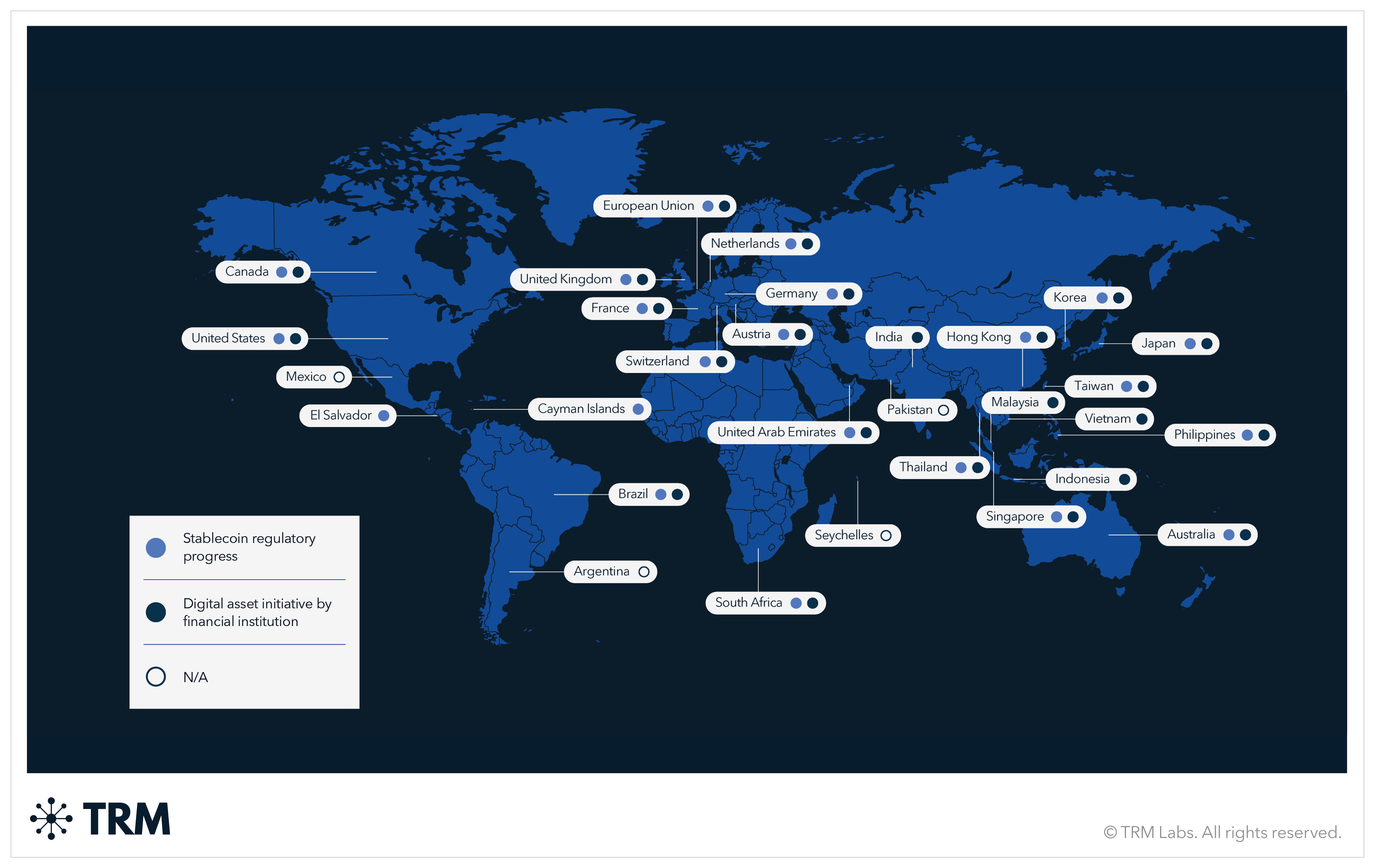
In this year’s Global Crypto Policy Review & Outlook 2025/26 report, TRM Labs reviewed crypto policy developments in 30 jurisdictions, representing over 70% of global crypto exposure — capturing a landscape defined by stablecoins taking center stage, institutional adoption driven by regulatory clarity, and a global push for consistent regulation and responsible innovation.

Stablecoins in focus

With stablecoins reaching a record high in 2025, it is no surprise that they dominated the global policy agenda, with over 70% of jurisdictions reviewed advancing new stablecoin regulatory frameworks.

Driven by the view that stablecoins could become true mediums of exchange on public blockchains due to their stability in value, numerous regulators have acknowledged the importance of a bespoke regulatory framework for stablecoins. From the US’ GENIUS Act to the EU’s MiCA rollout and new regimes making progress in Hong Kong, Japan, Singapore and the UAE, regulators articulated standards in key areas like issuance, reserves, and redemption. 

For industry, stablecoins became the entry point for institutional adoption, with their combination of value stability and blockchain-native efficiency lending themselves to strong utility across payments, settlements, and more. 

Institutional adoption fueled by regulatory clarity

As rules crystallized, financial institutions moved in. In 2025, about 80% of our reviewed jurisdictions saw financial institutions announce digital asset initiatives. In particular, markets with clear, innovation-friendly regulation — such as the US, EU, and parts of Asia — became catalysts for global institutional participation. Notably, we saw financial institutions engaging more with public blockchains, in step with more conducive regulatory climates in some key jurisdictions. In contrast, jurisdictions with unclear rules or restrictions on bank participation in digital assets saw financial institutions take a more cautious stance.

A key signal of the shifting supervisory posture toward institutional adoption came in November, when the Basel Committee announced a review of its proposed prudential rules for banks’ crypto exposures. The original framework — which would have required full capital deductions for most crypto assets, including certain stablecoins on public blockchains — was slated for implementation by January 1, 2026. But with major jurisdictions such as the US and UK declining to adopt the standards, as well as rapid growth of the stablecoin market, the Committee agreed to fast-track a reassessment of the rules.

With signs pointing toward a softening of regulatory attitudes regarding banks’ engagement with digital assets, institutional momentum is set to continue into 2026 and beyond. For highly regulated financial institutions, compliance and risk management are central priorities — and crypto-native firms increasingly recognize that strong regulatory standing is key to partnership.

Undeniable impact of regulation — and the importance of global consistency

Robust crypto regulation continues to prove its impact on illicit finance. TRM analysis found that virtual asset service providers (VASPs), which are the most widely regulated segment of the crypto ecosystem, have significantly lower rates of illicit activity than the overall ecosystem.

Regulators increasingly view compliant intermediaries as essential partners in combating financial crime and building a safer, more sustainable digital asset ecosystem. Responsible actors are responding in kind: the launch of Beacon Network, the industry’s first real-time information-sharing platform, has been met with support from VASPs representing over 75% of total crypto volume, as well as more than 60 law enforcement agencies across 15 countries.

But with crypto’s global and borderless nature, consistency is critical to preventing regulatory arbitrage. International bodies reinforced this throughout 2025. The Financial Action Task Force (FATF) warned that as long as gaps in standards implementation persist, “VASPs in jurisdictions with weak or non-existent frameworks” remain vulnerable to exploitation “without detection or disruption.” Similarly, the Financial Stability Board (FSB) cautioned that “gaps and inconsistencies” in implementing standards could pose risks to financial stability and market resilience.

This was underscored by North Korea’s record-breaking hack on Bybit in early 2025, which led to the exchange losing over USD 1.5 billion in Ethereum tokens. The attackers laundered proceeds through unlicensed over-the-counter (OTC) brokers, cross-chain bridges, and decentralized exchanges — infrastructure that largely sits outside existing regulatory perimeters. The incident illustrated how illicit actors exploit unregulated or lightly supervised technologies to obscure funds, reinforcing the need for better cross-jurisdictional coordination and real-time information sharing between compliant VASPs and law enforcement. 

2025 saw the US lead an acceleration in crypto policymaking and friendlier regulatory attitudes toward digital assets. This report takes stock of how various jurisdictions and standard-setting bodies have navigated a shifting global policy environment, and what lies ahead in 2026.

{{premium-content_chapter-divider}}

Crypto regulation around the world

In 2025, we saw regulatory clarity accelerate institutional adoption, with regulators around the world zooming in on stablecoins. Here’s a look at how institutional adoption and stablecoin regulation are progressing in 30 jurisdictions across the globe, representing more than 70% of global crypto exposure.
{{premium-content_chapter-divider}}

2025 highlights

Jurisdictional developments

JurisdictionHighlights
Americas
ArgentinaExpanded VASP registration requirements, introduced legal framework for tokenized assets, and faced controversy over presidential memecoin scandal
BrazilFinalized regulatory regime for VASPs; dropped the use of blockchain technology in its CBDC project
CanadaEnforced rules around stablecoins permitted for trading and confirmed plans to regulate stablecoins
Cayman IslandsIntroduced a full licensing regime for custodians and exchanges
El Salvador Expanded crypto licensing and enforcement efforts, and made Bitcoin use voluntary
MexicoStrengthened anti-money laundering (AML) rules for crypto and other non-financial service providers
United States (US)Achieved landmark progress with the GENIUS Act for stablecoin regulation, and coordinated agency action under Trump’s administration
Europe, Middle East, and Africa
AustriaTight MiCA rollout with few CASP approvals and push for tougher EU-wide supervision
European Union (EU)Implementation phase of MiCA saw national authorities diverge on approaches; DORA regime for tech risks took effect; expanded crypto-related sanctions, especially in connection with Russia
FrancePaced MiCA onboarding prioritizing existing operators; strengthened AML/market abuse guidance; Franco-German push for EU digital sovereignty and global competitiveness
GermanyLed EU in MiCA approvals and contributed to major takedowns of high-risk crypto platforms
The NetherlandsEarly MiCA mover with significant licensing throughput and active industry engagement; enhanced AML guidance
The Seychelles Tightened VASP oversight with new licensing and supervision regime; cautious licensing approach and public warnings against unlicensed activity
South AfricaScoped stablecoin and crypto landscape to advance regulatory responses; implemented FATF Travel Rule and made progress getting off FATF gray list
SwitzerlandIssued first distributed ledger technology trading facility license; prepared to introduce crypto tax reporting standards
United Arab Emirates (UAE)Consolidation of regulatory frameworks into a coordinated national strategy; expanded stablecoin rules and finalized federal framework for security and commodity tokens
United Kingdom (UK)Busy consultation year covering market structure, stablecoins, prudential rules and tokenization; rising AML/sanctions focus
Asia Pacific
AustraliaPublished long-awaited draft laws for digital asset and stablecoin regulation; granted first financial services license to a stablecoin issuer; tightened AML oversight, especially for crypto ATMs
Hong KongLaunched roadmap to improve crypto hub competitiveness, including potential revision of strict custody rules; rolled out stablecoin regime with a high bar for licensing
IndiaContinued divergence in policy thinking on comprehensive crypto regulation; robust enforcement on unlicensed activity under current registration regime continues
IndonesiaTransitioned crypto oversight from commodities to securities regulator; strengthened compliance requirements for licensed crypto entities while supporting innovation
JapanMoved toward regulating crypto as securities rather than payment services, advanced stablecoin licensing, and prepared for major tax cuts to boost domestic crypto markets
KoreaCommenced institutional trading pilot and advanced stablecoin regulation amidst growing government support for the crypto industry
MalaysiaLaunched Digital Asset Innovation Hub and proposed streamlined token listing rules to spur market growth
PakistanFormed new dedicated crypto government agencies and partnerships to drive market growth; laid groundwork for a formal licensing framework
The PhilippinesCentral bank extended VASP licensing moratorium while securities regulator introduced new CASP regulatory regime and sandbox
SingaporeExpanded scope of crypto licensing to discourage Singapore crypto entities from serving offshore customers
TaiwanTightened VASP registration, advanced comprehensive crypto legislation, and licensed banks to offer crypto custody services
ThailandApproved first USD stablecoins for trading on local platforms; introduced tokenization initiatives and tax break for crypto capital gains
VietnamPassed law defining crypto and tokenized assets; approved pilot implementation of crypto services; prepared licensing regime

International organizations

OrganizationHighlights
Financial Action Task Force (FATF)Expanded list of Materially Important Jurisdictions; updated on Recommendation 15 implementation progress, pushing for global regulatory consistency
Financial Stability Board / International Organization of Securities Commissions (FSB/IOSCO) Published implementation monitoring reports on crypto and stablecoin policy recommendations
Bank for International Settlements (BIS)Advocated for tokenized central and commercial bank money but hawkish on stablecoins; plans to review strict prudential standards for banks’ crypto holdings in face of pushback

{{premium-content_chapter-divider}}

Jurisdictional developments

<h3 class="premium-components_show-toc">Americas</h3>

Argentina

{{global-crypto-policy-review-outlook-2025-26-argentina}}

2025 was an eventful year for Argentine crypto policy, with the government tightening regulatory oversight of service providers, introducing a framework for tokenized assets, and confronting market integrity concerns following a high-profile controversy.

In February, President Javier Milei briefly promoted a little-known meme coin, $LIBRA, on social media. The coin surged and then collapsed, sparking a judicial investigation into his role. No charges have been filed, but the episode highlighted risks of misinformation, market manipulation, and retail investor exposure in a lightly regulated environment.

On the regulatory front, 2025 saw Argentina raise requirements under its VASP registration regime, which commenced in March 2024 under General Resolution 994 (GR 994). In May 2025, General Resolution 1058 came into effect, introducing additional registration requirements for VASPs in a number of areas including AML, segregation of customer assets, cyber security, audit, and corporate governance. VASPs who had previously registered with the CNV under GR 994 had to submit additional information on compliance with the new rules by 3Q25 to maintain their registration.

In June, the government also issued General Resolutions 1069 and 1081 to introduce a formal legal framework for tokenized assets, administered by the CNV. The framework will be piloted in a regulatory sandbox environment for an initial period of one year. Commenting on the progress, CNV President Dr Roberto E. Silva outlined the regulator’s goal to have “a modern regulatory framework, which promotes the development and growth of the capital market in Argentina.”

In 2025, Argentina laid important groundwork for a clearer and more innovation-friendly regulatory environment. In 2026, attention will turn to how these frameworks are practically implemented and translated into concrete supervisory expectations.

Brazil

{{global-crypto-policy-review-outlook-2025-26-brazil}}

2025 was a landmark year for Brazil’s digital asset ecosystem, as the anticipated regulatory regime for VASPs finally went live in November.

After being designated in 2023 as the lead supervisor for VASPs, the BCB ran several consultation processes addressing various details such as the scope of regulated assets and services, VASP authorization requirements, and the interface of VASP activities with foreign exchange and cross-border operations, which wrapped up in February 2025. Then, in November 2025, the BCB published three resolutions to operationalize its regulatory powers over VASPs. The BCB’s authorization regime, which is slated to commence on February 2, 2026, requires that firms comply with requirements across various key areas such as AML/CFT, disclosure, and transparency — as well as minimum capital requirements ranging between BRL 10.8 million (USD 2 million) to BRL 37.2 million (USD 6.9 million). VASPs already established or operating in Brazil before the February go-live date will be grandfathered, and have a grace period of up to 270 days (i.e. until October 30, 2026) to comply with obligations to notify BCB and/or apply for authorization in order to continue operating.

Beyond capital and licensing, the rules bring crypto transactions — especially those tied to stablecoins and cross-border transfers — under Brazil’s foreign exchange and payments oversight. Transactions exceeding roughly USD 100,000 will be subject to enhanced reporting obligations, including details on counterparties and asset types. The government is also reportedly considering taxing the use of cryptocurrencies for cross-border payments to boost tax revenue and prevent regulatory arbitrage through stablecoins. Crypto adoption has been growing rapidly in Brazil, driven largely by the use of stablecoins. In a February 2025 speech, BCB Deputy Governor Gabriel Galipolo said that crypto asset use in Brazil has surged in the past three years, and 90% of it can be linked to stablecoins. 

Brazil’s central bank digital currency project, Drex, also took a major turn in 2025. In August, the BCB announced it was dropping plans for a blockchain-based digital asset system. Instead, Drex will now focus on a short-term lien reconciliation solution while continuing to mature blockchain technology for future use. The decision surprised private sector participants in the Drex pilot and will likely delay the adoption of distributed ledger technology in arBrazil’s payments ecosystem.

Looking ahead to 2026, attention will turn to the implementation of the VASP regime and its impact on the development of Brazil’s crypto and payments landscape.

Canada

{{global-crypto-policy-review-outlook-2025-26-canada}}

Canada’s crypto regulatory framework remained steady in 2025 but tightened around stablecoins as the CSA’s Staff Notice 21-333 took full effect after a transition period ending December 31, 2024. The rules permit only fiat-backed stablecoins pegged to CAD or USD, fully reserved, redeemable at par, and custodized with qualified entities. Ahead of the deadline, Circle’s USDC became the first stablecoin to meet the new rules. In June 2025, QCAD also announced plans to meet the requirements and become the “first regulated Canadian stablecoin.” Meanwhile, regulators and law enforcement like FINTRAC and the Royal Canadian Mounted Police have continued bringing enforcement actions against unregistered platforms and local fraud schemes.

In November, the government confirmed its intention to regulate stablecoins as part of an overall payments modernization plan, with the Bank of Canada administering the legislation. The Bank had previously expressed concern that the country was lagging global peers in payments innovation, and stressed the importance of regulation in enabling new technology to flourish safely. Noting that stablecoins were a "different story” compared to other cryptocurrencies, the central bank acknowledged their utility for payments and growing use around the world. The Bank has been allocated CAD 10 million (USD 7 million) over two years to administer the upcoming stablecoin regime.

Looking ahead, we will be watching closely for progress on the promised stablecoin regime — a development that many observers see as key to fostering innovation and clarity in the sector.

Cayman Islands 

{{global-crypto-policy-review-outlook-2025-26-cayman-islands}}

2025 was a watershed year for the Cayman Islands, with comprehensive licensing requirements for virtual asset custodians and trading platforms taking effect on April 1. This transition builds on the earlier registration regime introduced in 2020. Firms were given 90 days to apply for a license, or exit the market. The new rules establish standards for capital adequacy, segregation of client assets, internal controls, and customer disclosures, bringing the jurisdiction into closer alignment with FATF recommendations and global best practices.

The regime also raises governance expectations. Licensed VASPs must appoint a minimum of three directors, including at least one independent board member. At the same time, CIMA’s supervisory authority has been expanded to include the power to require audited financial statements, conduct systems assessments, and grant exemptions for entities already regulated under other Cayman frameworks. Together, these measures aim to mitigate risks stemming from weak governance, asset mismanagement, and criminal misuse, while strengthening investor protection and market transparency.

In November, CIMA released findings from a desk-based review of 11 registered VASPs conducted between September 2024 to February 2025. The review identified gaps including inadequate business continuity planning, incomplete internal audit functions, and deficiencies in cybersecurity governance and threat monitoring capabilities. At the same time, the review also noted examples of improving practice, such as the adoption of recognized cybersecurity frameworks by several VASPs and the use of real-time monitoring tools by more advanced operators. With the new regime coming into effect, CIMA also encouraged VASPs to review their current operations and controls to ensure they comply with the additional requirements.

In 2026, implementation will remain in focus as more firms transition from licensing to ongoing supervision. Market participants will be watching how CIMA applies its new supervisory powers, and how the licensing framework accommodates innovation while upholding effective risk management.

El Salvador

{{global-crypto-policy-review-outlook-2025-26-el-salvador}}

In 2025, El Salvador’s reputation as the first country to adopt Bitcoin as legal tender continues to influence its evolving approach to digital assets. The Legislative Assembly passed reforms in January that removed the mandatory requirement for merchants to accept Bitcoin — shifting its acceptance to a voluntary status. This comes on the back of its commitment to International Monetary Fund (IMF) conditions for a USD 1.4 billion dollar loan, which restricts Bitcoin use in the country and limits Bitcoin-related activities and transactions by the public sector.

Meanwhile, regulatory work continues apace. CNAD, El Salvador’s dedicated digital assets regulator established under the 2023 Digital Assets Issuance Law, issued 26 DASP licenses in 2025, bringing the total number of licensed DASPs to 601. CNAD also publicly flagged unauthorized operations that lack required business plans or fail AML/CFT standards. Signaling its ambition to lead regional standard setting, CNAD also signed a regulatory cooperation pact with the Central Bank of Bolivia in mid-2025. The agreement will see the two regulators collaborate on a range of crypto regulation initiatives, including the use of blockchain intelligence tools and risk analysis.

In August 2025, El Salvador also paved the way for institutional adoption by approving a new law that allows regulated financial institutions to apply for a license to offer crypto-related services. Only investment banks with at least USD 50 million in capital will be eligible, and they may only offer services to investors with more than USD 250,000 in liquid assets, which can include Bitcoin. 

In 2026, we will be watching for further licensing activity and policy measures as El Salvador continues to balance innovation and risk management in its oversight of the sector.

1 As of December 1, 2025

Mexico

{{global-crypto-policy-review-outlook-2025-26-mexico}}

In 2025, Mexico’s approach to digital assets evolved under the global spotlight of its FATF presidency. The country has emphasized financial inclusion while simultaneously pressing for stronger international standards tailored to emerging markets. Domestically, Mexico passed wide-ranging reforms to its AML law (LFPIORPI) in July 2025, which introduced additional requirements for obliged entities, such as risk-based assessments, a designated compliance officer, and periodic compliance audits. It also expands the scope of vulnerable activities that are subject to AML obligations. In particular, the scope for virtual asset activities was expanded to include services by non-financial entities like VASPs, and the thresholds and conditions for reporting virtual asset operations are more clearly defined.

Within the financial sector, regulators and enforcement agencies continue to maintain a cautious stance. The 2018 FinTech Law confines virtual asset activities to licensed financial institutions with prior Banxico authorization, and approvals remain scarce.

All in all, Mexico’s path remains cautious but deliberate, shaped both by its leadership role at FATF and by the recognition that digital assets are increasingly embedded in its economy.

United States (US)

{{global-crypto-policy-review-outlook-2025-26-united-states}}

2025 certainly saw the US make up for lost time, as it made major strides in regulatory clarity and pushed forward with a slew of crypto-friendly policies under the Trump administration.

Executive branch

In January 2025, during his first week in office, President Donald Trump issued an executive order on digital assets emphasizing innovation, rejecting a retail CBDC, and creating a President’s Working Group on Digital Asset Markets (PWG). The PWG released a 163-page report in July — the most detailed whole-of-government framework to date — mapping coordinated action on market structure, stablecoins, payments, AML/CFT safeguards, and banking integration. Crucially, it directed regulators to provide clarity even absent congressional action. 

{{global-crypto-policy-review-outlook-2025-26-quote}}

Regulators responded. The US SEC, under Chair Paul Atkins, modernized securities regulation, beginning with a crypto task force led by Commissioner Hester Peirce, and elevated into Project Crypto — the agency’s first comprehensive digital asset rulemaking program. It is clarifying when tokens qualify as securities, considering safe harbors for early-stage development, and revising custody and trading rules for on-chain settlement. The Commission has approved generic listing standards for spot commodity-based ETFs and created a cross-border enforcement team to target offshore fraud and manipulation. Atkins’ willingness to use exemptions and interpretive relief marks a striking departure from the enforcement-heavy stance of prior leadership.

The CFTC, under Acting Chair Caroline Pham, launched a “crypto sprint” to align registration, margin, and reporting standards with Congress and the PWG report. Pham has stressed collaboration with the US SEC’s Project Crypto, with both agencies issuing joint statements on spot products, hosting joint roundtables, and harmonizing definitions — an unprecedented level of interagency coordination.

Other regulators are also moving. Treasury continues to target scams, pig butchering networks, ransomware, and sanctions evasion, while supporting a proportionate stablecoin framework. The Federal Reserve, barred from issuing a retail CBDC, is focusing on wholesale pilots with tokenized treasuries and interbank payments. The OCC has reopened channels for national banks to provide custody and issue stablecoins under strict supervisory standards. 

At the state level, NYDFS tightened capital and audit requirements, warned about memecoins, provided guidance to banks on the use of blockchain intelligence like TRM, and took significant enforcement actions. In 2025, the California Department of Financial Protection and Innovation (DFPI) advanced its implementation of the Digital Financial Assets Law (DFAL) — the state’s landmark framework for licensing and supervising crypto firms. In April, DFPI released formal rulemaking proposals outlining registration procedures, disclosure requirements, and surety bond standards ahead of the July 1, 2026 compliance deadline, marking a significant step toward full regulatory oversight of digital asset businesses in California. The agency also expanded its consumer protection initiatives, relaunching the Crypto Scam Tracker to help Californians identify and report fraudulent activity in the digital asset space. In October, DFPI demonstrated its enforcement authority by issuing a cease-and-desist order against a noncompliant crypto ATM operator for repeated violations under the DFAL. 

Meanwhile, in Wyoming, the state’s Frontier Stable Token (FRNT) — the first US state-issued stablecoin — officially launched across seven blockchains. Fully backed by US dollars and short-term Treasuries, FRNT represents a new model for public-sector innovation in digital money and state-level financial infrastructure. 

Legislative branch

2025 has brought the most momentum yet on Capitol Hill. The GENIUS Act on stablecoins has passed, establishing a federal regime for issuance, reserves, audits, and oversight. The House has also passed the CLARITY Act, a market structure bill that divides jurisdiction between the US SEC and CFTC, defines when tokens may transition from securities to commodities, and creates a registration pathway for platforms. Drafts are circulating in the Senate, with possible passage by year-end. Lawmakers are also revisiting crypto taxation, seeking to scale back reporting obligations introduced under the 2021 infrastructure law.

What’s next

The crypto industry was hopeful for market-structure legislation in 2025. However, while the momentum is still there for a comprehensive crypto bill, the window has shifted, and early 2026 now looks like the more realistic landing spot. As for the GENIUS Act, federal regulators must issue implementing regulations no later than July 18, 2026. The Act will then take effect on the earlier of either January 18, 2027 (18 months after its enactment) or 120 days after the implementing regulations are issued. The US Treasury Department is actively working on final regulations for GENIUS Act implementation after a period of industry engagement. 

Agency leadership changes, particularly at the US SEC, may accelerate the transition to a rules-first regulatory environment. The US is also signaling its intent to lead globally, pushing proportionate standards at the G20, FSB, and FATF that support dollar-backed stablecoins and tokenized markets while mitigating financial crime.

For the first time, the US regulatory landscape is moving beyond fragmented enforcement to a legislated, coordinated framework. The combination of the White House PWG report, the US SEC’s Project Crypto, and congressional action marks a decisive turning point — one that balances innovation with safeguards and positions the US as a central player in shaping the future of digital finance.

Unpack the key findings of this report with Ari Redbord, Angela Ang, and Luke Dufour on December 11 or 12. Register here.

<h3 class="premium-components_show-toc">Europe, Middle East, and Africa</h3>

Austria

{{global-crypto-policy-review-outlook-2025-26-austria}}

Like other European Union (EU) member states, 2025 brought clarity around Austria’s approach to implementing MiCA. FMA Executive Director Eduard Müller highlighted the challenges of regulating the crypto sector, as shown by the FMA’s experience with AML registration for VASPs, where only a handful of the 79 applicants managed to retain their applications.” MiCA would “play a key role in separating the wheat from the chaff in the digital asset market,” he added. 

As its grandfathering period for existing CASPs comes to an end in December 2025, only four of 13 existing CASPs have received MiCA authorization from the FMA.2 All existing CASPs in Austria who do not receive a MiCA license by December 31, 2025 will have to cease regulated services.

In September, Austria further established its view that MiCA implementation needed to be consistently robust across the EU. The FMA, alongside France and Italy, called for a stronger European framework for crypto asset markets, citing concerns around uneven implementation of MiCA rules and “major weaknesses” in the text around sector-specific risks such as cyber security.

In 2026, we can expect to see greater clarity on Austria’s supervisory approach for its MiCA-licensed CASPs, and how it will navigate MiCA passporting given its concerns on implementation consistency.

2 As of November 25, 2025

European Union (EU)

{{global-crypto-policy-review-outlook-2025-26-european-union-eu}}

<div class="z-index-1"><div class="anchor-component" id="mica"></div>MiCA</div>

2025 was a big year for MiCA as it moved from policy to practice. On December 31, 2024, the MiCA rules for CASPs came into force alongside the obligations placed on firms under the Travel Rule. In January 2025, ESMA released a supervisory briefing to support national competent authorities (NCAs) in implementing the regime, and started to publish a registry of MiCA-authorized entities, alongside a list of non-compliant entities. 

Together with the European Commission, ESMA also published guidance on the treatment of non-MiCA compliant stablecoins — known as asset-referenced tokens (ARTs) and electronic money tokens (EMTs) under MiCA, depending on the pegged asset(s) — effectively giving CASPs a grace period until the end of Q1 2025 to align their offerings. The guidance made clear that NCAs should ensure that services which amount to “offer to the public” or “admission to trading” of non-compliant ARTs/EMTs must cease by the end of Q1 2025, and that CASPs may maintain “sell-only” access in the interim to facilitate orderly exits.

As implementation progressed, national differences in regulatory expectations became more apparent. In September, the French, Austrian, and Italian regulators jointly called for a stronger European framework for crypto asset markets, citing “major differences in how crypto markets are being supervised by national authorities.” In absence of stronger EU-level oversight, “national authorities hosting market participants authorized by another authority could be forced to resort to the precautionary measures [...] to prevent any risk for national investors,” they warned.

Earlier in 2025, there was also considerable discussion in policy and crypto circles about a possible MiCA II or supplementary framework that would bring decentralized finance explicitly under EU regulation. The idea was that MiCA’s original drafting had left gaps around decentralized protocols and that new legislation would be needed to address them. However, as the year progressed, that momentum receded. By mid-2025, talk of a wholesale MiCA II faded, and the EU instead focused on consolidating the architecture established by MiCA and strengthening enforcement, rather than

DORA

Beyond MiCA, 2025 also saw the EU’s Digital Operational Resilience Act (DORA) become fully applicable across the financial sector on January 17. DORA imposes harmonized information and communication technology (ICT) risk, incident, testing, and third-party resilience obligations on financial institutions and certain ICT service providers. While much of the early spotlight was on MiCA and AML/CTF, DORA extends a new layer of accountability to crypto firms at a time when sophisticated cyber attacks continue to test the sector’s defences.

AML/CTF 

On the financial crime front, the EU’s Anti-Money Laundering Authority (AMLA) made crypto a priority, and emphasized the risk of “diverging application of AML/CFT requirements and inconsistent controls” across national regimes as a particular vulnerability in the crypto domain. From 2028, some CASPs are likely to be directly supervised by AMLA under the EU’s Anti-Money Laundering and Counter Terrorist Financing framework.

Echoing the AMLA’s concerns, the EBA also highlighted the AML/CFT risks posed by the crypto sector in its fifth biennial assessment of evolving ML/TF threats. In particular, the report noted a “2.5-fold increase in the number of authorised CASPs in the EU between 2022 and 2024,” alongside persistent weaknesses in AML/CFT systems, customer identification, and risk management. 

Sanctions

2025 saw a spate of crypto-related sanctions designations by the EU. Its February designation of the Russian crypto exchange Garantex marked the first time the EU has placed a cryptocurrency trading platform itself under its restrictive regime. Later in the year, it adopted wider sanctions against Russia in its 18th and 19th sanctions packages, including a direct prohibition on cryptocurrency platforms and transactions for Russian residents.

Digital euro

On the central bank digital currency (CBDC) front, questions persisted about the digital euro’s ability to compete in a global payments ecosystem increasingly shaped by USD-denominated stablecoins. In a July 2025 European Central Bank blog post, officials explicitly acknowledged the challenge, warning that Europe must ensure its central bank digital currency “remains relevant in an environment where digital money choices multiply.” Yet, as of October 2025, no concrete policy or design interventions had been announced to address these competitiveness risks. The ECB instead reiterated its focus on “resilience, trust, and autonomy” as guiding principles for the digital euro’s development — signalling that work is still in the phase of strategic reflection rather than implementation and delivery.

What’s next

2025 was undoubtedly a busy year for EU crypto policy, with progress on both regulatory implementation and policy thinking. At the same time, the divergence in MiCA implementation has revealed the challenge of maintaining regulatory consistency across the bloc. In 2026, we will be watching for more clarity on MiCA supervisory approaches across the different NCAs, and how the bloc will reconcile implementation differences. We are also expecting the implementation of EU Directive 2023/2226 (DAC8) across the bloc, which will implement tax reporting requirements, and the exchange of information between EU countries, in line with the OECD Cryptoasset Reporting Framework (CARF).

France

{{global-crypto-policy-review-outlook-2025-26-france}}

France began 2025 navigating the transition from its national regime to the EU’s MiCA framework. By early January, eight CASPs had secured MiCA authorization in France, reflecting a deliberate pace by the AMF, which prioritized the orderly conversion of existing firms over rapid expansion. The February 2025 decree aligning France’s Monetary and Financial Code with MiCA formalized this approach, establishing a structured path for existing registered providers to migrate into the new system through to 2026.

Throughout the year, France positioned itself as one of MiCA’s strictest interpreters. The AMF, alongside Austria’s FMA and Italy’s CONSOB, called for stronger EU-level oversight and tighter supervision of cross-border activity to prevent “jurisdiction shopping.” Paris made clear that it favored harmonization through consistency, even if that meant challenging weaker national licensing practices.

Domestically, the AMF reinforced compliance expectations. In April, it issued Position DOC-2025-02, embedding EBA guidance on internal controls and AML/CTF obligations for CASPs, followed in July by the adoption of ESMA’s crypto market abuse guidelines. Meanwhile, amendments to the Monetary and Financial Code introduced a framework for pledging crypto assets as collateral — signalling France’s intent to integrate digital assets into mainstream financial law. Enforcement remained active, with continued blacklisting of unauthorized platforms and ongoing investigations into major exchanges

In parallel, both France and Germany deepened their policy coordination through a renewed Joint Economic Agenda, unveiled in August 2025, which seeks to bolster EU competitiveness and digital sovereignty. The agenda reaffirms support for a digital euro as a cornerstone of European monetary independence, emphasizing privacy, stability, and democratic legitimacy. It also backs the Eurosystem’s work on wholesale settlement of tokenized assets in central bank money, framing it as critical to a more integrated EU financial infrastructure. Both countries committed to nurturing a strong, MiCA-compliant European crypto asset market and to managing external risks through equivalence and reciprocity frameworks with third countries.

The overall tone of MiCA implementation in France has been one of controlled maturity. 2025 was less about license volume and more about institutional strength — embedding MiCA within a stable, transparent, and credible supervisory model. For firms, France offers regulatory certainty — so long as they can meet its higher bar for compliance and governance.

Germany

{{global-crypto-policy-review-outlook-2025-26-germany}}

In 2025, MiCA licensing kicked into high gear in Germany, with BaFin approving 20 CASPs — leading the rest of the EU with 30% of total approvals across the bloc.

Notably, through its MiCA licensing actions in 2025, Germany has taken advantage of the accelerated institutional focus in crypto assets with their licensing approach, not only with crypto-native institutional leaning services choosing Germany as their primary EU location, but with approvals from the regulator, BaFin, for numerous traditional German financial institutions and fintechs.

For example, on August 1, BaFin approved its first euro-denominated stablecoin under MiCA. The token, issued by AllUnity — a joint venture between Deutsche Bank’s DWS, Flow Traders, and Galaxy Digital — is an ERC‑20 asset built on Ethereum, and is designed for financial institutions, fintechs, and corporates seeking regulated, instant cross-border euro payments.

In coordination with France, Germany also reaffirmed its support for the digital euro and MiCA. “On the basis of MiCA we are committed to develop a vital European market in crypto assets that promotes international competitiveness of MiCA-compliant European crypto service providers”, both countries said.

On the enforcement front, 2025 saw Germany involved in a number of high profile takedowns. In March, Germany worked with authorities in the United States, Netherlands, and Finland to disrupt the operations of the sanctioned Russian exchange, Garantex. And, in April, German authorities seized infrastructure belonging to eXch — a crypto swap service believed to have been used for the laundering of stolen funds associated with the Bybit hack — confiscating crypto worth more than EUR 25 million (USD 30 million). 

2025 was undoubtedly a busy one for Germany. In 2026, we can expect MiCA licensing to continue apace. We are also expecting the implementation of DAC8 into national law from January 1. This will implement tax reporting requirements, and the exchange of information between EU countries, in line with the OECD CARF.

The Netherlands 

{{global-crypto-policy-review-outlook-2025-26-the-netherlands}}

With one of the shortest MiCA transition periods — six months ending June 30, 2025 — in the EU, 2025 opened with significant licensing action in the Netherlands. The country became the first to issue MiCA licenses, with four CASP licenses issued on the MiCA commencement date of December 30, and a further 14 issued over the course of 2025.3 Dutch-issued MiCA licenses account for over 20% of the EU total, the second highest after Germany. The early authorizations reflect both the AFM’s readiness to operationalize MiCA and its desire to position the Netherlands as a credible jurisdiction for compliant digital-asset activity.

In parallel, Dutch regulators deepened their focus on AML and counter-terrorist financing standards under the Dutch Anti-Money Laundering and Counter-Terrorist Financing Act (Wwft). On May 2, 2025, the AFM published an annex to the Wwft guidelines dedicated to CASPs, setting out expectations on customer due diligence, transaction monitoring, beneficial ownership verification, and suspicious-activity reporting. The update underscores that crypto supervision is being brought onto the same footing as the rest of the financial sector, rather than remaining an experimental perimeter.

The AFM and DNB have maintained a reputation for constructive engagement with fintechs — continuing to operate sandboxes, pre-licensing dialogues, and supervisory consultations — but with clear expectations that innovation must coexist with governance discipline. This balance has made the Netherlands one of the first EU member states to blend regulatory clarity with market dynamism under MiCA.

Overall, 2025 represented a maturing phase for Dutch crypto policy. Looking ahead to 2026, we will be watching how the Netherlands builds on its early-mover advantage under MiCA — for example by deepening supervisory practice, refining guidance, and shaping EU-level implementation.

3 As of November 25, 2025

The Seychelles

{{global-crypto-policy-review-outlook-2025-26-the-seychelles}}

2025 saw Seychelles significantly tighten its oversight of VASPs. Historically, Seychelles has been a preferred location for VASPs to incorporate, with TRM observing more than 100 VASPs, including numerous global services, registered there. 

However, in August 2024, Seychelles enacted the Virtual Asset Services Providers (VASP) Act, which provided clarity to businesses and powers to the Seychelles Financial Services Authority (FSA) to license and supervise VASPs, ICOs, and NFTs. The VASP Act also provides the FSA with strong enforcement powers, and makes the operations of mining facilities, mixing services, or undertaking virtual asset activities as individuals a criminal offense.

The transition period for existing services to submit an application ended in December 2024. All existing VASPs who had not submitted an application by December 31, 2024 were required to cease operations. Nine VASPs remain under assessment, and no licenses have been granted,4 underscoring a cautious approach to licensing. In the meantime, the FSA is taking a firm stance on unlicensed activity, issuing more than 20 public warnings to unauthorized entities, including large multinational service providers.

In 2026, we will be watching for more licensing activity, as well as whether the regulator will step up enforcement action against unlicensed providers. 

4 As of December 1, 2025

South Africa

{{global-crypto-policy-review-outlook-2025-26-south-africa}}

In 2025, South Africa took a range of steps to broaden understanding of the crypto asset sector,  and support more effective supervision and development of future regulatory frameworks — for example for stablecoin arrangements.

In March, the South African Intergovernmental Fintech Working Group (IFWG)’s Crypto Asset Regulatory Working Group (CAR WG) published its stablecoin landscape diagnostic, which discusses the use cases of local currency stablecoins, and attendant risks and benefits. The paper noted that six local currency stablecoins had been issued, all by non-banks. However, there were stablecoin-specific gaps in the current crypto regulatory regime, such as a lack of oversight on issuance activities, as well as requirements on governance, reserve assets, redemption rights, and more. The CAR WG will build on its findings with a second phase of work, with the view to develop recommendations on a comprehensive regulatory response to stablecoins. 

April saw South Africa become one of the first few African countries to make progress on the implementation of the FATF Travel Rule, when Directive 9, issued by its Financial Intelligence Center in November 2024, officially came into effect in April. In June, FATF also announced that South Africa has substantially completed all necessary action items to be removed from the FATF list of jurisdictions under increasing monitoring (also known as the “gray list”), subject to an onsite assessment. South Africa was placed on the gray list in February 2023, with a list of 22 action items around strengthening AML/CFT capacity, controls, enforcement, and international cooperation — none of which were crypto-specific.

In October 2025, the FSCA also issued a comprehensive request for information to its over 240 licensed CASPs, with the aim of deepening its understanding of the CASP landscape so as to advance “effective regulatory development,” consumer protection, and market integrity and efficiency. The request encompasses a broad spectrum of detailed and practical questions, covering everything from business models and volumes, risk management, AML/CFT (including the use of blockchain intelligence tools), and consumer protection measures. It also includes specific questions on stablecoin activities and how CASPs comply with currency exchange controls set by the South African Reserve Bank. 

2025 saw South Africa make significant strides in its understanding and oversight of the industry. In 2026, we are anticipating more clarity on South Africa’s approach to stablecoins, as well as its approach to supervising CASPs.

Switzerland

{{global-crypto-policy-review-outlook-2025-26-switzerland}}

2025 saw Switzerland continue to demonstrate support for innovation with regard for risk management and supervisory priorities. 

In its 2024 annual report, FINMA emphasised its “risk-based and technology neutral” approach to innovation business models. In March 2025, we gained fresh insight into how the regulator applies these principles when it issued its first license to a distributed ledger technology (DLT) trading facility, BX Digital, the Swiss subsidiary of the Börse Stuttgart Group. The license was granted under Switzerland’s DLT Act, which entered into force in August 2021. The Act created a new type of financial market infrastructure, the DLT trading facility, to support “innovation on a solid legal basis.” 

FINMA shared that it had clarified a number of important underlying issues during the licensing process, such as business continuity and operational risk management measures, especially as it relates to the use of public blockchains and smart contracts. Clearly, FINMA’s technology-neutral stance does not mean disregarding the specifics of new technologies altogether. Rather, it is about ensuring that new business models are held to the same regulatory expectations as existing ones, acknowledging that the underlying technology may require specialized implementation. 

Against this supportive regulatory environment, we see Swiss financial institutions continue to push forward in digital asset innovation. In September, the Swiss Bankers Association (SBA), PostFinance, Sygnum, and UBS completed their proof of concept for a Swiss franc deposit token. And in October, UBS, alongside other global banks, announced plans to develop a jointly backed stablecoin focused on G7 currencies. 

In October, Switzerland also took a major step forward in crypto regulation with a proposed amendment to its Financial Institutions Act. The amendment would introduce two new dedicated license types for digital assets — the payment instrument institution license for stablecoin issuers and the crypto institution license for crypto service providers — which would supersede the existing fintech license regime. The proposed regime, which is open for consultation until February 2026, would provide more tailored regulatory clarity for crypto businesses, and is expected to increase “the attractiveness of Switzerland as an economic and financial center for innovative and technology-driven business models.”

On the tax front, the Federal Council adopted a dispatch in February 2025 that would see the exchange of tax information in line with the OECD CARF standards implemented from January 1, 2026. This aligns with the implementation date for the EU’s DAC8, which facilitates a similar exchange of tax information between EU countries. Simultaneous implementation of CARF standards will facilitate exchange of information between Switzerland and EU countries as well — in October, the European Council passed a decision to allow this

In 2026, we will be watching developments around the new licensing framework and whether this will drive further interest in Switzerland as a digital asset hub.

United Arab Emirates (UAE)

{{global-crypto-policy-review-outlook-2025-26-united-arab-emirates-uae}}

The UAE’s digital asset framework matured significantly in 2025, as regulators consolidated stablecoin, tokenization, and AML oversight into a coherent national strategy. The Payment Token Services Regulation (PTSR), issued by the CBUAE in June 2024, entered full effect mid-2025, concluding its transition period and establishing that only local currency stablecoins issued by licensed entities may be used for domestic payments. By anchoring digital payments to the UAE dirham, the CBUAE reaffirmed monetary sovereignty and prohibited the use of foreign currency or algorithmic stablecoins. The clarity of this stance catalyzed compliant innovation. AE Coin became the first national regulated dirham-backed stablecoin, while First Abu Dhabi Bank and ADQ advanced a regulated AED-backed stablecoin project.

Meanwhile in ADGM, the FSRA published Consultation Paper No. 9 of 2025, proposing an expanded framework for Fiat-Referenced Tokens (FRTs) that extends regulation beyond issuance to custody, intermediation, and usage in regulated activities. The paper outlines how both domestic and foreign FRTs could be “accepted” within ADGM under reserve, jurisdictional, and transparency criteria — an approach that could define the region’s stablecoin taxonomy in 2026. 

Federal regulator SCA complemented this by finalizing its framework for security and commodity tokens, bringing tokenized instruments formally within the UAE’s existing securities law. Trading and settlement are restricted to SCA-licensed venues or approved wallets under strict AML and finality rules, embedding tokenization within mainstream capital market infrastructure. 

Across the federation, AML and sanctions compliance became a focal point. Regulators imposed fines on several exchange houses and insurance brokers for failures in AML/CTF compliance. The EU also voted to remove the UAE from the EU’s “high-risk” AML list, bolstering its global credibility.

Meanwhile, Dubai’s VARA released Version 2.0 of its rulebooks in May 2025, expanding governance and reporting standards for all licensed virtual asset activities. The authority imposed a deadline for compliance by June 19, 2025, allowing firms a 30-day transition period, underscoring the regulator’s shift from sandbox experimentation to mature supervision.

In addition to these developments, VARA continued to take significant civil enforcement action against unlicensed operators in Dubai, issuing cease and desist orders and penalties across numerous platforms.

Together, these measures signal a new phase for the UAE: the transition from fragmented experimentation to integrated oversight. By asserting control over stablecoins, formalizing tokenization, tightening AML compliance and enforcement against unlicensed activity, and harmonizing supervision across free trade zones, the UAE is seeking to position itself as the Middle East’s most structured and internationally credible crypto regulatory environment.

5 Abu Dhabi Global Market (ADGM) under FSRA since 2018, Dubai International Financial Centre (DIFC) under DFSA since November 2022, Emirate of Dubai under VARA since February 2023, and the UAE under SCA since January 2023 and under CBUAE since June 2024.

United Kingdom (UK)

{{global-crypto-policy-review-outlook-2025-26-united-kingdom-uk}}

Crypto and stablecoin regulation

The UK spent 2025 building the scaffolding for a comprehensive crypto regime. The FCA ran a packed consultation slate: a discussion paper on crypto market abuse and admissions or disclosures (DP24/4), followed by a broader discussion paper on trading venues, intermediation, lending/borrowing, staking, and decentralized finance, or DeFi (DP25/1). These set out the spine of a UK-specific market integrity framework and floated a “MARC” (market abuse for crypto) regime alongside an admissions/disclosure rulebook for token listings. It also consulted on stablecoin issuance and custody (CP25/14) and a prudential regime for crypto firms (CP25/15), with final rules signposted for 2026. And, in October, the regulator also advanced fund tokenization proposals to keep London competitive in asset management. 

In parallel, HM Treasury published its hotly anticipated draft statutory instrument that would  bring “qualifying crypto assets” and “qualifying stablecoins” into the perimeter of the Financial Services Markets Act. This means that certain activities related to these assets will need to be carried out by FCA authorized entities. 

As summer gave way to fall, we saw cross-border cooperation pick up as London worked with Washington to launch a Transatlantic Taskforce for Markets of the Future in September. The Taskforce aims to smooth capital market access and coordinate on crypto. It is expected to report back within 180 days on short- and long-term changes to enhance collaboration between the two nations.

In November, the Bank of England (BoE) released its widely anticipated consultation on a regulatory framework for systemic GBP-denominated stablecoins — those used widely enough in payments to impact financial stability. By carving out systemic stablecoins from the wider FCA-regulated crypto-asset space, the BoE is signaling that large-scale digital money arrangements will face oversight comparable to traditional payment systems. A central feature — and the most controversial — is the introduction of temporary holding caps: GBP 20,000 (USD 26,300) per individual and GBP 10 million (USD 13 million) per business. BoE said these limits were needed to prevent rapid outflows from bank deposits into stablecoins during the transition period. Crypto industry groups, however, argued that such caps could stifle adoption or push issuers offshore, especially as jurisdictions like the US and EU moved toward more permissive, risk-based approaches. Still, BoE emphasized that caps will be lifted once the regime is fully embedded and systemic risks are understood.

AML and sanctions

On the AML front, the UK’s National Risk Assessment 2025 upgraded money laundering risk for crypto assets to high, “driven by the increased criminal use of crypto assets accompanying an increase in their licit use by the general public, alongside the speed with which money can be moved.” The NRA kept terrorist financing risk at “medium,” citing rising on-chain use in UK intelligence. 

The Office of Financial Sanctions Implementation (OFSI) issued a first-of-its-kind crypto sanctions threat assessment, providing much-needed guidance to firms in respect of indirect exposure on the blockchain. OFSI recommends that firms trace a minimum of three to five transaction “hops,” or until funds hit an attributed service, and to escalate suspected exposure — guidance that will have a far-reaching impact on financial crime compliance frameworks across the industry. The report also highlighted significant exposure from UK-linked firms to Garantex since 2022.

We also saw quite a lot of proactive sanctions activity targeting networks accused of facilitating Russia’s sanctions evasion. Notably, in May, A7 — the issuer of the ruble-pegged A7A5 stablecoin — was designated under UK sanctions law for its involvement in financial services that undermine Ukraine’s sovereignty. In August, the UK also imposed sanctions on crypto exchanges Grinex and Meer, linking them to the A7A5 stablecoin, which reportedly, at the time, had processed around USD 9.3 billion over a four-month span.

As 2026 unfolds, we will be watching whether the UK can convert consultation momentum into regulatory delivery — delivering a clear, competitive framework for digital assets.

<h3 class="premium-components_show-toc">Asia Pacific</h3>

Australia

{{global-crypto-policy-review-outlook-2025-26-australia}}

After a slow 2024, 2025 saw crypto regulation gain renewed momentum in Australia. Most significantly, we witnessed a marked shift in the government’s attitude toward digital assets. In addition to a strong emphasis on consumer protection and scam prevention over the past few years, the government is now also prioritizing a conductive regulatory environment for innovation.

Digital asset and stablecoin regulation

2025 saw not one, but two, long awaited pieces of draft legislation finally being published. In September, the Commonwealth Treasury consulted on the long awaited draft legislation for regulating digital assets. The framework, which was first consulted on in 2023, will see digital asset platforms and tokenized custody platforms regulated under the Australian Financial Services License (AFSL) regime, administered by ASIC. 

In a nod to the fast evolving nature of the space, the regime is designed with flexibility, allowing regulators to adjust safeguards as new risks or technologies emerge. Then, in October, Treasury consulted on the first tranche of legislative amendments for payments regulatory reform, including a licensing framework for stablecoins. Under the proposal, single currency stablecoins will be regulated as tokenized stored value facilities, which will see corporate issuers and other service providers require an AFSL.

Licensing and regulatory reliefs

In the meantime, ASIC continues to engage with industry players on AFSL applications under existing laws. It revised its INFO 225 guidance on the regulatory treatment of digital assets, clarifying that a range of digital assets — including exchange tokens, tokenized securities, and stablecoins — already require an AFSL. Emphasizing that it aims to provide “regulatory clarity” for firms to “innovate confidently in Australia,” ASIC has provided a transitional relief until June 30, 2026, before which time it would not take action against firms engaging in licensable digital asset activities, to enable firms to assess their obligations and apply for a license. It also plans to provide licensing relief to distributors of stablecoins and wrapped tokens issued by firms holding an AFSL. 

Strengthening AML oversight

That said, robust enforcement continues to be on the agenda, with AUSTRAC putting crypto ATMs on notice, taking enforcement actions on non-compliant providers, and putting an AUD 5,000 limit on ATM transactions. Australia is currently the world’s third largest crypto ATM market, and AUSTRAC’s actions come on the back of data indicating outsized use of these ATMs for scams. AUSTRAC is also taking steps to tighten oversight of digital currency exchanges with a “use it or lose it” blitz that will see dormant entities lose their registration. This could bode well for compliant and engaged players, as weeding out recalcitrant businesses could engender greater trust in the industry as a whole.

In 2026, we can look forward to additional tranches of payment reforms regulation, which will cover details such as safeguarding requirements for payment-related monies, exemptions and exclusions, and transitional arrangements. FATF Travel Rule requirements will also come into force from March 2026, bringing greater transparency to virtual asset transactions between DCEs. 

Things are looking up for Australia, and we look forward to digital assets regulation crystallizing further next year — bringing greater clarity to the sector and driving growth and innovation.

Hong Kong

{{global-crypto-policy-review-outlook-2025-26-hong-kong}}

Licensing

2025 was another busy year for Hong Kong crypto regulators. In January, the SFC launched a streamlined “swift licensing process” for VATPs. Instead of an onsite SFC inspection, VATPs would have their control implementations reviewed by an SFC-approved external assessor under SFC supervision. 2025 saw four more local players receiving their VATP license, bringing the total number of licensed VATPs to 11.6

ASPIRe roadmap

In February, the SFC launched its ASPIRe roadmap to establish Hong Kong as a global crypto hub. Perhaps the most significant promise of the roadmap was a change in rules around custody of customer crypto assets. Hong Kong’s existing 98% onshore cold wallet storage requirement — arguably the strictest in the world — has been a bugbear for many industry players. Acknowledging that such “rigid mandates for cold storage ratios” can create “operational impracticalities” for VASPs, SFC pledged to consider a "technology-neutral, outcome-based" approach that looks at "holistic safeguards." The roadmap also included other initiatives such as licensing regimes for crypto OTC trading and custody services to enhance regulatory clarity, and expanding crypto product offerings and services that can be offered by regulated providers. This was reinforced by the government’s July 2025 Policy Statement 2.0 on the Development of Digital Assets in Hong Kong, which added to the SFC’s work with additional initiatives on RWA tokenization and stablecoins.  

SFC moved at speed to deliver on roadmap promises over the course of 2025. In April, it greenlit the provision of staking services by licensed VATPs, subject to SFC approval and the implementation of robust safeguards and disclosures. In July, it consulted on its regulatory frameworks for virtual asset dealing (including OTC services) and custody. The dealing regime   marks a shift from earlier drafts that would have put physical OTC dealers under the Customs and Excise Department. Instead, the new framework broadens oversight to cover a variety of business models, from buying and selling crypto, to brokerage services and advisory activities, under a principle of “same risk, same activity, same regulation.” In August, the SFC introduced enhanced custody requirements in preparation for allowing VATPs to adopt “more advanced custody technologies,” as promised in the roadmap. And, in November, the SFC allowed VATPs to share order books with qualifying overseas affiliates, to “tap global market liquidity efficiently with better price discovery and more competitive prices.” It also relaxed requirements for tokens offered to professional investors, and widened the range of products and services VATPs could offer. 

Stablecoin regulation

Hong Kong’s stablecoin scene was also abuzz as its regulatory framework came into effect on August 1. The new regulatory framework brings all stablecoin issuers who issue, or actively market the issuance of, their fiat-referenced stablecoins (FRS) in Hong Kong, under the oversight of the HKMA. In order to access HK retail investors, stablecoins must be regulated under this framework. Existing issuers in Hong Kong had to submit an application to the HKMA by October 31, 2025, or shut down within a month. Issuers who withdraw their applications or are rejected by the HKMA must also wind down operations within a month. Issuers with a “reasonable prospect” of demonstrating compliance with the regulatory requirements may be granted a provisional license before February 1, 2026.

The HKMA received over 70 expressions of interest, but expressed concerns over the lack of “viable and concrete plans” and “practical use cases.” The central bank plans to maintain a “high bar for licensing,” and noted that “no more than a handful” of licenses would be issued.

2025 has seen Hong Kong regulators display nimbleness in responding to industry feedback, as they made numerous moves to iterate and improve on rules and processes. As more industry players enter and navigate the licensing process, we will be watching in 2026 to see if Hong Kong’s policy moves will indeed fuel its crypto hub ambitions.

6 As of December 1, 2025

India

{{global-crypto-policy-review-outlook-2025-26-india}}

In 2025, India’s FIU continues to enforce its registration regime, putting 25 offshore crypto platforms on notice for providing services in India without registration. The number of FIU-registered providers hit 50 this year, underscoring continued growth in one of the world’s most active crypto markets. 

Meanwhile, broader regulatory clarity continues to prove elusive, as another year passes without the publication of India’s long awaited crypto policy discussion paper. Early this year, Economic Affairs Secretary Ajay Seth said that India was reassessing its stance on crypto amidst shifting global attitudes. While he did not specifically mention the US, the statement came shortly after President Trump made a series of crypto-friendly policy announcements, bringing hope that India could be shifting toward a more crypto-friendly stance itself. 

But, as the year comes to a close without the policy paper in sight, India’s central bank continues to hold fast to its hawkish view on crypto, reportedly advocating against regulating cryptocurrencies, which would grant them “legitimacy.” India’s commerce minister also advocated for the benefits of its CBDC, the e-rupee, adding that the government “doesn’t encourage or discourage” crypto and that trading is “at your own risk.” These reports show continued uncertainty within the Indian government on how crypto should be treated. Similarly, financial institutions’ engagement with digital assets has been focused on the e-rupee, with several banks tipped to participate in the central bank’s deposit tokenization pilot.

In 2026, we will be watching if India can reconcile competing policy views on crypto and chart a path to regulatory clarity.

Indonesia

{{global-crypto-policy-review-outlook-2025-26-indonesia}}

In January 2025, Indonesia saw the official transition of regulatory oversight from the Commodity Futures Trading Regulatory Agency (Bappebti) to its securities regulator, the Otoritas Jasa Keuangan (OJK). 

Under the new digital asset regulations issued by OJK, exchanges and custodians must be licensed and comply with AML/CFT measures, consumer protection, data protection, and other governance measures. Under the transitional provisions, the firms licensed by Bapebbti have been recognized by OJK. Other service providers who were still in the licensing process with Bapebbti continued the process with OJK, with a number of new licenses being issued over the course of 2025. As of October 2025, there are 29 crypto asset service providers licensed by OJK, including 15 exchanges. 

OJK has been progressively rolling out additional rules and initiatives for crypto asset service providers. For example, in July, OJK applied fit and proper requirements for key persons, and in August, it added cybersecurity guidelines. It is also looking into the implementation of Single Investor Identification for crypto asset consumers to support KYC and AML/CFT measures. Meanwhile, the regulator continues to support growth and innovation, and is also looking into the role of crypto assets in Islamic finance

Throughout 2025, OJK has been in the thick of implementation — we will likely see this continue in 2026.

Japan

{{global-crypto-policy-review-outlook-2025-26-japan}}

In 2025, Japan appears to be laying the groundwork for a potentially significant regulatory shift — moving oversight of crypto from the Payment Services Act to the Financial Instruments and Exchange Act (FIEA) — meaning that crypto assets would be regulated as securities. In March, the ruling Liberal Democratic Party's Web3 Working Group published a proposal on "Making Crypto Assets Their Own Asset Class," mooting this idea. The proposal has continued to gain steam over the course of 2025, with the JFSA laying out a proposal for the new regulatory regime. The JFSA noted gaps in the crypto sector — such as unclear token whitepapers, inaccurate disclosures, unregistered operations, investment fraud, hacks, and market abuse — could be better addressed by the FIEA, which had many provisions in place to address such issues in traditional capital markets. And, perhaps more importantly for investors, Japan is also set to cut crypto taxes from 55% to 20% in 2026, which would align tax rates with traditional capital gains.  

Meanwhile, we see growing momentum on the stablecoin front following the implementation of its regulatory framework in 2023. In March 2025, the JFSA issued its first electronic payment services provider license to SBI VC Trade for the distribution of the USDC stablecoin. Then, in August, the regulator issued its first funds transfer service provider license to JPYC for the issuance of its eponymous yen-backed stablecoin. In November, it announced support for a stablecoin pilot by major Japanese banks.

The JFSA also released a research paper on the healthy development of stablecoins, which noted that stablecoins "have the advantage of avoiding the price volatility risks associated with traditional cryptocurrencies, enabling fast and low-cost remittances and payments." Underscoring the importance of anti-financial crime measures, the paper highlights measures such as blocklisting of addresses and immediate freezing of illicit assets, alongside public-private collaboration like the T3 Financial Crime Unit, which has worked with law enforcement to freeze over USD 300 million in its first year, as key to combating illicit stablecoin activity. 

Looking ahead, Japan is reportedly also considering regulatory reforms to allow banks to acquire and hold crypto assets for investments, which could spur further institutional adoption. With Japan’s new prime minister expected to bring fresh political momentum for crypto, we hope to see policy progress continue to reinforce industry innovation in 2026.

Korea

{{global-crypto-policy-review-outlook-2025-26-korea}}

2025 has proved to be an exciting year full of policy and commercial momentum for Korea. 

In February 2025, the Korea FSC unveiled its roadmap for institutional crypto trading. The first phase of the roadmap commenced in June 2025, and allows corporate crypto transactions for liquidation purposes. The second phase, which is slated to commence by end 2025, is a pilot program allowing select institutions to trade crypto under strict regulatory conditions. About 3,500 companies — including listed companies, but excluding financial institutions — are expected to qualify for the second phase. They will be required to use independent custodians and implement enhanced AML measures and public disclosures. The Korea FSC will conduct a mid to long-term review on whether to open up institutional trading to other companies after "closely analyzing the virtual asset market situation" and the results of the pilot.

Adding to the momentum, President Lee Jae-myung, who took office in June, campaigned on a number of pro-crypto policies, including legalizing spot crypto ETFs and won-based stablecoins. Already, under Lee, Korea has opened access to government financing, incentives, and support programs for crypto businesses. 

On the stablecoin front, multiple legislative proposals were circulated in 2025 by lawmakers from various political parties. The Korea FSC is also expected to submit its draft stablecoin bill to legislators by the end of 2025. At the same time, the central bank remains concerned about the monetary policy implications of stablecoins, and is seeking regulatory authority to manage these concerns. 

While stablecoin regulation continues to be worked on, financial institutions in Korea are laying the groundwork on stablecoin initiatives. In September, Woori Bank and Korean crypto custodian BDACS announced the successful completion of a proof of concept for KRW1, a won-backed stablecoin on the Avalanche blockchain. Shinhan Bank, Nonghyup Bank, and Kbank completed the first phase of their Korea-Japan cross-border stablecoin remittance project.

This year has brought promising beginnings of institutional adoption in Korea. In 2026, we’ll be watching for further crypto-friendly policy momentum to reinforce this trend.

Malaysia

{{global-crypto-policy-review-outlook-2025-26-malaysia}}

In 2025, Malaysia made a few key moves to support digital asset innovation. 

In June, Prime Minister Anwar Ibrahim launched the country’s Digital Asset Innovation Hub, a strong signal of support for the sector. Calling it the “beginning of a new chapter […] that calls for deeper collaboration between regulators and industry players,” PM Anwar said that it would “serve as a catalyst for progress, enabling innovators to test use cases such as programmable payments, Ringgit-backed stablecoins, and supply chain financing, unlocking new efficiencies across the financial system and the broader economy.”

In July, SC also announced plans to relax the token listing process for digital asset exchanges to enable faster time to market. This could enhance the competitiveness of domestic exchanges, encouraging more investors to trade onshore. Under the proposal, exchanges will no longer have to get the SC’s green light to list new tokens. Instead, exchanges would make the final listing decision, subject to tokens meeting criteria such as sufficient liquidity and distribution, robust security, viable economics, published annual security audits, and trading for at least one year on other VASPs compliant with FATF standards. Concurrently, SC also plans to strengthen custody, governance and financial requirements for exchanges in order to improve investor protection and strengthen exchanges’ resilience and integrity.

Looking to 2026, we will be watching to see how the implementation of these proposals drive market growth and innovation.

Pakistan

{{global-crypto-policy-review-outlook-2025-26-pakistan}}

In past years, Pakistani regulators’ attitudes toward crypto ranged from hawkish to laissez-faire. This year, however, saw Pakistan move at speed to provide regulatory clarity and drive innovation in the crypto sector. In March, it formed the Pakistan Crypto Council (PCC) to foster innovation and sustainable growth in Pakistan's crypto sector, and develop a sound and effective regulatory framework. The Council is led by entrepreneur Bilal bin Saqib, who was concurrently appointed the country’s first Minister of State for Crypto and Blockchain. In May, the PCC announced a partnership with the Trump family’s World Liberty Financial to "accelerate blockchain innovation, stablecoin adoption, and DeFi integration across Pakistan," as well as the formation of its first Strategic Bitcoin Reserve.

2025 also saw the formation of PVARA as a dedicated crypto regulator to license, monitor, and supervise VASPs. PVARA has invited global VASPs to apply for a license and partner with the government in “building a transparent and inclusive digital financial future for Pakistan.” Eligibility is limited to VASPs already licensed by recognized international regulators. Applicants must also demonstrate compliance with AML/CFT and KYC standards. 

Meanwhile, the State Bank of Pakistan (SBP) is “preparing to launch a pilot for a digital currency and is finalizing legislation to regulate virtual assets." The SBP also clarified that crypto assets were not illegal in Pakistan, but advised financial institutions not to engage with them until a formal licensing framework was in place. 

Significant steps toward regulatory clarity have been taken in 2025, and we expect to see this continue into 2026. 

The Philippines

{{global-crypto-policy-review-outlook-2025-26-the-philippines}}

2025 saw the Philippines’ securities regulator introduce crypto oversight requirements through a regulatory framework for CASPs. In contrast to the BSP’s existing regime for VASPs — which focuses on virtual assets as a form of money services — the Philippines SEC’s regime will cover crypto assets that are securities. Because many crypto tokens may function as both payment/utility assets and investment-type assets, crypto service firms in the Philippines will likely need to assess obligations under both regimes.

The CASP regime came into effect in May 2025 following a public consultation process that began in December 2024. Under the new regime, CASPs like exchanges, custodians, intermediaries, and ICO offerers will require SEC licensing to offer and market services locally. Licensed CASPs must comply with AML/CFT laws, meet a minimum paid-up capital requirements of PHP 100 million (USD 1.8 million) and maintain a physical office in the Philippines. They must also comply with requirements around market integrity, segregation of customer assets, advertising, and cyber security.

Taking an innovation-forward posture, the SEC also launched a thematic strategic sandbox specifically for CASPs, with the aim of providing a controlled environment for testing and informing the development of the regulatory framework. In the sandbox environment, the SEC may relax or modify applicable regulatory requirements. The innovative application of technology, as well as benefits of the proposed service, will be considered in the application.

At the same time, the BSP announced in August that it would be extending its moratorium on new VASP licenses indefinitely. The BSP first introduced the moratorium in September 2022 for a period of three years ending September 2025, citing the need to “strike a balance between promoting innovation [...] and ensuring that associated risks remain within manageable level.” In extending the moratorium, the BSP highlighted “heightened risks associated with virtual assets,” coupled with consumer protection and financial stability and integrity concerns. 

Still, 2025 did bring progress in the stablecoin space as existing BSP-licensed VASPs continued to roll out stablecoin initiatives. The Philippine Digital Asset Exchange (PDAX) worked with various partners to enable stablecoin-based remittances, payroll, and digital wallet top-ups in the Philippines. Meanwhile, crypto exchange Coins.ph received BSP approval to pilot PHPC, a local currency pegged stablecoin in the central bank’s regulatory sandbox. Four Filipino banks also announced plans to launch a PHP stablecoin on the Hedera network this year.

Looking ahead to 2026, attention will turn to how the Philippines SEC operationalizes the CASP regime — from licensing decisions to supervisory practice — and how its approach interacts with the BSP’s oversight of VASPs.

Singapore

{{global-crypto-policy-review-outlook-2025-26-singapore}}

Financial Services and Markets Act

2025 saw Singapore expand the crypto regulatory perimeter with the implementation of additional licensing provisions under the Financial Services and Markets Act (FSMA). Enacted in April 2022, the FSMA is an omnibus legislation that streamlines and strengthens MAS’ regulatory powers across the financial sector. 

For the crypto sector, the FSMA introduces a licensing regime for digital token service providers (DTSPs) that operate in or from Singapore, even if they only serve overseas markets. This expands the scope of regulation beyond the existing frameworks such as the Payment Services Act (PS Act), which focus on services provided to customers in Singapore. With effect from June 30, DTSPs with a substantive presence in Singapore — even if they do not serve local customers — must obtain a license and comply with AML/CFT requirements.

However, MAS has no intention of licensing DTSPs under the FSMA. Instead, the regulator emphasized that it is “unlikely to approve any application by an entity to provide DT services from Singapore to only overseas persons, given the higher inherent ML/TF risks and the limited supervisory oversight MAS can exercise over such entities.” It therefore seems that the purpose of the FSMA requirements is to discourage such business models, which could be attempting to circumvent regulation in their customer markets by operating offshore, in Singapore.

This latest move — long signaled by MAS over the past three years — is consistent with the regulator’s broader approach to addressing the AML risks in the growing crypto economy. Nonetheless, the accelerated commencement of the new rules threw a renewed spotlight on Singapore’s attitude toward crypto and whether it remains a conducive jurisdiction in which crypto firms can operate. The reality on the ground has been mixed. Two major unlicensed crypto exchanges reportedly reorganized their Singapore teams, but staff from another major unlicensed crypto exchange have “not been significantly affected.”

Stablecoin regulation

Meanwhile, licensing of crypto firms under the PS Act continues apace, with eight new licenses being issued in 2025 — bringing the total number of licenses to 36. By the end of 2025, MAS is also expected to issue its long-awaited consultation on legislative amendments for its stablecoin issuance regime. The proposed amendments will create an opt-in stablecoin issuance service under the PS Act, under which stablecoins meeting strict prudential and regulatory requirements can carry the designation of “MAS-regulated stablecoin.” All other stablecoins will remain regulated as DPTs. In late 2023, MAS granted three DPT licenses to issuers that already met substantive requirements of the framework.

The current framework requires that MAS-regulated stablecoins be issued solely in Singapore, precluding stablecoins already issued in other jurisdictions. That said, MAS has signaled its willingness to explore global regulatory cooperation. In October, Singapore’s Deputy Prime Minister and MAS Chairman Gan Kim Yong said that the regulator was closely monitoring GENIUS Act developments, and “will consider appropriate regulatory cooperation on the safe and secure cross-border use of regulated stablecoins.”

On the innovation front, MAS continued to partner industry on efforts to explore the use of all three forms of what it considers “safe and reliable settlement assets” — well-regulated stablecoins, tokenized bank liabilities, and CBDCs. In October, it launched Project BLOOM to collaborate with the financial industry to enable settlement in tokenized bank liabilities and well-regulated stablecoins. On the CBDC front, MAS has announced plans to trial the issuance of tokenized bills following the first successful live trial issuance of SGD wholesale CBDC for settlement.

2025 has seen MAS continue to progress its twin themes of responsible innovation and robust regulation for digital assets. We can expect to see this continue in 2026 as key pieces — such as the stablecoin issuance regime and crypto market integrity guidelines — get finalized.

Taiwan

{{global-crypto-policy-review-outlook-2025-26-taiwan}}

2025 saw a cleanup of Taiwan’s regulated VASP sector. Last November, Taiwan amended its AML rules, expanding the scope of its VASP registration regime and tightening registration requirements. Transitional provisions allowed existing VASPs to continue operating while their registrations were reviewed. In September, the Taiwan FSC announced that it had assessed just nine out of 27 VASPs as compliant. The remaining 18 were unsuccessful in their registration and required to cease providing regulated services. A number of the nine compliant VASPs were optimistic about the cleanup driving greater trust and raising compliance standards in the industry.

In parallel, the Taiwan FSC continues to pursue more comprehensive crypto regulation. In March, the regulator published the long-awaited draft of its Virtual Assets Services Act. If passed, the Act would introduce a comprehensive licensing framework for a wide range of VASPs, including exchanges, brokerages, custodians, and underwriters of token offerings. All VASPs will be required to incorporate locally and maintain minimum paid-up capital ranging from NTD 10 million to NTD 300 million (USD 300,000 to USD 9 million), depending on the nature of the services offered. The law also restricts the use of terms like “virtual assets” in company names to licensed entities only. Additionally, stablecoin issuers based in Taiwan will need a dedicated license and must meet requirements such as full reserve backing, redemption at par, and regular audits. Meanwhile, foreign stablecoins may be offered by Taiwanese VASPs subject to listing standards and transparency on issuer obligations.

In November, Taiwan’s central bank weighed in on stablecoins for the first time — signaling support for regulation while warning that their payment functionality could impact the traditional payment system and be exploited for money laundering or fraud. The central bank added that it is working closely with the Taiwan FSC, which is leading the drafting of the Act, to shape rules on reserve assets and foreign exchange — drawing on elements of the US and EU stablecoin frameworks.

On the custody front, the Taiwan FSC’s pilot program for Taiwanese banks to provide virtual asset custody services officially kicked off on January 1, 2025. In August, several major Taiwanese banks received regulatory approval to launch virtual asset custody offerings, a clear demonstration of how regulatory clarity paves the way for institutional participation in crypto. 

In 2026, we will be watching for progress on the implementation of the Virtual Asset Services Act, and how greater regulatory clarity could drive growth in Taiwan’s crypto industry.

Thailand

{{global-crypto-policy-review-outlook-2025-26-thailand}}

2025 saw Thai policymakers make moves to enhance the competitiveness of the country’s domestic crypto sector. Over the course of the year, the Thai SEC has permitted a wider range of digital assets to be offered on local exchanges, beginning In March, when it approved both USDC and USDT stablecoins for trading. In May, the government announced plans to launch a tokenized government bond, the G-Token, supported by local crypto firms. The G-Token program aims to promote financial inclusion by lowering the minimum investment threshold. G-Tokens will be offered to individuals, non-profits, and other eligible legal entities — and purchases can start as low as THB 100 (USD 3). In September, the Thai SEC greenlit the trading of carbon reduction tokens, as well. It is also looking to permit the listing of proprietary tokens by regulated exchanges.

In a bid to encourage foreign investment, the government introduced a five-year tax exemption on capital gains from crypto trades on regulated exchanges in September. Earlier in August, it also launched Tourist DigiPay, which will enable visitors to pay Thai businesses using crypto. The crypto will be converted into local currency by regulated operators, and merchants will receive payments in fiat. TouristDigiPay is expected to boost tourism spending in Thailand by up to 10%, or THB 175 billion (USD 5.4 billion) each year.

The Thai SEC also streamlined a number of key regulatory requirements; for example, it reduced the frequency of knowledge assessments for retail investors in ICOs from quarterly to biennial. The regulator also relaxed capital requirements for digital asset custodians for assets stored in cold wallets. Custodians will be required to store a minimum of 95% of client digital assets in cold wallets. Net capital charge on assets in cold wallets will be reduced from 2% to 1%, and may be reduced to 0% if the token meets the Thai SEC’s prescribed conditions.

Looking ahead, the Thai SEC has said that it is in the midst of developing guidelines for crypto ETFs, with the rollout expected early next year. WIth an increasingly crypto-friendly tone from the government, it looks like we can expect more innovation-forward policies in 2026.

Vietnam

{{global-crypto-policy-review-outlook-2025-26-vietnam}}

2025 saw Vietnam make strides in regulatory clarity that matched its burgeoning crypto adoption. In June, it passed the Digital Technology Industry Law, which gives legal status to crypto and tokenized assets. The law, which takes effect on January 1, 2026, defines both virtual assets and tokenized assets — classified “based on their intended use and technology.” Prior to this, crypto existed in an unregulated gray area, although policymakers have been watching the space for several years

In September, the Vietnamese government also passed a resolution for a pilot implementation of crypto services. Entities involved in the pilot include crypto asset issuers and service providers, crypto market operators, and individual and institutional investors (both local and foreign).

With the pilot in place, investors may only trade crypto on platforms licensed by the Vietnamese Ministry of Finance. Crypto may only be offered and issued (e.g. through ICOs) to foreign investors, and must be backed by real assets. However, issuance of crypto assets backed by fiat and securities — such as stablecoins and securities tokens — are not allowed. Licensing criteria for crypto platforms include local incorporation, minimum capital of VND 10 trillion (USD 380 million), and majority local ownership. The government plans to grant no more than five licenses in the pilot phase.

In 2026, we could see the introduction of a licensing regime substantially change crypto ecosystem dynamics in Vietnam. The government plans to begin enforcing penalties for trading on unlicensed offshore platforms six months after it grants its first license. Vietnam’s significant market opportunity could make it attractive for global crypto businesses to enter the market, in order to avoid losing Vietnamese investors.

<h3 class="premium-components_show-toc">International organizations</h3>

Financial Action Task Force (FATF)

Implementation monitoring

2025 saw FATF continue implementation monitoring for FATF Recommendation 15, which applies financial crime measures to new technologies, including virtual assets, with the goal of accelerating implementation progress across its member jurisdictions.

In June, FATF published its sixth targeted update on the implementation of its virtual asset standards. While FATF notes progress in regulatory development and enforcement actions  since its last update in June 2024, the report identifies persistent gaps in licensing, registration, VASP identification, and oversight of offshore platforms. 

Nonetheless, FATF noted that jurisdictions were progressing implementation of AML/CFT standards for virtual assets. The targeted update also included a refreshed “Table of Jurisdictions with Materially Important Virtual Asset Sectors.” The table, which was first published in March 2024, assesses how effectively these crypto hubs were implementing Recommendation 15. The 2025 update saw the list of jurisdictions expanded from 58 to 67 — nine new countries were added to the list as their digital asset markets have become materially significant. Despite the expanded list, implementation progress remained similar to 2024. For example, FATF found that 90% of jurisdictions had either enacted, or were in the progress of enacting legislation AML/CFT licensing or registration regimes (2024: 91%), while 85% had implemented the travel rule (2024: 84%). 

Risk assessment toolkit

To support implementation work, FATF released a toolkit for AML National Risk Assessments in August 2025. Notably, FATF provided additional guidance for assessing "challenging areas," including virtual assets and VASPs. In particular, the guidance highlighted that not all virtual assets or service providers are alike — and should not be assessed as such. Instead, countries are encouraged to understand the different types of assets and VASPs in their ecosystem, recognizing that each may present unique vulnerabilities to misuse. Authorities should analyze which assets or business models are more exposed to illicit activity and tailor their mitigation efforts accordingly. FATF also recommended using diverse, reliable data sources — including supervisory data, STRs/SARs, blockchain analytics, and international information sharing — and engaging the private sector to fill data gaps and provide practical insights.

Terrorist financing

FATF also underscored the growing use of emerging technologies by threat actors, emphasizing the need for capacity building and stronger public-private partnerships to ensure regulators and industry can keep pace in combating financial crime.

Its July 2025 Comprehensive Update on Terrorist Financing Risks echoed this sentiment, highlighting the “integration of digital technologies with conventional techniques,” which added “new layers of complexity to TF activities.” Specific to virtual assets, the report noted that while the use of virtual currencies by terrorist financiers was hard to quantify, it was generally on the increase. For example, citing TRM Labs’ findings on the use of virtual assets by groups such as ISIL-Khorasan, the report highlighted that virtual assets had become a more important element of ISIL’s financial tradecraft. At the same time, the report acknowledged that, with the right tools and expertise, public blockchain traceability can facilitate investigations into illicit transactions, and highlighted the key role of VASPs in assisting law enforcement.

Sanctions evasion and proliferation financing

FATF observed similar trends in sanctions evasion and proliferation financing. In a June 2025 report, it identified the use of virtual assets and other technologies as one of four main typologies in complex proliferation financing and sanctions evasion schemes. Stressing the importance of effective supervision and global consistency, FATF emphasized: “As long as there are gaps in implementation of the FATF Standards for virtual assets and VASPs across jurisdictions, [proliferation financing] networks can use VASPs in jurisdictions with weak or non-existent frameworks without detection or disruption.”

In 2026, we expect virtual assets to remain squarely on the FATF agenda, as FATF continues its work to hasten the pace of — and raise standards for — implementation of Recommendation15. Stablecoins are likely to be a focus area, with a targeted report expected in the first quarter of 2026 that will deep-dive into the stablecoin-related risks and mitigation measures. 

Financial Stability Board (FSB) and International Organization of Securities Commissions (IOSCO) 

With policy recommendations in place, 2025 saw FSB and IOSCO buckle down to focus on implementation. In February 2025, the FSB launched a thematic peer review to assess how jurisdictions are implementing its policy recommendations for crypto assets and global stablecoin arrangements that were finalized in July 2023. Meanwhile, IOSCO announced in March that it would launch a pilot implementation monitoring initiative for its crypto and digital assets recommendations published in November 2023, pledging close collaboration with the FSB.

In October 2025, both organizations released their reports, which highlighted the fast-evolving and borderless nature of crypto as a challenge for regulators, stressing the importance of cross-border cooperation and regulatory alignment. FSB's report highlighted concerns over the pace and inconsistency of implementation, which could lead to regulatory arbitrage. It noted that even in countries with finalized regulatory frameworks, full alignment with the FSB recommendations remains limited. Stablecoin regulation in particular was "fragmented and inconsistent," and implementation progress has been "slow." The FSB made eight recommendations for jurisdictions to address the pace, consistency, and comprehensiveness of implementation, as well as strengthen cross-border cooperation and coordination. Further progress is expected in 2026, with 70% of members expecting to align on both recommendations by the end of next year. 

Meanwhile, IOSCO's report found that "significant progress" had been made on key elements of its recommendations, in particular around custody of customer assets. At the same time, IOSCO noted that the frameworks are "still developing" and "risks to investor protection and market integrity remain." It also noted that it was "still too early to evaluate" the effectiveness of the various regimes. IOSCO also said that it would strengthen capacity-building efforts to support jurisdictions who had found implementation challenging. It also stressed the importance of international cooperation and information sharing to promote technical assistance and mutual understanding. IOSCO plans to develop a full assessment methodology in 2026, for regular consistency assessments by its Assessment Committee thereafter.

IOSCO also advanced adjacent work through its November 2025 report on tokenization of financial assets. The report noted that tokenization is growing but nascent, with uneven efficiency gains and varying regulatory approaches. IOSCO encouraged regulators to apply its existing policy recommendations on crypto markets and DeFi to tokenized financial assets, in line with its “same activities, same risks, same regulator outcomes” philosophy. 

Taken together, the three strands of work show that despite progress in global standard-setting, implementation remains uneven and coordination gaps persist. It remains to be seen whether 2026 will bring the consistency and follow-through needed to turn these frameworks into effective oversight.

Bank for International Settlements (BIS)

Next-generation monetary and financial system

2025 saw BIS articulate its thinking on the positioning of crypto assets within broader debates on monetary architecture and financial integrity.

In its June 2025 annual economic report, the BIS was optimistic about tokenized forms of central and commercial bank money — such as central bank digital currencies (CBDCs) and tokenized deposits — while expressing concerns about stablecoins. The BIS argued that trustworthy monetary systems must demonstrate singleness, elasticity, and integrity, and that the existing two-tier model of central and commercial bank money best meets these criteria. By contrast, the BIS found that stablecoins fell short. Specifically, it cited concerns over the pseudonymity of public blockchains on which stablecoins are issued, limited capacity to ensure singleness and elasticity, and the inherent tension between maintaining par convertibility and sustaining a viable business model involving liquidity or credit risk.

AML compliance for crypto assets

Nonetheless, in an August 2025 bulletin, we saw the BIS propose an approach to AML compliance for crypto assets, including stablecoins, that leverages the transparency of public blockchains. The bulletin argues that current international AML standards attempt to replicate fiat-based, intermediary-driven frameworks in the crypto world — an approach that has clear limitations in decentralized systems.

Instead, the authors suggest identifying multiple “contact points” within the crypto ecosystem where AML checks can be applied, even without traditional intermediaries. Central to the proposal is the concept of an “AML compliance score,” which would trace a wallet’s full transaction history and assign a risk rating based on its past activity. High scores would indicate “clean” wallets, while low scores would flag higher-risk ones, allowing regulators and institutions to set thresholds for acceptable interactions.

The bulletin also highlights the need to clarify which actors — from users and service providers to stablecoin clearing houses — should be responsible for halting illicit flows. Overall, the BIS’s proposal represents a constructive step toward rethinking AML for crypto, emphasizing data-driven, risk-based oversight rather than replicating legacy fiat-era compliance models.

Prudential treatment of banks’ crypto asset exposures

Meanwhile, the BIS’ Basel Committee on Banking Supervision (BCBS) made a dramatic turn on its standards for the prudential treatment of banks' crypto asset exposures. In November, the BCBS announced plans to review the standards, after the US and UK refused to implement them. 

The standards were originally finalized in November 2024 with an implementation deadline of January 1, 2026. Of particular concern to many industry stakeholders is the classification of all crypto assets on public blockchains as Group 2 assets, which attract the most stringent prudential treatment. Specifically, every dollar held in Group 2 assets must be fully deducted from a bank’s capital base — and exposure to such assets must not exceed 2% and should generally be lower than 1%. 

The standards have faced mounting pushback, and a lack of implementation momentum. In August 2025, eight international trade bodies submitted a joint letter urging the BCBS to temporarily pause implementation of the standards and consider key revisions to "account for recent and ongoing developments in global crypto asset markets." The letter highlighted that the regulatory landscape had evolved significantly in recent years, leading to “distinct differences” between the BCBS standards and supervisory guidance in several jurisdictions. In particular, it noted that US banking regulators had rescinded requirements for supervisory non-objection or notification before a bank could engage in crypto-related activities.

Some key regulators had also delayed implementation in response to stakeholder feedback and the lack of global alignment. For example, in October, the Monetary Authority of Singapore announced that it would defer implementation of the standards to January 2027. And, in early November, the US Federal Reserve Vice Chair Michelle Bowman said that the standards were “not very realistic” and that the US was “not adopting” them. BCBS Chair Erik Theeden also acknowledged an impetus for the review, citing “fairly dramatic" developments such as a "very strong increase in stablecoins" that necessitated a "different approach."

The BCBS has pledged an expedited review of “targeted elements” of the standards, and we will be watching as the revisions take shape in 2026. As institutional adoption accelerates globally, a more friendly set of prudential standards could drive further momentum for banks in digital assets. 

7 Specifically the recession of Federal Reserve Supervisory Letters 22-6 and 23-8, Office of the Comptroller of the Currency (OCC) Interpretative Letter 1179 and Federal Deposit Insurance Corporation (FDIC) Financial Institution Letter 16-2022 between March and April 2025.

{{premium-content_chapter-divider}}

Key dates for 2026

2025 brought much progress in regulatory clarity — and more plans will come to fruition in 2026 as implementation deadlines approach. These are the dates and events that are already on TRM’s policy calendar and radar for next year.

{{premium-content_chapter-divider}}

About TRM Labs

TRM Labs provides blockchain analytics solutions to help law enforcement and national security agencies, financial institutions, and cryptocurrency businesses detect, investigate, and disrupt crypto-related fraud and financial crime. TRM’s blockchain intelligence platform includes solutions to trace the source and destination of funds, identify illicit activity, build cases, and construct an operating picture of threats. TRM is trusted by leading agencies and businesses worldwide who rely on TRM to enable a safer, more secure crypto ecosystem. TRM is based in San Francisco, CA, and is hiring across engineering, product, sales, and data science. To learn more, visit www.trmlabs.com.

This is some text inside of a div block.

2025 crypto adoption ranking: 18

Main regulator(s): National Securities Commission (CNV)

Status: Registration for VASPs since March 2024

2025 crypto adoption ranking: 18

Main regulator(s): National Securities Commission (CNV)

Status: Registration for VASPs since March 2024

2025 crypto adoption ranking: 18

Main regulator(s): National Securities Commission (CNV)

Status: Registration for VASPs since March 2024

2025 crypto adoption ranking: 18

Main regulator(s): National Securities Commission (CNV)

Status: Registration for VASPs since March 2024

2025 crypto adoption ranking: 18

Main regulator(s): National Securities Commission (CNV)

Status: Registration for VASPs since March 2024

2025 crypto adoption ranking: 18

Main regulator(s): National Securities Commission (CNV)

Status: Registration for VASPs since March 2024

2025 crypto adoption ranking: 18

Main regulator(s): National Securities Commission (CNV)

Status: Registration for VASPs since March 2024

2025 crypto adoption ranking: 18

Main regulator(s): National Securities Commission (CNV)

Status: Registration for VASPs since March 2024

2025 crypto adoption ranking: 18

Main regulator(s): National Securities Commission (CNV)

Status: Registration for VASPs since March 2024

2025 crypto adoption ranking: 18

Main regulator(s): National Securities Commission (CNV)

Status: Registration for VASPs since March 2024

2025 crypto adoption ranking: 18

Main regulator(s): National Securities Commission (CNV)

Status: Registration for VASPs since March 2024

2025 crypto adoption ranking: 18

Main regulator(s): National Securities Commission (CNV)

Status: Registration for VASPs since March 2024

2025 crypto adoption ranking: 18

Main regulator(s): National Securities Commission (CNV)

Status: Registration for VASPs since March 2024

2025 crypto adoption ranking: 18

Main regulator(s): National Securities Commission (CNV)

Status: Registration for VASPs since March 2024

2025 crypto adoption ranking: 18

Main regulator(s): National Securities Commission (CNV)

Status: Registration for VASPs since March 2024

2025 crypto adoption ranking: 18

Main regulator(s): National Securities Commission (CNV)

Status: Registration for VASPs since March 2024

2025 crypto adoption ranking: 18

Main regulator(s): National Securities Commission (CNV)

Status: Registration for VASPs since March 2024

2025 crypto adoption ranking: 18

Main regulator(s): National Securities Commission (CNV)

Status: Registration for VASPs since March 2024

2025 crypto adoption ranking: 18

Main regulator(s): National Securities Commission (CNV)

Status: Registration for VASPs since March 2024

2025 crypto adoption ranking: 18

Main regulator(s): National Securities Commission (CNV)

Status: Registration for VASPs since March 2024

2025 crypto adoption ranking: 18

Main regulator(s): National Securities Commission (CNV)

Status: Registration for VASPs since March 2024

2025 crypto adoption ranking: 32

Main regulator(s): AUSTRAC; Australian Securities and Investments Commission (ASIC)

Status: AML registration for digital currency exchanges (DCEs) since April 2018; licensing for certain financial services related to crypto assets that are financial products since September 2017

2025 crypto adoption ranking: 32

Main regulator(s): AUSTRAC; Australian Securities and Investments Commission (ASIC)

Status: AML registration for digital currency exchanges (DCEs) since April 2018; licensing for certain financial services related to crypto assets that are financial products since September 2017

2025 crypto adoption ranking: 32

Main regulator(s): AUSTRAC; Australian Securities and Investments Commission (ASIC)

Status: AML registration for digital currency exchanges (DCEs) since April 2018; licensing for certain financial services related to crypto assets that are financial products since September 2017

2025 crypto adoption ranking: 32

Main regulator(s): AUSTRAC; Australian Securities and Investments Commission (ASIC)

Status: AML registration for digital currency exchanges (DCEs) since April 2018; licensing for certain financial services related to crypto assets that are financial products since September 2017

2025 crypto adoption ranking: 32

Main regulator(s): AUSTRAC; Australian Securities and Investments Commission (ASIC)

Status: AML registration for digital currency exchanges (DCEs) since April 2018; licensing for certain financial services related to crypto assets that are financial products since September 2017

2025 crypto adoption ranking: 32

Main regulator(s): AUSTRAC; Australian Securities and Investments Commission (ASIC)

Status: AML registration for digital currency exchanges (DCEs) since April 2018; licensing for certain financial services related to crypto assets that are financial products since September 2017

2025 crypto adoption ranking: 32

Main regulator(s): AUSTRAC; Australian Securities and Investments Commission (ASIC)

Status: AML registration for digital currency exchanges (DCEs) since April 2018; licensing for certain financial services related to crypto assets that are financial products since September 2017

2025 crypto adoption ranking: 32

Main regulator(s): AUSTRAC; Australian Securities and Investments Commission (ASIC)

Status: AML registration for digital currency exchanges (DCEs) since April 2018; licensing for certain financial services related to crypto assets that are financial products since September 2017

2025 crypto adoption ranking: 32

Main regulator(s): AUSTRAC; Australian Securities and Investments Commission (ASIC)

Status: AML registration for digital currency exchanges (DCEs) since April 2018; licensing for certain financial services related to crypto assets that are financial products since September 2017

2025 crypto adoption ranking: 32

Main regulator(s): AUSTRAC; Australian Securities and Investments Commission (ASIC)

Status: AML registration for digital currency exchanges (DCEs) since April 2018; licensing for certain financial services related to crypto assets that are financial products since September 2017

2025 crypto adoption ranking: 32

Main regulator(s): AUSTRAC; Australian Securities and Investments Commission (ASIC)

Status: AML registration for digital currency exchanges (DCEs) since April 2018; licensing for certain financial services related to crypto assets that are financial products since September 2017

2025 crypto adoption ranking: 32

Main regulator(s): AUSTRAC; Australian Securities and Investments Commission (ASIC)

Status: AML registration for digital currency exchanges (DCEs) since April 2018; licensing for certain financial services related to crypto assets that are financial products since September 2017

2025 crypto adoption ranking: 32

Main regulator(s): AUSTRAC; Australian Securities and Investments Commission (ASIC)

Status: AML registration for digital currency exchanges (DCEs) since April 2018; licensing for certain financial services related to crypto assets that are financial products since September 2017

2025 crypto adoption ranking: 32

Main regulator(s): AUSTRAC; Australian Securities and Investments Commission (ASIC)

Status: AML registration for digital currency exchanges (DCEs) since April 2018; licensing for certain financial services related to crypto assets that are financial products since September 2017

2025 crypto adoption ranking: 32

Main regulator(s): AUSTRAC; Australian Securities and Investments Commission (ASIC)

Status: AML registration for digital currency exchanges (DCEs) since April 2018; licensing for certain financial services related to crypto assets that are financial products since September 2017

2025 crypto adoption ranking: 32

Main regulator(s): AUSTRAC; Australian Securities and Investments Commission (ASIC)

Status: AML registration for digital currency exchanges (DCEs) since April 2018; licensing for certain financial services related to crypto assets that are financial products since September 2017

2025 crypto adoption ranking: 32

Main regulator(s): AUSTRAC; Australian Securities and Investments Commission (ASIC)

Status: AML registration for digital currency exchanges (DCEs) since April 2018; licensing for certain financial services related to crypto assets that are financial products since September 2017

2025 crypto adoption ranking: 32

Main regulator(s): AUSTRAC; Australian Securities and Investments Commission (ASIC)

Status: AML registration for digital currency exchanges (DCEs) since April 2018; licensing for certain financial services related to crypto assets that are financial products since September 2017

2025 crypto adoption ranking: 32

Main regulator(s): AUSTRAC; Australian Securities and Investments Commission (ASIC)

Status: AML registration for digital currency exchanges (DCEs) since April 2018; licensing for certain financial services related to crypto assets that are financial products since September 2017

2025 crypto adoption ranking: 32

Main regulator(s): AUSTRAC; Australian Securities and Investments Commission (ASIC)

Status: AML registration for digital currency exchanges (DCEs) since April 2018; licensing for certain financial services related to crypto assets that are financial products since September 2017

2025 crypto adoption ranking: 32

Main regulator(s): AUSTRAC; Australian Securities and Investments Commission (ASIC)

Status: AML registration for digital currency exchanges (DCEs) since April 2018; licensing for certain financial services related to crypto assets that are financial products since September 2017

2025 crypto adoption ranking: 74

Main regulator(s): Financial Market Authority Austria (FMA)

Status: MiCA regime for stablecoin issuers since June 2024; regime for crypto asset service providers (CASPs) since December 2024

2025 crypto adoption ranking: 74

Main regulator(s): Financial Market Authority Austria (FMA)

Status: MiCA regime for stablecoin issuers since June 2024; regime for crypto asset service providers (CASPs) since December 2024

2025 crypto adoption ranking: 74

Main regulator(s): Financial Market Authority Austria (FMA)

Status: MiCA regime for stablecoin issuers since June 2024; regime for crypto asset service providers (CASPs) since December 2024

2025 crypto adoption ranking: 74

Main regulator(s): Financial Market Authority Austria (FMA)

Status: MiCA regime for stablecoin issuers since June 2024; regime for crypto asset service providers (CASPs) since December 2024

2025 crypto adoption ranking: 74

Main regulator(s): Financial Market Authority Austria (FMA)

Status: MiCA regime for stablecoin issuers since June 2024; regime for crypto asset service providers (CASPs) since December 2024

2025 crypto adoption ranking: 74

Main regulator(s): Financial Market Authority Austria (FMA)

Status: MiCA regime for stablecoin issuers since June 2024; regime for crypto asset service providers (CASPs) since December 2024

2025 crypto adoption ranking: 74

Main regulator(s): Financial Market Authority Austria (FMA)

Status: MiCA regime for stablecoin issuers since June 2024; regime for crypto asset service providers (CASPs) since December 2024

2025 crypto adoption ranking: 74

Main regulator(s): Financial Market Authority Austria (FMA)

Status: MiCA regime for stablecoin issuers since June 2024; regime for crypto asset service providers (CASPs) since December 2024

2025 crypto adoption ranking: 74

Main regulator(s): Financial Market Authority Austria (FMA)

Status: MiCA regime for stablecoin issuers since June 2024; regime for crypto asset service providers (CASPs) since December 2024

2025 crypto adoption ranking: 74

Main regulator(s): Financial Market Authority Austria (FMA)

Status: MiCA regime for stablecoin issuers since June 2024; regime for crypto asset service providers (CASPs) since December 2024

2025 crypto adoption ranking: 74

Main regulator(s): Financial Market Authority Austria (FMA)

Status: MiCA regime for stablecoin issuers since June 2024; regime for crypto asset service providers (CASPs) since December 2024

2025 crypto adoption ranking: 74

Main regulator(s): Financial Market Authority Austria (FMA)

Status: MiCA regime for stablecoin issuers since June 2024; regime for crypto asset service providers (CASPs) since December 2024

2025 crypto adoption ranking: 74

Main regulator(s): Financial Market Authority Austria (FMA)

Status: MiCA regime for stablecoin issuers since June 2024; regime for crypto asset service providers (CASPs) since December 2024

2025 crypto adoption ranking: 74

Main regulator(s): Financial Market Authority Austria (FMA)

Status: MiCA regime for stablecoin issuers since June 2024; regime for crypto asset service providers (CASPs) since December 2024

2025 crypto adoption ranking: 74

Main regulator(s): Financial Market Authority Austria (FMA)

Status: MiCA regime for stablecoin issuers since June 2024; regime for crypto asset service providers (CASPs) since December 2024

2025 crypto adoption ranking: 74

Main regulator(s): Financial Market Authority Austria (FMA)

Status: MiCA regime for stablecoin issuers since June 2024; regime for crypto asset service providers (CASPs) since December 2024

2025 crypto adoption ranking: 74

Main regulator(s): Financial Market Authority Austria (FMA)

Status: MiCA regime for stablecoin issuers since June 2024; regime for crypto asset service providers (CASPs) since December 2024

2025 crypto adoption ranking: 74

Main regulator(s): Financial Market Authority Austria (FMA)

Status: MiCA regime for stablecoin issuers since June 2024; regime for crypto asset service providers (CASPs) since December 2024

2025 crypto adoption ranking: 74

Main regulator(s): Financial Market Authority Austria (FMA)

Status: MiCA regime for stablecoin issuers since June 2024; regime for crypto asset service providers (CASPs) since December 2024

2025 crypto adoption ranking: 74

Main regulator(s): Financial Market Authority Austria (FMA)

Status: MiCA regime for stablecoin issuers since June 2024; regime for crypto asset service providers (CASPs) since December 2024

2025 crypto adoption ranking: 74

Main regulator(s): Financial Market Authority Austria (FMA)

Status: MiCA regime for stablecoin issuers since June 2024; regime for crypto asset service providers (CASPs) since December 2024

2025 crypto adoption ranking: 5

Main regulator(s): Banco Central do Brasil (BCB)

Status: Authorization for virtual asset service providers since November 2025

2025 crypto adoption ranking: 5

Main regulator(s): Banco Central do Brasil (BCB)

Status: Authorization for virtual asset service providers since November 2025

2025 crypto adoption ranking: 5

Main regulator(s): Banco Central do Brasil (BCB)

Status: Authorization for virtual asset service providers since November 2025

2025 crypto adoption ranking: 5

Main regulator(s): Banco Central do Brasil (BCB)

Status: Authorization for virtual asset service providers since November 2025

2025 crypto adoption ranking: 5

Main regulator(s): Banco Central do Brasil (BCB)

Status: Authorization for virtual asset service providers since November 2025

2025 crypto adoption ranking: 5

Main regulator(s): Banco Central do Brasil (BCB)

Status: Authorization for virtual asset service providers since November 2025

2025 crypto adoption ranking: 5

Main regulator(s): Banco Central do Brasil (BCB)

Status: Authorization for virtual asset service providers since November 2025

2025 crypto adoption ranking: 5

Main regulator(s): Banco Central do Brasil (BCB)

Status: Authorization for virtual asset service providers since November 2025

2025 crypto adoption ranking: 5

Main regulator(s): Banco Central do Brasil (BCB)

Status: Authorization for virtual asset service providers since November 2025

2025 crypto adoption ranking: 5

Main regulator(s): Banco Central do Brasil (BCB)

Status: Authorization for virtual asset service providers since November 2025

2025 crypto adoption ranking: 5

Main regulator(s): Banco Central do Brasil (BCB)

Status: Authorization for virtual asset service providers since November 2025

2025 crypto adoption ranking: 5

Main regulator(s): Banco Central do Brasil (BCB)

Status: Authorization for virtual asset service providers since November 2025

2025 crypto adoption ranking: 5

Main regulator(s): Banco Central do Brasil (BCB)

Status: Authorization for virtual asset service providers since November 2025

2025 crypto adoption ranking: 5

Main regulator(s): Banco Central do Brasil (BCB)

Status: Authorization for virtual asset service providers since November 2025

2025 crypto adoption ranking: 5

Main regulator(s): Banco Central do Brasil (BCB)

Status: Authorization for virtual asset service providers since November 2025

2025 crypto adoption ranking: 5

Main regulator(s): Banco Central do Brasil (BCB)

Status: Authorization for virtual asset service providers since November 2025

2025 crypto adoption ranking: 5

Main regulator(s): Banco Central do Brasil (BCB)

Status: Authorization for virtual asset service providers since November 2025

2025 crypto adoption ranking: 5

Main regulator(s): Banco Central do Brasil (BCB)

Status: Authorization for virtual asset service providers since November 2025

2025 crypto adoption ranking: 5

Main regulator(s): Banco Central do Brasil (BCB)

Status: Authorization for virtual asset service providers since November 2025

2025 crypto adoption ranking: 5

Main regulator(s): Banco Central do Brasil (BCB)

Status: Authorization for virtual asset service providers since November 2025

2025 crypto adoption ranking: 5

Main regulator(s): Banco Central do Brasil (BCB)

Status: Authorization for virtual asset service providers since November 2025

Main regulator(s): Cayman Islands Monetary Authority (CIMA)

Status: Licensing for virtual asset custody and virtual asset trading platform services since April 2025

Main regulator(s): Cayman Islands Monetary Authority (CIMA)

Status: Licensing for virtual asset custody and virtual asset trading platform services since April 2025

Main regulator(s): Cayman Islands Monetary Authority (CIMA)

Status: Licensing for virtual asset custody and virtual asset trading platform services since April 2025

Main regulator(s): Cayman Islands Monetary Authority (CIMA)

Status: Licensing for virtual asset custody and virtual asset trading platform services since April 2025

Main regulator(s): Cayman Islands Monetary Authority (CIMA)

Status: Licensing for virtual asset custody and virtual asset trading platform services since April 2025

Main regulator(s): Cayman Islands Monetary Authority (CIMA)

Status: Licensing for virtual asset custody and virtual asset trading platform services since April 2025

Main regulator(s): Cayman Islands Monetary Authority (CIMA)

Status: Licensing for virtual asset custody and virtual asset trading platform services since April 2025

Main regulator(s): Cayman Islands Monetary Authority (CIMA)

Status: Licensing for virtual asset custody and virtual asset trading platform services since April 2025

Main regulator(s): Cayman Islands Monetary Authority (CIMA)

Status: Licensing for virtual asset custody and virtual asset trading platform services since April 2025

Main regulator(s): Cayman Islands Monetary Authority (CIMA)

Status: Licensing for virtual asset custody and virtual asset trading platform services since April 2025

Main regulator(s): Cayman Islands Monetary Authority (CIMA)

Status: Licensing for virtual asset custody and virtual asset trading platform services since April 2025

Main regulator(s): Cayman Islands Monetary Authority (CIMA)

Status: Licensing for virtual asset custody and virtual asset trading platform services since April 2025

Main regulator(s): Cayman Islands Monetary Authority (CIMA)

Status: Licensing for virtual asset custody and virtual asset trading platform services since April 2025

Main regulator(s): Cayman Islands Monetary Authority (CIMA)

Status: Licensing for virtual asset custody and virtual asset trading platform services since April 2025

Main regulator(s): Cayman Islands Monetary Authority (CIMA)

Status: Licensing for virtual asset custody and virtual asset trading platform services since April 2025

Main regulator(s): Cayman Islands Monetary Authority (CIMA)

Status: Licensing for virtual asset custody and virtual asset trading platform services since April 2025

Main regulator(s): Cayman Islands Monetary Authority (CIMA)

Status: Licensing for virtual asset custody and virtual asset trading platform services since April 2025

Main regulator(s): Cayman Islands Monetary Authority (CIMA)

Status: Licensing for virtual asset custody and virtual asset trading platform services since April 2025

Main regulator(s): Cayman Islands Monetary Authority (CIMA)

Status: Licensing for virtual asset custody and virtual asset trading platform services since April 2025

Main regulator(s): Cayman Islands Monetary Authority (CIMA)

Status: Licensing for virtual asset custody and virtual asset trading platform services since April 2025

Main regulator(s): Cayman Islands Monetary Authority (CIMA)

Status: Licensing for virtual asset custody and virtual asset trading platform services since April 2025

2025 crypto adoption ranking: 7

Main regulator(s): Ministry of Finance – Prospective

Status: Crypto regulation not yet in force

2025 crypto adoption ranking: 7

Main regulator(s): Ministry of Finance – Prospective

Status: Crypto regulation not yet in force

2025 crypto adoption ranking: 7

Main regulator(s): Ministry of Finance – Prospective

Status: Crypto regulation not yet in force

2025 crypto adoption ranking: 7

Main regulator(s): Ministry of Finance – Prospective

Status: Crypto regulation not yet in force

2025 crypto adoption ranking: 7

Main regulator(s): Ministry of Finance – Prospective

Status: Crypto regulation not yet in force

2025 crypto adoption ranking: 7

Main regulator(s): Ministry of Finance – Prospective

Status: Crypto regulation not yet in force

2025 crypto adoption ranking: 7

Main regulator(s): Ministry of Finance – Prospective

Status: Crypto regulation not yet in force

2025 crypto adoption ranking: 7

Main regulator(s): Ministry of Finance – Prospective

Status: Crypto regulation not yet in force

2025 crypto adoption ranking: 7

Main regulator(s): Ministry of Finance – Prospective

Status: Crypto regulation not yet in force

2025 crypto adoption ranking: 7

Main regulator(s): Ministry of Finance – Prospective

Status: Crypto regulation not yet in force

2025 crypto adoption ranking: 7

Main regulator(s): Ministry of Finance – Prospective

Status: Crypto regulation not yet in force

2025 crypto adoption ranking: 7

Main regulator(s): Ministry of Finance – Prospective

Status: Crypto regulation not yet in force

2025 crypto adoption ranking: 7

Main regulator(s): Ministry of Finance – Prospective

Status: Crypto regulation not yet in force

2025 crypto adoption ranking: 7

Main regulator(s): Ministry of Finance – Prospective

Status: Crypto regulation not yet in force

2025 crypto adoption ranking: 7

Main regulator(s): Ministry of Finance – Prospective

Status: Crypto regulation not yet in force

2025 crypto adoption ranking: 7

Main regulator(s): Ministry of Finance – Prospective

Status: Crypto regulation not yet in force

2025 crypto adoption ranking: 7

Main regulator(s): Ministry of Finance – Prospective

Status: Crypto regulation not yet in force

2025 crypto adoption ranking: 7

Main regulator(s): Ministry of Finance – Prospective

Status: Crypto regulation not yet in force

2025 crypto adoption ranking: 7

Main regulator(s): Ministry of Finance – Prospective

Status: Crypto regulation not yet in force

2025 crypto adoption ranking: 7

Main regulator(s): Ministry of Finance – Prospective

Status: Crypto regulation not yet in force

2025 crypto adoption ranking: 7

Main regulator(s): Ministry of Finance – Prospective

Status: Crypto regulation not yet in force

2025 crypto adoption ranking: 2

Main regulator(s): Financial Crimes Enforcement Network (FinCEN); Securities and Exchange Commission (US SEC); Commodity Futures Trading Commission (CFTC); Office of the Comptroller of the Currency (OCC); Federal Reserve; US Treasury; New York Department of Financial Services (NYDFS)

Status: AML registration for virtual currency administrators and exchangers since March 2013, licensing for virtual currency businesses in New York state since June 2015. Major federal legislation passed on stablecoins in 2025 with comprehensive market structure up next – likely in early 2026.

2025 crypto adoption ranking: 2

Main regulator(s): Financial Crimes Enforcement Network (FinCEN); Securities and Exchange Commission (US SEC); Commodity Futures Trading Commission (CFTC); Office of the Comptroller of the Currency (OCC); Federal Reserve; US Treasury; New York Department of Financial Services (NYDFS)

Status: AML registration for virtual currency administrators and exchangers since March 2013, licensing for virtual currency businesses in New York state since June 2015. Major federal legislation passed on stablecoins in 2025 with comprehensive market structure up next – likely in early 2026.

2025 crypto adoption ranking: 2

Main regulator(s): Financial Crimes Enforcement Network (FinCEN); Securities and Exchange Commission (US SEC); Commodity Futures Trading Commission (CFTC); Office of the Comptroller of the Currency (OCC); Federal Reserve; US Treasury; New York Department of Financial Services (NYDFS)

Status: AML registration for virtual currency administrators and exchangers since March 2013, licensing for virtual currency businesses in New York state since June 2015. Major federal legislation passed on stablecoins in 2025 with comprehensive market structure up next – likely in early 2026.

2025 crypto adoption ranking: 2

Main regulator(s): Financial Crimes Enforcement Network (FinCEN); Securities and Exchange Commission (US SEC); Commodity Futures Trading Commission (CFTC); Office of the Comptroller of the Currency (OCC); Federal Reserve; US Treasury; New York Department of Financial Services (NYDFS)

Status: AML registration for virtual currency administrators and exchangers since March 2013, licensing for virtual currency businesses in New York state since June 2015. Major federal legislation passed on stablecoins in 2025 with comprehensive market structure up next – likely in early 2026.

2025 crypto adoption ranking: 2

Main regulator(s): Financial Crimes Enforcement Network (FinCEN); Securities and Exchange Commission (US SEC); Commodity Futures Trading Commission (CFTC); Office of the Comptroller of the Currency (OCC); Federal Reserve; US Treasury; New York Department of Financial Services (NYDFS)

Status: AML registration for virtual currency administrators and exchangers since March 2013, licensing for virtual currency businesses in New York state since June 2015. Major federal legislation passed on stablecoins in 2025 with comprehensive market structure up next – likely in early 2026.

2025 crypto adoption ranking: 2

Main regulator(s): Financial Crimes Enforcement Network (FinCEN); Securities and Exchange Commission (US SEC); Commodity Futures Trading Commission (CFTC); Office of the Comptroller of the Currency (OCC); Federal Reserve; US Treasury; New York Department of Financial Services (NYDFS)

Status: AML registration for virtual currency administrators and exchangers since March 2013, licensing for virtual currency businesses in New York state since June 2015. Major federal legislation passed on stablecoins in 2025 with comprehensive market structure up next – likely in early 2026.

2025 crypto adoption ranking: 2

Main regulator(s): Financial Crimes Enforcement Network (FinCEN); Securities and Exchange Commission (US SEC); Commodity Futures Trading Commission (CFTC); Office of the Comptroller of the Currency (OCC); Federal Reserve; US Treasury; New York Department of Financial Services (NYDFS)

Status: AML registration for virtual currency administrators and exchangers since March 2013, licensing for virtual currency businesses in New York state since June 2015. Major federal legislation passed on stablecoins in 2025 with comprehensive market structure up next – likely in early 2026.

2025 crypto adoption ranking: 2

Main regulator(s): Financial Crimes Enforcement Network (FinCEN); Securities and Exchange Commission (US SEC); Commodity Futures Trading Commission (CFTC); Office of the Comptroller of the Currency (OCC); Federal Reserve; US Treasury; New York Department of Financial Services (NYDFS)

Status: AML registration for virtual currency administrators and exchangers since March 2013, licensing for virtual currency businesses in New York state since June 2015. Major federal legislation passed on stablecoins in 2025 with comprehensive market structure up next – likely in early 2026.

2025 crypto adoption ranking: 2

Main regulator(s): Financial Crimes Enforcement Network (FinCEN); Securities and Exchange Commission (US SEC); Commodity Futures Trading Commission (CFTC); Office of the Comptroller of the Currency (OCC); Federal Reserve; US Treasury; New York Department of Financial Services (NYDFS)

Status: AML registration for virtual currency administrators and exchangers since March 2013, licensing for virtual currency businesses in New York state since June 2015. Major federal legislation passed on stablecoins in 2025 with comprehensive market structure up next – likely in early 2026.

2025 crypto adoption ranking: 2

Main regulator(s): Financial Crimes Enforcement Network (FinCEN); Securities and Exchange Commission (US SEC); Commodity Futures Trading Commission (CFTC); Office of the Comptroller of the Currency (OCC); Federal Reserve; US Treasury; New York Department of Financial Services (NYDFS)

Status: AML registration for virtual currency administrators and exchangers since March 2013, licensing for virtual currency businesses in New York state since June 2015. Major federal legislation passed on stablecoins in 2025 with comprehensive market structure up next – likely in early 2026.

2025 crypto adoption ranking: 2

Main regulator(s): Financial Crimes Enforcement Network (FinCEN); Securities and Exchange Commission (US SEC); Commodity Futures Trading Commission (CFTC); Office of the Comptroller of the Currency (OCC); Federal Reserve; US Treasury; New York Department of Financial Services (NYDFS)

Status: AML registration for virtual currency administrators and exchangers since March 2013, licensing for virtual currency businesses in New York state since June 2015. Major federal legislation passed on stablecoins in 2025 with comprehensive market structure up next – likely in early 2026.

2025 crypto adoption ranking: 2

Main regulator(s): Financial Crimes Enforcement Network (FinCEN); Securities and Exchange Commission (US SEC); Commodity Futures Trading Commission (CFTC); Office of the Comptroller of the Currency (OCC); Federal Reserve; US Treasury; New York Department of Financial Services (NYDFS)

Status: AML registration for virtual currency administrators and exchangers since March 2013, licensing for virtual currency businesses in New York state since June 2015. Major federal legislation passed on stablecoins in 2025 with comprehensive market structure up next – likely in early 2026.

2025 crypto adoption ranking: 2

Main regulator(s): Financial Crimes Enforcement Network (FinCEN); Securities and Exchange Commission (US SEC); Commodity Futures Trading Commission (CFTC); Office of the Comptroller of the Currency (OCC); Federal Reserve; US Treasury; New York Department of Financial Services (NYDFS)

Status: AML registration for virtual currency administrators and exchangers since March 2013, licensing for virtual currency businesses in New York state since June 2015. Major federal legislation passed on stablecoins in 2025 with comprehensive market structure up next – likely in early 2026.

2025 crypto adoption ranking: 2

Main regulator(s): Financial Crimes Enforcement Network (FinCEN); Securities and Exchange Commission (US SEC); Commodity Futures Trading Commission (CFTC); Office of the Comptroller of the Currency (OCC); Federal Reserve; US Treasury; New York Department of Financial Services (NYDFS)

Status: AML registration for virtual currency administrators and exchangers since March 2013, licensing for virtual currency businesses in New York state since June 2015. Major federal legislation passed on stablecoins in 2025 with comprehensive market structure up next – likely in early 2026.

2025 crypto adoption ranking: 2

Main regulator(s): Financial Crimes Enforcement Network (FinCEN); Securities and Exchange Commission (US SEC); Commodity Futures Trading Commission (CFTC); Office of the Comptroller of the Currency (OCC); Federal Reserve; US Treasury; New York Department of Financial Services (NYDFS)

Status: AML registration for virtual currency administrators and exchangers since March 2013, licensing for virtual currency businesses in New York state since June 2015. Major federal legislation passed on stablecoins in 2025 with comprehensive market structure up next – likely in early 2026.

2025 crypto adoption ranking: 2

Main regulator(s): Financial Crimes Enforcement Network (FinCEN); Securities and Exchange Commission (US SEC); Commodity Futures Trading Commission (CFTC); Office of the Comptroller of the Currency (OCC); Federal Reserve; US Treasury; New York Department of Financial Services (NYDFS)

Status: AML registration for virtual currency administrators and exchangers since March 2013, licensing for virtual currency businesses in New York state since June 2015. Major federal legislation passed on stablecoins in 2025 with comprehensive market structure up next – likely in early 2026.

2025 crypto adoption ranking: 2

Main regulator(s): Financial Crimes Enforcement Network (FinCEN); Securities and Exchange Commission (US SEC); Commodity Futures Trading Commission (CFTC); Office of the Comptroller of the Currency (OCC); Federal Reserve; US Treasury; New York Department of Financial Services (NYDFS)

Status: AML registration for virtual currency administrators and exchangers since March 2013, licensing for virtual currency businesses in New York state since June 2015. Major federal legislation passed on stablecoins in 2025 with comprehensive market structure up next – likely in early 2026.

2025 crypto adoption ranking: 2

Main regulator(s): Financial Crimes Enforcement Network (FinCEN); Securities and Exchange Commission (US SEC); Commodity Futures Trading Commission (CFTC); Office of the Comptroller of the Currency (OCC); Federal Reserve; US Treasury; New York Department of Financial Services (NYDFS)

Status: AML registration for virtual currency administrators and exchangers since March 2013, licensing for virtual currency businesses in New York state since June 2015. Major federal legislation passed on stablecoins in 2025 with comprehensive market structure up next – likely in early 2026.

2025 crypto adoption ranking: 2

Main regulator(s): Financial Crimes Enforcement Network (FinCEN); Securities and Exchange Commission (US SEC); Commodity Futures Trading Commission (CFTC); Office of the Comptroller of the Currency (OCC); Federal Reserve; US Treasury; New York Department of Financial Services (NYDFS)

Status: AML registration for virtual currency administrators and exchangers since March 2013, licensing for virtual currency businesses in New York state since June 2015. Major federal legislation passed on stablecoins in 2025 with comprehensive market structure up next – likely in early 2026.

2025 crypto adoption ranking: 2

Main regulator(s): Financial Crimes Enforcement Network (FinCEN); Securities and Exchange Commission (US SEC); Commodity Futures Trading Commission (CFTC); Office of the Comptroller of the Currency (OCC); Federal Reserve; US Treasury; New York Department of Financial Services (NYDFS)

Status: AML registration for virtual currency administrators and exchangers since March 2013, licensing for virtual currency businesses in New York state since June 2015. Major federal legislation passed on stablecoins in 2025 with comprehensive market structure up next – likely in early 2026.

2025 crypto adoption ranking: 2

Main regulator(s): Financial Crimes Enforcement Network (FinCEN); Securities and Exchange Commission (US SEC); Commodity Futures Trading Commission (CFTC); Office of the Comptroller of the Currency (OCC); Federal Reserve; US Treasury; New York Department of Financial Services (NYDFS)

Status: AML registration for virtual currency administrators and exchangers since March 2013, licensing for virtual currency businesses in New York state since June 2015. Major federal legislation passed on stablecoins in 2025 with comprehensive market structure up next – likely in early 2026.

2025 crypto adoption ranking: 17

Main regulator(s): Financial Conduct Authority (FCA)

Status: AML registration for crypto asset firms since January 2020

2025 crypto adoption ranking: 17

Main regulator(s): Financial Conduct Authority (FCA)

Status: AML registration for crypto asset firms since January 2020

2025 crypto adoption ranking: 17

Main regulator(s): Financial Conduct Authority (FCA)

Status: AML registration for crypto asset firms since January 2020

2025 crypto adoption ranking: 17

Main regulator(s): Financial Conduct Authority (FCA)

Status: AML registration for crypto asset firms since January 2020

2025 crypto adoption ranking: 17

Main regulator(s): Financial Conduct Authority (FCA)

Status: AML registration for crypto asset firms since January 2020

2025 crypto adoption ranking: 17

Main regulator(s): Financial Conduct Authority (FCA)

Status: AML registration for crypto asset firms since January 2020

2025 crypto adoption ranking: 17

Main regulator(s): Financial Conduct Authority (FCA)

Status: AML registration for crypto asset firms since January 2020

2025 crypto adoption ranking: 17

Main regulator(s): Financial Conduct Authority (FCA)

Status: AML registration for crypto asset firms since January 2020

2025 crypto adoption ranking: 17

Main regulator(s): Financial Conduct Authority (FCA)

Status: AML registration for crypto asset firms since January 2020

2025 crypto adoption ranking: 17

Main regulator(s): Financial Conduct Authority (FCA)

Status: AML registration for crypto asset firms since January 2020

2025 crypto adoption ranking: 17

Main regulator(s): Financial Conduct Authority (FCA)

Status: AML registration for crypto asset firms since January 2020

2025 crypto adoption ranking: 17

Main regulator(s): Financial Conduct Authority (FCA)

Status: AML registration for crypto asset firms since January 2020

2025 crypto adoption ranking: 17

Main regulator(s): Financial Conduct Authority (FCA)

Status: AML registration for crypto asset firms since January 2020

2025 crypto adoption ranking: 17

Main regulator(s): Financial Conduct Authority (FCA)

Status: AML registration for crypto asset firms since January 2020

2025 crypto adoption ranking: 17

Main regulator(s): Financial Conduct Authority (FCA)

Status: AML registration for crypto asset firms since January 2020

2025 crypto adoption ranking: 17

Main regulator(s): Financial Conduct Authority (FCA)

Status: AML registration for crypto asset firms since January 2020

2025 crypto adoption ranking: 17

Main regulator(s): Financial Conduct Authority (FCA)

Status: AML registration for crypto asset firms since January 2020

2025 crypto adoption ranking: 17

Main regulator(s): Financial Conduct Authority (FCA)

Status: AML registration for crypto asset firms since January 2020

2025 crypto adoption ranking: 17

Main regulator(s): Financial Conduct Authority (FCA)

Status: AML registration for crypto asset firms since January 2020

2025 crypto adoption ranking: 17

Main regulator(s): Financial Conduct Authority (FCA)

Status: AML registration for crypto asset firms since January 2020

2025 crypto adoption ranking: 17

Main regulator(s): Financial Conduct Authority (FCA)

Status: AML registration for crypto asset firms since January 2020

2025 crypto adoption ranking: 64

Main regulator(s): Central Bank of the UAE (CBUAE); UAE Securities and Commodities Authority (SCA); Dubai’s Virtual Assets Regulatory Authority (VARA); Abu Dhabi Global Market’s (ADGM) Financial Services Regulatory Authority (FSRA); Dubai International Financial Centre’s (DIFC) Dubai Financial Services Authority (DFSA)

Status: Licensing for various classes of virtual assets at federal level and across various emirates, and free trade zones from 20185

2025 crypto adoption ranking: 64

Main regulator(s): Central Bank of the UAE (CBUAE); UAE Securities and Commodities Authority (SCA); Dubai’s Virtual Assets Regulatory Authority (VARA); Abu Dhabi Global Market’s (ADGM) Financial Services Regulatory Authority (FSRA); Dubai International Financial Centre’s (DIFC) Dubai Financial Services Authority (DFSA)

Status: Licensing for various classes of virtual assets at federal level and across various emirates, and free trade zones from 20185

2025 crypto adoption ranking: 64

Main regulator(s): Central Bank of the UAE (CBUAE); UAE Securities and Commodities Authority (SCA); Dubai’s Virtual Assets Regulatory Authority (VARA); Abu Dhabi Global Market’s (ADGM) Financial Services Regulatory Authority (FSRA); Dubai International Financial Centre’s (DIFC) Dubai Financial Services Authority (DFSA)

Status: Licensing for various classes of virtual assets at federal level and across various emirates, and free trade zones from 20185

2025 crypto adoption ranking: 64

Main regulator(s): Central Bank of the UAE (CBUAE); UAE Securities and Commodities Authority (SCA); Dubai’s Virtual Assets Regulatory Authority (VARA); Abu Dhabi Global Market’s (ADGM) Financial Services Regulatory Authority (FSRA); Dubai International Financial Centre’s (DIFC) Dubai Financial Services Authority (DFSA)

Status: Licensing for various classes of virtual assets at federal level and across various emirates, and free trade zones from 20185

2025 crypto adoption ranking: 64

Main regulator(s): Central Bank of the UAE (CBUAE); UAE Securities and Commodities Authority (SCA); Dubai’s Virtual Assets Regulatory Authority (VARA); Abu Dhabi Global Market’s (ADGM) Financial Services Regulatory Authority (FSRA); Dubai International Financial Centre’s (DIFC) Dubai Financial Services Authority (DFSA)

Status: Licensing for various classes of virtual assets at federal level and across various emirates, and free trade zones from 20185

2025 crypto adoption ranking: 64

Main regulator(s): Central Bank of the UAE (CBUAE); UAE Securities and Commodities Authority (SCA); Dubai’s Virtual Assets Regulatory Authority (VARA); Abu Dhabi Global Market’s (ADGM) Financial Services Regulatory Authority (FSRA); Dubai International Financial Centre’s (DIFC) Dubai Financial Services Authority (DFSA)

Status: Licensing for various classes of virtual assets at federal level and across various emirates, and free trade zones from 20185

2025 crypto adoption ranking: 64

Main regulator(s): Central Bank of the UAE (CBUAE); UAE Securities and Commodities Authority (SCA); Dubai’s Virtual Assets Regulatory Authority (VARA); Abu Dhabi Global Market’s (ADGM) Financial Services Regulatory Authority (FSRA); Dubai International Financial Centre’s (DIFC) Dubai Financial Services Authority (DFSA)

Status: Licensing for various classes of virtual assets at federal level and across various emirates, and free trade zones from 20185

2025 crypto adoption ranking: 64

Main regulator(s): Central Bank of the UAE (CBUAE); UAE Securities and Commodities Authority (SCA); Dubai’s Virtual Assets Regulatory Authority (VARA); Abu Dhabi Global Market’s (ADGM) Financial Services Regulatory Authority (FSRA); Dubai International Financial Centre’s (DIFC) Dubai Financial Services Authority (DFSA)

Status: Licensing for various classes of virtual assets at federal level and across various emirates, and free trade zones from 20185

2025 crypto adoption ranking: 64

Main regulator(s): Central Bank of the UAE (CBUAE); UAE Securities and Commodities Authority (SCA); Dubai’s Virtual Assets Regulatory Authority (VARA); Abu Dhabi Global Market’s (ADGM) Financial Services Regulatory Authority (FSRA); Dubai International Financial Centre’s (DIFC) Dubai Financial Services Authority (DFSA)

Status: Licensing for various classes of virtual assets at federal level and across various emirates, and free trade zones from 20185

2025 crypto adoption ranking: 64

Main regulator(s): Central Bank of the UAE (CBUAE); UAE Securities and Commodities Authority (SCA); Dubai’s Virtual Assets Regulatory Authority (VARA); Abu Dhabi Global Market’s (ADGM) Financial Services Regulatory Authority (FSRA); Dubai International Financial Centre’s (DIFC) Dubai Financial Services Authority (DFSA)

Status: Licensing for various classes of virtual assets at federal level and across various emirates, and free trade zones from 20185

2025 crypto adoption ranking: 64

Main regulator(s): Central Bank of the UAE (CBUAE); UAE Securities and Commodities Authority (SCA); Dubai’s Virtual Assets Regulatory Authority (VARA); Abu Dhabi Global Market’s (ADGM) Financial Services Regulatory Authority (FSRA); Dubai International Financial Centre’s (DIFC) Dubai Financial Services Authority (DFSA)

Status: Licensing for various classes of virtual assets at federal level and across various emirates, and free trade zones from 20185

2025 crypto adoption ranking: 64

Main regulator(s): Central Bank of the UAE (CBUAE); UAE Securities and Commodities Authority (SCA); Dubai’s Virtual Assets Regulatory Authority (VARA); Abu Dhabi Global Market’s (ADGM) Financial Services Regulatory Authority (FSRA); Dubai International Financial Centre’s (DIFC) Dubai Financial Services Authority (DFSA)

Status: Licensing for various classes of virtual assets at federal level and across various emirates, and free trade zones from 20185

2025 crypto adoption ranking: 64

Main regulator(s): Central Bank of the UAE (CBUAE); UAE Securities and Commodities Authority (SCA); Dubai’s Virtual Assets Regulatory Authority (VARA); Abu Dhabi Global Market’s (ADGM) Financial Services Regulatory Authority (FSRA); Dubai International Financial Centre’s (DIFC) Dubai Financial Services Authority (DFSA)

Status: Licensing for various classes of virtual assets at federal level and across various emirates, and free trade zones from 20185

2025 crypto adoption ranking: 64

Main regulator(s): Central Bank of the UAE (CBUAE); UAE Securities and Commodities Authority (SCA); Dubai’s Virtual Assets Regulatory Authority (VARA); Abu Dhabi Global Market’s (ADGM) Financial Services Regulatory Authority (FSRA); Dubai International Financial Centre’s (DIFC) Dubai Financial Services Authority (DFSA)

Status: Licensing for various classes of virtual assets at federal level and across various emirates, and free trade zones from 20185

2025 crypto adoption ranking: 64

Main regulator(s): Central Bank of the UAE (CBUAE); UAE Securities and Commodities Authority (SCA); Dubai’s Virtual Assets Regulatory Authority (VARA); Abu Dhabi Global Market’s (ADGM) Financial Services Regulatory Authority (FSRA); Dubai International Financial Centre’s (DIFC) Dubai Financial Services Authority (DFSA)

Status: Licensing for various classes of virtual assets at federal level and across various emirates, and free trade zones from 20185

2025 crypto adoption ranking: 64

Main regulator(s): Central Bank of the UAE (CBUAE); UAE Securities and Commodities Authority (SCA); Dubai’s Virtual Assets Regulatory Authority (VARA); Abu Dhabi Global Market’s (ADGM) Financial Services Regulatory Authority (FSRA); Dubai International Financial Centre’s (DIFC) Dubai Financial Services Authority (DFSA)

Status: Licensing for various classes of virtual assets at federal level and across various emirates, and free trade zones from 20185

2025 crypto adoption ranking: 64

Main regulator(s): Central Bank of the UAE (CBUAE); UAE Securities and Commodities Authority (SCA); Dubai’s Virtual Assets Regulatory Authority (VARA); Abu Dhabi Global Market’s (ADGM) Financial Services Regulatory Authority (FSRA); Dubai International Financial Centre’s (DIFC) Dubai Financial Services Authority (DFSA)

Status: Licensing for various classes of virtual assets at federal level and across various emirates, and free trade zones from 20185

2025 crypto adoption ranking: 64

Main regulator(s): Central Bank of the UAE (CBUAE); UAE Securities and Commodities Authority (SCA); Dubai’s Virtual Assets Regulatory Authority (VARA); Abu Dhabi Global Market’s (ADGM) Financial Services Regulatory Authority (FSRA); Dubai International Financial Centre’s (DIFC) Dubai Financial Services Authority (DFSA)

Status: Licensing for various classes of virtual assets at federal level and across various emirates, and free trade zones from 20185

2025 crypto adoption ranking: 64

Main regulator(s): Central Bank of the UAE (CBUAE); UAE Securities and Commodities Authority (SCA); Dubai’s Virtual Assets Regulatory Authority (VARA); Abu Dhabi Global Market’s (ADGM) Financial Services Regulatory Authority (FSRA); Dubai International Financial Centre’s (DIFC) Dubai Financial Services Authority (DFSA)

Status: Licensing for various classes of virtual assets at federal level and across various emirates, and free trade zones from 20185

2025 crypto adoption ranking: 64

Main regulator(s): Central Bank of the UAE (CBUAE); UAE Securities and Commodities Authority (SCA); Dubai’s Virtual Assets Regulatory Authority (VARA); Abu Dhabi Global Market’s (ADGM) Financial Services Regulatory Authority (FSRA); Dubai International Financial Centre’s (DIFC) Dubai Financial Services Authority (DFSA)

Status: Licensing for various classes of virtual assets at federal level and across various emirates, and free trade zones from 20185

2025 crypto adoption ranking: 64

Main regulator(s): Central Bank of the UAE (CBUAE); UAE Securities and Commodities Authority (SCA); Dubai’s Virtual Assets Regulatory Authority (VARA); Abu Dhabi Global Market’s (ADGM) Financial Services Regulatory Authority (FSRA); Dubai International Financial Centre’s (DIFC) Dubai Financial Services Authority (DFSA)

Status: Licensing for various classes of virtual assets at federal level and across various emirates, and free trade zones from 20185

Main regulator(s): Seychelles Financial Services Authority

Status: Licensing for virtual asset service providers (VASPs) since August 2024

Main regulator(s): Seychelles Financial Services Authority

Status: Licensing for virtual asset service providers (VASPs) since August 2024

Main regulator(s): Seychelles Financial Services Authority

Status: Licensing for virtual asset service providers (VASPs) since August 2024

Main regulator(s): Seychelles Financial Services Authority

Status: Licensing for virtual asset service providers (VASPs) since August 2024

Main regulator(s): Seychelles Financial Services Authority

Status: Licensing for virtual asset service providers (VASPs) since August 2024

Main regulator(s): Seychelles Financial Services Authority

Status: Licensing for virtual asset service providers (VASPs) since August 2024

Main regulator(s): Seychelles Financial Services Authority

Status: Licensing for virtual asset service providers (VASPs) since August 2024

Main regulator(s): Seychelles Financial Services Authority

Status: Licensing for virtual asset service providers (VASPs) since August 2024

Main regulator(s): Seychelles Financial Services Authority

Status: Licensing for virtual asset service providers (VASPs) since August 2024

Main regulator(s): Seychelles Financial Services Authority

Status: Licensing for virtual asset service providers (VASPs) since August 2024

Main regulator(s): Seychelles Financial Services Authority

Status: Licensing for virtual asset service providers (VASPs) since August 2024

Main regulator(s): Seychelles Financial Services Authority

Status: Licensing for virtual asset service providers (VASPs) since August 2024

Main regulator(s): Seychelles Financial Services Authority

Status: Licensing for virtual asset service providers (VASPs) since August 2024

Main regulator(s): Seychelles Financial Services Authority

Status: Licensing for virtual asset service providers (VASPs) since August 2024

Main regulator(s): Seychelles Financial Services Authority

Status: Licensing for virtual asset service providers (VASPs) since August 2024

Main regulator(s): Seychelles Financial Services Authority

Status: Licensing for virtual asset service providers (VASPs) since August 2024

Main regulator(s): Seychelles Financial Services Authority

Status: Licensing for virtual asset service providers (VASPs) since August 2024

Main regulator(s): Seychelles Financial Services Authority

Status: Licensing for virtual asset service providers (VASPs) since August 2024

Main regulator(s): Seychelles Financial Services Authority

Status: Licensing for virtual asset service providers (VASPs) since August 2024

Main regulator(s): Seychelles Financial Services Authority

Status: Licensing for virtual asset service providers (VASPs) since August 2024

Main regulator(s): Seychelles Financial Services Authority

Status: Licensing for virtual asset service providers (VASPs) since August 2024

2025 crypto adoption ranking: 4

Main regulator(s): Bangko Sentral ng Pilipinas (BSP); Securities and Exchange Commission, Philippines (Philippines SEC)

Status: Licensing for virtual asset service providers (VASPs) since January 2021 under the BSP (moratorium on new licenses since September 2022); licensing for crypto asset service providers (CASPs) since May 2025 under the Philippines SEC

2025 crypto adoption ranking: 4

Main regulator(s): Bangko Sentral ng Pilipinas (BSP); Securities and Exchange Commission, Philippines (Philippines SEC)

Status: Licensing for virtual asset service providers (VASPs) since January 2021 under the BSP (moratorium on new licenses since September 2022); licensing for crypto asset service providers (CASPs) since May 2025 under the Philippines SEC

2025 crypto adoption ranking: 4

Main regulator(s): Bangko Sentral ng Pilipinas (BSP); Securities and Exchange Commission, Philippines (Philippines SEC)

Status: Licensing for virtual asset service providers (VASPs) since January 2021 under the BSP (moratorium on new licenses since September 2022); licensing for crypto asset service providers (CASPs) since May 2025 under the Philippines SEC

2025 crypto adoption ranking: 4

Main regulator(s): Bangko Sentral ng Pilipinas (BSP); Securities and Exchange Commission, Philippines (Philippines SEC)

Status: Licensing for virtual asset service providers (VASPs) since January 2021 under the BSP (moratorium on new licenses since September 2022); licensing for crypto asset service providers (CASPs) since May 2025 under the Philippines SEC

2025 crypto adoption ranking: 4

Main regulator(s): Bangko Sentral ng Pilipinas (BSP); Securities and Exchange Commission, Philippines (Philippines SEC)

Status: Licensing for virtual asset service providers (VASPs) since January 2021 under the BSP (moratorium on new licenses since September 2022); licensing for crypto asset service providers (CASPs) since May 2025 under the Philippines SEC

2025 crypto adoption ranking: 4

Main regulator(s): Bangko Sentral ng Pilipinas (BSP); Securities and Exchange Commission, Philippines (Philippines SEC)

Status: Licensing for virtual asset service providers (VASPs) since January 2021 under the BSP (moratorium on new licenses since September 2022); licensing for crypto asset service providers (CASPs) since May 2025 under the Philippines SEC

2025 crypto adoption ranking: 4

Main regulator(s): Bangko Sentral ng Pilipinas (BSP); Securities and Exchange Commission, Philippines (Philippines SEC)

Status: Licensing for virtual asset service providers (VASPs) since January 2021 under the BSP (moratorium on new licenses since September 2022); licensing for crypto asset service providers (CASPs) since May 2025 under the Philippines SEC

2025 crypto adoption ranking: 4

Main regulator(s): Bangko Sentral ng Pilipinas (BSP); Securities and Exchange Commission, Philippines (Philippines SEC)

Status: Licensing for virtual asset service providers (VASPs) since January 2021 under the BSP (moratorium on new licenses since September 2022); licensing for crypto asset service providers (CASPs) since May 2025 under the Philippines SEC

2025 crypto adoption ranking: 4

Main regulator(s): Bangko Sentral ng Pilipinas (BSP); Securities and Exchange Commission, Philippines (Philippines SEC)

Status: Licensing for virtual asset service providers (VASPs) since January 2021 under the BSP (moratorium on new licenses since September 2022); licensing for crypto asset service providers (CASPs) since May 2025 under the Philippines SEC

2025 crypto adoption ranking: 4

Main regulator(s): Bangko Sentral ng Pilipinas (BSP); Securities and Exchange Commission, Philippines (Philippines SEC)

Status: Licensing for virtual asset service providers (VASPs) since January 2021 under the BSP (moratorium on new licenses since September 2022); licensing for crypto asset service providers (CASPs) since May 2025 under the Philippines SEC

2025 crypto adoption ranking: 4

Main regulator(s): Bangko Sentral ng Pilipinas (BSP); Securities and Exchange Commission, Philippines (Philippines SEC)

Status: Licensing for virtual asset service providers (VASPs) since January 2021 under the BSP (moratorium on new licenses since September 2022); licensing for crypto asset service providers (CASPs) since May 2025 under the Philippines SEC

2025 crypto adoption ranking: 4

Main regulator(s): Bangko Sentral ng Pilipinas (BSP); Securities and Exchange Commission, Philippines (Philippines SEC)

Status: Licensing for virtual asset service providers (VASPs) since January 2021 under the BSP (moratorium on new licenses since September 2022); licensing for crypto asset service providers (CASPs) since May 2025 under the Philippines SEC

2025 crypto adoption ranking: 4

Main regulator(s): Bangko Sentral ng Pilipinas (BSP); Securities and Exchange Commission, Philippines (Philippines SEC)

Status: Licensing for virtual asset service providers (VASPs) since January 2021 under the BSP (moratorium on new licenses since September 2022); licensing for crypto asset service providers (CASPs) since May 2025 under the Philippines SEC

2025 crypto adoption ranking: 4

Main regulator(s): Bangko Sentral ng Pilipinas (BSP); Securities and Exchange Commission, Philippines (Philippines SEC)

Status: Licensing for virtual asset service providers (VASPs) since January 2021 under the BSP (moratorium on new licenses since September 2022); licensing for crypto asset service providers (CASPs) since May 2025 under the Philippines SEC

2025 crypto adoption ranking: 4

Main regulator(s): Bangko Sentral ng Pilipinas (BSP); Securities and Exchange Commission, Philippines (Philippines SEC)

Status: Licensing for virtual asset service providers (VASPs) since January 2021 under the BSP (moratorium on new licenses since September 2022); licensing for crypto asset service providers (CASPs) since May 2025 under the Philippines SEC

2025 crypto adoption ranking: 4

Main regulator(s): Bangko Sentral ng Pilipinas (BSP); Securities and Exchange Commission, Philippines (Philippines SEC)

Status: Licensing for virtual asset service providers (VASPs) since January 2021 under the BSP (moratorium on new licenses since September 2022); licensing for crypto asset service providers (CASPs) since May 2025 under the Philippines SEC

2025 crypto adoption ranking: 4

Main regulator(s): Bangko Sentral ng Pilipinas (BSP); Securities and Exchange Commission, Philippines (Philippines SEC)

Status: Licensing for virtual asset service providers (VASPs) since January 2021 under the BSP (moratorium on new licenses since September 2022); licensing for crypto asset service providers (CASPs) since May 2025 under the Philippines SEC

2025 crypto adoption ranking: 4

Main regulator(s): Bangko Sentral ng Pilipinas (BSP); Securities and Exchange Commission, Philippines (Philippines SEC)

Status: Licensing for virtual asset service providers (VASPs) since January 2021 under the BSP (moratorium on new licenses since September 2022); licensing for crypto asset service providers (CASPs) since May 2025 under the Philippines SEC

2025 crypto adoption ranking: 4

Main regulator(s): Bangko Sentral ng Pilipinas (BSP); Securities and Exchange Commission, Philippines (Philippines SEC)

Status: Licensing for virtual asset service providers (VASPs) since January 2021 under the BSP (moratorium on new licenses since September 2022); licensing for crypto asset service providers (CASPs) since May 2025 under the Philippines SEC

2025 crypto adoption ranking: 4

Main regulator(s): Bangko Sentral ng Pilipinas (BSP); Securities and Exchange Commission, Philippines (Philippines SEC)

Status: Licensing for virtual asset service providers (VASPs) since January 2021 under the BSP (moratorium on new licenses since September 2022); licensing for crypto asset service providers (CASPs) since May 2025 under the Philippines SEC

2025 crypto adoption ranking: 4

Main regulator(s): Bangko Sentral ng Pilipinas (BSP); Securities and Exchange Commission, Philippines (Philippines SEC)

Status: Licensing for virtual asset service providers (VASPs) since January 2021 under the BSP (moratorium on new licenses since September 2022); licensing for crypto asset service providers (CASPs) since May 2025 under the Philippines SEC

2025 crypto adoption ranking: 43

Main regulator(s): Dutch Authority for the Financial Markets (AFM), De Nederlandsche Bank (DNB)

Status: MiCA regime for stablecoin issuers since June 2024; regime for crypto asset service providers (CASPs) since December 2024

2025 crypto adoption ranking: 43

Main regulator(s): Dutch Authority for the Financial Markets (AFM), De Nederlandsche Bank (DNB)

Status: MiCA regime for stablecoin issuers since June 2024; regime for crypto asset service providers (CASPs) since December 2024

2025 crypto adoption ranking: 43

Main regulator(s): Dutch Authority for the Financial Markets (AFM), De Nederlandsche Bank (DNB)

Status: MiCA regime for stablecoin issuers since June 2024; regime for crypto asset service providers (CASPs) since December 2024

2025 crypto adoption ranking: 43

Main regulator(s): Dutch Authority for the Financial Markets (AFM), De Nederlandsche Bank (DNB)

Status: MiCA regime for stablecoin issuers since June 2024; regime for crypto asset service providers (CASPs) since December 2024

2025 crypto adoption ranking: 43

Main regulator(s): Dutch Authority for the Financial Markets (AFM), De Nederlandsche Bank (DNB)

Status: MiCA regime for stablecoin issuers since June 2024; regime for crypto asset service providers (CASPs) since December 2024

2025 crypto adoption ranking: 43

Main regulator(s): Dutch Authority for the Financial Markets (AFM), De Nederlandsche Bank (DNB)

Status: MiCA regime for stablecoin issuers since June 2024; regime for crypto asset service providers (CASPs) since December 2024

2025 crypto adoption ranking: 43

Main regulator(s): Dutch Authority for the Financial Markets (AFM), De Nederlandsche Bank (DNB)

Status: MiCA regime for stablecoin issuers since June 2024; regime for crypto asset service providers (CASPs) since December 2024

2025 crypto adoption ranking: 43

Main regulator(s): Dutch Authority for the Financial Markets (AFM), De Nederlandsche Bank (DNB)

Status: MiCA regime for stablecoin issuers since June 2024; regime for crypto asset service providers (CASPs) since December 2024

2025 crypto adoption ranking: 43

Main regulator(s): Dutch Authority for the Financial Markets (AFM), De Nederlandsche Bank (DNB)

Status: MiCA regime for stablecoin issuers since June 2024; regime for crypto asset service providers (CASPs) since December 2024

2025 crypto adoption ranking: 43

Main regulator(s): Dutch Authority for the Financial Markets (AFM), De Nederlandsche Bank (DNB)

Status: MiCA regime for stablecoin issuers since June 2024; regime for crypto asset service providers (CASPs) since December 2024

2025 crypto adoption ranking: 43

Main regulator(s): Dutch Authority for the Financial Markets (AFM), De Nederlandsche Bank (DNB)

Status: MiCA regime for stablecoin issuers since June 2024; regime for crypto asset service providers (CASPs) since December 2024

2025 crypto adoption ranking: 43

Main regulator(s): Dutch Authority for the Financial Markets (AFM), De Nederlandsche Bank (DNB)

Status: MiCA regime for stablecoin issuers since June 2024; regime for crypto asset service providers (CASPs) since December 2024

2025 crypto adoption ranking: 43

Main regulator(s): Dutch Authority for the Financial Markets (AFM), De Nederlandsche Bank (DNB)

Status: MiCA regime for stablecoin issuers since June 2024; regime for crypto asset service providers (CASPs) since December 2024

2025 crypto adoption ranking: 43

Main regulator(s): Dutch Authority for the Financial Markets (AFM), De Nederlandsche Bank (DNB)

Status: MiCA regime for stablecoin issuers since June 2024; regime for crypto asset service providers (CASPs) since December 2024

2025 crypto adoption ranking: 43

Main regulator(s): Dutch Authority for the Financial Markets (AFM), De Nederlandsche Bank (DNB)

Status: MiCA regime for stablecoin issuers since June 2024; regime for crypto asset service providers (CASPs) since December 2024

2025 crypto adoption ranking: 43

Main regulator(s): Dutch Authority for the Financial Markets (AFM), De Nederlandsche Bank (DNB)

Status: MiCA regime for stablecoin issuers since June 2024; regime for crypto asset service providers (CASPs) since December 2024

2025 crypto adoption ranking: 43

Main regulator(s): Dutch Authority for the Financial Markets (AFM), De Nederlandsche Bank (DNB)

Status: MiCA regime for stablecoin issuers since June 2024; regime for crypto asset service providers (CASPs) since December 2024

2025 crypto adoption ranking: 43

Main regulator(s): Dutch Authority for the Financial Markets (AFM), De Nederlandsche Bank (DNB)

Status: MiCA regime for stablecoin issuers since June 2024; regime for crypto asset service providers (CASPs) since December 2024

2025 crypto adoption ranking: 43

Main regulator(s): Dutch Authority for the Financial Markets (AFM), De Nederlandsche Bank (DNB)

Status: MiCA regime for stablecoin issuers since June 2024; regime for crypto asset service providers (CASPs) since December 2024

2025 crypto adoption ranking: 43

Main regulator(s): Dutch Authority for the Financial Markets (AFM), De Nederlandsche Bank (DNB)

Status: MiCA regime for stablecoin issuers since June 2024; regime for crypto asset service providers (CASPs) since December 2024

2025 crypto adoption ranking: 43

Main regulator(s): Dutch Authority for the Financial Markets (AFM), De Nederlandsche Bank (DNB)

Status: MiCA regime for stablecoin issuers since June 2024; regime for crypto asset service providers (CASPs) since December 2024

2025 crypto adoption ranking: 15

Main regulator(s): Securities and Exchange Commission, Thailand (Thai SEC)

Status: Licensing for digital asset business operators since March 2018

2025 crypto adoption ranking: 15

Main regulator(s): Securities and Exchange Commission, Thailand (Thai SEC)

Status: Licensing for digital asset business operators since March 2018

2025 crypto adoption ranking: 15

Main regulator(s): Securities and Exchange Commission, Thailand (Thai SEC)

Status: Licensing for digital asset business operators since March 2018

2025 crypto adoption ranking: 15

Main regulator(s): Securities and Exchange Commission, Thailand (Thai SEC)

Status: Licensing for digital asset business operators since March 2018

2025 crypto adoption ranking: 15

Main regulator(s): Securities and Exchange Commission, Thailand (Thai SEC)

Status: Licensing for digital asset business operators since March 2018

2025 crypto adoption ranking: 15

Main regulator(s): Securities and Exchange Commission, Thailand (Thai SEC)

Status: Licensing for digital asset business operators since March 2018

2025 crypto adoption ranking: 15

Main regulator(s): Securities and Exchange Commission, Thailand (Thai SEC)

Status: Licensing for digital asset business operators since March 2018

2025 crypto adoption ranking: 15

Main regulator(s): Securities and Exchange Commission, Thailand (Thai SEC)

Status: Licensing for digital asset business operators since March 2018

2025 crypto adoption ranking: 15

Main regulator(s): Securities and Exchange Commission, Thailand (Thai SEC)

Status: Licensing for digital asset business operators since March 2018

2025 crypto adoption ranking: 15

Main regulator(s): Securities and Exchange Commission, Thailand (Thai SEC)

Status: Licensing for digital asset business operators since March 2018

2025 crypto adoption ranking: 15

Main regulator(s): Securities and Exchange Commission, Thailand (Thai SEC)

Status: Licensing for digital asset business operators since March 2018

2025 crypto adoption ranking: 15

Main regulator(s): Securities and Exchange Commission, Thailand (Thai SEC)

Status: Licensing for digital asset business operators since March 2018

2025 crypto adoption ranking: 15

Main regulator(s): Securities and Exchange Commission, Thailand (Thai SEC)

Status: Licensing for digital asset business operators since March 2018

2025 crypto adoption ranking: 15

Main regulator(s): Securities and Exchange Commission, Thailand (Thai SEC)

Status: Licensing for digital asset business operators since March 2018

2025 crypto adoption ranking: 15

Main regulator(s): Securities and Exchange Commission, Thailand (Thai SEC)

Status: Licensing for digital asset business operators since March 2018

2025 crypto adoption ranking: 15

Main regulator(s): Securities and Exchange Commission, Thailand (Thai SEC)

Status: Licensing for digital asset business operators since March 2018

2025 crypto adoption ranking: 15

Main regulator(s): Securities and Exchange Commission, Thailand (Thai SEC)

Status: Licensing for digital asset business operators since March 2018

2025 crypto adoption ranking: 15

Main regulator(s): Securities and Exchange Commission, Thailand (Thai SEC)

Status: Licensing for digital asset business operators since March 2018

2025 crypto adoption ranking: 15

Main regulator(s): Securities and Exchange Commission, Thailand (Thai SEC)

Status: Licensing for digital asset business operators since March 2018

2025 crypto adoption ranking: 15

Main regulator(s): Securities and Exchange Commission, Thailand (Thai SEC)

Status: Licensing for digital asset business operators since March 2018

2025 crypto adoption ranking: 15

Main regulator(s): Securities and Exchange Commission, Thailand (Thai SEC)

Status: Licensing for digital asset business operators since March 2018

2025 crypto adoption ranking: 47

Main regulator(s): Financial Supervisory Commission (Taiwan FSC) 

Status: Registration for virtual currency platforms and trading businesses since July 2021

2025 crypto adoption ranking: 47

Main regulator(s): Financial Supervisory Commission (Taiwan FSC) 

Status: Registration for virtual currency platforms and trading businesses since July 2021

2025 crypto adoption ranking: 47

Main regulator(s): Financial Supervisory Commission (Taiwan FSC) 

Status: Registration for virtual currency platforms and trading businesses since July 2021

2025 crypto adoption ranking: 47

Main regulator(s): Financial Supervisory Commission (Taiwan FSC) 

Status: Registration for virtual currency platforms and trading businesses since July 2021

2025 crypto adoption ranking: 47

Main regulator(s): Financial Supervisory Commission (Taiwan FSC) 

Status: Registration for virtual currency platforms and trading businesses since July 2021

2025 crypto adoption ranking: 47

Main regulator(s): Financial Supervisory Commission (Taiwan FSC) 

Status: Registration for virtual currency platforms and trading businesses since July 2021

2025 crypto adoption ranking: 47

Main regulator(s): Financial Supervisory Commission (Taiwan FSC) 

Status: Registration for virtual currency platforms and trading businesses since July 2021

2025 crypto adoption ranking: 47

Main regulator(s): Financial Supervisory Commission (Taiwan FSC) 

Status: Registration for virtual currency platforms and trading businesses since July 2021

2025 crypto adoption ranking: 47

Main regulator(s): Financial Supervisory Commission (Taiwan FSC) 

Status: Registration for virtual currency platforms and trading businesses since July 2021

2025 crypto adoption ranking: 47

Main regulator(s): Financial Supervisory Commission (Taiwan FSC) 

Status: Registration for virtual currency platforms and trading businesses since July 2021

2025 crypto adoption ranking: 47

Main regulator(s): Financial Supervisory Commission (Taiwan FSC) 

Status: Registration for virtual currency platforms and trading businesses since July 2021

2025 crypto adoption ranking: 47

Main regulator(s): Financial Supervisory Commission (Taiwan FSC) 

Status: Registration for virtual currency platforms and trading businesses since July 2021

2025 crypto adoption ranking: 47

Main regulator(s): Financial Supervisory Commission (Taiwan FSC) 

Status: Registration for virtual currency platforms and trading businesses since July 2021

2025 crypto adoption ranking: 47

Main regulator(s): Financial Supervisory Commission (Taiwan FSC) 

Status: Registration for virtual currency platforms and trading businesses since July 2021

2025 crypto adoption ranking: 47

Main regulator(s): Financial Supervisory Commission (Taiwan FSC) 

Status: Registration for virtual currency platforms and trading businesses since July 2021

2025 crypto adoption ranking: 47

Main regulator(s): Financial Supervisory Commission (Taiwan FSC) 

Status: Registration for virtual currency platforms and trading businesses since July 2021

2025 crypto adoption ranking: 47

Main regulator(s): Financial Supervisory Commission (Taiwan FSC) 

Status: Registration for virtual currency platforms and trading businesses since July 2021

2025 crypto adoption ranking: 47

Main regulator(s): Financial Supervisory Commission (Taiwan FSC) 

Status: Registration for virtual currency platforms and trading businesses since July 2021

2025 crypto adoption ranking: 47

Main regulator(s): Financial Supervisory Commission (Taiwan FSC) 

Status: Registration for virtual currency platforms and trading businesses since July 2021

2025 crypto adoption ranking: 47

Main regulator(s): Financial Supervisory Commission (Taiwan FSC) 

Status: Registration for virtual currency platforms and trading businesses since July 2021

2025 crypto adoption ranking: 47

Main regulator(s): Financial Supervisory Commission (Taiwan FSC) 

Status: Registration for virtual currency platforms and trading businesses since July 2021

2025 crypto adoption ranking: 76

Main regulator(s): Swiss Financial Market Supervisory Authority (FINMA) 

Status: Licensing for crypto asset businesses since August 2019 

2025 crypto adoption ranking: 76

Main regulator(s): Swiss Financial Market Supervisory Authority (FINMA) 

Status: Licensing for crypto asset businesses since August 2019 

2025 crypto adoption ranking: 76

Main regulator(s): Swiss Financial Market Supervisory Authority (FINMA) 

Status: Licensing for crypto asset businesses since August 2019 

2025 crypto adoption ranking: 76

Main regulator(s): Swiss Financial Market Supervisory Authority (FINMA) 

Status: Licensing for crypto asset businesses since August 2019 

2025 crypto adoption ranking: 76

Main regulator(s): Swiss Financial Market Supervisory Authority (FINMA) 

Status: Licensing for crypto asset businesses since August 2019 

2025 crypto adoption ranking: 76

Main regulator(s): Swiss Financial Market Supervisory Authority (FINMA) 

Status: Licensing for crypto asset businesses since August 2019 

2025 crypto adoption ranking: 76

Main regulator(s): Swiss Financial Market Supervisory Authority (FINMA) 

Status: Licensing for crypto asset businesses since August 2019 

2025 crypto adoption ranking: 76

Main regulator(s): Swiss Financial Market Supervisory Authority (FINMA) 

Status: Licensing for crypto asset businesses since August 2019 

2025 crypto adoption ranking: 76

Main regulator(s): Swiss Financial Market Supervisory Authority (FINMA) 

Status: Licensing for crypto asset businesses since August 2019 

2025 crypto adoption ranking: 76

Main regulator(s): Swiss Financial Market Supervisory Authority (FINMA) 

Status: Licensing for crypto asset businesses since August 2019 

2025 crypto adoption ranking: 76

Main regulator(s): Swiss Financial Market Supervisory Authority (FINMA) 

Status: Licensing for crypto asset businesses since August 2019 

2025 crypto adoption ranking: 76

Main regulator(s): Swiss Financial Market Supervisory Authority (FINMA) 

Status: Licensing for crypto asset businesses since August 2019 

2025 crypto adoption ranking: 76

Main regulator(s): Swiss Financial Market Supervisory Authority (FINMA) 

Status: Licensing for crypto asset businesses since August 2019 

2025 crypto adoption ranking: 76

Main regulator(s): Swiss Financial Market Supervisory Authority (FINMA) 

Status: Licensing for crypto asset businesses since August 2019 

2025 crypto adoption ranking: 76

Main regulator(s): Swiss Financial Market Supervisory Authority (FINMA) 

Status: Licensing for crypto asset businesses since August 2019 

2025 crypto adoption ranking: 76

Main regulator(s): Swiss Financial Market Supervisory Authority (FINMA) 

Status: Licensing for crypto asset businesses since August 2019 

2025 crypto adoption ranking: 76

Main regulator(s): Swiss Financial Market Supervisory Authority (FINMA) 

Status: Licensing for crypto asset businesses since August 2019 

2025 crypto adoption ranking: 76

Main regulator(s): Swiss Financial Market Supervisory Authority (FINMA) 

Status: Licensing for crypto asset businesses since August 2019 

2025 crypto adoption ranking: 76

Main regulator(s): Swiss Financial Market Supervisory Authority (FINMA) 

Status: Licensing for crypto asset businesses since August 2019 

2025 crypto adoption ranking: 76

Main regulator(s): Swiss Financial Market Supervisory Authority (FINMA) 

Status: Licensing for crypto asset businesses since August 2019 

2025 crypto adoption ranking: 76

Main regulator(s): Swiss Financial Market Supervisory Authority (FINMA) 

Status: Licensing for crypto asset businesses since August 2019 

2025 crypto adoption ranking: 23

Main regulator(s): Financial Sector Conduct Authority (FSCA)

Status: Licensing for crypto asset providers (CASPs) since October 2022

2025 crypto adoption ranking: 23

Main regulator(s): Financial Sector Conduct Authority (FSCA)

Status: Licensing for crypto asset providers (CASPs) since October 2022

2025 crypto adoption ranking: 23

Main regulator(s): Financial Sector Conduct Authority (FSCA)

Status: Licensing for crypto asset providers (CASPs) since October 2022

2025 crypto adoption ranking: 23

Main regulator(s): Financial Sector Conduct Authority (FSCA)

Status: Licensing for crypto asset providers (CASPs) since October 2022

2025 crypto adoption ranking: 23

Main regulator(s): Financial Sector Conduct Authority (FSCA)

Status: Licensing for crypto asset providers (CASPs) since October 2022

2025 crypto adoption ranking: 23

Main regulator(s): Financial Sector Conduct Authority (FSCA)

Status: Licensing for crypto asset providers (CASPs) since October 2022

2025 crypto adoption ranking: 23

Main regulator(s): Financial Sector Conduct Authority (FSCA)

Status: Licensing for crypto asset providers (CASPs) since October 2022

2025 crypto adoption ranking: 23

Main regulator(s): Financial Sector Conduct Authority (FSCA)

Status: Licensing for crypto asset providers (CASPs) since October 2022

2025 crypto adoption ranking: 23

Main regulator(s): Financial Sector Conduct Authority (FSCA)

Status: Licensing for crypto asset providers (CASPs) since October 2022

2025 crypto adoption ranking: 23

Main regulator(s): Financial Sector Conduct Authority (FSCA)

Status: Licensing for crypto asset providers (CASPs) since October 2022

2025 crypto adoption ranking: 23

Main regulator(s): Financial Sector Conduct Authority (FSCA)

Status: Licensing for crypto asset providers (CASPs) since October 2022

2025 crypto adoption ranking: 23

Main regulator(s): Financial Sector Conduct Authority (FSCA)

Status: Licensing for crypto asset providers (CASPs) since October 2022

2025 crypto adoption ranking: 23

Main regulator(s): Financial Sector Conduct Authority (FSCA)

Status: Licensing for crypto asset providers (CASPs) since October 2022

2025 crypto adoption ranking: 23

Main regulator(s): Financial Sector Conduct Authority (FSCA)

Status: Licensing for crypto asset providers (CASPs) since October 2022

2025 crypto adoption ranking: 23

Main regulator(s): Financial Sector Conduct Authority (FSCA)

Status: Licensing for crypto asset providers (CASPs) since October 2022

2025 crypto adoption ranking: 23

Main regulator(s): Financial Sector Conduct Authority (FSCA)

Status: Licensing for crypto asset providers (CASPs) since October 2022

2025 crypto adoption ranking: 23

Main regulator(s): Financial Sector Conduct Authority (FSCA)

Status: Licensing for crypto asset providers (CASPs) since October 2022

2025 crypto adoption ranking: 23

Main regulator(s): Financial Sector Conduct Authority (FSCA)

Status: Licensing for crypto asset providers (CASPs) since October 2022

2025 crypto adoption ranking: 23

Main regulator(s): Financial Sector Conduct Authority (FSCA)

Status: Licensing for crypto asset providers (CASPs) since October 2022

2025 crypto adoption ranking: 23

Main regulator(s): Financial Sector Conduct Authority (FSCA)

Status: Licensing for crypto asset providers (CASPs) since October 2022

2025 crypto adoption ranking: 23

Main regulator(s): Financial Sector Conduct Authority (FSCA)

Status: Licensing for crypto asset providers (CASPs) since October 2022

2025 crypto adoption ranking: 72

Main regulator(s): Monetary Authority of Singapore (MAS)

Status: Licensing for digital payment token (DPT) services since January 2020; licensing for offshore digital token service since June 2025

2025 crypto adoption ranking: 72

Main regulator(s): Monetary Authority of Singapore (MAS)

Status: Licensing for digital payment token (DPT) services since January 2020; licensing for offshore digital token service since June 2025

2025 crypto adoption ranking: 72

Main regulator(s): Monetary Authority of Singapore (MAS)

Status: Licensing for digital payment token (DPT) services since January 2020; licensing for offshore digital token service since June 2025

2025 crypto adoption ranking: 72

Main regulator(s): Monetary Authority of Singapore (MAS)

Status: Licensing for digital payment token (DPT) services since January 2020; licensing for offshore digital token service since June 2025

2025 crypto adoption ranking: 72

Main regulator(s): Monetary Authority of Singapore (MAS)

Status: Licensing for digital payment token (DPT) services since January 2020; licensing for offshore digital token service since June 2025

2025 crypto adoption ranking: 72

Main regulator(s): Monetary Authority of Singapore (MAS)

Status: Licensing for digital payment token (DPT) services since January 2020; licensing for offshore digital token service since June 2025

2025 crypto adoption ranking: 72

Main regulator(s): Monetary Authority of Singapore (MAS)

Status: Licensing for digital payment token (DPT) services since January 2020; licensing for offshore digital token service since June 2025

2025 crypto adoption ranking: 72

Main regulator(s): Monetary Authority of Singapore (MAS)

Status: Licensing for digital payment token (DPT) services since January 2020; licensing for offshore digital token service since June 2025

2025 crypto adoption ranking: 72

Main regulator(s): Monetary Authority of Singapore (MAS)

Status: Licensing for digital payment token (DPT) services since January 2020; licensing for offshore digital token service since June 2025

2025 crypto adoption ranking: 72

Main regulator(s): Monetary Authority of Singapore (MAS)

Status: Licensing for digital payment token (DPT) services since January 2020; licensing for offshore digital token service since June 2025

2025 crypto adoption ranking: 72

Main regulator(s): Monetary Authority of Singapore (MAS)

Status: Licensing for digital payment token (DPT) services since January 2020; licensing for offshore digital token service since June 2025

2025 crypto adoption ranking: 72

Main regulator(s): Monetary Authority of Singapore (MAS)

Status: Licensing for digital payment token (DPT) services since January 2020; licensing for offshore digital token service since June 2025

2025 crypto adoption ranking: 72

Main regulator(s): Monetary Authority of Singapore (MAS)

Status: Licensing for digital payment token (DPT) services since January 2020; licensing for offshore digital token service since June 2025

2025 crypto adoption ranking: 72

Main regulator(s): Monetary Authority of Singapore (MAS)

Status: Licensing for digital payment token (DPT) services since January 2020; licensing for offshore digital token service since June 2025

2025 crypto adoption ranking: 72

Main regulator(s): Monetary Authority of Singapore (MAS)

Status: Licensing for digital payment token (DPT) services since January 2020; licensing for offshore digital token service since June 2025

2025 crypto adoption ranking: 72

Main regulator(s): Monetary Authority of Singapore (MAS)

Status: Licensing for digital payment token (DPT) services since January 2020; licensing for offshore digital token service since June 2025

2025 crypto adoption ranking: 72

Main regulator(s): Monetary Authority of Singapore (MAS)

Status: Licensing for digital payment token (DPT) services since January 2020; licensing for offshore digital token service since June 2025

2025 crypto adoption ranking: 72

Main regulator(s): Monetary Authority of Singapore (MAS)

Status: Licensing for digital payment token (DPT) services since January 2020; licensing for offshore digital token service since June 2025

2025 crypto adoption ranking: 72

Main regulator(s): Monetary Authority of Singapore (MAS)

Status: Licensing for digital payment token (DPT) services since January 2020; licensing for offshore digital token service since June 2025

2025 crypto adoption ranking: 72

Main regulator(s): Monetary Authority of Singapore (MAS)

Status: Licensing for digital payment token (DPT) services since January 2020; licensing for offshore digital token service since June 2025

2025 crypto adoption ranking: 72

Main regulator(s): Monetary Authority of Singapore (MAS)

Status: Licensing for digital payment token (DPT) services since January 2020; licensing for offshore digital token service since June 2025

“Even if you think back three or four years ago where we were debating in Washington policy circles of advancing legislation on stablecoins, that seems to be a long time ago. Now that we have the GENIUS legislation enacted, we have this comprehensive report that has been published and it seems like there's a lot of momentum in Congress to advance market structure legislation. We have stablecoins, we have market structure, and then we have this report that is all of the different issues across the ecosystem in digital assets that we've put on paper, and it's a roadmap for what we want to accomplish.” 

- Tyler Willams, Counselor to the Treasury Secretary for Digital Assets, on TRM Talks

“Even if you think back three or four years ago where we were debating in Washington policy circles of advancing legislation on stablecoins, that seems to be a long time ago. Now that we have the GENIUS legislation enacted, we have this comprehensive report that has been published and it seems like there's a lot of momentum in Congress to advance market structure legislation. We have stablecoins, we have market structure, and then we have this report that is all of the different issues across the ecosystem in digital assets that we've put on paper, and it's a roadmap for what we want to accomplish.” 

- Tyler Willams, Counselor to the Treasury Secretary for Digital Assets, on TRM Talks

“Even if you think back three or four years ago where we were debating in Washington policy circles of advancing legislation on stablecoins, that seems to be a long time ago. Now that we have the GENIUS legislation enacted, we have this comprehensive report that has been published and it seems like there's a lot of momentum in Congress to advance market structure legislation. We have stablecoins, we have market structure, and then we have this report that is all of the different issues across the ecosystem in digital assets that we've put on paper, and it's a roadmap for what we want to accomplish.” 

- Tyler Willams, Counselor to the Treasury Secretary for Digital Assets, on TRM Talks

“Even if you think back three or four years ago where we were debating in Washington policy circles of advancing legislation on stablecoins, that seems to be a long time ago. Now that we have the GENIUS legislation enacted, we have this comprehensive report that has been published and it seems like there's a lot of momentum in Congress to advance market structure legislation. We have stablecoins, we have market structure, and then we have this report that is all of the different issues across the ecosystem in digital assets that we've put on paper, and it's a roadmap for what we want to accomplish.” 

- Tyler Willams, Counselor to the Treasury Secretary for Digital Assets, on TRM Talks

“Even if you think back three or four years ago where we were debating in Washington policy circles of advancing legislation on stablecoins, that seems to be a long time ago. Now that we have the GENIUS legislation enacted, we have this comprehensive report that has been published and it seems like there's a lot of momentum in Congress to advance market structure legislation. We have stablecoins, we have market structure, and then we have this report that is all of the different issues across the ecosystem in digital assets that we've put on paper, and it's a roadmap for what we want to accomplish.” 

- Tyler Willams, Counselor to the Treasury Secretary for Digital Assets, on TRM Talks

“Even if you think back three or four years ago where we were debating in Washington policy circles of advancing legislation on stablecoins, that seems to be a long time ago. Now that we have the GENIUS legislation enacted, we have this comprehensive report that has been published and it seems like there's a lot of momentum in Congress to advance market structure legislation. We have stablecoins, we have market structure, and then we have this report that is all of the different issues across the ecosystem in digital assets that we've put on paper, and it's a roadmap for what we want to accomplish.” 

- Tyler Willams, Counselor to the Treasury Secretary for Digital Assets, on TRM Talks

“Even if you think back three or four years ago where we were debating in Washington policy circles of advancing legislation on stablecoins, that seems to be a long time ago. Now that we have the GENIUS legislation enacted, we have this comprehensive report that has been published and it seems like there's a lot of momentum in Congress to advance market structure legislation. We have stablecoins, we have market structure, and then we have this report that is all of the different issues across the ecosystem in digital assets that we've put on paper, and it's a roadmap for what we want to accomplish.” 

- Tyler Willams, Counselor to the Treasury Secretary for Digital Assets, on TRM Talks

“Even if you think back three or four years ago where we were debating in Washington policy circles of advancing legislation on stablecoins, that seems to be a long time ago. Now that we have the GENIUS legislation enacted, we have this comprehensive report that has been published and it seems like there's a lot of momentum in Congress to advance market structure legislation. We have stablecoins, we have market structure, and then we have this report that is all of the different issues across the ecosystem in digital assets that we've put on paper, and it's a roadmap for what we want to accomplish.” 

- Tyler Willams, Counselor to the Treasury Secretary for Digital Assets, on TRM Talks

“Even if you think back three or four years ago where we were debating in Washington policy circles of advancing legislation on stablecoins, that seems to be a long time ago. Now that we have the GENIUS legislation enacted, we have this comprehensive report that has been published and it seems like there's a lot of momentum in Congress to advance market structure legislation. We have stablecoins, we have market structure, and then we have this report that is all of the different issues across the ecosystem in digital assets that we've put on paper, and it's a roadmap for what we want to accomplish.” 

- Tyler Willams, Counselor to the Treasury Secretary for Digital Assets, on TRM Talks

“Even if you think back three or four years ago where we were debating in Washington policy circles of advancing legislation on stablecoins, that seems to be a long time ago. Now that we have the GENIUS legislation enacted, we have this comprehensive report that has been published and it seems like there's a lot of momentum in Congress to advance market structure legislation. We have stablecoins, we have market structure, and then we have this report that is all of the different issues across the ecosystem in digital assets that we've put on paper, and it's a roadmap for what we want to accomplish.” 

- Tyler Willams, Counselor to the Treasury Secretary for Digital Assets, on TRM Talks

“Even if you think back three or four years ago where we were debating in Washington policy circles of advancing legislation on stablecoins, that seems to be a long time ago. Now that we have the GENIUS legislation enacted, we have this comprehensive report that has been published and it seems like there's a lot of momentum in Congress to advance market structure legislation. We have stablecoins, we have market structure, and then we have this report that is all of the different issues across the ecosystem in digital assets that we've put on paper, and it's a roadmap for what we want to accomplish.” 

- Tyler Willams, Counselor to the Treasury Secretary for Digital Assets, on TRM Talks

“Even if you think back three or four years ago where we were debating in Washington policy circles of advancing legislation on stablecoins, that seems to be a long time ago. Now that we have the GENIUS legislation enacted, we have this comprehensive report that has been published and it seems like there's a lot of momentum in Congress to advance market structure legislation. We have stablecoins, we have market structure, and then we have this report that is all of the different issues across the ecosystem in digital assets that we've put on paper, and it's a roadmap for what we want to accomplish.” 

- Tyler Willams, Counselor to the Treasury Secretary for Digital Assets, on TRM Talks

“Even if you think back three or four years ago where we were debating in Washington policy circles of advancing legislation on stablecoins, that seems to be a long time ago. Now that we have the GENIUS legislation enacted, we have this comprehensive report that has been published and it seems like there's a lot of momentum in Congress to advance market structure legislation. We have stablecoins, we have market structure, and then we have this report that is all of the different issues across the ecosystem in digital assets that we've put on paper, and it's a roadmap for what we want to accomplish.” 

- Tyler Willams, Counselor to the Treasury Secretary for Digital Assets, on TRM Talks

“Even if you think back three or four years ago where we were debating in Washington policy circles of advancing legislation on stablecoins, that seems to be a long time ago. Now that we have the GENIUS legislation enacted, we have this comprehensive report that has been published and it seems like there's a lot of momentum in Congress to advance market structure legislation. We have stablecoins, we have market structure, and then we have this report that is all of the different issues across the ecosystem in digital assets that we've put on paper, and it's a roadmap for what we want to accomplish.” 

- Tyler Willams, Counselor to the Treasury Secretary for Digital Assets, on TRM Talks

“Even if you think back three or four years ago where we were debating in Washington policy circles of advancing legislation on stablecoins, that seems to be a long time ago. Now that we have the GENIUS legislation enacted, we have this comprehensive report that has been published and it seems like there's a lot of momentum in Congress to advance market structure legislation. We have stablecoins, we have market structure, and then we have this report that is all of the different issues across the ecosystem in digital assets that we've put on paper, and it's a roadmap for what we want to accomplish.” 

- Tyler Willams, Counselor to the Treasury Secretary for Digital Assets, on TRM Talks

“Even if you think back three or four years ago where we were debating in Washington policy circles of advancing legislation on stablecoins, that seems to be a long time ago. Now that we have the GENIUS legislation enacted, we have this comprehensive report that has been published and it seems like there's a lot of momentum in Congress to advance market structure legislation. We have stablecoins, we have market structure, and then we have this report that is all of the different issues across the ecosystem in digital assets that we've put on paper, and it's a roadmap for what we want to accomplish.” 

- Tyler Willams, Counselor to the Treasury Secretary for Digital Assets, on TRM Talks

“Even if you think back three or four years ago where we were debating in Washington policy circles of advancing legislation on stablecoins, that seems to be a long time ago. Now that we have the GENIUS legislation enacted, we have this comprehensive report that has been published and it seems like there's a lot of momentum in Congress to advance market structure legislation. We have stablecoins, we have market structure, and then we have this report that is all of the different issues across the ecosystem in digital assets that we've put on paper, and it's a roadmap for what we want to accomplish.” 

- Tyler Willams, Counselor to the Treasury Secretary for Digital Assets, on TRM Talks

“Even if you think back three or four years ago where we were debating in Washington policy circles of advancing legislation on stablecoins, that seems to be a long time ago. Now that we have the GENIUS legislation enacted, we have this comprehensive report that has been published and it seems like there's a lot of momentum in Congress to advance market structure legislation. We have stablecoins, we have market structure, and then we have this report that is all of the different issues across the ecosystem in digital assets that we've put on paper, and it's a roadmap for what we want to accomplish.” 

- Tyler Willams, Counselor to the Treasury Secretary for Digital Assets, on TRM Talks

“Even if you think back three or four years ago where we were debating in Washington policy circles of advancing legislation on stablecoins, that seems to be a long time ago. Now that we have the GENIUS legislation enacted, we have this comprehensive report that has been published and it seems like there's a lot of momentum in Congress to advance market structure legislation. We have stablecoins, we have market structure, and then we have this report that is all of the different issues across the ecosystem in digital assets that we've put on paper, and it's a roadmap for what we want to accomplish.” 

- Tyler Willams, Counselor to the Treasury Secretary for Digital Assets, on TRM Talks

“Even if you think back three or four years ago where we were debating in Washington policy circles of advancing legislation on stablecoins, that seems to be a long time ago. Now that we have the GENIUS legislation enacted, we have this comprehensive report that has been published and it seems like there's a lot of momentum in Congress to advance market structure legislation. We have stablecoins, we have market structure, and then we have this report that is all of the different issues across the ecosystem in digital assets that we've put on paper, and it's a roadmap for what we want to accomplish.” 

- Tyler Willams, Counselor to the Treasury Secretary for Digital Assets, on TRM Talks

“Even if you think back three or four years ago where we were debating in Washington policy circles of advancing legislation on stablecoins, that seems to be a long time ago. Now that we have the GENIUS legislation enacted, we have this comprehensive report that has been published and it seems like there's a lot of momentum in Congress to advance market structure legislation. We have stablecoins, we have market structure, and then we have this report that is all of the different issues across the ecosystem in digital assets that we've put on paper, and it's a roadmap for what we want to accomplish.” 

- Tyler Willams, Counselor to the Treasury Secretary for Digital Assets, on TRM Talks

2025 crypto adoption ranking: 3

Main regulator(s): Pakistan Virtual Assets Regulatory Authority (PVARA)

Status: Licensing framework in development

2025 crypto adoption ranking: 3

Main regulator(s): Pakistan Virtual Assets Regulatory Authority (PVARA)

Status: Licensing framework in development

2025 crypto adoption ranking: 3

Main regulator(s): Pakistan Virtual Assets Regulatory Authority (PVARA)

Status: Licensing framework in development

2025 crypto adoption ranking: 3

Main regulator(s): Pakistan Virtual Assets Regulatory Authority (PVARA)

Status: Licensing framework in development

2025 crypto adoption ranking: 3

Main regulator(s): Pakistan Virtual Assets Regulatory Authority (PVARA)

Status: Licensing framework in development

2025 crypto adoption ranking: 3

Main regulator(s): Pakistan Virtual Assets Regulatory Authority (PVARA)

Status: Licensing framework in development

2025 crypto adoption ranking: 3

Main regulator(s): Pakistan Virtual Assets Regulatory Authority (PVARA)

Status: Licensing framework in development

2025 crypto adoption ranking: 3

Main regulator(s): Pakistan Virtual Assets Regulatory Authority (PVARA)

Status: Licensing framework in development

2025 crypto adoption ranking: 3

Main regulator(s): Pakistan Virtual Assets Regulatory Authority (PVARA)

Status: Licensing framework in development

2025 crypto adoption ranking: 3

Main regulator(s): Pakistan Virtual Assets Regulatory Authority (PVARA)

Status: Licensing framework in development

2025 crypto adoption ranking: 3

Main regulator(s): Pakistan Virtual Assets Regulatory Authority (PVARA)

Status: Licensing framework in development

2025 crypto adoption ranking: 3

Main regulator(s): Pakistan Virtual Assets Regulatory Authority (PVARA)

Status: Licensing framework in development

2025 crypto adoption ranking: 3

Main regulator(s): Pakistan Virtual Assets Regulatory Authority (PVARA)

Status: Licensing framework in development

2025 crypto adoption ranking: 3

Main regulator(s): Pakistan Virtual Assets Regulatory Authority (PVARA)

Status: Licensing framework in development

2025 crypto adoption ranking: 3

Main regulator(s): Pakistan Virtual Assets Regulatory Authority (PVARA)

Status: Licensing framework in development

2025 crypto adoption ranking: 3

Main regulator(s): Pakistan Virtual Assets Regulatory Authority (PVARA)

Status: Licensing framework in development

2025 crypto adoption ranking: 3

Main regulator(s): Pakistan Virtual Assets Regulatory Authority (PVARA)

Status: Licensing framework in development

2025 crypto adoption ranking: 3

Main regulator(s): Pakistan Virtual Assets Regulatory Authority (PVARA)

Status: Licensing framework in development

2025 crypto adoption ranking: 3

Main regulator(s): Pakistan Virtual Assets Regulatory Authority (PVARA)

Status: Licensing framework in development

2025 crypto adoption ranking: 3

Main regulator(s): Pakistan Virtual Assets Regulatory Authority (PVARA)

Status: Licensing framework in development

2025 crypto adoption ranking: 3

Main regulator(s): Pakistan Virtual Assets Regulatory Authority (PVARA)

Status: Licensing framework in development

2025 crypto adoption ranking: 19

Main regulator(s): Bank of Mexico (Banxico)

Status: Authorization for financial institutions’ virtual asset operations since March 2019

2025 crypto adoption ranking: 19

Main regulator(s): Bank of Mexico (Banxico)

Status: Authorization for financial institutions’ virtual asset operations since March 2019

2025 crypto adoption ranking: 19

Main regulator(s): Bank of Mexico (Banxico)

Status: Authorization for financial institutions’ virtual asset operations since March 2019

2025 crypto adoption ranking: 19

Main regulator(s): Bank of Mexico (Banxico)

Status: Authorization for financial institutions’ virtual asset operations since March 2019

2025 crypto adoption ranking: 19

Main regulator(s): Bank of Mexico (Banxico)

Status: Authorization for financial institutions’ virtual asset operations since March 2019

2025 crypto adoption ranking: 19

Main regulator(s): Bank of Mexico (Banxico)

Status: Authorization for financial institutions’ virtual asset operations since March 2019

2025 crypto adoption ranking: 19

Main regulator(s): Bank of Mexico (Banxico)

Status: Authorization for financial institutions’ virtual asset operations since March 2019

2025 crypto adoption ranking: 19

Main regulator(s): Bank of Mexico (Banxico)

Status: Authorization for financial institutions’ virtual asset operations since March 2019

2025 crypto adoption ranking: 19

Main regulator(s): Bank of Mexico (Banxico)

Status: Authorization for financial institutions’ virtual asset operations since March 2019

2025 crypto adoption ranking: 19

Main regulator(s): Bank of Mexico (Banxico)

Status: Authorization for financial institutions’ virtual asset operations since March 2019

2025 crypto adoption ranking: 19

Main regulator(s): Bank of Mexico (Banxico)

Status: Authorization for financial institutions’ virtual asset operations since March 2019

2025 crypto adoption ranking: 19

Main regulator(s): Bank of Mexico (Banxico)

Status: Authorization for financial institutions’ virtual asset operations since March 2019

2025 crypto adoption ranking: 19

Main regulator(s): Bank of Mexico (Banxico)

Status: Authorization for financial institutions’ virtual asset operations since March 2019

2025 crypto adoption ranking: 19

Main regulator(s): Bank of Mexico (Banxico)

Status: Authorization for financial institutions’ virtual asset operations since March 2019

2025 crypto adoption ranking: 19

Main regulator(s): Bank of Mexico (Banxico)

Status: Authorization for financial institutions’ virtual asset operations since March 2019

2025 crypto adoption ranking: 19

Main regulator(s): Bank of Mexico (Banxico)

Status: Authorization for financial institutions’ virtual asset operations since March 2019

2025 crypto adoption ranking: 19

Main regulator(s): Bank of Mexico (Banxico)

Status: Authorization for financial institutions’ virtual asset operations since March 2019

2025 crypto adoption ranking: 19

Main regulator(s): Bank of Mexico (Banxico)

Status: Authorization for financial institutions’ virtual asset operations since March 2019

2025 crypto adoption ranking: 19

Main regulator(s): Bank of Mexico (Banxico)

Status: Authorization for financial institutions’ virtual asset operations since March 2019

2025 crypto adoption ranking: 19

Main regulator(s): Bank of Mexico (Banxico)

Status: Authorization for financial institutions’ virtual asset operations since March 2019

2025 crypto adoption ranking: 19

Main regulator(s): Bank of Mexico (Banxico)

Status: Authorization for financial institutions’ virtual asset operations since March 2019

2025 crypto adoption ranking: 44

Main regulator(s): Securities Commission Malaysia (SC)

Status: Licensing for digital asset exchanges since January 2019, initial exchange offering operators and digital asset custodians since October 2020

2025 crypto adoption ranking: 44

Main regulator(s): Securities Commission Malaysia (SC)

Status: Licensing for digital asset exchanges since January 2019, initial exchange offering operators and digital asset custodians since October 2020

2025 crypto adoption ranking: 44

Main regulator(s): Securities Commission Malaysia (SC)

Status: Licensing for digital asset exchanges since January 2019, initial exchange offering operators and digital asset custodians since October 2020

2025 crypto adoption ranking: 44

Main regulator(s): Securities Commission Malaysia (SC)

Status: Licensing for digital asset exchanges since January 2019, initial exchange offering operators and digital asset custodians since October 2020

2025 crypto adoption ranking: 44

Main regulator(s): Securities Commission Malaysia (SC)

Status: Licensing for digital asset exchanges since January 2019, initial exchange offering operators and digital asset custodians since October 2020

2025 crypto adoption ranking: 44

Main regulator(s): Securities Commission Malaysia (SC)

Status: Licensing for digital asset exchanges since January 2019, initial exchange offering operators and digital asset custodians since October 2020

2025 crypto adoption ranking: 44

Main regulator(s): Securities Commission Malaysia (SC)

Status: Licensing for digital asset exchanges since January 2019, initial exchange offering operators and digital asset custodians since October 2020

2025 crypto adoption ranking: 44

Main regulator(s): Securities Commission Malaysia (SC)

Status: Licensing for digital asset exchanges since January 2019, initial exchange offering operators and digital asset custodians since October 2020

2025 crypto adoption ranking: 44

Main regulator(s): Securities Commission Malaysia (SC)

Status: Licensing for digital asset exchanges since January 2019, initial exchange offering operators and digital asset custodians since October 2020

2025 crypto adoption ranking: 44

Main regulator(s): Securities Commission Malaysia (SC)

Status: Licensing for digital asset exchanges since January 2019, initial exchange offering operators and digital asset custodians since October 2020

2025 crypto adoption ranking: 44

Main regulator(s): Securities Commission Malaysia (SC)

Status: Licensing for digital asset exchanges since January 2019, initial exchange offering operators and digital asset custodians since October 2020

2025 crypto adoption ranking: 44

Main regulator(s): Securities Commission Malaysia (SC)

Status: Licensing for digital asset exchanges since January 2019, initial exchange offering operators and digital asset custodians since October 2020

2025 crypto adoption ranking: 44

Main regulator(s): Securities Commission Malaysia (SC)

Status: Licensing for digital asset exchanges since January 2019, initial exchange offering operators and digital asset custodians since October 2020

2025 crypto adoption ranking: 44

Main regulator(s): Securities Commission Malaysia (SC)

Status: Licensing for digital asset exchanges since January 2019, initial exchange offering operators and digital asset custodians since October 2020

2025 crypto adoption ranking: 44

Main regulator(s): Securities Commission Malaysia (SC)

Status: Licensing for digital asset exchanges since January 2019, initial exchange offering operators and digital asset custodians since October 2020

2025 crypto adoption ranking: 44

Main regulator(s): Securities Commission Malaysia (SC)

Status: Licensing for digital asset exchanges since January 2019, initial exchange offering operators and digital asset custodians since October 2020

2025 crypto adoption ranking: 44

Main regulator(s): Securities Commission Malaysia (SC)

Status: Licensing for digital asset exchanges since January 2019, initial exchange offering operators and digital asset custodians since October 2020

2025 crypto adoption ranking: 44

Main regulator(s): Securities Commission Malaysia (SC)

Status: Licensing for digital asset exchanges since January 2019, initial exchange offering operators and digital asset custodians since October 2020

2025 crypto adoption ranking: 44

Main regulator(s): Securities Commission Malaysia (SC)

Status: Licensing for digital asset exchanges since January 2019, initial exchange offering operators and digital asset custodians since October 2020

2025 crypto adoption ranking: 44

Main regulator(s): Securities Commission Malaysia (SC)

Status: Licensing for digital asset exchanges since January 2019, initial exchange offering operators and digital asset custodians since October 2020

2025 crypto adoption ranking: 44

Main regulator(s): Securities Commission Malaysia (SC)

Status: Licensing for digital asset exchanges since January 2019, initial exchange offering operators and digital asset custodians since October 2020

2025 crypto adoption ranking: 8

Main regulator(s): Financial Services Commission (Korea FSC); Korea Financial Intelligence Unit (KoFIU); Financial Supervisory Service (FSS)

Status: Licensing for virtual asset service providers since July 2024

2025 crypto adoption ranking: 8

Main regulator(s): Financial Services Commission (Korea FSC); Korea Financial Intelligence Unit (KoFIU); Financial Supervisory Service (FSS)

Status: Licensing for virtual asset service providers since July 2024

2025 crypto adoption ranking: 8

Main regulator(s): Financial Services Commission (Korea FSC); Korea Financial Intelligence Unit (KoFIU); Financial Supervisory Service (FSS)

Status: Licensing for virtual asset service providers since July 2024

2025 crypto adoption ranking: 8

Main regulator(s): Financial Services Commission (Korea FSC); Korea Financial Intelligence Unit (KoFIU); Financial Supervisory Service (FSS)

Status: Licensing for virtual asset service providers since July 2024

2025 crypto adoption ranking: 8

Main regulator(s): Financial Services Commission (Korea FSC); Korea Financial Intelligence Unit (KoFIU); Financial Supervisory Service (FSS)

Status: Licensing for virtual asset service providers since July 2024

2025 crypto adoption ranking: 8

Main regulator(s): Financial Services Commission (Korea FSC); Korea Financial Intelligence Unit (KoFIU); Financial Supervisory Service (FSS)

Status: Licensing for virtual asset service providers since July 2024

2025 crypto adoption ranking: 8

Main regulator(s): Financial Services Commission (Korea FSC); Korea Financial Intelligence Unit (KoFIU); Financial Supervisory Service (FSS)

Status: Licensing for virtual asset service providers since July 2024

2025 crypto adoption ranking: 8

Main regulator(s): Financial Services Commission (Korea FSC); Korea Financial Intelligence Unit (KoFIU); Financial Supervisory Service (FSS)

Status: Licensing for virtual asset service providers since July 2024

2025 crypto adoption ranking: 8

Main regulator(s): Financial Services Commission (Korea FSC); Korea Financial Intelligence Unit (KoFIU); Financial Supervisory Service (FSS)

Status: Licensing for virtual asset service providers since July 2024

2025 crypto adoption ranking: 8

Main regulator(s): Financial Services Commission (Korea FSC); Korea Financial Intelligence Unit (KoFIU); Financial Supervisory Service (FSS)

Status: Licensing for virtual asset service providers since July 2024

2025 crypto adoption ranking: 8

Main regulator(s): Financial Services Commission (Korea FSC); Korea Financial Intelligence Unit (KoFIU); Financial Supervisory Service (FSS)

Status: Licensing for virtual asset service providers since July 2024

2025 crypto adoption ranking: 8

Main regulator(s): Financial Services Commission (Korea FSC); Korea Financial Intelligence Unit (KoFIU); Financial Supervisory Service (FSS)

Status: Licensing for virtual asset service providers since July 2024

2025 crypto adoption ranking: 8

Main regulator(s): Financial Services Commission (Korea FSC); Korea Financial Intelligence Unit (KoFIU); Financial Supervisory Service (FSS)

Status: Licensing for virtual asset service providers since July 2024

2025 crypto adoption ranking: 8

Main regulator(s): Financial Services Commission (Korea FSC); Korea Financial Intelligence Unit (KoFIU); Financial Supervisory Service (FSS)

Status: Licensing for virtual asset service providers since July 2024

2025 crypto adoption ranking: 8

Main regulator(s): Financial Services Commission (Korea FSC); Korea Financial Intelligence Unit (KoFIU); Financial Supervisory Service (FSS)

Status: Licensing for virtual asset service providers since July 2024

2025 crypto adoption ranking: 8

Main regulator(s): Financial Services Commission (Korea FSC); Korea Financial Intelligence Unit (KoFIU); Financial Supervisory Service (FSS)

Status: Licensing for virtual asset service providers since July 2024

2025 crypto adoption ranking: 8

Main regulator(s): Financial Services Commission (Korea FSC); Korea Financial Intelligence Unit (KoFIU); Financial Supervisory Service (FSS)

Status: Licensing for virtual asset service providers since July 2024

2025 crypto adoption ranking: 8

Main regulator(s): Financial Services Commission (Korea FSC); Korea Financial Intelligence Unit (KoFIU); Financial Supervisory Service (FSS)

Status: Licensing for virtual asset service providers since July 2024

2025 crypto adoption ranking: 8

Main regulator(s): Financial Services Commission (Korea FSC); Korea Financial Intelligence Unit (KoFIU); Financial Supervisory Service (FSS)

Status: Licensing for virtual asset service providers since July 2024

2025 crypto adoption ranking: 8

Main regulator(s): Financial Services Commission (Korea FSC); Korea Financial Intelligence Unit (KoFIU); Financial Supervisory Service (FSS)

Status: Licensing for virtual asset service providers since July 2024

2025 crypto adoption ranking: 8

Main regulator(s): Financial Services Commission (Korea FSC); Korea Financial Intelligence Unit (KoFIU); Financial Supervisory Service (FSS)

Status: Licensing for virtual asset service providers since July 2024

2025 in crypto policy: Key highlights

  • TRM Labs reviewed 2025 crypto policy developments in 30 jurisdictions, representing over 70% of global crypto exposure.
  • Stablecoins were a huge focus for policymakers worldwide, with over 70% of jurisdictions progressing stablecoin regulation in 2025.
  • Increasing regulatory clarity also created major tailwinds for institutional adoption, with financial institutions in about 80% of jurisdictions announcing new digital asset initiatives.
  • The impact of regulation on illicit finance remains clear. TRM analysis found that  virtual asset service providers (VASPs), which are the most widely regulated segment of the crypto ecosystem, have significantly lower rates of illicit activity than the overall ecosystem.

2025 in crypto policy: Key highlights

  • TRM Labs reviewed 2025 crypto policy developments in 30 jurisdictions, representing over 70% of global crypto exposure.
  • Stablecoins were a huge focus for policymakers worldwide, with over 70% of jurisdictions progressing stablecoin regulation in 2025.
  • Increasing regulatory clarity also created major tailwinds for institutional adoption, with financial institutions in about 80% of jurisdictions announcing new digital asset initiatives.
  • The impact of regulation on illicit finance remains clear. TRM analysis found that  virtual asset service providers (VASPs), which are the most widely regulated segment of the crypto ecosystem, have significantly lower rates of illicit activity than the overall ecosystem.

2025 in crypto policy: Key highlights

  • TRM Labs reviewed 2025 crypto policy developments in 30 jurisdictions, representing over 70% of global crypto exposure.
  • Stablecoins were a huge focus for policymakers worldwide, with over 70% of jurisdictions progressing stablecoin regulation in 2025.
  • Increasing regulatory clarity also created major tailwinds for institutional adoption, with financial institutions in about 80% of jurisdictions announcing new digital asset initiatives.
  • The impact of regulation on illicit finance remains clear. TRM analysis found that  virtual asset service providers (VASPs), which are the most widely regulated segment of the crypto ecosystem, have significantly lower rates of illicit activity than the overall ecosystem.

2025 in crypto policy: Key highlights

  • TRM Labs reviewed 2025 crypto policy developments in 30 jurisdictions, representing over 70% of global crypto exposure.
  • Stablecoins were a huge focus for policymakers worldwide, with over 70% of jurisdictions progressing stablecoin regulation in 2025.
  • Increasing regulatory clarity also created major tailwinds for institutional adoption, with financial institutions in about 80% of jurisdictions announcing new digital asset initiatives.
  • The impact of regulation on illicit finance remains clear. TRM analysis found that  virtual asset service providers (VASPs), which are the most widely regulated segment of the crypto ecosystem, have significantly lower rates of illicit activity than the overall ecosystem.

2025 in crypto policy: Key highlights

  • TRM Labs reviewed 2025 crypto policy developments in 30 jurisdictions, representing over 70% of global crypto exposure.
  • Stablecoins were a huge focus for policymakers worldwide, with over 70% of jurisdictions progressing stablecoin regulation in 2025.
  • Increasing regulatory clarity also created major tailwinds for institutional adoption, with financial institutions in about 80% of jurisdictions announcing new digital asset initiatives.
  • The impact of regulation on illicit finance remains clear. TRM analysis found that  virtual asset service providers (VASPs), which are the most widely regulated segment of the crypto ecosystem, have significantly lower rates of illicit activity than the overall ecosystem.

2025 in crypto policy: Key highlights

  • TRM Labs reviewed 2025 crypto policy developments in 30 jurisdictions, representing over 70% of global crypto exposure.
  • Stablecoins were a huge focus for policymakers worldwide, with over 70% of jurisdictions progressing stablecoin regulation in 2025.
  • Increasing regulatory clarity also created major tailwinds for institutional adoption, with financial institutions in about 80% of jurisdictions announcing new digital asset initiatives.
  • The impact of regulation on illicit finance remains clear. TRM analysis found that  virtual asset service providers (VASPs), which are the most widely regulated segment of the crypto ecosystem, have significantly lower rates of illicit activity than the overall ecosystem.

2025 in crypto policy: Key highlights

  • TRM Labs reviewed 2025 crypto policy developments in 30 jurisdictions, representing over 70% of global crypto exposure.
  • Stablecoins were a huge focus for policymakers worldwide, with over 70% of jurisdictions progressing stablecoin regulation in 2025.
  • Increasing regulatory clarity also created major tailwinds for institutional adoption, with financial institutions in about 80% of jurisdictions announcing new digital asset initiatives.
  • The impact of regulation on illicit finance remains clear. TRM analysis found that  virtual asset service providers (VASPs), which are the most widely regulated segment of the crypto ecosystem, have significantly lower rates of illicit activity than the overall ecosystem.

2025 in crypto policy: Key highlights

  • TRM Labs reviewed 2025 crypto policy developments in 30 jurisdictions, representing over 70% of global crypto exposure.
  • Stablecoins were a huge focus for policymakers worldwide, with over 70% of jurisdictions progressing stablecoin regulation in 2025.
  • Increasing regulatory clarity also created major tailwinds for institutional adoption, with financial institutions in about 80% of jurisdictions announcing new digital asset initiatives.
  • The impact of regulation on illicit finance remains clear. TRM analysis found that  virtual asset service providers (VASPs), which are the most widely regulated segment of the crypto ecosystem, have significantly lower rates of illicit activity than the overall ecosystem.

2025 in crypto policy: Key highlights

  • TRM Labs reviewed 2025 crypto policy developments in 30 jurisdictions, representing over 70% of global crypto exposure.
  • Stablecoins were a huge focus for policymakers worldwide, with over 70% of jurisdictions progressing stablecoin regulation in 2025.
  • Increasing regulatory clarity also created major tailwinds for institutional adoption, with financial institutions in about 80% of jurisdictions announcing new digital asset initiatives.
  • The impact of regulation on illicit finance remains clear. TRM analysis found that  virtual asset service providers (VASPs), which are the most widely regulated segment of the crypto ecosystem, have significantly lower rates of illicit activity than the overall ecosystem.

2025 in crypto policy: Key highlights

  • TRM Labs reviewed 2025 crypto policy developments in 30 jurisdictions, representing over 70% of global crypto exposure.
  • Stablecoins were a huge focus for policymakers worldwide, with over 70% of jurisdictions progressing stablecoin regulation in 2025.
  • Increasing regulatory clarity also created major tailwinds for institutional adoption, with financial institutions in about 80% of jurisdictions announcing new digital asset initiatives.
  • The impact of regulation on illicit finance remains clear. TRM analysis found that  virtual asset service providers (VASPs), which are the most widely regulated segment of the crypto ecosystem, have significantly lower rates of illicit activity than the overall ecosystem.

2025 in crypto policy: Key highlights

  • TRM Labs reviewed 2025 crypto policy developments in 30 jurisdictions, representing over 70% of global crypto exposure.
  • Stablecoins were a huge focus for policymakers worldwide, with over 70% of jurisdictions progressing stablecoin regulation in 2025.
  • Increasing regulatory clarity also created major tailwinds for institutional adoption, with financial institutions in about 80% of jurisdictions announcing new digital asset initiatives.
  • The impact of regulation on illicit finance remains clear. TRM analysis found that  virtual asset service providers (VASPs), which are the most widely regulated segment of the crypto ecosystem, have significantly lower rates of illicit activity than the overall ecosystem.

2025 in crypto policy: Key highlights

  • TRM Labs reviewed 2025 crypto policy developments in 30 jurisdictions, representing over 70% of global crypto exposure.
  • Stablecoins were a huge focus for policymakers worldwide, with over 70% of jurisdictions progressing stablecoin regulation in 2025.
  • Increasing regulatory clarity also created major tailwinds for institutional adoption, with financial institutions in about 80% of jurisdictions announcing new digital asset initiatives.
  • The impact of regulation on illicit finance remains clear. TRM analysis found that  virtual asset service providers (VASPs), which are the most widely regulated segment of the crypto ecosystem, have significantly lower rates of illicit activity than the overall ecosystem.

2025 in crypto policy: Key highlights

  • TRM Labs reviewed 2025 crypto policy developments in 30 jurisdictions, representing over 70% of global crypto exposure.
  • Stablecoins were a huge focus for policymakers worldwide, with over 70% of jurisdictions progressing stablecoin regulation in 2025.
  • Increasing regulatory clarity also created major tailwinds for institutional adoption, with financial institutions in about 80% of jurisdictions announcing new digital asset initiatives.
  • The impact of regulation on illicit finance remains clear. TRM analysis found that  virtual asset service providers (VASPs), which are the most widely regulated segment of the crypto ecosystem, have significantly lower rates of illicit activity than the overall ecosystem.

2025 in crypto policy: Key highlights

  • TRM Labs reviewed 2025 crypto policy developments in 30 jurisdictions, representing over 70% of global crypto exposure.
  • Stablecoins were a huge focus for policymakers worldwide, with over 70% of jurisdictions progressing stablecoin regulation in 2025.
  • Increasing regulatory clarity also created major tailwinds for institutional adoption, with financial institutions in about 80% of jurisdictions announcing new digital asset initiatives.
  • The impact of regulation on illicit finance remains clear. TRM analysis found that  virtual asset service providers (VASPs), which are the most widely regulated segment of the crypto ecosystem, have significantly lower rates of illicit activity than the overall ecosystem.

2025 in crypto policy: Key highlights

  • TRM Labs reviewed 2025 crypto policy developments in 30 jurisdictions, representing over 70% of global crypto exposure.
  • Stablecoins were a huge focus for policymakers worldwide, with over 70% of jurisdictions progressing stablecoin regulation in 2025.
  • Increasing regulatory clarity also created major tailwinds for institutional adoption, with financial institutions in about 80% of jurisdictions announcing new digital asset initiatives.
  • The impact of regulation on illicit finance remains clear. TRM analysis found that  virtual asset service providers (VASPs), which are the most widely regulated segment of the crypto ecosystem, have significantly lower rates of illicit activity than the overall ecosystem.

2025 in crypto policy: Key highlights

  • TRM Labs reviewed 2025 crypto policy developments in 30 jurisdictions, representing over 70% of global crypto exposure.
  • Stablecoins were a huge focus for policymakers worldwide, with over 70% of jurisdictions progressing stablecoin regulation in 2025.
  • Increasing regulatory clarity also created major tailwinds for institutional adoption, with financial institutions in about 80% of jurisdictions announcing new digital asset initiatives.
  • The impact of regulation on illicit finance remains clear. TRM analysis found that  virtual asset service providers (VASPs), which are the most widely regulated segment of the crypto ecosystem, have significantly lower rates of illicit activity than the overall ecosystem.

2025 in crypto policy: Key highlights

  • TRM Labs reviewed 2025 crypto policy developments in 30 jurisdictions, representing over 70% of global crypto exposure.
  • Stablecoins were a huge focus for policymakers worldwide, with over 70% of jurisdictions progressing stablecoin regulation in 2025.
  • Increasing regulatory clarity also created major tailwinds for institutional adoption, with financial institutions in about 80% of jurisdictions announcing new digital asset initiatives.
  • The impact of regulation on illicit finance remains clear. TRM analysis found that  virtual asset service providers (VASPs), which are the most widely regulated segment of the crypto ecosystem, have significantly lower rates of illicit activity than the overall ecosystem.

2025 in crypto policy: Key highlights

  • TRM Labs reviewed 2025 crypto policy developments in 30 jurisdictions, representing over 70% of global crypto exposure.
  • Stablecoins were a huge focus for policymakers worldwide, with over 70% of jurisdictions progressing stablecoin regulation in 2025.
  • Increasing regulatory clarity also created major tailwinds for institutional adoption, with financial institutions in about 80% of jurisdictions announcing new digital asset initiatives.
  • The impact of regulation on illicit finance remains clear. TRM analysis found that  virtual asset service providers (VASPs), which are the most widely regulated segment of the crypto ecosystem, have significantly lower rates of illicit activity than the overall ecosystem.

2025 in crypto policy: Key highlights

  • TRM Labs reviewed 2025 crypto policy developments in 30 jurisdictions, representing over 70% of global crypto exposure.
  • Stablecoins were a huge focus for policymakers worldwide, with over 70% of jurisdictions progressing stablecoin regulation in 2025.
  • Increasing regulatory clarity also created major tailwinds for institutional adoption, with financial institutions in about 80% of jurisdictions announcing new digital asset initiatives.
  • The impact of regulation on illicit finance remains clear. TRM analysis found that  virtual asset service providers (VASPs), which are the most widely regulated segment of the crypto ecosystem, have significantly lower rates of illicit activity than the overall ecosystem.

2025 in crypto policy: Key highlights

  • TRM Labs reviewed 2025 crypto policy developments in 30 jurisdictions, representing over 70% of global crypto exposure.
  • Stablecoins were a huge focus for policymakers worldwide, with over 70% of jurisdictions progressing stablecoin regulation in 2025.
  • Increasing regulatory clarity also created major tailwinds for institutional adoption, with financial institutions in about 80% of jurisdictions announcing new digital asset initiatives.
  • The impact of regulation on illicit finance remains clear. TRM analysis found that  virtual asset service providers (VASPs), which are the most widely regulated segment of the crypto ecosystem, have significantly lower rates of illicit activity than the overall ecosystem.

2025 in crypto policy: Key highlights

  • TRM Labs reviewed 2025 crypto policy developments in 30 jurisdictions, representing over 70% of global crypto exposure.
  • Stablecoins were a huge focus for policymakers worldwide, with over 70% of jurisdictions progressing stablecoin regulation in 2025.
  • Increasing regulatory clarity also created major tailwinds for institutional adoption, with financial institutions in about 80% of jurisdictions announcing new digital asset initiatives.
  • The impact of regulation on illicit finance remains clear. TRM analysis found that  virtual asset service providers (VASPs), which are the most widely regulated segment of the crypto ecosystem, have significantly lower rates of illicit activity than the overall ecosystem.

2025 crypto adoption ranking: 9

Main regulator(s): Financial Services Agency, Japan (JFSA)

Status: AML registration for crypto asset exchanges service providers since April 2017, industry self-regulation since October 2018

2025 crypto adoption ranking: 9

Main regulator(s): Financial Services Agency, Japan (JFSA)

Status: AML registration for crypto asset exchanges service providers since April 2017, industry self-regulation since October 2018

2025 crypto adoption ranking: 9

Main regulator(s): Financial Services Agency, Japan (JFSA)

Status: AML registration for crypto asset exchanges service providers since April 2017, industry self-regulation since October 2018

2025 crypto adoption ranking: 9

Main regulator(s): Financial Services Agency, Japan (JFSA)

Status: AML registration for crypto asset exchanges service providers since April 2017, industry self-regulation since October 2018

2025 crypto adoption ranking: 9

Main regulator(s): Financial Services Agency, Japan (JFSA)

Status: AML registration for crypto asset exchanges service providers since April 2017, industry self-regulation since October 2018

2025 crypto adoption ranking: 9

Main regulator(s): Financial Services Agency, Japan (JFSA)

Status: AML registration for crypto asset exchanges service providers since April 2017, industry self-regulation since October 2018

2025 crypto adoption ranking: 9

Main regulator(s): Financial Services Agency, Japan (JFSA)

Status: AML registration for crypto asset exchanges service providers since April 2017, industry self-regulation since October 2018

2025 crypto adoption ranking: 9

Main regulator(s): Financial Services Agency, Japan (JFSA)

Status: AML registration for crypto asset exchanges service providers since April 2017, industry self-regulation since October 2018

2025 crypto adoption ranking: 9

Main regulator(s): Financial Services Agency, Japan (JFSA)

Status: AML registration for crypto asset exchanges service providers since April 2017, industry self-regulation since October 2018

2025 crypto adoption ranking: 9

Main regulator(s): Financial Services Agency, Japan (JFSA)

Status: AML registration for crypto asset exchanges service providers since April 2017, industry self-regulation since October 2018

2025 crypto adoption ranking: 9

Main regulator(s): Financial Services Agency, Japan (JFSA)

Status: AML registration for crypto asset exchanges service providers since April 2017, industry self-regulation since October 2018

2025 crypto adoption ranking: 9

Main regulator(s): Financial Services Agency, Japan (JFSA)

Status: AML registration for crypto asset exchanges service providers since April 2017, industry self-regulation since October 2018

2025 crypto adoption ranking: 9

Main regulator(s): Financial Services Agency, Japan (JFSA)

Status: AML registration for crypto asset exchanges service providers since April 2017, industry self-regulation since October 2018

2025 crypto adoption ranking: 9

Main regulator(s): Financial Services Agency, Japan (JFSA)

Status: AML registration for crypto asset exchanges service providers since April 2017, industry self-regulation since October 2018

2025 crypto adoption ranking: 9

Main regulator(s): Financial Services Agency, Japan (JFSA)

Status: AML registration for crypto asset exchanges service providers since April 2017, industry self-regulation since October 2018

2025 crypto adoption ranking: 9

Main regulator(s): Financial Services Agency, Japan (JFSA)

Status: AML registration for crypto asset exchanges service providers since April 2017, industry self-regulation since October 2018

2025 crypto adoption ranking: 9

Main regulator(s): Financial Services Agency, Japan (JFSA)

Status: AML registration for crypto asset exchanges service providers since April 2017, industry self-regulation since October 2018

2025 crypto adoption ranking: 9

Main regulator(s): Financial Services Agency, Japan (JFSA)

Status: AML registration for crypto asset exchanges service providers since April 2017, industry self-regulation since October 2018

2025 crypto adoption ranking: 9

Main regulator(s): Financial Services Agency, Japan (JFSA)

Status: AML registration for crypto asset exchanges service providers since April 2017, industry self-regulation since October 2018

2025 crypto adoption ranking: 9

Main regulator(s): Financial Services Agency, Japan (JFSA)

Status: AML registration for crypto asset exchanges service providers since April 2017, industry self-regulation since October 2018

2025 crypto adoption ranking: 9

Main regulator(s): Financial Services Agency, Japan (JFSA)

Status: AML registration for crypto asset exchanges service providers since April 2017, industry self-regulation since October 2018

2025 crypto adoption ranking: 6

Main regulator(s): Otoritas Jasa Keuangan (OJK)

Status: Licensing regime for crypto asset service providers since January 2025

2025 crypto adoption ranking: 6

Main regulator(s): Otoritas Jasa Keuangan (OJK)

Status: Licensing regime for crypto asset service providers since January 2025

2025 crypto adoption ranking: 6

Main regulator(s): Otoritas Jasa Keuangan (OJK)

Status: Licensing regime for crypto asset service providers since January 2025

2025 crypto adoption ranking: 6

Main regulator(s): Otoritas Jasa Keuangan (OJK)

Status: Licensing regime for crypto asset service providers since January 2025

2025 crypto adoption ranking: 6

Main regulator(s): Otoritas Jasa Keuangan (OJK)

Status: Licensing regime for crypto asset service providers since January 2025

2025 crypto adoption ranking: 6

Main regulator(s): Otoritas Jasa Keuangan (OJK)

Status: Licensing regime for crypto asset service providers since January 2025

2025 crypto adoption ranking: 6

Main regulator(s): Otoritas Jasa Keuangan (OJK)

Status: Licensing regime for crypto asset service providers since January 2025

2025 crypto adoption ranking: 6

Main regulator(s): Otoritas Jasa Keuangan (OJK)

Status: Licensing regime for crypto asset service providers since January 2025

2025 crypto adoption ranking: 6

Main regulator(s): Otoritas Jasa Keuangan (OJK)

Status: Licensing regime for crypto asset service providers since January 2025

2025 crypto adoption ranking: 6

Main regulator(s): Otoritas Jasa Keuangan (OJK)

Status: Licensing regime for crypto asset service providers since January 2025

2025 crypto adoption ranking: 6

Main regulator(s): Otoritas Jasa Keuangan (OJK)

Status: Licensing regime for crypto asset service providers since January 2025

2025 crypto adoption ranking: 6

Main regulator(s): Otoritas Jasa Keuangan (OJK)

Status: Licensing regime for crypto asset service providers since January 2025

2025 crypto adoption ranking: 6

Main regulator(s): Otoritas Jasa Keuangan (OJK)

Status: Licensing regime for crypto asset service providers since January 2025

2025 crypto adoption ranking: 6

Main regulator(s): Otoritas Jasa Keuangan (OJK)

Status: Licensing regime for crypto asset service providers since January 2025

2025 crypto adoption ranking: 6

Main regulator(s): Otoritas Jasa Keuangan (OJK)

Status: Licensing regime for crypto asset service providers since January 2025

2025 crypto adoption ranking: 6

Main regulator(s): Otoritas Jasa Keuangan (OJK)

Status: Licensing regime for crypto asset service providers since January 2025

2025 crypto adoption ranking: 6

Main regulator(s): Otoritas Jasa Keuangan (OJK)

Status: Licensing regime for crypto asset service providers since January 2025

2025 crypto adoption ranking: 6

Main regulator(s): Otoritas Jasa Keuangan (OJK)

Status: Licensing regime for crypto asset service providers since January 2025

2025 crypto adoption ranking: 6

Main regulator(s): Otoritas Jasa Keuangan (OJK)

Status: Licensing regime for crypto asset service providers since January 2025

2025 crypto adoption ranking: 6

Main regulator(s): Otoritas Jasa Keuangan (OJK)

Status: Licensing regime for crypto asset service providers since January 2025

2025 crypto adoption ranking: 6

Main regulator(s): Otoritas Jasa Keuangan (OJK)

Status: Licensing regime for crypto asset service providers since January 2025

2025 crypto adoption ranking: 1

Main regulator(s): Financial Intelligence Unit – India (FIU-India)

Status: AML registration for virtual digital asset providers since March 2023

2025 crypto adoption ranking: 1

Main regulator(s): Financial Intelligence Unit – India (FIU-India)

Status: AML registration for virtual digital asset providers since March 2023

2025 crypto adoption ranking: 1

Main regulator(s): Financial Intelligence Unit – India (FIU-India)

Status: AML registration for virtual digital asset providers since March 2023

2025 crypto adoption ranking: 1

Main regulator(s): Financial Intelligence Unit – India (FIU-India)

Status: AML registration for virtual digital asset providers since March 2023

2025 crypto adoption ranking: 1

Main regulator(s): Financial Intelligence Unit – India (FIU-India)

Status: AML registration for virtual digital asset providers since March 2023

2025 crypto adoption ranking: 1

Main regulator(s): Financial Intelligence Unit – India (FIU-India)

Status: AML registration for virtual digital asset providers since March 2023

2025 crypto adoption ranking: 1

Main regulator(s): Financial Intelligence Unit – India (FIU-India)

Status: AML registration for virtual digital asset providers since March 2023

2025 crypto adoption ranking: 1

Main regulator(s): Financial Intelligence Unit – India (FIU-India)

Status: AML registration for virtual digital asset providers since March 2023

2025 crypto adoption ranking: 1

Main regulator(s): Financial Intelligence Unit – India (FIU-India)

Status: AML registration for virtual digital asset providers since March 2023

2025 crypto adoption ranking: 1

Main regulator(s): Financial Intelligence Unit – India (FIU-India)

Status: AML registration for virtual digital asset providers since March 2023

2025 crypto adoption ranking: 1

Main regulator(s): Financial Intelligence Unit – India (FIU-India)

Status: AML registration for virtual digital asset providers since March 2023

2025 crypto adoption ranking: 1

Main regulator(s): Financial Intelligence Unit – India (FIU-India)

Status: AML registration for virtual digital asset providers since March 2023

2025 crypto adoption ranking: 1

Main regulator(s): Financial Intelligence Unit – India (FIU-India)

Status: AML registration for virtual digital asset providers since March 2023

2025 crypto adoption ranking: 1

Main regulator(s): Financial Intelligence Unit – India (FIU-India)

Status: AML registration for virtual digital asset providers since March 2023

2025 crypto adoption ranking: 1

Main regulator(s): Financial Intelligence Unit – India (FIU-India)

Status: AML registration for virtual digital asset providers since March 2023

2025 crypto adoption ranking: 1

Main regulator(s): Financial Intelligence Unit – India (FIU-India)

Status: AML registration for virtual digital asset providers since March 2023

2025 crypto adoption ranking: 1

Main regulator(s): Financial Intelligence Unit – India (FIU-India)

Status: AML registration for virtual digital asset providers since March 2023

2025 crypto adoption ranking: 1

Main regulator(s): Financial Intelligence Unit – India (FIU-India)

Status: AML registration for virtual digital asset providers since March 2023

2025 crypto adoption ranking: 1

Main regulator(s): Financial Intelligence Unit – India (FIU-India)

Status: AML registration for virtual digital asset providers since March 2023

2025 crypto adoption ranking: 1

Main regulator(s): Financial Intelligence Unit – India (FIU-India)

Status: AML registration for virtual digital asset providers since March 2023

2025 crypto adoption ranking: 1

Main regulator(s): Financial Intelligence Unit – India (FIU-India)

Status: AML registration for virtual digital asset providers since March 2023

2025 crypto adoption ranking: 53

Main regulator(s): Securities and Futures Commission (SFC); Hong Kong Monetary Authority (HKMA)

Status: Licensing for virtual asset trading platforms (VATPs) since June 2023; licensing for stablecoin issuers since August 2025

2025 crypto adoption ranking: 53

Main regulator(s): Securities and Futures Commission (SFC); Hong Kong Monetary Authority (HKMA)

Status: Licensing for virtual asset trading platforms (VATPs) since June 2023; licensing for stablecoin issuers since August 2025

2025 crypto adoption ranking: 53

Main regulator(s): Securities and Futures Commission (SFC); Hong Kong Monetary Authority (HKMA)

Status: Licensing for virtual asset trading platforms (VATPs) since June 2023; licensing for stablecoin issuers since August 2025

2025 crypto adoption ranking: 53

Main regulator(s): Securities and Futures Commission (SFC); Hong Kong Monetary Authority (HKMA)

Status: Licensing for virtual asset trading platforms (VATPs) since June 2023; licensing for stablecoin issuers since August 2025

2025 crypto adoption ranking: 53

Main regulator(s): Securities and Futures Commission (SFC); Hong Kong Monetary Authority (HKMA)

Status: Licensing for virtual asset trading platforms (VATPs) since June 2023; licensing for stablecoin issuers since August 2025

2025 crypto adoption ranking: 53

Main regulator(s): Securities and Futures Commission (SFC); Hong Kong Monetary Authority (HKMA)

Status: Licensing for virtual asset trading platforms (VATPs) since June 2023; licensing for stablecoin issuers since August 2025

2025 crypto adoption ranking: 53

Main regulator(s): Securities and Futures Commission (SFC); Hong Kong Monetary Authority (HKMA)

Status: Licensing for virtual asset trading platforms (VATPs) since June 2023; licensing for stablecoin issuers since August 2025

2025 crypto adoption ranking: 53

Main regulator(s): Securities and Futures Commission (SFC); Hong Kong Monetary Authority (HKMA)

Status: Licensing for virtual asset trading platforms (VATPs) since June 2023; licensing for stablecoin issuers since August 2025

2025 crypto adoption ranking: 53

Main regulator(s): Securities and Futures Commission (SFC); Hong Kong Monetary Authority (HKMA)

Status: Licensing for virtual asset trading platforms (VATPs) since June 2023; licensing for stablecoin issuers since August 2025

2025 crypto adoption ranking: 53

Main regulator(s): Securities and Futures Commission (SFC); Hong Kong Monetary Authority (HKMA)

Status: Licensing for virtual asset trading platforms (VATPs) since June 2023; licensing for stablecoin issuers since August 2025

2025 crypto adoption ranking: 53

Main regulator(s): Securities and Futures Commission (SFC); Hong Kong Monetary Authority (HKMA)

Status: Licensing for virtual asset trading platforms (VATPs) since June 2023; licensing for stablecoin issuers since August 2025

2025 crypto adoption ranking: 53

Main regulator(s): Securities and Futures Commission (SFC); Hong Kong Monetary Authority (HKMA)

Status: Licensing for virtual asset trading platforms (VATPs) since June 2023; licensing for stablecoin issuers since August 2025

2025 crypto adoption ranking: 53

Main regulator(s): Securities and Futures Commission (SFC); Hong Kong Monetary Authority (HKMA)

Status: Licensing for virtual asset trading platforms (VATPs) since June 2023; licensing for stablecoin issuers since August 2025

2025 crypto adoption ranking: 53

Main regulator(s): Securities and Futures Commission (SFC); Hong Kong Monetary Authority (HKMA)

Status: Licensing for virtual asset trading platforms (VATPs) since June 2023; licensing for stablecoin issuers since August 2025

2025 crypto adoption ranking: 53

Main regulator(s): Securities and Futures Commission (SFC); Hong Kong Monetary Authority (HKMA)

Status: Licensing for virtual asset trading platforms (VATPs) since June 2023; licensing for stablecoin issuers since August 2025

2025 crypto adoption ranking: 53

Main regulator(s): Securities and Futures Commission (SFC); Hong Kong Monetary Authority (HKMA)

Status: Licensing for virtual asset trading platforms (VATPs) since June 2023; licensing for stablecoin issuers since August 2025

2025 crypto adoption ranking: 53

Main regulator(s): Securities and Futures Commission (SFC); Hong Kong Monetary Authority (HKMA)

Status: Licensing for virtual asset trading platforms (VATPs) since June 2023; licensing for stablecoin issuers since August 2025

2025 crypto adoption ranking: 53

Main regulator(s): Securities and Futures Commission (SFC); Hong Kong Monetary Authority (HKMA)

Status: Licensing for virtual asset trading platforms (VATPs) since June 2023; licensing for stablecoin issuers since August 2025

2025 crypto adoption ranking: 53

Main regulator(s): Securities and Futures Commission (SFC); Hong Kong Monetary Authority (HKMA)

Status: Licensing for virtual asset trading platforms (VATPs) since June 2023; licensing for stablecoin issuers since August 2025

2025 crypto adoption ranking: 53

Main regulator(s): Securities and Futures Commission (SFC); Hong Kong Monetary Authority (HKMA)

Status: Licensing for virtual asset trading platforms (VATPs) since June 2023; licensing for stablecoin issuers since August 2025

2025 crypto adoption ranking: 53

Main regulator(s): Securities and Futures Commission (SFC); Hong Kong Monetary Authority (HKMA)

Status: Licensing for virtual asset trading platforms (VATPs) since June 2023; licensing for stablecoin issuers since August 2025

2025 crypto adoption ranking: 24

Main regulator(s): Federal Financial Supervisory Authority (BaFin)

Status: MiCA regime for stablecoin issuers since June 2024; regime for crypto asset service providers (CASPs) since December 2024

2025 crypto adoption ranking: 24

Main regulator(s): Federal Financial Supervisory Authority (BaFin)

Status: MiCA regime for stablecoin issuers since June 2024; regime for crypto asset service providers (CASPs) since December 2024

2025 crypto adoption ranking: 24

Main regulator(s): Federal Financial Supervisory Authority (BaFin)

Status: MiCA regime for stablecoin issuers since June 2024; regime for crypto asset service providers (CASPs) since December 2024

2025 crypto adoption ranking: 24

Main regulator(s): Federal Financial Supervisory Authority (BaFin)

Status: MiCA regime for stablecoin issuers since June 2024; regime for crypto asset service providers (CASPs) since December 2024

2025 crypto adoption ranking: 24

Main regulator(s): Federal Financial Supervisory Authority (BaFin)

Status: MiCA regime for stablecoin issuers since June 2024; regime for crypto asset service providers (CASPs) since December 2024

2025 crypto adoption ranking: 24

Main regulator(s): Federal Financial Supervisory Authority (BaFin)

Status: MiCA regime for stablecoin issuers since June 2024; regime for crypto asset service providers (CASPs) since December 2024

2025 crypto adoption ranking: 24

Main regulator(s): Federal Financial Supervisory Authority (BaFin)

Status: MiCA regime for stablecoin issuers since June 2024; regime for crypto asset service providers (CASPs) since December 2024

2025 crypto adoption ranking: 24

Main regulator(s): Federal Financial Supervisory Authority (BaFin)

Status: MiCA regime for stablecoin issuers since June 2024; regime for crypto asset service providers (CASPs) since December 2024

2025 crypto adoption ranking: 24

Main regulator(s): Federal Financial Supervisory Authority (BaFin)

Status: MiCA regime for stablecoin issuers since June 2024; regime for crypto asset service providers (CASPs) since December 2024

2025 crypto adoption ranking: 24

Main regulator(s): Federal Financial Supervisory Authority (BaFin)

Status: MiCA regime for stablecoin issuers since June 2024; regime for crypto asset service providers (CASPs) since December 2024

2025 crypto adoption ranking: 24

Main regulator(s): Federal Financial Supervisory Authority (BaFin)

Status: MiCA regime for stablecoin issuers since June 2024; regime for crypto asset service providers (CASPs) since December 2024

2025 crypto adoption ranking: 24

Main regulator(s): Federal Financial Supervisory Authority (BaFin)

Status: MiCA regime for stablecoin issuers since June 2024; regime for crypto asset service providers (CASPs) since December 2024

2025 crypto adoption ranking: 24

Main regulator(s): Federal Financial Supervisory Authority (BaFin)

Status: MiCA regime for stablecoin issuers since June 2024; regime for crypto asset service providers (CASPs) since December 2024

2025 crypto adoption ranking: 24

Main regulator(s): Federal Financial Supervisory Authority (BaFin)

Status: MiCA regime for stablecoin issuers since June 2024; regime for crypto asset service providers (CASPs) since December 2024

2025 crypto adoption ranking: 24

Main regulator(s): Federal Financial Supervisory Authority (BaFin)

Status: MiCA regime for stablecoin issuers since June 2024; regime for crypto asset service providers (CASPs) since December 2024

2025 crypto adoption ranking: 24

Main regulator(s): Federal Financial Supervisory Authority (BaFin)

Status: MiCA regime for stablecoin issuers since June 2024; regime for crypto asset service providers (CASPs) since December 2024

2025 crypto adoption ranking: 24

Main regulator(s): Federal Financial Supervisory Authority (BaFin)

Status: MiCA regime for stablecoin issuers since June 2024; regime for crypto asset service providers (CASPs) since December 2024

2025 crypto adoption ranking: 24

Main regulator(s): Federal Financial Supervisory Authority (BaFin)

Status: MiCA regime for stablecoin issuers since June 2024; regime for crypto asset service providers (CASPs) since December 2024

2025 crypto adoption ranking: 24

Main regulator(s): Federal Financial Supervisory Authority (BaFin)

Status: MiCA regime for stablecoin issuers since June 2024; regime for crypto asset service providers (CASPs) since December 2024

2025 crypto adoption ranking: 24

Main regulator(s): Federal Financial Supervisory Authority (BaFin)

Status: MiCA regime for stablecoin issuers since June 2024; regime for crypto asset service providers (CASPs) since December 2024

2025 crypto adoption ranking: 24

Main regulator(s): Federal Financial Supervisory Authority (BaFin)

Status: MiCA regime for stablecoin issuers since June 2024; regime for crypto asset service providers (CASPs) since December 2024

2025 crypto adoption ranking: 34

Main regulator(s): Autorité des marchés financiers (AMF); Autorité de contrôle prudentiel (ACPR)

Status: MiCA regime for stablecoin issuers since June 2024; regime for crypto asset service providers (CASPs) since December 2024

2025 crypto adoption ranking: 34

Main regulator(s): Autorité des marchés financiers (AMF); Autorité de contrôle prudentiel (ACPR)

Status: MiCA regime for stablecoin issuers since June 2024; regime for crypto asset service providers (CASPs) since December 2024

2025 crypto adoption ranking: 34

Main regulator(s): Autorité des marchés financiers (AMF); Autorité de contrôle prudentiel (ACPR)

Status: MiCA regime for stablecoin issuers since June 2024; regime for crypto asset service providers (CASPs) since December 2024

2025 crypto adoption ranking: 34

Main regulator(s): Autorité des marchés financiers (AMF); Autorité de contrôle prudentiel (ACPR)

Status: MiCA regime for stablecoin issuers since June 2024; regime for crypto asset service providers (CASPs) since December 2024

2025 crypto adoption ranking: 34

Main regulator(s): Autorité des marchés financiers (AMF); Autorité de contrôle prudentiel (ACPR)

Status: MiCA regime for stablecoin issuers since June 2024; regime for crypto asset service providers (CASPs) since December 2024

2025 crypto adoption ranking: 34

Main regulator(s): Autorité des marchés financiers (AMF); Autorité de contrôle prudentiel (ACPR)

Status: MiCA regime for stablecoin issuers since June 2024; regime for crypto asset service providers (CASPs) since December 2024

2025 crypto adoption ranking: 34

Main regulator(s): Autorité des marchés financiers (AMF); Autorité de contrôle prudentiel (ACPR)

Status: MiCA regime for stablecoin issuers since June 2024; regime for crypto asset service providers (CASPs) since December 2024

2025 crypto adoption ranking: 34

Main regulator(s): Autorité des marchés financiers (AMF); Autorité de contrôle prudentiel (ACPR)

Status: MiCA regime for stablecoin issuers since June 2024; regime for crypto asset service providers (CASPs) since December 2024

2025 crypto adoption ranking: 34

Main regulator(s): Autorité des marchés financiers (AMF); Autorité de contrôle prudentiel (ACPR)

Status: MiCA regime for stablecoin issuers since June 2024; regime for crypto asset service providers (CASPs) since December 2024

2025 crypto adoption ranking: 34

Main regulator(s): Autorité des marchés financiers (AMF); Autorité de contrôle prudentiel (ACPR)

Status: MiCA regime for stablecoin issuers since June 2024; regime for crypto asset service providers (CASPs) since December 2024

2025 crypto adoption ranking: 34

Main regulator(s): Autorité des marchés financiers (AMF); Autorité de contrôle prudentiel (ACPR)

Status: MiCA regime for stablecoin issuers since June 2024; regime for crypto asset service providers (CASPs) since December 2024

2025 crypto adoption ranking: 34

Main regulator(s): Autorité des marchés financiers (AMF); Autorité de contrôle prudentiel (ACPR)

Status: MiCA regime for stablecoin issuers since June 2024; regime for crypto asset service providers (CASPs) since December 2024

2025 crypto adoption ranking: 34

Main regulator(s): Autorité des marchés financiers (AMF); Autorité de contrôle prudentiel (ACPR)

Status: MiCA regime for stablecoin issuers since June 2024; regime for crypto asset service providers (CASPs) since December 2024

2025 crypto adoption ranking: 34

Main regulator(s): Autorité des marchés financiers (AMF); Autorité de contrôle prudentiel (ACPR)

Status: MiCA regime for stablecoin issuers since June 2024; regime for crypto asset service providers (CASPs) since December 2024

2025 crypto adoption ranking: 34

Main regulator(s): Autorité des marchés financiers (AMF); Autorité de contrôle prudentiel (ACPR)

Status: MiCA regime for stablecoin issuers since June 2024; regime for crypto asset service providers (CASPs) since December 2024

2025 crypto adoption ranking: 34

Main regulator(s): Autorité des marchés financiers (AMF); Autorité de contrôle prudentiel (ACPR)

Status: MiCA regime for stablecoin issuers since June 2024; regime for crypto asset service providers (CASPs) since December 2024

2025 crypto adoption ranking: 34

Main regulator(s): Autorité des marchés financiers (AMF); Autorité de contrôle prudentiel (ACPR)

Status: MiCA regime for stablecoin issuers since June 2024; regime for crypto asset service providers (CASPs) since December 2024

2025 crypto adoption ranking: 34

Main regulator(s): Autorité des marchés financiers (AMF); Autorité de contrôle prudentiel (ACPR)

Status: MiCA regime for stablecoin issuers since June 2024; regime for crypto asset service providers (CASPs) since December 2024

2025 crypto adoption ranking: 34

Main regulator(s): Autorité des marchés financiers (AMF); Autorité de contrôle prudentiel (ACPR)

Status: MiCA regime for stablecoin issuers since June 2024; regime for crypto asset service providers (CASPs) since December 2024

2025 crypto adoption ranking: 34

Main regulator(s): Autorité des marchés financiers (AMF); Autorité de contrôle prudentiel (ACPR)

Status: MiCA regime for stablecoin issuers since June 2024; regime for crypto asset service providers (CASPs) since December 2024

2025 crypto adoption ranking: 34

Main regulator(s): Autorité des marchés financiers (AMF); Autorité de contrôle prudentiel (ACPR)

Status: MiCA regime for stablecoin issuers since June 2024; regime for crypto asset service providers (CASPs) since December 2024

Main regulator(s): European Banking Authority (EBA); European Securities and Markets Authority (ESMA)

Status: MiCA regime for stablecoin issuers since June 2024; regime for crypto asset service providers (CASPs) since December 2024

Main regulator(s): European Banking Authority (EBA); European Securities and Markets Authority (ESMA)

Status: MiCA regime for stablecoin issuers since June 2024; regime for crypto asset service providers (CASPs) since December 2024

Main regulator(s): European Banking Authority (EBA); European Securities and Markets Authority (ESMA)

Status: MiCA regime for stablecoin issuers since June 2024; regime for crypto asset service providers (CASPs) since December 2024

Main regulator(s): European Banking Authority (EBA); European Securities and Markets Authority (ESMA)

Status: MiCA regime for stablecoin issuers since June 2024; regime for crypto asset service providers (CASPs) since December 2024

Main regulator(s): European Banking Authority (EBA); European Securities and Markets Authority (ESMA)

Status: MiCA regime for stablecoin issuers since June 2024; regime for crypto asset service providers (CASPs) since December 2024

Main regulator(s): European Banking Authority (EBA); European Securities and Markets Authority (ESMA)

Status: MiCA regime for stablecoin issuers since June 2024; regime for crypto asset service providers (CASPs) since December 2024

Main regulator(s): European Banking Authority (EBA); European Securities and Markets Authority (ESMA)

Status: MiCA regime for stablecoin issuers since June 2024; regime for crypto asset service providers (CASPs) since December 2024

Main regulator(s): European Banking Authority (EBA); European Securities and Markets Authority (ESMA)

Status: MiCA regime for stablecoin issuers since June 2024; regime for crypto asset service providers (CASPs) since December 2024

Main regulator(s): European Banking Authority (EBA); European Securities and Markets Authority (ESMA)

Status: MiCA regime for stablecoin issuers since June 2024; regime for crypto asset service providers (CASPs) since December 2024

Main regulator(s): European Banking Authority (EBA); European Securities and Markets Authority (ESMA)

Status: MiCA regime for stablecoin issuers since June 2024; regime for crypto asset service providers (CASPs) since December 2024

Main regulator(s): European Banking Authority (EBA); European Securities and Markets Authority (ESMA)

Status: MiCA regime for stablecoin issuers since June 2024; regime for crypto asset service providers (CASPs) since December 2024

Main regulator(s): European Banking Authority (EBA); European Securities and Markets Authority (ESMA)

Status: MiCA regime for stablecoin issuers since June 2024; regime for crypto asset service providers (CASPs) since December 2024

Main regulator(s): European Banking Authority (EBA); European Securities and Markets Authority (ESMA)

Status: MiCA regime for stablecoin issuers since June 2024; regime for crypto asset service providers (CASPs) since December 2024

Main regulator(s): European Banking Authority (EBA); European Securities and Markets Authority (ESMA)

Status: MiCA regime for stablecoin issuers since June 2024; regime for crypto asset service providers (CASPs) since December 2024

Main regulator(s): European Banking Authority (EBA); European Securities and Markets Authority (ESMA)

Status: MiCA regime for stablecoin issuers since June 2024; regime for crypto asset service providers (CASPs) since December 2024

Main regulator(s): European Banking Authority (EBA); European Securities and Markets Authority (ESMA)

Status: MiCA regime for stablecoin issuers since June 2024; regime for crypto asset service providers (CASPs) since December 2024

Main regulator(s): European Banking Authority (EBA); European Securities and Markets Authority (ESMA)

Status: MiCA regime for stablecoin issuers since June 2024; regime for crypto asset service providers (CASPs) since December 2024

Main regulator(s): European Banking Authority (EBA); European Securities and Markets Authority (ESMA)

Status: MiCA regime for stablecoin issuers since June 2024; regime for crypto asset service providers (CASPs) since December 2024

Main regulator(s): European Banking Authority (EBA); European Securities and Markets Authority (ESMA)

Status: MiCA regime for stablecoin issuers since June 2024; regime for crypto asset service providers (CASPs) since December 2024

Main regulator(s): European Banking Authority (EBA); European Securities and Markets Authority (ESMA)

Status: MiCA regime for stablecoin issuers since June 2024; regime for crypto asset service providers (CASPs) since December 2024

Main regulator(s): European Banking Authority (EBA); European Securities and Markets Authority (ESMA)

Status: MiCA regime for stablecoin issuers since June 2024; regime for crypto asset service providers (CASPs) since December 2024

2025 crypto adoption ranking: 86

Main regulator(s): National Commission of Digital Assets (CNAD)

Status: Registration of Digital Asset Service Providers (DASPs) since August 2023 and Bitcoin Service Providers since September 2021

2025 crypto adoption ranking: 86

Main regulator(s): National Commission of Digital Assets (CNAD)

Status: Registration of Digital Asset Service Providers (DASPs) since August 2023 and Bitcoin Service Providers since September 2021

2025 crypto adoption ranking: 86

Main regulator(s): National Commission of Digital Assets (CNAD)

Status: Registration of Digital Asset Service Providers (DASPs) since August 2023 and Bitcoin Service Providers since September 2021

2025 crypto adoption ranking: 86

Main regulator(s): National Commission of Digital Assets (CNAD)

Status: Registration of Digital Asset Service Providers (DASPs) since August 2023 and Bitcoin Service Providers since September 2021

2025 crypto adoption ranking: 86

Main regulator(s): National Commission of Digital Assets (CNAD)

Status: Registration of Digital Asset Service Providers (DASPs) since August 2023 and Bitcoin Service Providers since September 2021

2025 crypto adoption ranking: 86

Main regulator(s): National Commission of Digital Assets (CNAD)

Status: Registration of Digital Asset Service Providers (DASPs) since August 2023 and Bitcoin Service Providers since September 2021

2025 crypto adoption ranking: 86

Main regulator(s): National Commission of Digital Assets (CNAD)

Status: Registration of Digital Asset Service Providers (DASPs) since August 2023 and Bitcoin Service Providers since September 2021

2025 crypto adoption ranking: 86

Main regulator(s): National Commission of Digital Assets (CNAD)

Status: Registration of Digital Asset Service Providers (DASPs) since August 2023 and Bitcoin Service Providers since September 2021

2025 crypto adoption ranking: 86

Main regulator(s): National Commission of Digital Assets (CNAD)

Status: Registration of Digital Asset Service Providers (DASPs) since August 2023 and Bitcoin Service Providers since September 2021

2025 crypto adoption ranking: 86

Main regulator(s): National Commission of Digital Assets (CNAD)

Status: Registration of Digital Asset Service Providers (DASPs) since August 2023 and Bitcoin Service Providers since September 2021

2025 crypto adoption ranking: 86

Main regulator(s): National Commission of Digital Assets (CNAD)

Status: Registration of Digital Asset Service Providers (DASPs) since August 2023 and Bitcoin Service Providers since September 2021

2025 crypto adoption ranking: 86

Main regulator(s): National Commission of Digital Assets (CNAD)

Status: Registration of Digital Asset Service Providers (DASPs) since August 2023 and Bitcoin Service Providers since September 2021

2025 crypto adoption ranking: 86

Main regulator(s): National Commission of Digital Assets (CNAD)

Status: Registration of Digital Asset Service Providers (DASPs) since August 2023 and Bitcoin Service Providers since September 2021

2025 crypto adoption ranking: 86

Main regulator(s): National Commission of Digital Assets (CNAD)

Status: Registration of Digital Asset Service Providers (DASPs) since August 2023 and Bitcoin Service Providers since September 2021

2025 crypto adoption ranking: 86

Main regulator(s): National Commission of Digital Assets (CNAD)

Status: Registration of Digital Asset Service Providers (DASPs) since August 2023 and Bitcoin Service Providers since September 2021

2025 crypto adoption ranking: 86

Main regulator(s): National Commission of Digital Assets (CNAD)

Status: Registration of Digital Asset Service Providers (DASPs) since August 2023 and Bitcoin Service Providers since September 2021

2025 crypto adoption ranking: 86

Main regulator(s): National Commission of Digital Assets (CNAD)

Status: Registration of Digital Asset Service Providers (DASPs) since August 2023 and Bitcoin Service Providers since September 2021

2025 crypto adoption ranking: 86

Main regulator(s): National Commission of Digital Assets (CNAD)

Status: Registration of Digital Asset Service Providers (DASPs) since August 2023 and Bitcoin Service Providers since September 2021

2025 crypto adoption ranking: 86

Main regulator(s): National Commission of Digital Assets (CNAD)

Status: Registration of Digital Asset Service Providers (DASPs) since August 2023 and Bitcoin Service Providers since September 2021

2025 crypto adoption ranking: 86

Main regulator(s): National Commission of Digital Assets (CNAD)

Status: Registration of Digital Asset Service Providers (DASPs) since August 2023 and Bitcoin Service Providers since September 2021

2025 crypto adoption ranking: 86

Main regulator(s): National Commission of Digital Assets (CNAD)

Status: Registration of Digital Asset Service Providers (DASPs) since August 2023 and Bitcoin Service Providers since September 2021

2025 crypto adoption ranking: 25

Main regulator(s): Canadian Securities Administrators (CSA); Financial Transactions and Reports Analysis Centre of Canada (FINTRAC)

Status: AML registration for virtual currency dealers since June 2019, and crypto asset trading platforms since March 2021

2025 crypto adoption ranking: 25

Main regulator(s): Canadian Securities Administrators (CSA); Financial Transactions and Reports Analysis Centre of Canada (FINTRAC)

Status: AML registration for virtual currency dealers since June 2019, and crypto asset trading platforms since March 2021

2025 crypto adoption ranking: 25

Main regulator(s): Canadian Securities Administrators (CSA); Financial Transactions and Reports Analysis Centre of Canada (FINTRAC)

Status: AML registration for virtual currency dealers since June 2019, and crypto asset trading platforms since March 2021

2025 crypto adoption ranking: 25

Main regulator(s): Canadian Securities Administrators (CSA); Financial Transactions and Reports Analysis Centre of Canada (FINTRAC)

Status: AML registration for virtual currency dealers since June 2019, and crypto asset trading platforms since March 2021

2025 crypto adoption ranking: 25

Main regulator(s): Canadian Securities Administrators (CSA); Financial Transactions and Reports Analysis Centre of Canada (FINTRAC)

Status: AML registration for virtual currency dealers since June 2019, and crypto asset trading platforms since March 2021

2025 crypto adoption ranking: 25

Main regulator(s): Canadian Securities Administrators (CSA); Financial Transactions and Reports Analysis Centre of Canada (FINTRAC)

Status: AML registration for virtual currency dealers since June 2019, and crypto asset trading platforms since March 2021

2025 crypto adoption ranking: 25

Main regulator(s): Canadian Securities Administrators (CSA); Financial Transactions and Reports Analysis Centre of Canada (FINTRAC)

Status: AML registration for virtual currency dealers since June 2019, and crypto asset trading platforms since March 2021

2025 crypto adoption ranking: 25

Main regulator(s): Canadian Securities Administrators (CSA); Financial Transactions and Reports Analysis Centre of Canada (FINTRAC)

Status: AML registration for virtual currency dealers since June 2019, and crypto asset trading platforms since March 2021

2025 crypto adoption ranking: 25

Main regulator(s): Canadian Securities Administrators (CSA); Financial Transactions and Reports Analysis Centre of Canada (FINTRAC)

Status: AML registration for virtual currency dealers since June 2019, and crypto asset trading platforms since March 2021

2025 crypto adoption ranking: 25

Main regulator(s): Canadian Securities Administrators (CSA); Financial Transactions and Reports Analysis Centre of Canada (FINTRAC)

Status: AML registration for virtual currency dealers since June 2019, and crypto asset trading platforms since March 2021

2025 crypto adoption ranking: 25

Main regulator(s): Canadian Securities Administrators (CSA); Financial Transactions and Reports Analysis Centre of Canada (FINTRAC)

Status: AML registration for virtual currency dealers since June 2019, and crypto asset trading platforms since March 2021

2025 crypto adoption ranking: 25

Main regulator(s): Canadian Securities Administrators (CSA); Financial Transactions and Reports Analysis Centre of Canada (FINTRAC)

Status: AML registration for virtual currency dealers since June 2019, and crypto asset trading platforms since March 2021

2025 crypto adoption ranking: 25

Main regulator(s): Canadian Securities Administrators (CSA); Financial Transactions and Reports Analysis Centre of Canada (FINTRAC)

Status: AML registration for virtual currency dealers since June 2019, and crypto asset trading platforms since March 2021

2025 crypto adoption ranking: 25

Main regulator(s): Canadian Securities Administrators (CSA); Financial Transactions and Reports Analysis Centre of Canada (FINTRAC)

Status: AML registration for virtual currency dealers since June 2019, and crypto asset trading platforms since March 2021

2025 crypto adoption ranking: 25

Main regulator(s): Canadian Securities Administrators (CSA); Financial Transactions and Reports Analysis Centre of Canada (FINTRAC)

Status: AML registration for virtual currency dealers since June 2019, and crypto asset trading platforms since March 2021

2025 crypto adoption ranking: 25

Main regulator(s): Canadian Securities Administrators (CSA); Financial Transactions and Reports Analysis Centre of Canada (FINTRAC)

Status: AML registration for virtual currency dealers since June 2019, and crypto asset trading platforms since March 2021

2025 crypto adoption ranking: 25

Main regulator(s): Canadian Securities Administrators (CSA); Financial Transactions and Reports Analysis Centre of Canada (FINTRAC)

Status: AML registration for virtual currency dealers since June 2019, and crypto asset trading platforms since March 2021

2025 crypto adoption ranking: 25

Main regulator(s): Canadian Securities Administrators (CSA); Financial Transactions and Reports Analysis Centre of Canada (FINTRAC)

Status: AML registration for virtual currency dealers since June 2019, and crypto asset trading platforms since March 2021

2025 crypto adoption ranking: 25

Main regulator(s): Canadian Securities Administrators (CSA); Financial Transactions and Reports Analysis Centre of Canada (FINTRAC)

Status: AML registration for virtual currency dealers since June 2019, and crypto asset trading platforms since March 2021

2025 crypto adoption ranking: 25

Main regulator(s): Canadian Securities Administrators (CSA); Financial Transactions and Reports Analysis Centre of Canada (FINTRAC)

Status: AML registration for virtual currency dealers since June 2019, and crypto asset trading platforms since March 2021

2025 crypto adoption ranking: 25

Main regulator(s): Canadian Securities Administrators (CSA); Financial Transactions and Reports Analysis Centre of Canada (FINTRAC)

Status: AML registration for virtual currency dealers since June 2019, and crypto asset trading platforms since March 2021

Subscribe to our latest insights
You can unsubscribe at any time. Read our Privacy Policy.