EU Adopts 20th Sanctions Package on Russia — Including a Sweeping Ban on All Crypto Asset Transactions With Russian and Belarusian Providers

Key takeaways
- The EU's 20th sanctions package imposed a blanket prohibition on all crypto asset transactions with any crypto asset service provider established in Russia and Belarus — a shift from targeting individual platforms to banning the entire Russia and Belarus-based crypto-asset service provider (CASP) ecosystem.
- The EU explicitly cited the ineffectiveness of individual designations, noting that further listings would result in new successor platforms. This reflects recognition of actions like the Garantex-to-Grinex migration, where sanctioned operators launched a near-identical replacement within months of the original platform's seizure.
- The A7A5 stablecoin, which served as the financial bridge between Garantex and Grinex, was designated under the EU's 19th package; the 20th closes the remaining gaps in Russia's crypto ecosystem.
- The 20th package expands the EU’s banned crypto-assets list: RUBx and the digital ruble join A7A5 in Annex LIII, both effective 24 May 2026. The digital ruble ban is preemptive — closing a circumvention channel before Russia’s planned CBDC rollout in September 2026.
{{horizontal-line}}
Today, the European Union adopted its 20th sanctions package against Russia, taking a serious step to cut off Moscow's access to digital assets. The package prohibits EU persons from engaging with any CASP established in Russia and Belarus, or from using any platform that allows the transfer and exchange of crypto assets based in the country. The Union also placed a transaction ban on the Digital rouble, RUBx, and the Belarusian Digital rouble.
The new measures represent a strategic shift in how the EU approaches crypto-related sanctions enforcement. Previous packages targeted individual platforms and entities — an approach the European Commission concluded was insufficient. According to today’s measures, "any further listing of individual crypto asset service providers is therefore likely to result in the set-up of new ones to circumvent those listings." The blanket prohibition is designed to close that gap.
EU continues focus on ecosystem-wide bans
The EU is opting to continue prioritizing transaction bans following a well-documented pattern of sanctioned Russian crypto providers being replaced by successor platforms - a trend described in TRMs 2026 crypto crime report as the “Russian rebrand.”
While the EU has already implemented a first-of-its-kind transaction ban against A7A5 as part of its 19th sanctions package, the persistence of successor platforms has prompted a pivot to a transaction ban on all Russia-based crypto asset service providers. After law enforcement seized USD 26 million from Garantex — the Russia-linked exchange sanctioned by the US in 2022 — former employees launched the successor platform Grinex. As TRM previously reported, the A7A5 stablecoin played a central role in this transition.
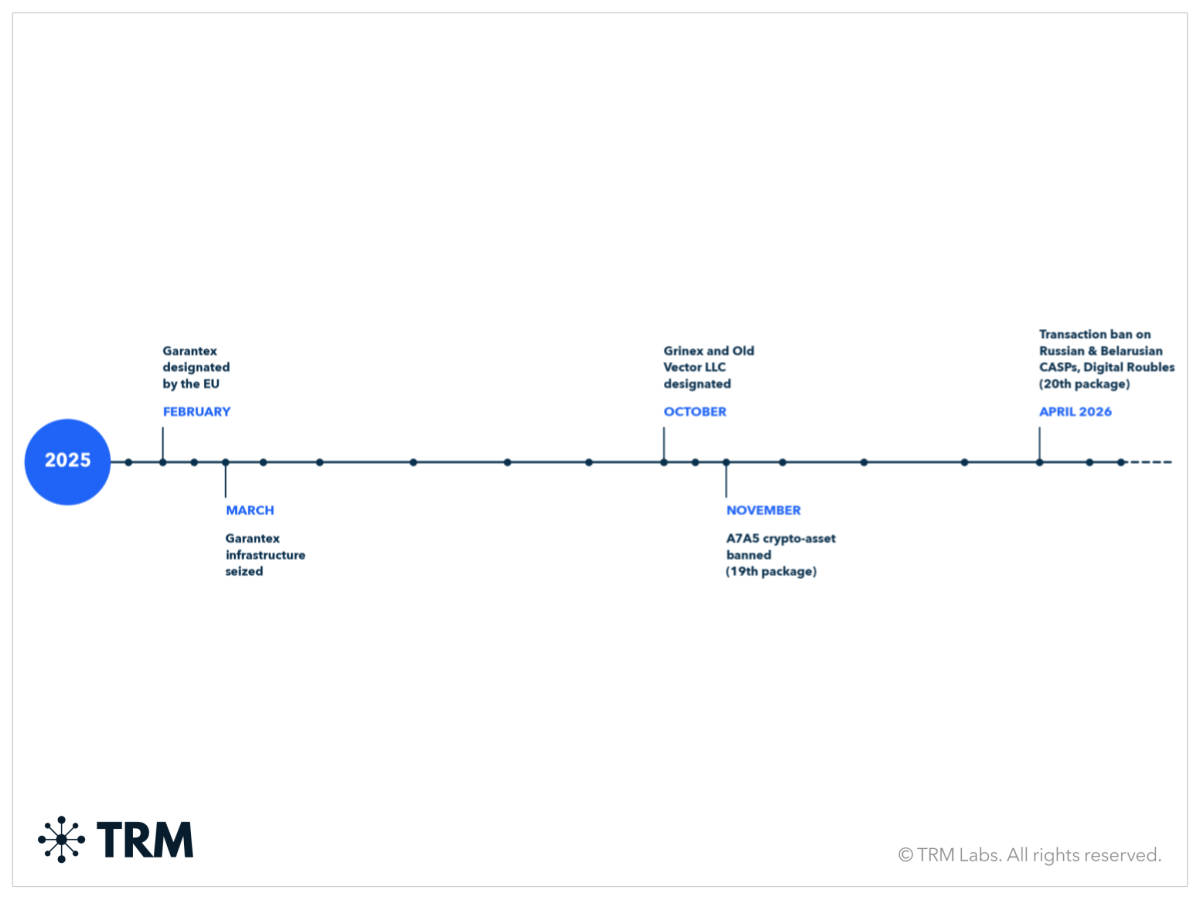
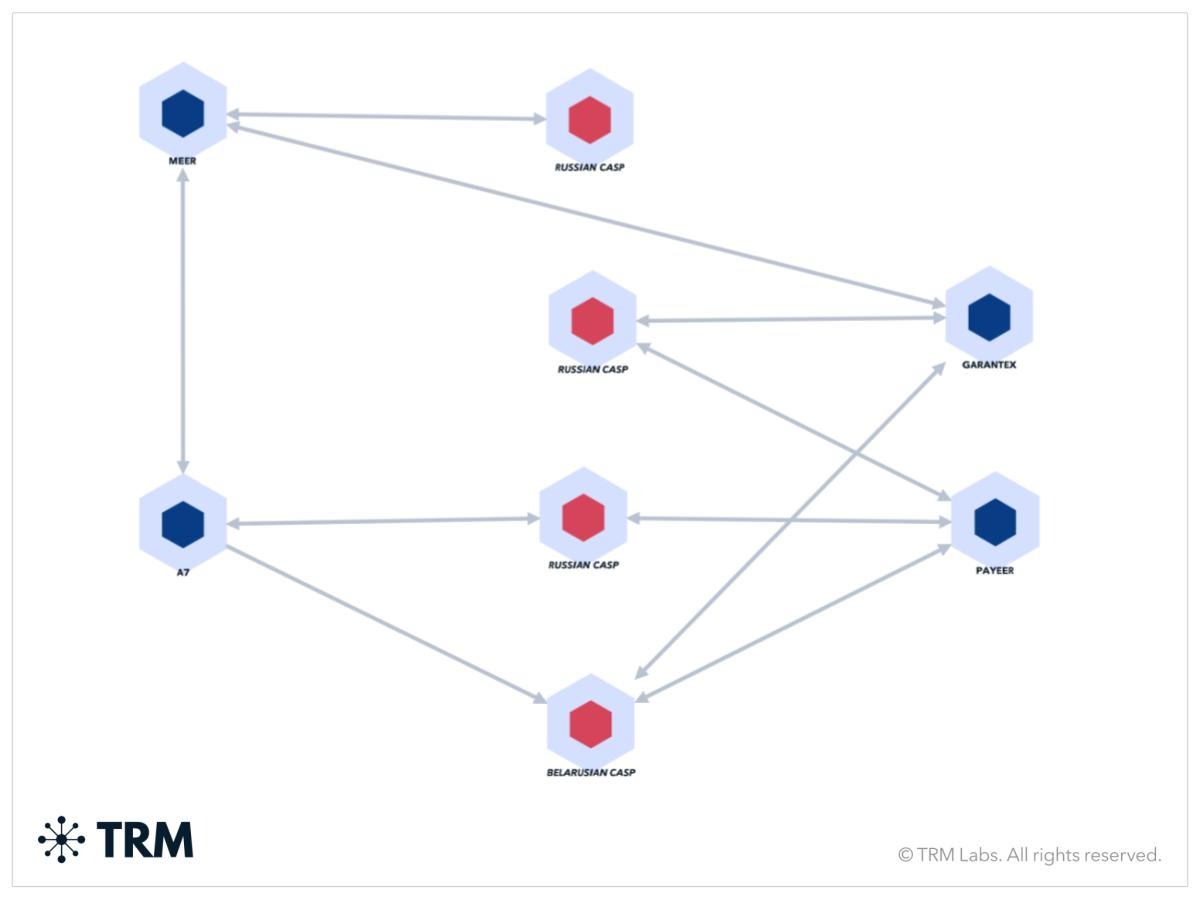
The 20th package also expands Annex LIII, the list of banned crypto-assets: alongside A7A5 (designated under the 19th package, effective November 2025), the 20th package adds RUBx and the digital ruble, both effective 24 May 2026. A parallel framework under the EU’s Belarus sanctions regime imposes an equivalent blanket ban on Belarus-based crypto providers and adds the Belarusian digital ruble to the prohibited assets list, also effective 24 May 2026. Today’s measure also targets Meer, a Kyrgyz trading platform used for trading A7A5.
Examining the Russian high-risk exchange ecosystem
The EU's blanket ban reflects the scale and resilience of Russia's crypto ecosystem, which TRM has tracked extensively. The network of entities targeted across successive sanctions packages — Garantex, Grinex, A7, and their associated infrastructure — illustrates how sanctioned actors have used crypto assets to maintain access to the global financial system.
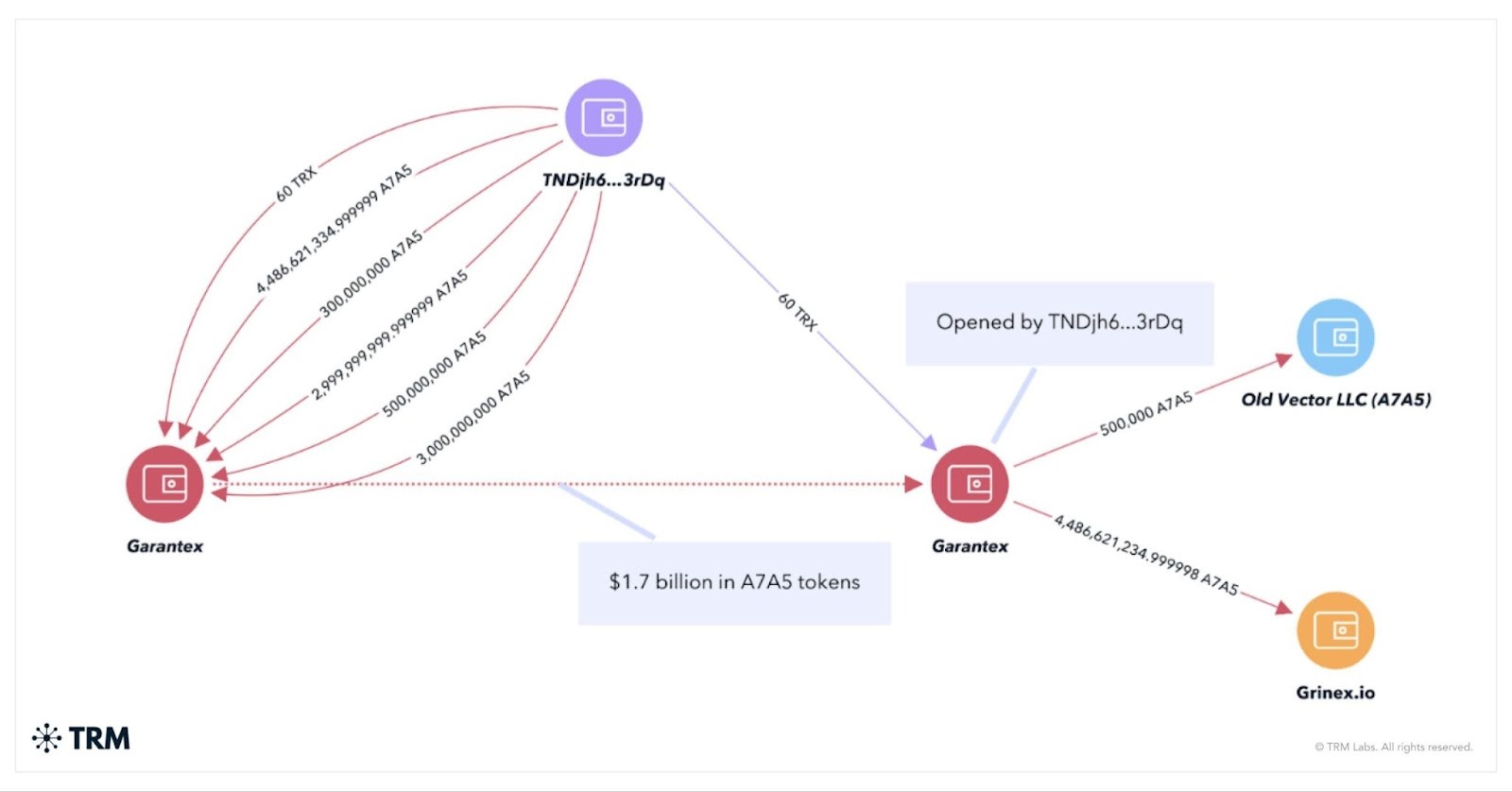
TRM analysis shows that the Russian high-risk exchange (HRE) ecosystem has consistently adapted to enforcement actions. When Garantex was seized in March 2025, its operators migrated to Grinex — a platform registered in December 2024 with an interface nearly identical to its predecessor. The A7A5 stablecoin served as the bridge, enabling users to transfer balances from the shuttered exchange to the new one.
Despite successive rounds of designations by the US, UK, and EU, the user base for these platforms continued to expand even as transaction volumes declined. This pattern of reduced volume but growing adoption explains why the EU concluded that targeting individual providers was insufficient and moved to a blanket prohibition.
Read TRM's full breakdown of the Garantex, Grinex, and A7A5 ecosystem here.
What this means for compliance teams
The 20th package shifts compliance obligations from screening against named entities or single addresses to a blanket prohibition on transacting with any crypto provider established in Russia. This places a premium on counterparty diligence, identification and jurisdictional screening — compliance teams will need tools that can identify the domicile and operational nexus of crypto asset service providers and flag Russia-based platforms, including newly created ones that have not yet been individually designated.
These measures build on the EU's Markets in Crypto-Assets Regulation (MiCA), which has been fully applicable since December 2024. The package also preemptively bans digital ruble transactions ahead of Russia's planned mass CBDC rollout beginning in September 2026, closing a potential future circumvention channel before it becomes operational at scale.
TRM coverage of the new sanctions package
All entities and platforms designated under the 20th sanctions package are labeled as sanctioned in TRM. While this transaction ban does not go into effect until May 24, 2026, TRM is working to enable our customers to quickly comply with the new sanctions. TRM has added a new category called Russian CASP Transaction Ban, which users can enable in the risk engine and define the severity for ownership, counterparty, and indirect risk. In the coming days, TRM will be adding entities to the new category that fall under the scope of the EU’s transaction ban. TRM Wallet Screening and TRM Transaction Monitoring customers can screen for exposure to these newly designated entities. For more information on how TRM supports sanctions compliance, visit TRM for Sanctions Compliance.
{{horizontal-line}}
Frequently asked questions (FAQs)
1. What exactly does the EU's 20th sanctions package prohibit regarding cryptocurrency?
The package imposes a blanket prohibition on EU persons engaging with any crypto asset service provider established in Russia, or using any platform that facilitates crypto asset transfers based in the country. This extends to Russia's digital ruble. Unlike previous packages, which targeted named entities, the 20th package bans the entire Russia-based CASP ecosystem — an explicit response to the failure of individual designations to prevent successor platforms from emerging.
2. Why did the EU shift from designating individual exchanges to a blanket prohibition?
The EU Commission concluded that individual designations were insufficient because sanctioned operators consistently relaunched as successor platforms. The seizure of Garantex in March 2025 led directly to Grinex — a near-identical platform registered in December 2024 — with users migrating via the A7A5 stablecoin. An internal Commission document cited in the package stated that further individual listings would simply result in new platforms being set up to circumvent them. The blanket ban is designed to close that replacement loop.
3. What is the A7A5 stablecoin and why was it central to Garantex's successor operations?
A7A5 is a stablecoin that served as the financial bridge between Garantex and Grinex, enabling users to transfer balances from the shuttered exchange to its successor in the weeks preceding Garantex's March 2025 seizure. The EU designated A7A5 under its 19th sanctions package — the first-ever crypto asset designation under EU Russia sanctions. TRM documented the full migration pattern, including A7A5's role and the A7 payment platform network that extends this ecosystem.
4. Does the 20th package cover Russia's digital ruble?
Yes. The 20th package adds two new assets to Annex LIII, the EU's list of banned crypto-assets: RUBx and the digital ruble — Russia's central bank digital currency — both effective 24 May 2026. A7A5, designated under the 19th package, remains banned. The digital ruble ban is explicitly preemptive, designed to close a circumvention channel before Russia's planned mass CBDC rollout in September 2026. The prohibitions cover both direct transactions and support for the development of these assets.
5. What should compliance teams do in response to the 20th package?
The blanket prohibition shifts compliance obligations from screening against individually named entities to jurisdictional screening — identifying whether a counterparty crypto provider is established in Russia, even if not yet individually designated. Compliance teams will need tools capable of identifying the operational nexus of crypto service providers and flagging Russia-based platforms, including newly created ones. All entities designated under the 20th package are already labeled in TRM; Wallet Screening and Transaction Monitoring customers can screen for exposure immediately.