Coinbase and West Midlands Police Unite to Bring Justice to Victims Targeted Through Grindr


Coinbase and West Midlands Police


Problem
A violent gang targeted members of the LGBTQ community, using Grindr to lure victims to a location where they were assaulted and robbed
Results
- All five gang members sentenced with a total of over 78 years
- Two of the gang members changed their pleas to guilty due to evidence presented
- Stronger public-private partnership in crypto crime investigations
Coinbase is one of the world’s leading cryptocurrency exchanges, providing individuals, businesses, and developers with a secure platform to buy, sell, store, and manage digital assets. Among its many specialized groups is the global intelligence team, a cohort dedicated to assisting law enforcement in investigating illicit activities on the platform. The UK team, led by skilled investigators like Richard Ashbrooke-Motte, plays a vital role in protecting users and the wider crypto economy from illicit activity.
West Midlands Police is the second-largest police force in England, serving nearly three million people. Its cyber crime unit is responsible for investigating a wide range of technology-enabled offenses, including the use of cryptocurrency in criminal activity. In recent years, the team has seen an increased demand for their expertise, corresponding with a notable rise in crypto-related cases. Leading that work is Nathan Bunn, a cyber and cryptocurrency investigator who has helped build out West Midlands’ capabilities for blockchain investigations.
Fake Grindr dates lead to violent assaults and robberies
In mid‑2023, a Coinbase customer in the UK reported being drugged, held for hours, and forced to unlock their phone with Face ID. Their identity documents were stolen, and the attackers used the victim’s passport to initiate transfers from their crypto wallet — draining their funds over the subsequent hours.
The investigation quickly expanded as more victims came forward with similar reports. The suspects had used fake profiles on the dating app Grindr to target LGBTQ individuals in a series of coordinated robberies.
As the prosecution prepared for trial, they realized that no blockchain analysis had been done to trace the stolen crypto. Days before the trial began, Nathan Bunn at West Midlands Police received a call. “I was in my office about to go home when I got the call,” recalls Bunn. “The prosecutor asked if it was possible to trace the stolen crypto, and I knew this was a moment to show how valuable this kind of tracing could be.”
Building the evidence with on- and off-chain data
Bunn immediately began analyzing the movement of funds using blockchain intelligence tools. The stolen assets had been moved through a fresh address and then dispersed across over 80 outgoing transactions, with ten linked to Coinbase.
“When I traced the cryptocurrency, it revealed exposure to Coinbase as an entity,” Bunn said. “That was the moment I knew we had to bring them into the investigation.”
He reached out to Coinbase’s global intelligence team, where the case landed on the desk of Richard Ashbrooke-Motte. “Our team had already been made aware of the case through our customer service channels,” said Ashbrooke-Motte. “As soon as we understood what had happened, we began working the case internally and collaborated closely with Bunn to connect on-chain data to off-chain information.”
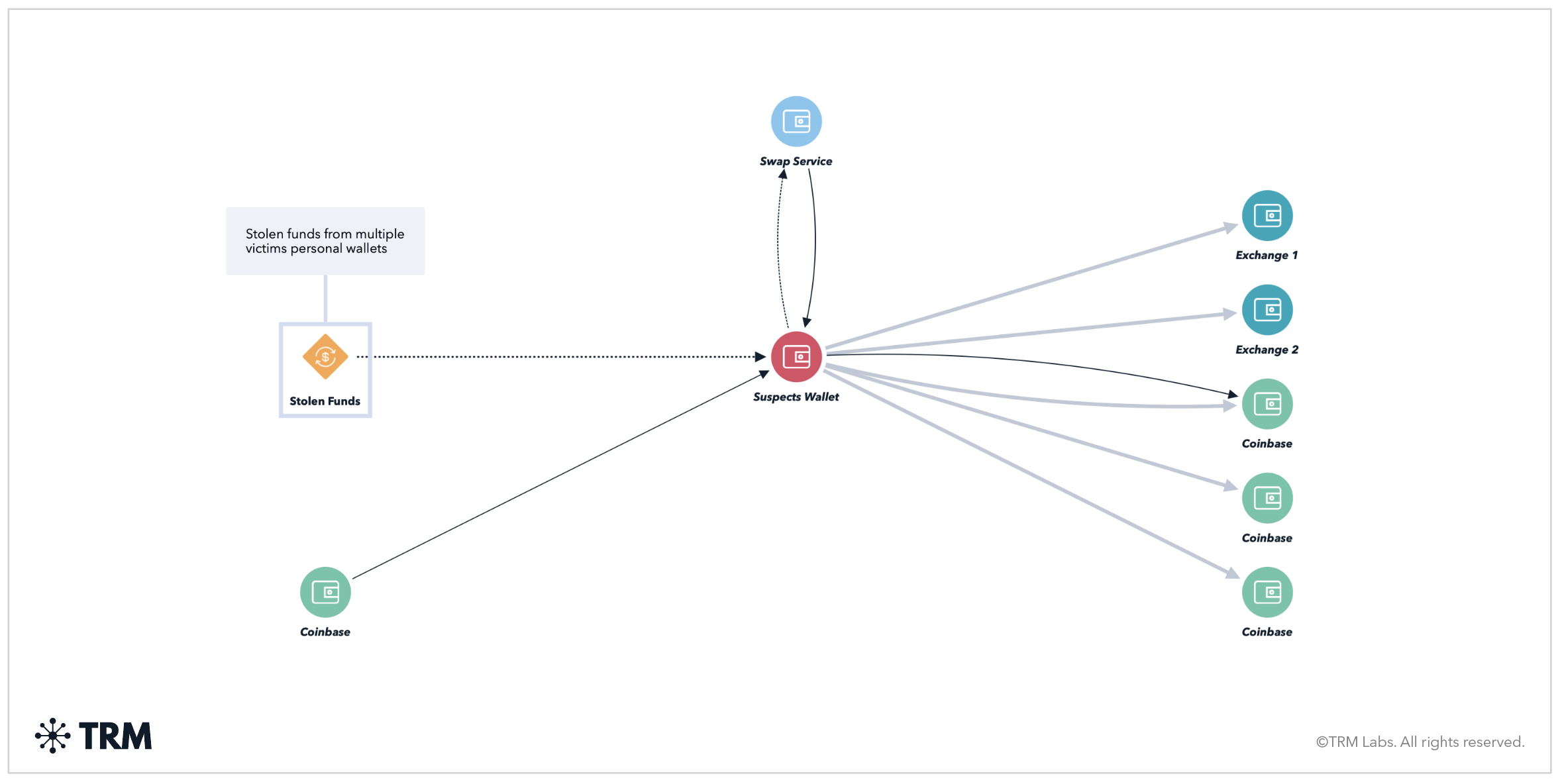
Ashbrooke-Motte and his team moved quickly to confirm account holders, link devices, and identify overlaps between victims and suspects. Using TRM Forensics, Ashbrooke-Motte and his team identified another Coinbase account that had sent only enough ETH to cover the gas fee, linking the fee funder directly to the stolen funds.
Decisive evidence turns into guilty pleas and convictions
Bunn and Ashbrooke-Motte worked rapidly to prepare materials that could be used in trial. The victim statements, blockchain analysis, and Coinbase’s attribution data collectively helped prosecutors strengthen the case.
“Seeing how quickly Coinbase got on board made all the difference,” said Bunn. “They understood the urgency and gave us what we needed to identify the right suspects.”
One critical piece of evidence Coinbase flagged was multiple ID verification attempts by the attackers. In one instance, the attackers had used a victim’s phone to verify their ID while the victim was detained. Coinbase’s system captured and stored images from this verification attempt, including visual evidence of the victim flanked by their attackers in the back seat of a car.
“We had never had a case like this,” said Ashbrooke-Motte. “This wasn’t just cybercrime. It was physical, violent, and it showed how crypto can intersect with real-world harms.”
The evidence contributed to the successful prosecution of five individuals, convicted in a six-week trial. Each had played a role in the Grindr robberies, which involved multiple counts of kidnap, false imprisonment, and aggravated assault. Two of the five perpetrators even changed their pleas to guilty with the introduction of the new evidence from blockchain tracing. In total, the five individuals received a sentence of over 78 years in prison.
Building trust with marginalized communities
This case highlights the importance of strengthening relationships with communities that are often underrepresented or hesitant to engage with law enforcement, including LGBTQ individuals. Crimes that exploit dating apps or target people based on their identity can have deep, lasting harm and victims may feel reluctant to report incidents. When investigators and industry partners lead with empathy, urgency, and technical expertise, they can help build trust and encourage more victims to come forward.
“Our goal is to give victims a voice,” said Ashbrooke-Motte. “And in this case, we were able to do just that.” The collaboration between Coinbase and West Midlands Police demonstrates how inclusive, community-aware approaches can deliver both justice and reassurance to those most at risk.
Reflecting on lessons learned to accelerate future investigations
Following the trial, the team held a multi-agency debrief. There was a shared recognition that engaging in crypto tracing earlier in the process would have dramatically accelerated the investigation and potentially prevented further attacks.
“What would have taken months in fiat tracing took days with crypto,” said Bunn. “Leveraging blockchain tracing capabilities earlier on could have made this case even stronger.”
For Coinbase, the case underscored how the exchange can play a critical role in supporting victims, protecting the ecosystem, and working hand-in-hand with law enforcement.
Ready to get started?
Fill out the form to schedule a demo with our team.


