White House Releases Report on Digital Assets

Overview
On July 30, 2025, the White House released its long-anticipated 180-Day Report on digital asset policy. Developed by the President’s Working Group on Digital Asset Markets in coordination with the National Economic Council, the 163-page report lays the foundation for a comprehensive US strategy on digital asset regulation, market structure, innovation, and national security. It is the most detailed articulation of the Trump administration’s digital asset agenda to date and responds directly to the January 2025 Executive Order titled “Strengthening American Leadership in Digital Financial Technology.”
Introduction and policy rationale
The report opens by framing digital assets as a central pillar of the future US financial system. It highlights rising global competition, the increasing adoption of blockchain-native infrastructure, and the escalating risk of financial crime as key motivators for regulatory action. The Working Group — composed of senior officials from Treasury, Justice, Commerce, Homeland Security, the SEC, CFTC, and the National Security Council — underscores the urgency of coordinated federal action to ensure both innovation and security.
The digital asset ecosystem
This section of the Report provides an expansive overview of the digital asset landscape. It covers the proliferation of stablecoins, tokenized financial instruments, and decentralized finance (DeFi) protocols. It defines key market actors — including custodians, exchanges, wallet providers, and protocol developers — and maps the existing patchwork of regulatory oversight across state and federal jurisdictions. The report makes clear that this fragmented structure impedes responsible growth and contributes to regulatory uncertainty.
Market structure and regulatory framework
A central pillar of the report is the call for a unified federal framework to govern digital asset markets. The Working Group urges Congress to clearly define the respective roles of the SEC and CFTC — particularly around the classification of digital assets as commodities or securities.
That work is already underway, with the recent passage of the CLARITY Act in the House and the release of a Senate discussion draft on market structure. The report also recommends establishing clear statutory pathways for asset registration, custody, and trading.
While Congress advances long-term legislation, the administration encourages federal agencies to act now — using interpretive guidance, safe harbors, and no-action relief to provide near-term clarity and enable lawful innovation to move forward without delay.
Banking and blockchain innovation
The chapter on banking highlights how financial institutions are exploring tokenized deposits, blockchain-based settlement rails, and stablecoin-backed payment systems. It notes, however, that inconsistent supervisory expectations and regulatory uncertainty have hindered broader adoption. The report calls for stronger interagency coordination, updated supervisory frameworks, and regulatory sandboxes to facilitate experimentation within traditional banking environments.
Stablecoins and the GENIUS Act
The report places significant emphasis on stablecoins, especially in light of the recently enacted GENIUS Act. It supports swift rulemaking by Treasury and federal banking regulators to implement the law’s provisions, which include requirements for transaction monitoring, sanctions compliance, reserve management, redemption rights, and auditability. The report encourages direct federal oversight of systemic stablecoin issuers and highlights the potential risk posed by foreign-denominated stablecoins to US monetary sovereignty. It also recommends that all large-scale stablecoin systems include built-in freeze-and-reissue functionality to support law enforcement.
Countering illicit finance
This chapter — spanning more than 20 pages — is one of the most comprehensive federal analyses to date of illicit finance risks in the digital asset ecosystem.
It underscores two major commitments: first, to equip law enforcement, regulators, and national security agencies with the blockchain intelligence tools, training, and resources needed to trace and disrupt illicit activity on-chain; and second, to strengthen public-private collaboration through robust safe harbor frameworks that allow innovation and enforcement to advance in parallel. At its core, the section lays out a whole-of-government strategy to combat crypto-enabled financial crime, structured around eight interlocking pillars.
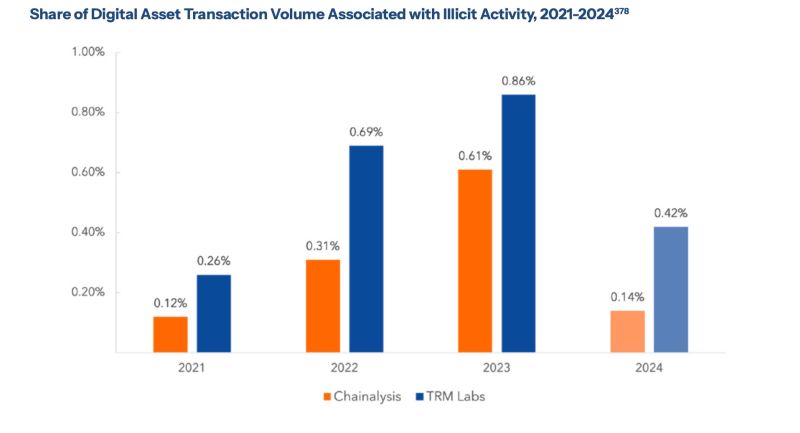
The Report includes a graph comparing data on attributed overall illicit finance volume in the overwhelming lawful and growing crypto ecosystem.
1. Illicit finance risks: Threats and vulnerabilities
The report opens by acknowledging the increased misuse of digital assets by ransomware groups, darknet market operators, sanctions evaders, and fraud networks. It emphasizes that while crypto-related illicit finance represents a relatively small share of total global crime, its velocity, pseudonymity, and cross-border accessibility make it uniquely dangerous. The use of anonymity-enhanced coins, mixers, and cross-chain obfuscation is specifically flagged as a challenge for regulators and investigators.
2. Public-private data and typology development
The Working Group stresses the need for greater collaboration between public agencies and private sector actors, including blockchain analytics firms and financial institutions. FinCEN is directed to lead a modernization of the Suspicious Activity Report (SAR) system to integrate blockchain-specific typologies, including wallet behaviors, mixer usage, token flows, and DeFi-related interactions. The report envisions real-time data-sharing environments and more dynamic risk models that reflect the actual behavior of illicit actors on-chain.
3. Disrupting illicit finance through enforcement and legal reform
The report calls for coordinated action by DOJ, Treasury, DHS, SEC, and CFTC to prioritize enforcement actions against actors using digital assets to facilitate crime. It identifies several key legal gaps and urges Congress to amend the National Stolen Property Act to clearly classify digital assets as “property.” It also recommends expanding anti-tip-off statutes to include VASPs and digital intermediaries, and calls for updated forfeiture laws that allow seizure of wallet-based funds even when specific coin provenance cannot be established — mirroring how cash is currently handled.
4. Cyber threats and Infrastructure security
Digital assets are increasingly being exploited by state-sponsored cyber actors. The report details how groups such as North Korea’s Lazarus Group use smart contract vulnerabilities, phishing, and infrastructure takeovers to steal and launder funds. In response, the Working Group recommends that regulators develop and enforce cybersecurity standards for digital asset firms, including multi-factor authentication, code audits, separation of roles, and robust custodial security.
5. Strengthening the regulatory framework
The report calls for a modernization of the Bank Secrecy Act to ensure its continued effectiveness in a rapidly evolving digital asset ecosystem. It urges Treasury and financial regulators to assess how AML/CFT obligations can be applied more consistently across both centralized and decentralized environments, including DeFi protocols and self-custody solutions.
While the report does not go so far as to recommend bringing decentralized platforms squarely under the BSA, it does encourage Treasury to study the issue and explore new categories of BSA-regulated financial institutions specifically tailored to digital assets. These could include not only custodial exchanges and wallet providers, but also bridge operators, validators, front-end interfaces, and other protocol participants depending on the functions they perform.
The Working Group makes clear that many actors are currently operating in legal gray zones — not because of intent to evade oversight, but because statutory definitions have not kept pace with technological change. The goal, according to the report, is to ensure that all entities facilitating digital financial activity are subject to appropriate AML safeguards, regardless of whether they operate within a traditional or decentralized structure.
The report also addresses legal reform, recommending that Congress codify AML/CFT requirements for decentralized infrastructure where appropriate and clarify law enforcement’s ability to access, monitor, and seize digital assets under existing forfeiture and property laws. It emphasizes the importance of updating these frameworks to ensure that investigators and prosecutors can respond effectively to new methods of obfuscation and asset movement across blockchain networks.
On the topic of anonymity-enhancing technologies, the report references FinCEN’s 2024 Notice of Proposed Rulemaking on convertible virtual currency (CVC) mixing. While it stops short of endorsing specific regulatory outcomes, it affirms the administration’s strong interest in addressing the national security and financial crime risks associated with mixing services.
The report encourages Treasury to evaluate next steps following public comment and consider how to strike an appropriate balance between preserving legitimate privacy interests and ensuring traceability in high-risk contexts. Although the inclusion of the NPRM reflects support for advancing tools to mitigate illicit finance risk, the report notably avoids committing to finalizing the rule — acknowledging the technical and legal complexity of enforcing obligations on privacy-enhancing protocols.
6. International engagement and coordination
Recognizing the global nature of digital asset markets, the report calls for deeper US leadership at the Financial Action Task Force (FATF), the G20, and other multilateral forums. It supports bilateral technical delegations focused on harmonizing enforcement strategies, seizure procedures, sanctions implementation, and typology sharing across borders. The report warns that continued regulatory divergence will enable criminals to exploit arbitrage opportunities in poorly regulated jurisdictions.
7. Government Capability and resourcing
The Working Group recommends significant investment in investigative and regulatory infrastructure. It supports expanding the capacity of DOJ, Treasury, DHS, and IRS-CI to conduct crypto-related investigations, including the formation of dedicated blockchain analytics teams within law enforcement agencies. The National Cyber Investigative Joint Task Force (NCIJTF) is encouraged to stand up a crypto-focused illicit finance division, and the DOJ is tasked with expanding its Crypto Sanctions Evasion Threat Tracker.
8. Implementation and governance
To ensure effective execution, the report outlines a responsibility matrix assigning leadership roles across agencies. It calls for coordinated typology development, formal governance around interagency data-sharing, and clear delineation of enforcement, compliance, and supervision roles. The report also recommends enhanced coordination between the SEC and CFTC on overlapping jurisdictional matters, particularly for hybrid instruments and tokenized products.
Safe harbors and innovation pilots
A critical recommendation throughout the report is the creation of safe harbor programs for compliant innovation. The Working Group proposes that federal agencies establish structured pilot programs for exchanges, custodians, DeFi front ends, and other entities experimenting with novel compliance approaches. These may include solutions for tracing without KYC, real-time mixer detection, wallet screening for self-custody environments, and advanced cross-chain analytics. In exchange for transparency and participation in technical audits, entities would receive limited liability protection. These pilots are designed to encourage innovation while maintaining visibility and risk mitigation — a central principle of the report’s enforcement strategy.
Taxation and reporting
The taxation chapter identifies persistent ambiguity around staking, mining, token rewards, and small-dollar payments. It supports a full review of existing IRS guidance, the introduction of a de minimis exemption for low-value crypto transactions, and expanded use of blockchain intelligence to improve compliance. The report also recommends that the IRS update its taxpayer education programs to reflect the realities of blockchain-native financial activity.
The digital asset reserve
In response to the Executive Order, the Working Group outlines early thinking on a strategic federal crypto reserve. While the report offers few specifics, it suggests potential applications including emergency financial response, cyber event stabilization, and limited economic interventions. Treasury and Commerce will lead the project on a budget-neutral basis, and implementation will proceed cautiously.
Conclusion
The White House’s 180-Day Report is both a blueprint and a signal. For the first time, digital asset policy in the United States is guided by a whole-of-government strategy that spans financial innovation, illicit finance enforcement, cyber resilience, and regulatory modernization. The illicit finance section in particular provides a sweeping roadmap for how federal agencies, Congress, law enforcement, and the private sector can work together to detect, disrupt, and deter criminal misuse of digital assets. By combining immediate regulatory action with longer-term legislative reform, the report sets a new standard for digital financial oversight and national security readiness.
How TRM can help
As agencies and institutions begin implementing the recommendations in the report, TRM Labs stands ready to support the mission. TRM’s blockchain intelligence tools power real-time wallet risk scoring, cross-chain investigations, sanctions screening, and typology development — all aligned with the strategic priorities outlined by the President’s Working Group. Whether helping law enforcement trace ransomware payments, enabling regulators to modernize AML systems, or supporting financial institutions preparing for GENIUS Act compliance, TRM provides the infrastructure for trusted, secure, and transparent digital finance.
{{horizontal-line}}
FAQs
1. What is the 180-Day White House Report on digital assets, and why does it matter?
The 180-Day Report, released by the White House on July 30, 2025, lays out the Trump administration’s most comprehensive strategy to date for governing the digital asset ecosystem. It proposes a unified federal framework to balance innovation with national security, outlines interagency priorities for combating illicit finance, and signals clear policy direction on emerging technologies like DeFi, stablecoins, and blockchain-based banking.
2. How does the 180-Day White House Report on digital assets differ from previous federal guidance on crypto?
While prior federal efforts often addressed digital assets in a piecemeal or reactive manner, this report represents a whole-of-government approach. It includes detailed recommendations across regulation, enforcement, innovation, and cybersecurity — emphasizing interagency coordination and legislative action as critical next steps.
3. What does the 180-Day White House Report on digital assets say about stablecoins and the GENIUS Act?
The report underscores the importance of swift implementation of the GENIUS Act, which introduces strict compliance obligations for systemic stablecoin issuers. These include transaction monitoring, reserve transparency, and redemption rights. It also warns that foreign-denominated stablecoins could pose risks to US monetary sovereignty, and calls for systems to include freeze-and-reissue mechanisms to support lawful enforcement efforts.
4. What are the key national security and illicit finance risks identified in the 180-Day White House Report on digital assets?
The report dedicates over 20 pages to illicit finance risks, highlighting how ransomware groups, darknet marketplaces, and sanctions evaders misuse digital assets. It proposes expanding enforcement capabilities, strengthening AML/CFT frameworks for decentralized platforms, and enhancing international coordination. It also calls for legal reform to modernize the treatment of digital assets under forfeiture and anti-tip-off statutes.
5. How can the private sector support implementation of the 180-Day White House Report on digital assets’ recommendations?
The report emphasizes the importance of public-private collaboration, encouraging blockchain intelligence firms, financial institutions, and protocol developers to contribute typologies, pilot new compliance models, and participate in safe harbor programs. These partnerships are seen as essential to enabling lawful innovation while equipping authorities with the tools they need to manage risk in real time.