Seize, Burn, Block, Reissue: Understanding the Legal Tools Behind Crypto Asset Recovery

On June 18, 2025, the US Attorney’s Office for the District of Columbia filed a civil forfeiture complaint involving over USD 225 million in cryptocurrency. According to the filing, the assets were linked to an international cryptocurrency investment fraud scheme involving hundreds of victims. The investigation, led by the US Secret Service and FBI, leveraged TRM’s blockchain intelligence, as detailed in the complaint, to trace illicit funds through complex laundering networks and ultimately identify the associated wallets for legal seizure.
This action, which represents the largest crypto seizure tied to investment fraud in US history, illustrates how digital asset tracing, combined with seizure and related technical tools — freezing, burning, and reissuing — can serve as instruments for law enforcement and restitution. The case also coincides with growing legislative interest in codifying such mechanisms, most notably through the GENIUS Act, which authorizes federal authorities to direct seizure or destruction of illicit stablecoins.
Definitions: What does it mean to seize, freeze, block, burn, reissue, or forfeit digital assets?
The terms used in digital assets-related enforcement actions often overlap, but carry distinct legal and technical meanings. The following definitions reflect how these concepts are understood in legal proceedings and practice:
Seize
A court-authorized action — typically under civil or criminal forfeiture laws — by which law enforcement takes control of a digital asset. In many cases, this involves directing an exchange, issuer, or wallet provider to transfer assets to a government-controlled address. Seizure may also occur when the government obtains credentials to transfer the asset directly.
Freeze / block
A mechanism that restricts movement of an asset, generally without removing it from the blockchain. Issuers, smart contracts, or custodial platforms may block or freeze addresses or tokens to prevent further transactions. These terms are often used interchangeably.
Burn
A technical process that destroys a token by sending it to an unrecoverable address. Burning a token removes it from circulation permanently and is typically carried out by the issuer, often following legal instruction or in response to a seizure order.
Reissue
The issuance of new tokens by a stablecoin issuer or other platform in an amount equivalent to the burned or frozen funds. This can be used to transfer value to government wallets for recovery or to return funds to victims in restitution processes. While commonly used in practice, the concept of reissue is not currently defined in law.
Forfeiture
A legal mechanism by which the government permanently obtains ownership of assets deemed connected to criminal activity. Forfeiture may be civil (against the asset) or criminal (following conviction), and enables authorities to dispose of, repurpose, or return assets based on judicial findings.
Statutory context: What asset destruction authority is proposed in the GENIUS Act?
The GENIUS Act (Guiding and Establishing National Innovation for US Stablecoins), which passed the Senate on June 17, 2025, proposes statutory authority for seizure and destruction of illicit digital assets. Specifically, Section 5(a)(2) states:
“The Secretary of the Treasury and the Attorney General, acting jointly, may take appropriate steps to seize or cause to be burned any stablecoin or related digital asset used in significant violation of sanctions law, federal criminal law, or any order of forfeiture issued by a court of competent jurisdiction.”
This language authorizes federal agencies to direct the seizure or burning of stablecoins associated with significant violations, including sanctions evasion and criminal schemes. The Act reflects an effort to align statutory tools with blockchain-native enforcement techniques.
Notably, the GENIUS Act does not mention or define reissuance — a mechanism that some stablecoin issuers have used to facilitate asset recovery and victim remediation. In practice, reissuance typically follows a burn event, in which illicit funds are rendered unspendable, and allows issuers to mint an equivalent amount of tokens back to government-controlled wallets or directly to victims. Its omission from the statute may reflect the issuer-specific or discretionary nature of the process. However, the absence of clear statutory recognition could also reduce the likelihood or consistency of victim recovery efforts in future enforcement actions.
DOJ case study: Asset tracing and seizure in USD 225 million forfeiture
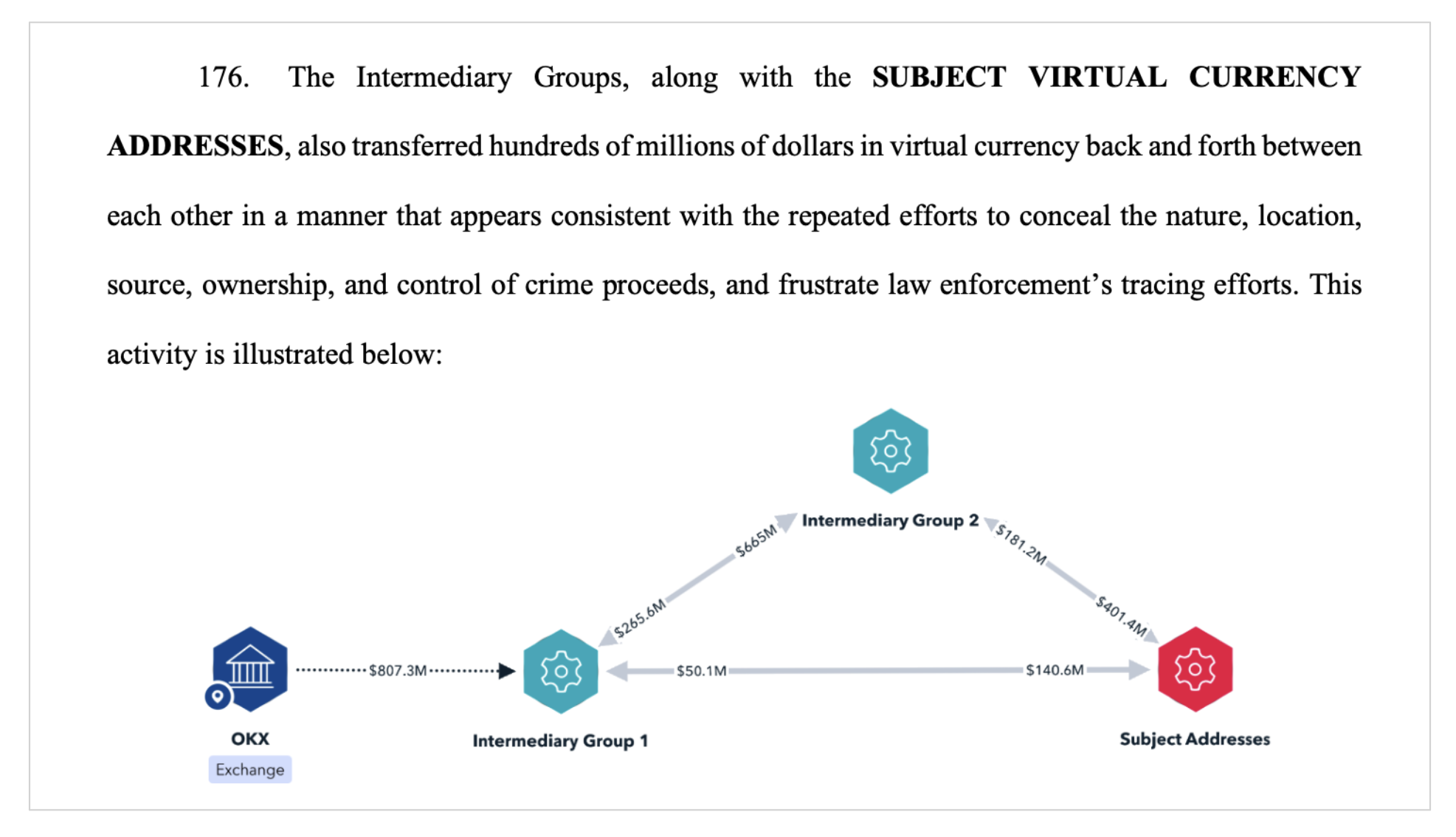
The June 2025 forfeiture complaint provides an example of how all five mechanisms — freezing, seizing, burning, reissuing, and forfeiture — are used in practice. Investigators used blockchain analytics to map the movement of funds through hundreds of thousands of transactions involving intermediary wallets and exchanges. In many cases, deposits were routed through dozens of transactions across the blockchain — often via peel chains and cross-chain swaps — to obscure their origin and arrive at consolidation wallets linked to fraud networks.
In one instance, a former bank CEO in Kansas, S.H., embezzled USD 47 million from Heartland Tri-State Bank and transferred over USD 3 million into a cryptocurrency confidence scheme. Using LIFO tracing, the funds were tracked through 17 wallet addresses to one of 22 suspect accounts. Additional tracing showed that funds were later consolidated into laundering addresses alongside other victim funds.
The complaint cites multiple examples where proceeds from fraud victims were deposited into addresses connected to larger laundering networks. Cryptocurrency exchanges were instrumental in enabling law enforcement to identify account holders and trace the flows of funds. However, the complaint does not specify whether any assets were burned or reissued — only that funds were traced and linked to criminal activity for the purposes of forfeiture.
What technical and cooperative mechanisms are in place to help reissue assets to victims?
In stablecoin ecosystems, seizure and burn are often dependent on the cooperation of the issuer. Tether and Circle, the largest issuers of stablecoins, for instance, have both frozen and burned tokens at the request of law enforcement in past cases. In some scenarios, burned tokens are followed by an equivalent minting of new tokens — reissued to the government or, in restitution efforts, to victims.
However, the reissue function is not standardized across blockchains or tokens. It depends on the underlying architecture, the legal process, and the policies of the issuer. As such, even when burning is authorized — either through legal seizure or court order — reissuance may not be automatic or assured.
Why is reissuance so important?
As the use of digital assets in fraud, sanctions evasion, and cybercrime grows, clarity around enforcement tools becomes increasingly important. The GENIUS Act provides the first proposed statutory language authorizing federal agencies to seize and burn illicit stablecoins. However, the absence of any reference to reissue leaves open questions about how forfeited assets can be restored to victims.
Reissuance — the technical act of issuing equivalent value to replace burned or forfeited tokens — has already played a role in some past recovery efforts. It enables stablecoin issuers and authorities to ensure that burned tokens are not simply destroyed, but that equivalent value is directed toward public ends, including restitution.
While reissue is not currently codified in law, it remains an operational tool in cases where issuer cooperation and technical capacity allow. As legislation evolves, these distinctions — seize, freeze, block, burn, reissue — may become the building blocks of a more complete legal framework for digital asset recovery and the funding of a strategic reserve.