Former Olympian Snowboarder Ryan Wedding Arrested in Major Transnational Criminal Case Spanning Drugs, Violence, and Crypto Laundering

Key takeaways
- Ryan Wedding’s arrest highlights how modern transnational criminal organizations rely on complex financial networks that span drugs, violence, shell companies, luxury assets, and digital payments.
- US authorities have described cryptocurrency as one component of the broader financial infrastructure used by Wedding’s organization, alongside traditional laundering methods and front businesses.
- The case illustrates how large criminal networks operate across multiple blockchains, with investigators identifying activity involving Bitcoin, Ethereum, TRON, Solana, and BNB Chain as part of a wider effort to move and obscure illicit proceeds.
- The coordinated use of arrests, indictments, and Treasury sanctions reflects a whole of government approach focused on dismantling financial and operational networks, not just individual offenders.
{{horizontal-line}}
Today, the FBI announced the arrest of Ryan Wedding, bringing to a close a yearslong international manhunt for a former Canadian Olympic snowboarder accused of leading one of the most violent transnational narcotics organizations operating in North America. Wedding, who competed in the 2002 Winter Olympics, now faces charges including large-scale cocaine trafficking and murder, marking a dramatic fall from elite athletics to alleged leadership of a global criminal enterprise.

According to US authorities, Wedding’s organization smuggled cocaine from Colombia and Mexico into the United States and Canada and ordered multiple killings across several countries, including the murder of a Canadian informant. Wedding was arrested in Mexico City after spending years as a fugitive on the FBI’s Ten Most Wanted list, underscoring both the scale of the alleged criminal network and the level of international coordination required to apprehend him.
Prior sanctions and financial disruption
The arrest follows earlier efforts by US and international authorities to dismantle the financial and operational backbone of Wedding’s organization. Last year, the US Department of the Treasury’s Office of Foreign Assets Control, in coordination with the FBI, the Department of Justice, and Mexico’s Financial Intelligence Unit, announced sweeping sanctions against Ryan James Wedding and key members of his network, exposing a transnational web of facilitators and front companies spanning Mexico, Canada, Colombia, Italy, and the United Kingdom. The US Attorney’s Office for the Central District of California also announced indictments against Wedding and his associates, while the State Department increased the reward for information leading to his capture to up to USD 15 million.
Role of cryptocurrency in the network
While the FBI’s arrest announcement focused on drug trafficking and murder charges, US Treasury officials have previously described cryptocurrency as a central tool used by Wedding’s organization to finance and sustain its operations. In November, OFAC sanctioned Wedding and a network of associates and entities, stating that the group used cryptocurrency to move and launder drug proceeds while concealing the origins of its illicit wealth.
Court filings and Treasury sanctions link the alleged operation to activity across multiple blockchains, including Bitcoin, Ethereum, TRON, BNB Chain, and Solana. Prosecutors have cited stablecoin payments as part of the scheme, including a documented transfer of approximately 17,300 USDT tied to a cocaine transaction. Treasury added twelve cryptocurrency addresses linked to Wedding and his associates to the SDN List, signaling what officials described as a deliberate, multi-chain laundering operation consistent with the scale of the alleged trafficking activity.
Global criminal network and key enablers
Authorities allege that Wedding led a vast criminal enterprise that blended violence with sophisticated financial infrastructure. In Mexico, he was protected by Edgar Aaron Vazquez Alvarado, a former law enforcement officer with ties to senior officials who provided protection and intelligence. Vazquez controlled several Mexico-based fuel and energy companies designated as fronts for the network. Wedding’s wife, Miryam Andrea Castillo Moreno, was sanctioned for laundering funds and facilitating violence, while Carmen Yelinet Valoyes Florez allegedly helped organize the January 2025 murder of a cooperating federal witness in Colombia. Daniela Alejandra Acuna Macias, a Colombian partner, collected large sums while knowingly aiding criminal activity.
Wedding’s Canadian attorney, Deepak Balwant Paradkar, was designated for introducing Wedding to cocaine suppliers and assisting with bribery, surveillance, and murder plots. Treasury stated that Paradkar enabled Wedding to monitor privileged communications of other targets and received payment through luxury goods and illicit retainers.
Money laundering through luxury assets and crypto
Treasury also detailed an extensive laundering architecture involving luxury assets and cryptocurrency. Canadian jeweler Rolan Sokolovski allegedly moved millions in cocaine proceeds using crypto while concealing value through jewelry and high-end assets. Gianluca Tiepolo, a former Italian special forces member, managed Wedding’s fleet of luxury vehicles, including a Mercedes CLK-GTR valued at approximately USD 13 million, using companies in Italy and the United Kingdom to disguise ownership and facilitate paramilitary-style training for enforcers.
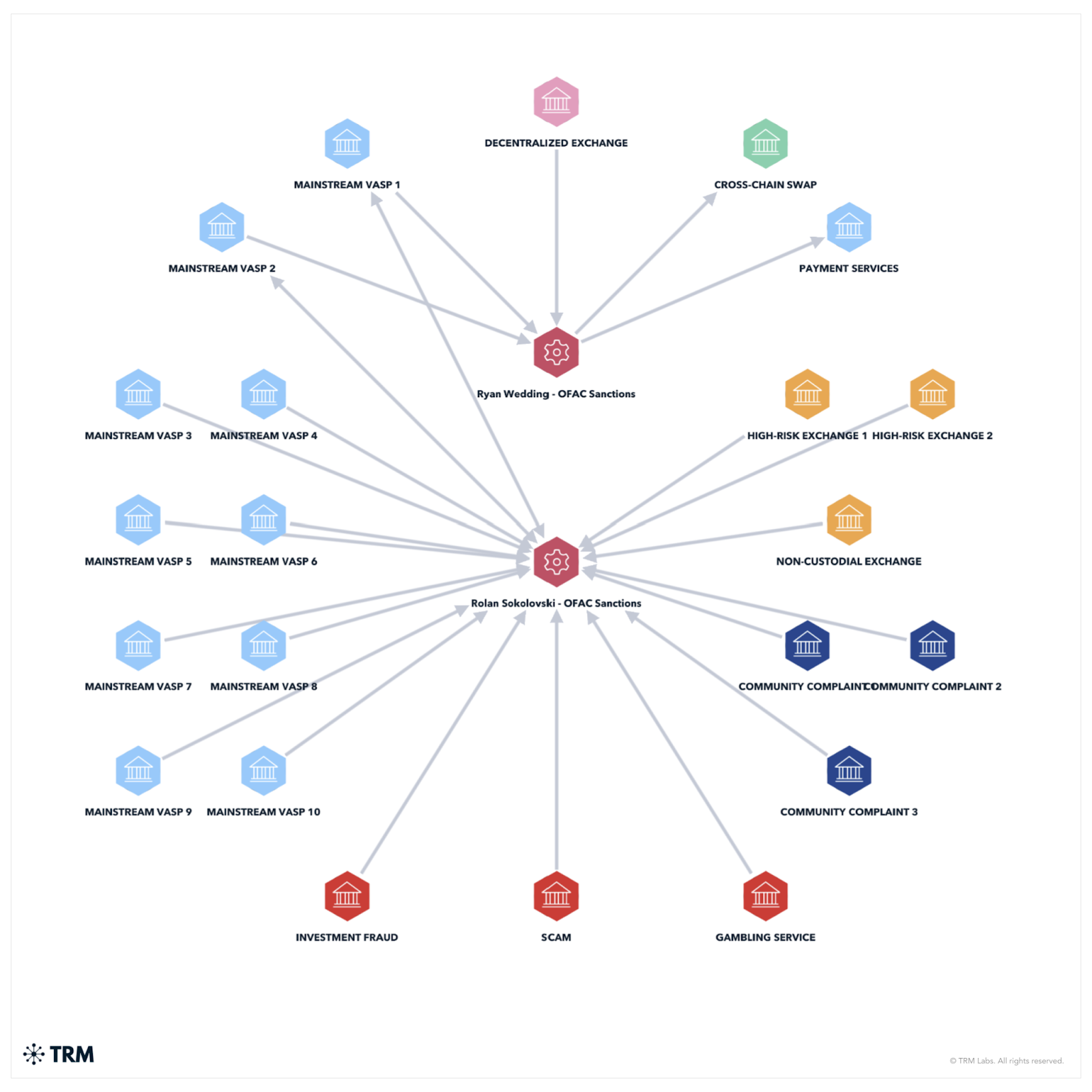
TRM blockchain analysis of wallets linked to Wedding and his facilitators shows extensive interaction with a wide network of Virtual Asset Service Providers, including several high-risk exchanges. The activity reflects deliberate layering across multiple blockchains, including cross-chain swaps designed to fragment flows and complicate tracing. Wallets attributed to Wedding directly interacted with infrastructure commonly used to move value across chains and obscure provenance.
Sanctions framework and enforcement implications
All designations were made under Executive Order 14059, which targets those materially contributing to international drug trafficking. As a result, all property and interests in property of designated individuals and entities under US jurisdiction are blocked, and US persons are prohibited from engaging in transactions with them. Treasury emphasized that entities owned 50 percent or more by designated persons are also subject to blocking.
Wedding’s arrest underscores a core reality of modern narcotics trafficking. The most dangerous criminal organizations today are not defined solely by violence or drugs, but by their ability to combine both with sophisticated financial systems, including cryptocurrency, to operate at global scale.
{{horizontal-line}}
Frequently asked questions (FAQs)
1. Who is Ryan Wedding
Ryan Wedding is a former Canadian Olympic snowboarder who competed in the 2002 Winter Olympics and is now accused by US authorities of leading a violent transnational narcotics trafficking organization.
2. What led to Ryan Wedding's arrest
Wedding was arrested in Mexico City following years of international investigation, including indictments in the United States, Treasury sanctions, and his placement on the FBI’s Ten Most Wanted list.
3. How cryptocurrency factored into the Ryan Wedding case
According to US authorities, cryptocurrency was used alongside other methods to move and launder proceeds connected to drug trafficking, with activity observed across several blockchain networks.
4. What actions did the US Treasury take against Ryan Wedding
The Treasury Department sanctioned Wedding and members of his network, designated associated individuals and entities, and added multiple crypto addresses to the SDN list to disrupt financial flows.
5. Why is the Ryan Wedding case is significant
The case shows how financial crime, violence, and digital assets increasingly intersect in transnational criminal activity, underscoring the importance of coordinated enforcement and financial intelligence.