OFAC Sanctions Cambodian Senator and Scam Center Network Targeting Americans With Digital Asset Fraud

Key takeaways
- Yesterday, OFAC designated Cambodian senator Kok An and 28 individuals and entities in his scam center network for defrauding Americans through digital asset investment fraud
- Bolai (aka Brilliancy Sihanoukville Investment and Development Co Ltd), a casino and scam compound in Sihanoukville, Cambodia is at the center of the designation — it coerces trafficking victims into running digital asset fraud schemes, operates social media channels and gambling websites used for money laundering, and has direct financial ties to US-based co-conspirators who laundered at least USD 73 million in victim funds, according to the US Treasury press release
- TRM's 2026 Crypto Crime Report documented approximately USD 158 billion in illicit cryptocurrency flows in 2025 — a 145% increase from USD 64.5 billion in 2024 and the highest level recorded in five years. Fraud and scams alone accounted for roughly USD 35 billion in confirmed flows to fraud-linked wallets.
- The designation was coordinated with the DOJ's Scam Center Strike Force, alongside criminal charges, domain seizures, and a US Department of State reward of up to USD 10 million for information leading to the recovery of scam proceeds linked to Tai Chang
- The action follows previous OFAC designations targeting Cambodia-based scam infrastructure, including the Prince Group in October 2025 and tycoon Ly Yong Phat in September 2024
{{horizontal-line}}
Yesterday, the US Department of the Treasury's Office of Foreign Assets Control (OFAC) designated Cambodian senator Kok An and 28 individuals and entities across his scam center network. The network operates digital asset investment fraud schemes — commonly known as "pig butchering" scams — out of casinos and compounds across Cambodia, stealing millions of dollars from victims. Many of these compounds also serve as sites of human trafficking, where individuals are coerced into carrying out scams under threat of violence.
The action was taken pursuant to Executive Order 13694, as amended, and in furtherance of E.O. 14390 of March 6, 2026, which directs US government agencies to deploy all available tools against foreign-backed criminal networks that exploit Americans through cybercrime and cyber-enabled fraud. It was coordinated with the Scam Center Strike Force, an initiative led by the US Attorney's Office for the District of Columbia, the DOJ's Criminal Division, the FBI, and the US Secret Service (USSS).
Bolai’s evolution from scam compound to money laundering hub
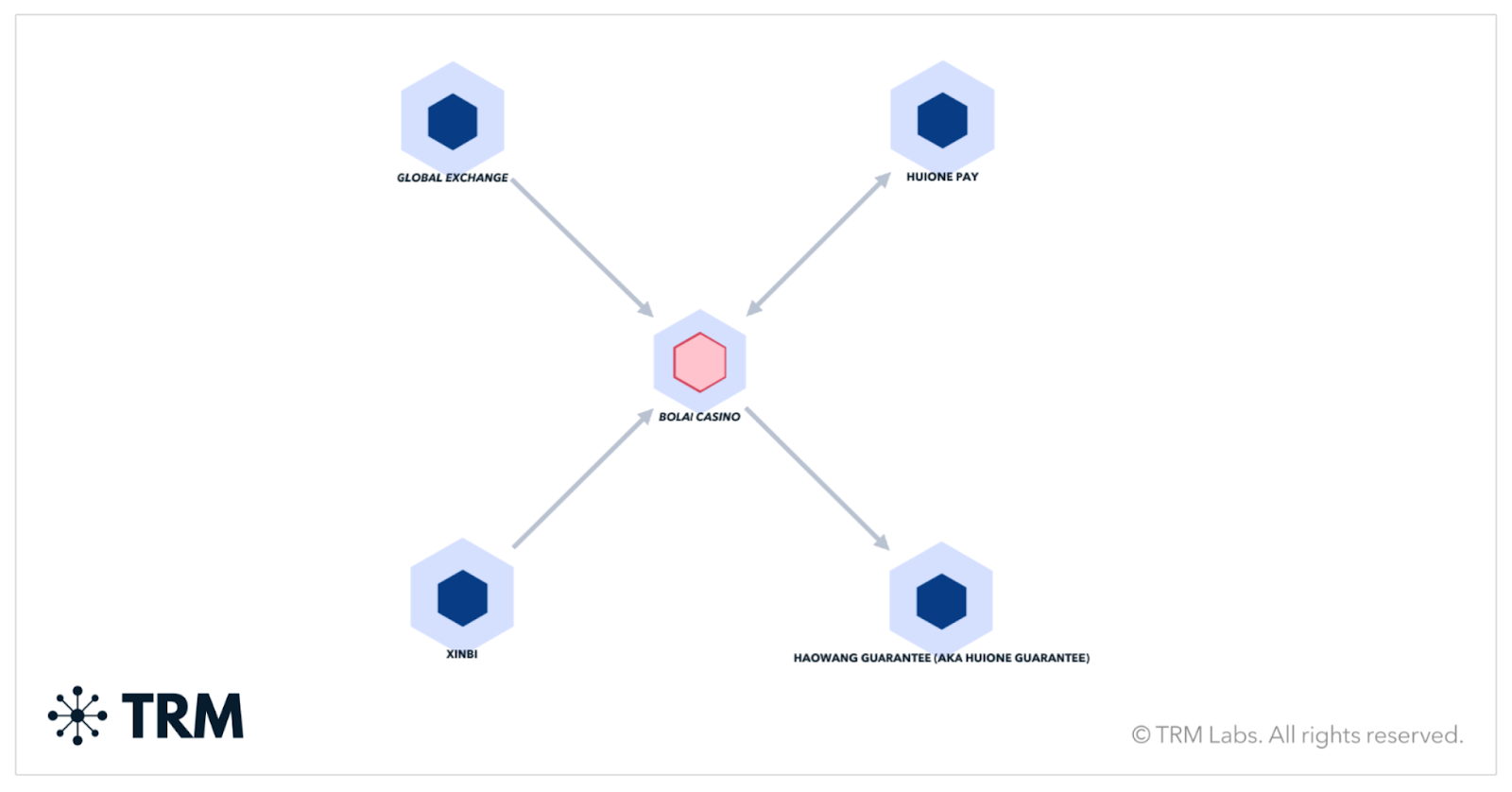
Included in yesterday’s designation was Brilliancy Sihanoukville Investment and Development Co Ltd, known as Bolai — a company that owns a casino and scam compound in Sihanoukville linked to the broader K99 Group network. According to OFAC, Bolai coerces human trafficking victims into targeting Americans with digital asset investment fraud. But Bolai's role extends beyond the compound itself: it also operates social media channels and gambling websites that enable criminals to launder money and move funds across borders.
Bolai was founded by Luo Hong, who obtained Cambodian citizenship after making large investments in the country. OFAC also designated two Luo Hong-owned companies that supported Bolai's expansion: Huan Hai Bo Lai International Investment Co Ltd, a real estate investment firm, and SSDD Construction Material Co Ltd, a construction company.
The USSS investigation tied Bolai directly to a US-based money laundering operation. Investigators identified individuals in the US who received bank transfers from Americans after making false promises to invest the cash in digital assets on their behalf. In reality, these individuals sent the money directly to bank accounts in Cambodia — including at least USD 1.3 million to accounts belonging to Luo Hong. In 2024, the USSS announced that it had taken action against a group of US-based individuals who laundered over USD 73 million in victim funds generated through digital asset investment scams connected to this network. Eight US-based co-conspirators have pleaded guilty, including Daren Li, who was convicted and sentenced on money laundering charges. Li remains a fugitive after removing his ankle monitor and fleeing the US.
Bolai's role as both a scam compound operator and a financial conduit illustrates how these networks have professionalized. A single entity can coerce trafficking victims into running scams, launder the proceeds through gambling infrastructure, and maintain direct financial pipelines to money laundering cells operating inside the United States. This mirrors the structure that TRM has previously analyzed across pig butchering networks, where on-chain data reveals interconnected webs of scam addresses, shared money laundering nodes, and links to organized crime.
The broader Kok An network
Bolai operates within a wider network controlled by Cambodian senator Kok An, who was also designated in yesterday’s action. Kok An's flagship hospitality company, Crown Resorts, owns casinos, resorts, and other buildings in Poipet, Sihanoukville, Bavet, and other Cambodian cities. According to OFAC, these properties have been converted into compounds from which criminal organizations conduct digital asset investment fraud. Kok An collects rental income from the compounds and provides services and security personnel through Anco Brothers Co Ltd, his business conglomerate, which also holds casino licenses for the properties, according to the US Treasury press release. OFAC designated both Crown Resorts and Anco Brothers, along with seven additional Kok An-owned entities, including Anco Specialized Bank Ltd.
OFAC also designated several of Kok An's close associates:
- Rithy Raksmei and K99 Culture and Media Co Ltd (K99 Group), a casino operator that owns properties where trafficking victims are forced to carry out scams. OFAC also designated K99 Group-linked entities Xing Tian Di Co Ltd and Nan Tian International Hotel Co Ltd (Nan Hai), both cited in trafficking victims' reports as sites of romance scams, Ponzi schemes, and attempted theft of digital asset wallets
- Aik Paung and Sai Aung Linn, two Burmese-born individuals who obtained Cambodian citizenship while investing in Cambodia's scam industry. They own Xihu Resort Hotel Co Ltd, another Sihanoukville casino associated with K99 Group, as well as Heng Feng Group Co Ltd and Heng Feng Cambodia Bank plc, a financial institution controlled by Sai Aung Linn.
In total, OFAC designated 29 individuals and entities in yesterday’s action.
Coordinated enforcement
Alongside the sanctions, the Scam Center Strike Force announced criminal charges against two individuals running a scam compound in Burma, the seizure of a social media messaging app used to recruit human trafficking victims to a Cambodian compound, and the seizure of 503 fraudulent web domains used to perpetuate digital asset investment fraud.
The Department of State also announced a reward of up to USD 10 million for information leading to the seizure or recovery of scam proceeds related to the Tai Chang scam compound in Burma's Karen State, as well as up to USD 4 million for information leading to the arrest of Daren Li.
Escalating US enforcement against scam center infrastructure
Yesterday’s action continues a campaign by the US Treasury against the scam center ecosystem in Cambodia and the broader region. Each of the below actions since 2024 has targeted a different layer of the infrastructure:
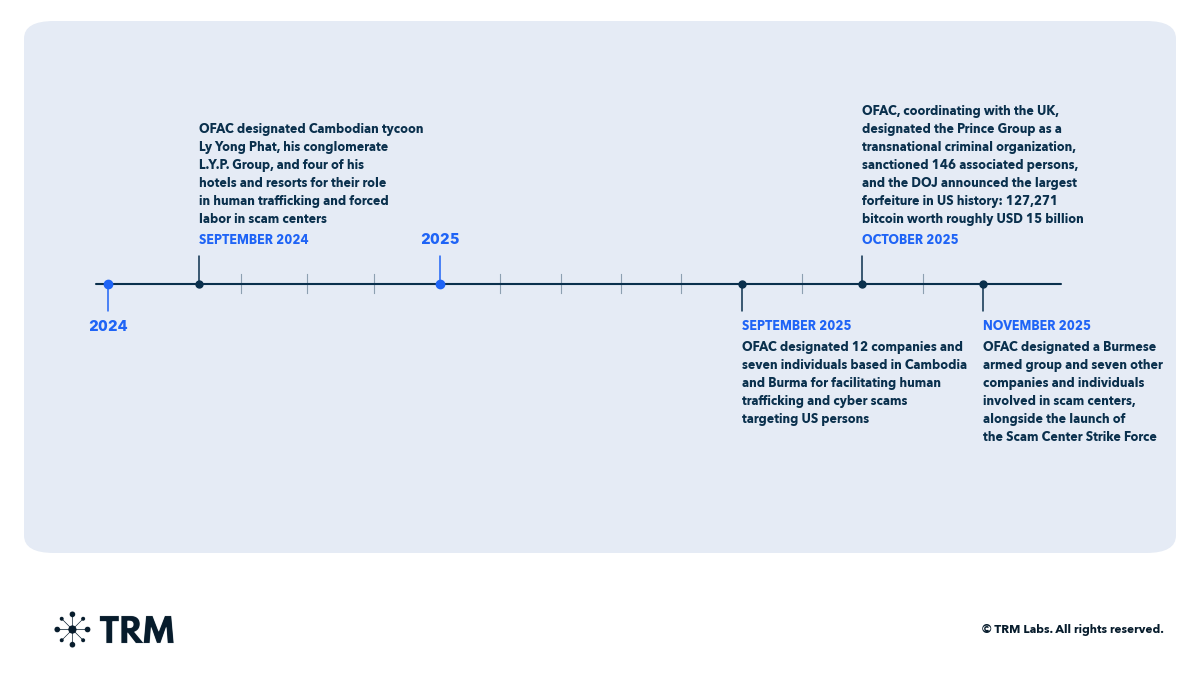
The Bolai designation adds a new dimension to these efforts. Where previous actions targeted property owners (Ly Yong Phat), conglomerates (Prince Group), and armed groups (DKBA), this action reaches into the operational layer, targeting the entities that run the scams day-to-day, launder the proceeds through gambling and social media infrastructure, and maintain financial links to money laundering cells inside the US. The designation of Heng Feng Cambodia Bank plc, controlled by scam network operator Sai Aung Linn, further signals Treasury's willingness to target financial institutions embedded in this ecosystem.
Implications for law enforcement and compliance teams
The breadth of the designation, which spans casinos, a bank, property management firms, and construction companies, reflects how deeply these operations are embedded in Cambodia's commercial infrastructure.
The Bolai case shows how a single entity can simultaneously operate as a scam compound, a money laundering vehicle, and a node in a cross-border financial network that reaches US bank accounts. Organizations should consider not only direct SDN list matches but also indirect exposure through business relationships with Cambodian entities in sectors associated with scam operations. According to TRM's analysis of pig butchering schemes, the cryptocurrency wallets that receive victim funds are often linked to multiple scams simultaneously, and over 75% of sampled scam addresses exhibit signs of sophisticated on-chain money laundering activity.
TRM's 2026 Crypto Crime Report documented approximately USD 158 billion in illicit cryptocurrency flows in 2025 — a 145% increase from USD 64.5 billion in 2024 and the highest level recorded in five years. Fraud and scams alone accounted for roughly USD 35 billion in confirmed flows to fraud-linked wallets.
The FBI's Internet Crime Complaint Center has documented record losses from cyber-enabled fraud, with investment fraud and romance scams representing the fastest-growing and most devastating categories of victim harm. But those figures capture only what victims report. TRM estimates that only about 15% of victims come forward — deterred by shame, skepticism that law enforcement can help, or simple uncertainty about where to turn. When that underreporting gap is factored in, global annual losses from cyber-enabled fraud against individuals likely exceed USD 200 billion.
{{horizontal-line}}
Frequently asked questions (FAQs)
1. What are "pig butchering" scams?
"Pig butchering" is a type of digital asset investment fraud in which scammers build trust with victims — often through romantic or friendship-based relationships — before convincing them to invest on platforms that appear legitimate but are controlled by the fraudsters. The term refers to the practice of "fattening" a victim with attention and trust before stealing their funds. For more on how these scams work, see TRM's analysis of pig butchering data.
2. What is Bolai and why is it central to this designation?
Bolai (Brilliancy Sihanoukville Investment and Development Co Ltd) is a Sihanoukville-based company that owns a casino and scam compound linked to the K99 Group network. Bolai combines multiple functions in a single entity: it operates scam operations using trafficked workers, runs social media channels and gambling websites used for money laundering, and maintains direct financial ties to US-based money launderers who moved over USD 73 million in victim funds. OFAC designated Bolai, its founder Luo Hong, and two supporting companies.
3. What is the Scam Center Strike Force?
The Scam Center Strike Force is a US government initiative led by the US Attorney's Office for the District of Columbia, the DOJ's Criminal Division, the FBI, and the US Secret Service. It focuses on investigating, disrupting, and prosecuting scam centers and their leaders, with a focus on Burma, Cambodia, and Laos. For a full overview of how the Strike Force operates, see TRM's analysis of the whole-of-government approach.
4. How does cryptocurrency factor into these scam operations?
Scam operators use digital assets in two primary ways: as the purported investment vehicle that lures victims into sending funds, and as a mechanism for moving and laundering stolen proceeds across borders. TRM's research shows that pig butchering networks typically move funds through complex webs of wallet-to-wallet transactions, with funds passing through shared money laundering infrastructure before reaching exchanges where they are swapped for stablecoins or cashed out.
5. What compliance steps should organizations take?
Organizations should screen customers, counterparties, and transactions against the updated Specially Designated Nationals (SDN) list. Given the breadth of this designation — which spans casinos, banks, real estate companies, and construction firms — compliance teams should also consider indirect exposure through business relationships with Cambodian entities in sectors associated with scam operations. The designation of Heng Feng Cambodia Bank plc underscores the risk that financial institutions in the region may be directly controlled by scam network operators.
6. How does this action connect to previous designations?
This designation is the latest in a series of escalating US actions against Cambodia's scam center ecosystem, following the designations of Ly Yong Phat (September 2024), the Prince Group (October 2025), and the DKBA and Tai Chang compound (November 2025). Each action has targeted a different layer of the scam infrastructure — from property owners and conglomerates to armed groups and, now, operational entities like Bolai that run scams and launder proceeds day-to-day.