What Latin America's Crypto Surge Means for Compliance Teams

TRM User Conference
Which mission will you select?
Key takeaways
- Stablecoins are the dominant payment rail across Latin America — and they now account for nearly 95% of inflows to sanctioned entities globally, making stablecoin-specific monitoring a baseline compliance requirement, not a nice-to-have.
- Regulatory obligations are arriving simultaneously across Brazil, Argentina, Mexico, and beyond: new authorization regimes, expanded AML scope, and FATF-driven enforcement attention mean compliance windows are narrowing in every major market at once.
- The illicit finance threats in LATAM are specific and well-documented — cartel-linked OTC brokers, Chinese money laundering networks, and Venezuela's structurally sanctioned stablecoin flows — and require blockchain-level entity and wallet screening to detect.
{{horizontal-line}}
Latin America's crypto adoption is established, accelerating, and creating immediate compliance exposure
Latin America is one of the world's most active crypto markets — and one of the most demanding environments in which to run compliance.
Five countries — Brazil (#5), Venezuela (#11), Argentina (#18), Mexico (#19), and Colombia (#22) — now rank among the top 25 globally on TRM's Country Crypto Adoption Index 2025, with several climbing significantly year over year. Bolivia (#36, up from #40), Nicaragua (#60, up from #95), and Honduras (#65, up from #85) are among the fastest-moving markets in the hemisphere. Each ranking represents direct compliance exposure: higher transaction volumes, a wider counterparty base, and cross-border flows that move fast across jurisdictions with different rules.
The scale is visible on-chain. According to TRM data, global retail crypto transactions rose by more than 125% between January and September 2025 compared with the same period in 2024. Much of that growth is concentrated in markets shaped by macroeconomic instability, limited access to dollar-denominated banking, and expanding digital infrastructure — the defining conditions across Latin America.
At the center of this shift are stablecoins. Globally, stablecoins now account for 30% of all on-chain crypto transaction volume, reaching over USD 4 trillion in the first seven months of 2025 alone — an 83% increase from the same period in 2024. More than 90% of fiat-backed stablecoins are pegged to the US dollar, with Tether (USDT) and Circle (USDC) representing 93% of total stablecoin market capitalization. In Latin America, where inflation and currency depreciation drive demand for dollar-denominated instruments, USDT on TRON and USDC on Ethereum are core payment and settlement infrastructure.
That ubiquity creates a specific compliance challenge. According to TRM's 2026 Crypto Crime Report, stablecoins now account for nearly 95% of inflows to sanctioned entities and jurisdictions globally. Any institution processing stablecoin volume in the region without robust monitoring is carrying significant unpriced risk.
Brazil: New rules mean new obligations
Brazil ranks fifth globally on TRM's adoption index and is setting the regulatory pace for the Americas. In November 2025, the Banco Central do Brasil (BCB) published three resolutions operationalizing its regulatory powers over virtual asset service providers (VASPs). The authorization regime, which commenced on February 2, 2026, establishes requirements across anti-money laundering (AML) / countering the financing of terrorism (CFT), disclosure, transparency, and minimum capital — ranging from BRL 10.8 million (USD 2 million) to BRL 37.2 million (USD 6.9 million).
The scale of Brazil's market underscores the urgency. In a February 2025 speech, BCB Deputy Governor Gabriel Galipolo noted that crypto asset use in Brazil has surged over the past three years, with 90% of that growth linked to stablecoins. The new rules bring stablecoin transactions and cross-border transfers under Brazil's foreign exchange and payments oversight — a direct response to the volume and velocity of stablecoin flows in the country.
{{46-what-latin-americas-crypto-surge-means-for-compliance-teams-callout-1}}
Argentina: Fast-moving regulation, fast-moving threats
Argentina ranks 18th globally for crypto adoption, and 2025 was a pivotal year for its regulatory landscape. The government tightened oversight under the National Securities Commission (CNV), with General Resolution 1058 introducing enhanced registration requirements for VASPs covering AML, segregation of customer assets, cybersecurity, audit, and corporate governance. In June, General Resolutions 1069 and 1081 introduced a formal legal framework for tokenized assets, to be piloted in a regulatory sandbox.
The need for robust oversight was underscored by a high-profile market integrity incident: In February 2025, President Javier Milei briefly promoted a little-known meme coin, $LIBRA, on social media. The coin surged and then collapsed, sparking a judicial investigation and highlighting the risks of market manipulation and retail investor exposure in a rapidly evolving environment.
{46-what-latin-americas-crypto-surge-means-for-compliance-teams-callout-2}}
Mexico: FATF spotlight raises the stakes
Mexico ranks 19th on the adoption index, up from 22nd the prior year. In 2025, the country held the presidency of the Financial Action Task Force (FATF), using its platform to press for stronger international AML standards tailored to emerging markets.
Domestically, Mexico passed wide-ranging reforms to its AML law (LFPIORPI) in July 2025, introducing risk-based assessments, designated compliance officers, and periodic compliance audits for obliged entities. The scope of virtual asset activities subject to AML obligations was expanded to include services by non-financial entities, with clearer thresholds for reporting. Within the financial sector, the 2018 FinTech Law continues to confine virtual asset activities to licensed institutions with prior Banxico authorization — and approvals remain scarce.
{{46-what-latin-americas-crypto-surge-means-for-compliance-teams-callout-3}}
Venezuela: Sanctions exposure embedded in everyday flows
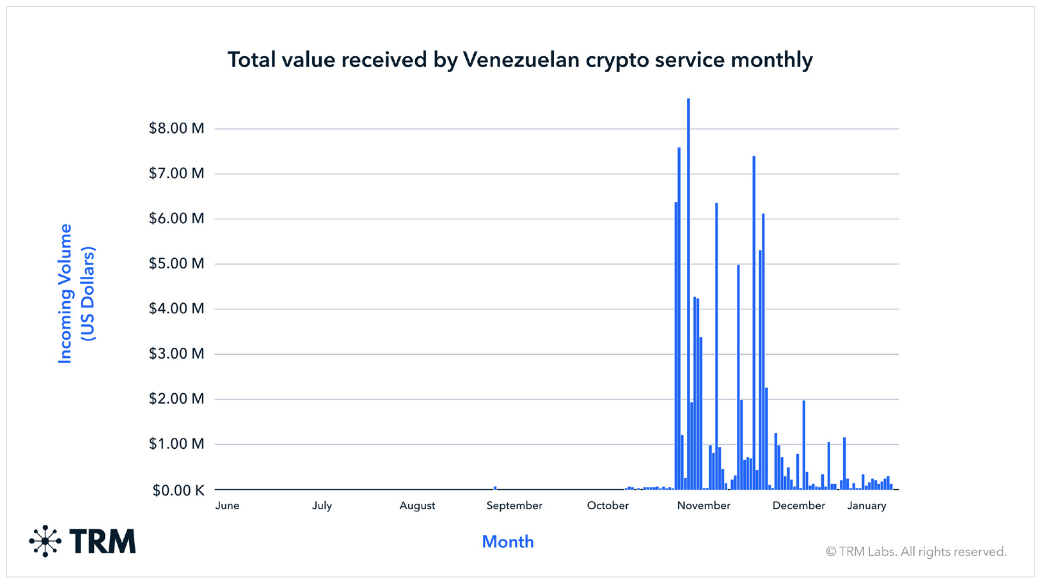
Venezuela's rise to 11th on TRM's adoption index — up from 14th in 2024 — reflects the degree to which cryptocurrency has become embedded in the country's dollarized economy. The bolívar depreciated by approximately 750% on the informal market in 2025, driving widespread reliance on USDT for retail payments, remittances, and informal settlement.
TRM's 2026 Crypto Crime Report identifies Venezuela as a jurisdiction where crypto functions as a primary financial infrastructure — supporting payments, remittances, and state-linked financial activity in a heavily sanctioned economy with limited traditional banking access. Government-tolerated domestic platforms coexist with informal peer-to-peer (P2P) rails, and Venezuela's fragmented regulatory environment — following the 2023 restructuring of SUNACRIP — has left oversight gaps that introduce structural sanctions exposure. TRM has identified exposure involving intermediaries historically linked to high-risk financial networks associated with Iran, Russia, and China, with stablecoins observed in transactions consistent with oil-linked trade flows.
{{46-what-latin-americas-crypto-surge-means-for-compliance-teams-callout-4}}
The illicit finance risks are region-specific and well-documented
Dollar scarcity, informal financial infrastructure, and high remittance volume drive both legitimate crypto adoption and the illicit activity that moves alongside it. TRM's 2026 Crypto Crime Report found that illicit crypto volume hit USD 158 billion in 2025, up nearly 145% from 2024.
The threats most relevant to LATAM compliance teams are specific and well-documented. Cartel-linked financial networks — particularly those tied to the Sinaloa Cartel — use local OTC brokers, P2P platforms, and casas de cambio to launder proceeds. Chinese money laundering organizations serve as critical intermediaries: TRM data shows that Chinese-language escrow services and underground banking networks processed over USD 103 billion in 2025. Of the more than 120 Chinese precursor chemical manufacturers studied by TRM in 2024, 97% offered payment in cryptocurrency — directly connecting drug production supply chains to crypto-based settlement.
In 2025, over 50% of OFAC-designated cryptocurrency addresses were associated with the illicit drug market, targeting businesses and individuals connected to fentanyl production and distribution. US sanctions policy is likely to remain focused on transnational criminal organizations, illicit drugs, and oil — with sustained emphasis on Iranian and Venezuelan entities — keeping Latin America squarely in the enforcement spotlight.
{{46-what-latin-americas-crypto-surge-means-for-compliance-teams-callout-5}}
The compliance window is narrowing
Latin America's regulatory landscape is formalizing rapidly. According to TRM's Global Crypto Policy Review & Outlook 2025/26, over 70% of jurisdictions reviewed globally are advancing new stablecoin regulatory frameworks, and the Americas are at the forefront. The Financial Action Task Force has warned that VASPs in jurisdictions with weak frameworks remain vulnerable to exploitation — and TRM's own analysis reinforces this: regulated VASPs have significantly lower rates of illicit activity than the broader ecosystem.
For exchanges, fintechs, and financial institutions operating in Latin America, regulatory requirements are arriving across the region simultaneously. Illicit finance risks are well-documented. Institutions building compliance infrastructure ahead of enforcement deadlines carry a clear operating advantage.

How TRM supports compliance teams in Latin America
The risks outlined above — cartel-adjacent flows, sanctions-exposed stablecoin volume, fragmented regulatory regimes across jurisdictions — require blockchain-level visibility that traditional compliance tools were not built to provide.
Compliance360 is how TRM delivers that visibility. The platform brings the same intelligence that powers TRM's investigative work directly into compliance workflows for exchanges, fintechs, and financial institutions. It provides risk intelligence across three core pillars that matter most for institutions operating across LATAM's crypto ecosystem:
1. Entity risk
Make informed onboarding and partnership decisions. Identify high-risk crypto counterparties — including casas de cambio, nested services, and informal OTC brokers — hidden within fiat flows, and monitor changes in risk exposure across your customer and partner base.
2. Address risk
Screen wallets before executing transactions. Investigate suspicious activity and validate exposure paths across complex transactions , including sanctions-nexus flows tied to Venezuelan state actors or cartel-linked wallet clusters.
3. Asset risk
Monitor the movement of stablecoins and other assets across blockchains and major holders. In a region where USDT and USDC volume is this high, asset-level visibility is a compliance requirement.
Compliance360 covers 190+ blockchains and 720+ cross-chain bridges, allowing teams to investigate risk without switching tools or stitching together fragmented data. TRM also supports customers with a compliance advisory team that helps benchmark controls and interpret regulatory changes, alongside customer success specialists with direct backgrounds in compliance and investigations.
88% of TRM users agree that TRM has the breadth and depth of blockchain intelligence they need*.
About TRM Labs
TRM Labs provides blockchain intelligence to help financial institutions, cryptocurrency businesses, and government agencies detect, investigate, and disrupt crypto-related fraud and financial crime.
As of April 2026, TRM has 52 people engaged across Latin America — intelligence analysts, investigators, engineers, compliance advisors, and customer success professionals supporting both public and private sector institutions. TRM intelligence has supported investigations that led to El Salvador's first crypto money laundering conviction, multiple T3 Financial Crime Unit operations in Brazil, and the attribution of more than 50 Latin American casas de cambio linked to illicit finance.
To connect with TRM's LATAM team, reach out to Enrique Edelstein, Account Director for LATAM Private Sector, at [email protected] or Matias Soto Quintus, Business Development Representative for LATAM, at [email protected]. You can also request a demo here.
{{horizontal-line}}
Frequently asked questions (FAQs)
1. Why is Latin America such an important region for crypto compliance?
Five LATAM countries rank in the global top 25 for crypto adoption, driven by macroeconomic instability and limited access to traditional banking — conditions that fuel both legitimate stablecoin use and the illicit activity that moves alongside it.
2. What makes stablecoin transactions particularly risky in Latin America?
Stablecoins now account for nearly 95% of inflows to sanctioned entities globally, and in Latin America, USDT and USDC are core payment infrastructure — meaning high-volume, everyday transactions can carry sanctions exposure that's invisible without wallet-level screening.
3. What new compliance obligations does Brazil's authorization regime introduce?
Brazil's BCB regulations, effective February 2026, require VASPs to meet AML/CFT standards, minimum capital thresholds (up to ~USD 6.9M), and new disclosure requirements — bringing stablecoin and cross-border transactions under formal payments oversight for the first time.
4. How do cartel-linked networks use crypto to launder proceeds?
Organizations such as the Sinaloa Cartel use local OTC brokers, P2P platforms, and casas de cambio to move illicit funds — often relying on Chinese money laundering intermediaries whose networks processed over USD 103 billion in 2025.
5. What should compliance teams prioritize when screening LATAM crypto flows?
Teams need entity- and wallet-level risk intelligence — not just jurisdiction-level flags — to identify exposure to high-risk P2P platforms, nested services, cartel-adjacent wallet clusters, and sanctions-linked Venezuelan stablecoin flows.